GOLDEN MYTHS THAT MADE HISTORY

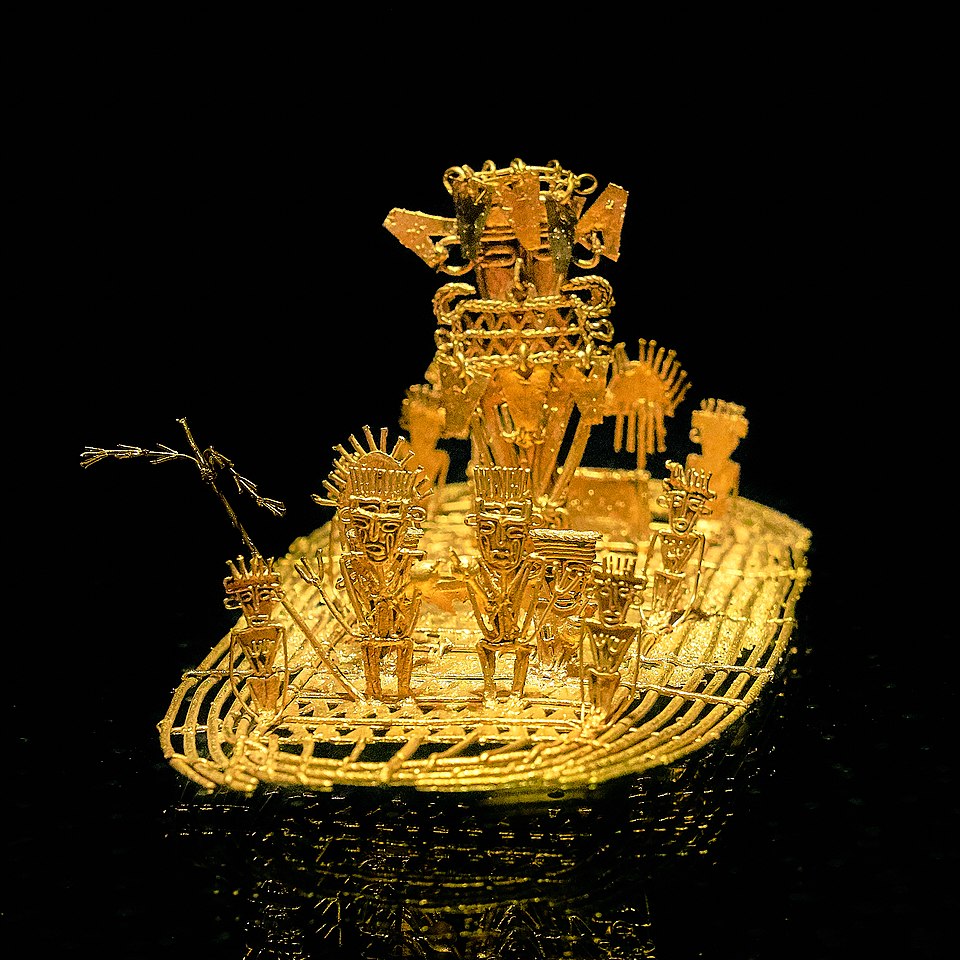
Muisca raft in the Gold Museum, Bogotá, Colombia. This raft made of gold was found in Pasca, Cundinamarca, in 1969, and is associated with the legend of El Dorado. CC Licence.

Ancient though their origins may be, the world’s many myths and legends have played an important role in history. Frightening fables of unknown southern lands, tales of lost cities and endless rumours of hidden hordes of gold motivated many of the world’s greatest explorations.

Five centuries before the common era, the Greeks knew the world was not flat. It was a globe and so, they reasoned, there must be a large landmass in the extreme south to balance the lands they knew in the northern hemisphere. The Romans embroidered the legend of a lost southern land by imagining it was peopled by strange beings who survived in great heat and necessarily walked upside down.  By the Second century AD it was widely accepted that there was a southern land, probably inhabited, and laying at the bottom of the world – somewhere. It featured on beautifully crafted European maps and charts complete with sea monsters and winged serpents. The Muslim world also produced maps that seem to represent some of Australia’s northern coastline in the Ninth century AD.

Mariners began searching for the southland from early times. It was frequently discovered, the news triumphantly announced, only to be disproved by later explorers. Many voyages undertaken by the Spanish, Portuguese, Dutch, French and British were inspired by the desire to solve the riddle of the mysterious continent. It would be centuries before anyone did, but these many efforts provided the world with knowledge of distant places, unknown seas, new flora and fauna and contact with indigenous peoples previously unknown to Europeans.

Other beliefs also fuelled world exploration. Stories about the ‘River of Gold’, now thought to be the Senegal River, reached southern Europe through contact with the Muslim world from perhaps as early as the Thirteenth century. But from ancient times there had been great interest in the rumoured river. Pliny the Elder and Claudius Ptolemy write about it and the Carthaginians sailed there more than four centuries BCE. A number of Arab expeditions were reported to have sought the river during the Twelfth century. Despite the unknown terrors of sea voyages in that era, people heard these yarns and went looking for the treasure. Most never returned. Or, if they did, we know nothing about it.

Despite – or perhaps because of – these uncertainties, the legend of the River of Gold grew on the tongues of traders, sailors and adventurers. An expansion of this tale based on ninth century Arab writings claimed that there was not just a river and an island but ‘Lands of Gold’ in the chief city of which gold ‘grew in the sand like carrots’ to be harvested at sunrise. Three centuries later writers were describing the magnificent gold clad horses and gold and silver-collared dogs of the king of this place (probably modern Ghana). His sons boasted gold-plaited hair and lowly pages who hefted swords mounted in gold.

Wild though these legends were, they spurred expansion into new lands, gradually filling the map of the world with facts rather than fictions. We will never know how many adventurers and treasure seekers set out to find the objects of their desire though we can be sure that most of them died in their quests. But in one case we do know the explorer’s fate.

The Spanish began their occupation of South America when Cortez conquered the Aztecs from 1519.  The astonishing amount of gold and other valuables the Spaniards found as they cut their way through the indigenous peoples rapidly established South America as a hot spot of fabled wealth. One of the most potent tales concerned an indigenous community whose kingship ritual involved covering the anointed man with gold dust – El Dorado, ‘the golden one’. Other items in the ceremony were also either made of gold or covered in the precious metal. Together with other valuables, the gold was thrown into Lake Guativita. The king went in as well, washing the gold dust from his body and adding to the riches carpeting the lake floor.

By the time the Elizabethan adventurer Sir Walter Raleigh first heard about El Dorado from a captured Spanish sailor it was no longer an individual but a place. A city of gold along an Amazonian river in the wilds of Guiana (Guyana). Slowly but steadily the lure of the golden city took hold of one of the greatest scholars and adventurers of the Elizabethan era. Raleigh had long been collecting relevant documents and maps and was well versed in the lore of the great treasure when he finally sailed to Trinidad and then to the mouth of the Orinoco River on his own quest for El Dorado in 1595. Previous unsuccessful attempts had been made from the east coast and Raleigh was not about to repeat the mistakes of others. Nor could he afford to fail.

It was a horror voyage. Raleigh’s passage through the “thick and troubled water” of the Orinoco and its endless tributaries was long, hot and arduous. Raleigh ended his account with a strong promise of untold riches. But the leaden truth was that “I gave among them [the Indians GS] many more pieces of gold than I received.” Raleigh’s quest had been a colossal failure – and he knew it. Although he did not find el dorado, his The Discovery of Guiana (1596), provided valuable anthropological, ecological and geographic knowledge of the region. Through it he also wrote himself out of immediate trouble with his Queen, Elizabeth I.

Still a believer, Raleigh tried again in 1617. His attempt was another failure and sealed his fate with a new monarch, James I. Soon after his empty-handed return to England the great Elizabethan and earnest seeker of El Dorado was beheaded at the Palace of Westminster on 29 October 1618. In his dying speech he admitted to being “a man full of all vanity, and having lived a sinful life, in all sinful callings, having been a soldier, a captain, a sea captain, and a courtier, which are all places of wickedness and vice …”.

Misty and murky though they were, these and the many other legends of unknown lands and golden treasures had very real consequences for individuals and for the greater sweep of world exploration and discovery.

*
MERMAID RAGE!

Sea monsters have been seen for at least two thousand years. As well as giant squids and krakens, mermaids have featured in many legends and sightings. Hybrid beings of human female and fish, modern mermaids are generally presented as Disneyesque beauties rather than the often savage and dangerous sirens and other hybrids that appear from antiquity into at least the early modern era.

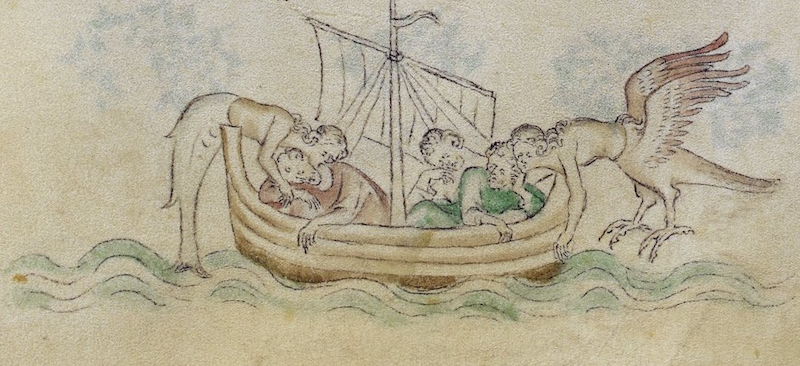
The year 1527 was a particularly bad one for mermaid attacks, it seems. According to Laurence Andrew’s, The Noble Lyfe and Natures of Man of Bestes, Serpentys, Fowles and Fisshes (British Library MS Royal 2 B VII, f. 97r):

The mermayde is a dedely beste that bringeth a man gladly to dethe. Frome the navyll up she is lyke a woman with a dredfull face, longe slymye here a grete body & is lyke the egle in the nether parte, havinge fete and talentis to tear asonder suche as she geteth. Her tayl is scaled like a fisshe and she singeth a maner of swete song and therwith deceyveth many a gode mariner for whan they here it they fall on slepe commonly & than she commeth and draweth them out of the shippe and tereth them asonder… but the wyse maryners stoppe their eares whan they se her for whan she playth on the water all they be in fear & than they cast out an empty tonne to let her play with it tyll they be past her. This is specifyed of them that have sene it. 

These mermaids were ugly and murderous, singing passing sailors to sleep before tearing them asunder. Fortunately, the slimy-haired beings don’t seem to have been very bright and were easily distracted from their murderous intent by sailors throwing a barrel into the sea for the creatures to play with. How the barrels might be cast while holding one’s hands over one’s ears to ward off the singing spell was not specified.

BANDIT LANDS 13 – VEERAPPAN, THE JUNGLE CAT

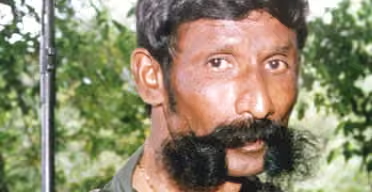
Veerappan stands with a gun in his jungle hideout in 1998. Photograph: AP

*

‘It was a pukka operation’ said Jyoti Mirgi, the head of the operation Cocoon force that had been pursing ‘the Jungle Cat’ since 1993. ‘We ordered him to surrender but he refused’.

Mirgi was referring to the gun battle between police and Koose Muniswamy Veerappan (1952-2004), ‘India’s most wanted bandit’ with a price on his head of 20 million rupees, approximately US 500 000 dollars. In October 2004 an undercover police informer working in what was left of the ageing dacoit’s gang tipped off the authorities that the famed bandit would be leaving his forest sanctuary and travelling to hospital for eye treatment. The ambulance that was to take him to the hospital was a police vehicle, as were others in the area.

Over thirty policemen ambushed Veerappan and three of his gang. According to the official report, the bandit was killed on the spot after refusing to surrender. Police gave thumbs up signs as they posed by the famous corpse, which was then was taken to Dharampuri hospital, where crowds reportedly numbering up to 20 000 gathered to see the remains of ‘India’s Robin Hood’, as the press dubbed the notorious outlaw.

Born in 1952, Koose Muniswamy Veerappan had by the time of his death led the authorities on the traditional merry outlaw’s dance for four decades, smuggling sandalwood and ivory, allegedly committing well over a hundred murders and conducting the traditional business of the dacoit, kidnapping politicians and celebrities. In trouble with the law from an early age, he became more active and violent from the 1980s, once allegedly claiming that he cut his victims into small pieces and fed them to fish.

His nickname of ‘The Jungle Cat’ was a linguistic acknowledgement of his ability to elude and outfox the large numbers of police and troops sent against him in his jungle hideaways in the southern Indian states of Tamil Nadu, Karanataka and Kerala. He was said to have the sympathy of the poor, a fact that made it difficult for the authorities to obtain reliable information about his activities and whereabouts.

His most ambitious crime was kidnapping an Indian movie star, Rakjumar, and extorting a ransom from the state government before returning the star unharmed. But he also kidnapped a former politician in 2002, murdering him when his demands for money were refused. The bandit’s own description of how he killed one enemy gives an insight into the realities of bandit life and death:

“I wanted to see the blood gushing out of Srinivas’ chest. I took out my gun before he knew what was happening and shot him. I then cut off his head and began hacking off his hands. These were the very hands that wanted to turn machineguns on me. I kept his head as a souvenir.”

As is often the case with elusive bandits, there were suspicions that Veerappan had contacts with political and security officials and with the separatist Tamil Nadu Liberation Army, a faction of which vowed to take revenge for his death, according to the Khaleej Times.  His long dacoit career and the expensive operations eventually mounted to track him down suggest that he may have had more help than that available to him from his poor supporters, among whom he was said to distribute some of the proceeds of his many crimes and to shower the village children with sweets

Reporting Veerappan’s demise, the press lapsed immediately into the ambivalent rhetoric always associated with such figures. According to The Times, he was ‘an Indian Osama bin Laden and Robin Hood rolled into one: endlessly elusive, apparently uncatchable, evading troops sent to search for him even as he mocked them from his jungle lair.’ The Independent suggested India had a similar love-hate relationship with Veerappan as that of America with Billy the Kid, saying ‘if Veerappan was India’s blackest villain to some, to others he was a hero. He was able to survive in the jungle because villagers brought him and his men food, motivated by a mixture of respect and fear. The government forces sent to capture Veerappan were also said to have oppressed the local people: “At least, he does not hurt us,” they say.

The Indian newspapers were more condemnatory. The Telegraph of Calcutta quoted a former hostage saying he was glad that the outlaw was dead as he was a ‘cruel animal and vermin of the gutter’. The Indian Express referred to Veerappan’s ‘evil little empire’ and wondered how he was able ‘to mock the law for so long’. Elsewhere in India the press portrayed the dead bandit more in the manner of the outlaw hero with The New Indian Express quoting his aged mother to the effect that poverty had driven Veerappan to outlawry, though it also suggested that he commanded support more by fear than by sympathy.

Veerappan continued to be controversial and contradictory even in death. The director of the 1995 film of the outlaw’s life, boasting that Veerappan had approved the script, retitled it as Veerappan: The Original. He was reportedly responding to news that a rival director was preparing another film production to be titled Let’s Kill Veerappan. He became the subject of books and press articles and a long series on Indian television in 2007. Various legal actions ensued, keeping the bandit’s name in the public eye. It was also said that Veerappan stashed his loot somewhere in the jungle; people have been looking for it ever since.

In the facts and the fictions of Veerappan’s life and death echo those of other bandit heroes. He was forced into a life of crime by circumstances. He had the support and sympathy of his social group. He preyed mostly, if not totally perhaps, on the rich and powerful, he was betrayed and he died game. All these attributes, real or not, contributed to his being dubbed ‘the Indian Robin Hood’. In many ways, Veerappan’s life and legend are a link between the older style of bandit hero and more modern criminals who have understood the tradition and sought, in various ways to bend it to personal, ideological or commercial ends.