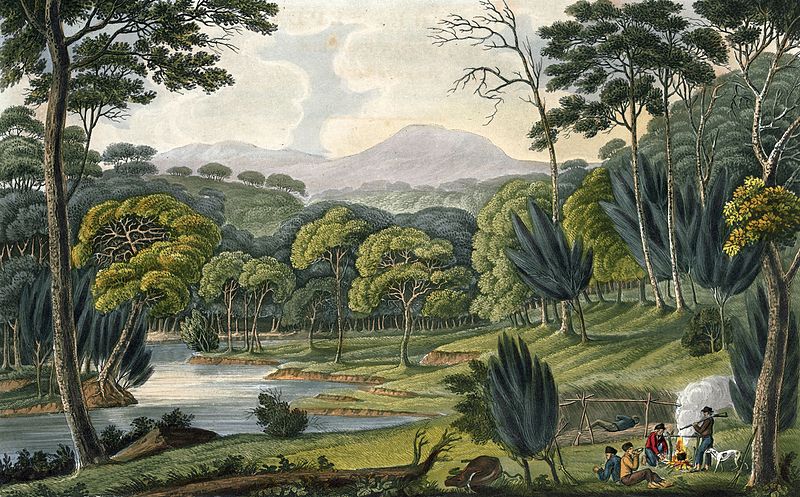
Convict artist Joseph Lycett’s 1825 painting of a gang of bushrangers on the Nepean River, NSW
The peculiar nature of modern Australia’s foundation and settlement produced a troubled politic consisting of the tension between gaolers and gaoled, the enmities of Ireland and England and the struggle over access to land and its resources. A distinctive version of the outlaw hero tradition developed across a number of boundaries – boundaries of ethnicity, religion, class as well as the physical divisions of property ownership. These began with the gulf between the incarcerating administration and those they were charged with punishing.
Later in the history of the colonies, the vague but contested nature of the boundaries between squatter properties and free selector’s blocks produced an ongoing conflict that underlay subsequent outbreaks of bushranging. From these events a select few individuals came to be celebrated by many, though hardly all, as heroic resisters of official oppression and injustice.
Brutality was the constant theme of the transported convict’s experience upon ‘the fatal shore’, particularly if involved in further crimes committed in the penal colony of New South Wales. From the first moments of European colonisation there was conflict between convicts and their keepers that initially led to attempts to escape. These ‘bolters’ as the escapees were called, fled into the unknown Australian bush, often to perish in ill-informed attempts to reach China, which, it was rumoured, was connected to the Australian landmass.
More practically minded bolters used the bush as their wilderness hideaways, established gangs of others like them and lived by highway robbery and raids on shepherds and isolated homesteads. Their freedom and their possession of stolen weaponry made them instant heroes to those of their kind still confined who saw them as avengers of their sense of oppression and brutalisation within a penal system that allowed violence and terror as everyday occurrences.
There were many escaped convicts who roamed the bush at this period, including Michael Howe, Martin Brady and Martin Cash in Tasmania, or Van Diemen’s Land as it was then known. Contemporary observers of these bushrangers were quick to make the connection with Robin Hood. In his Impressions of Australia Felix (1845), Richard Howitt wrote that ‘The more gentlemanly of them in Van Diemen’s Land are there what Robin Hood and Rob Roy were in Britain …’.
Just over a decade later the historian of the Van Diemen’s Land bushrangers described them as ‘ a sort of martyr to convictism’ and as men who were seen by their peers as ‘the bold Robin Hood of their morning songs, and he was now the unfortunate victim of legal oppression …’.
In the much larger colony of New South Wales there were also many convict escapees ranging through the bush, though one was destined to become the most famous of all. The Irishman Jack Donohoe was transported to New South Wales for life in 1824-5, found guilty of intent to commit an unspecified felony. Escaping in 1827 to range the bush, he was credited by the ballads and some witnesses with many of the attributes of the outlaw hero: he was courteous to women, never robbed ‘the poor’, in this case the convict and ex-convict population, was heroically daring and died ‘game’. He enjoyed the sympathy and the support of convict society, many of whose members provided the bushranger and his gang with information about trooper movements, food and shelter. This assistance kept Donohoe alive until 1830, when he was killed in a shoot-out with the troopers near Sydney.
A number of ballads were composed about Donohoe, though the one that has survived presents the bushranger in unabashed outlaw hero terms, drawing explicit comparisons with earlier outlaw heroes from Robin Hood, and the Irish Willie Brennan, Captain Freney (here appearing as ‘Freincy’) and Jeremiah Grant.
There were Freincy, Grant, bold Robin Hood, Brennan and O’Hare:
With Donahoe this highwayman none of them could compare…
As well, the ballad introduces a strong note of anti-authoritarianism, expressed as antagonism towards the representatives of the English government and Crown. This element recurs often in subsequent Australian manifestations of the outlaw hero tradition, including though not restricted to, Frank Gardiner, Ben Hall and Ned Kelly, and has also ensured the popularity of the ballad, in various versions.


