Renowned Australian folk musician and singer Dave De Hugard has been singing and researching ‘Waltzing Matilda’, in one version or another, for many years. He has now released the fruits of his labours – a different angle on the origins of the famous song and a compelling new composition based on the original.
Listen to Dave sing his new song, ‘Waltzing Matilda: The Real Swagman’s Story’ here. (scroll to bottom of page)
Coincidentally, Dave also has a couple of new album releases out and available here
Untangling Matilda: A clarification of the origin of the original lyrics of Banjo Paterson’s ‘Waltzing Matilda’
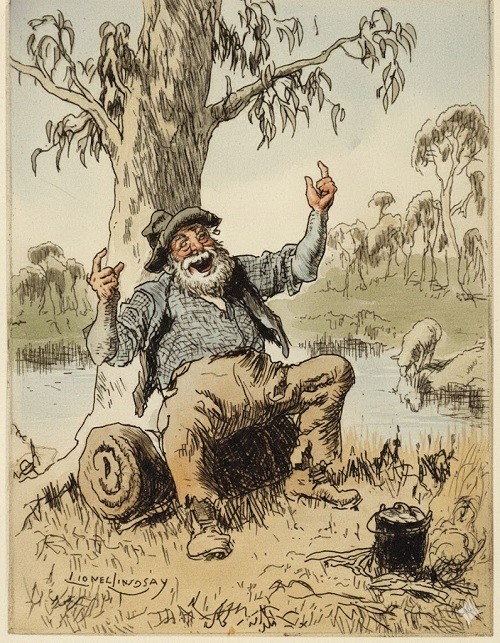
In 1895 as a guest at Dagworth, the Macpherson sheep station, Banjo Paterson, inspired by a tune Christina Macpherson was playing, said to Christina that he thought he could put some words to it. He then and there created in a few lines of verse, the image of a happy swagman, singing as he boiled up his billy by a billabong, ‘Who’ll come a-waltzing Matilda with me?’
This in time would become the first verse of the ‘Waltzing Matilda’ that many of us know. Other verses would follow later, but they would take a decidedly different turn. In this paper I will be looking closely at events and incidents that may have played a significant part in inspiring those later verses. But before we do that, there are some important things we need to know.
First and foremost we need to know that there really was a swagman who drowned at a billabong known as the Combo waterhole. This happened in April 1893, two years before Banjo Paterson arrived at Dagworth. We don’t know who the swagman was but we do know that he had knocked off one of Bob Macpherson’s sheep. This was during the seriously troubled times of the shearer’s strike. At that time, a Constable Pat Duffy and a tracker were looking for a Dagworth stockman who had killed an aboriginal youth, for not looking after the horses properly; and it just so happened they headed towards the Combo waterhole where the swagman was camped. The swagman spotted them and decided to make himself scarce. He tried to get across the billabong but he drowned in the attempt.
That’s one thing we need to know. But we also need to know that Banjo Paterson was aware of this event. The Combo waterhole had been a picnic spot from time to time for the local graziers. And it was at a picnic at that Combo waterhole that Banjo heard from Bob Macpherson, not only the story of the drowned swagman, but also Bob Macpherson’s belief that the billabong was haunted by the swagman’s ghost. This information is contained in the 2nd edition of Sydney May’s ‘The Story of Waltzing Matilda’ (1955). It comes from a Jane Black, a friend of the Macphersons. Jane Black tells us that on a visit to the MacPhersons, she got a retelling from Bob Macpherson of the events that happened during the Paterson visit. This included confirmation from Bob Macpherson that Banjo Paterson had been a guest at a Combo waterhole picnic; and that during that picnic, the story of the drowned swagman and the swagman’s ghost had been told. She tells us also, that she was so impressed with Bob’s story of the drowned swagman and the ghost that haunted the billabong, that ‘we deviated a little next day on our way to Kynuna to get a good view of the magic waterhole’.
With this information under our belt, we can now look at the rest of the verses that Paterson put together to complete his waltzing Matilda story. And what we find is not at all a straight retelling of the story that he had heard from Bob Macpherson. The main ingredients are there – the police, the jumbuck, the drowned swagman and the ghost – but the story has changed completely. Not only does Paterson have the swagman caught and interrogated by his captors but he then has the swagman jump into the billabong and drown himself. He keeps Bob Macpherson’s ghost, but it now sings through the billabong, with a very much less promising, ‘Who’ll come a-waltzing Matilda with me’.
And there is another change as well, and a particularly significant one. It is significant because it relates directly to what I believe Paterson’s original ‘Waltzing Matilda’ was all about. What he did was to remove the original police involved in Bob Macpherson’s account of the drowned swagman. And in their place he put a squatter on a thorough-bred with three policemen in tow. And this wasn’t just any squatter. This squatter was Bob Macpherson. And we know this, because in September 1894, the year before Paterson arrived at Dagworth, a band of striking shearers had burnt down the Macpherson wool shed with a 140 or so sheep inside. Many shots were fired during the night as well. And the next day, to his credit, Bob Macpherson rode out to the shearer’s camp with three policemen to confront the striking shearers. That is all understood and accepted. But what we really want to know is, what is Bob Macpherson doing, now popping up in the earlier drowned swagman story? There is an answer to this, but we first need to go back to the shearer’s strike.
One of the consequences of the strike was that there had been a major breakdown in the usual amicable relations between swagmen on the track and the homestead. Now, instead of calling into the homestead for the usual rations of sugar tea and flour, swagmen would just knock off a sheep in the paddock without a second thought; and this was still happening when Paterson was at Dagworth.
Bob Macpherson’s brother Gideon tells us for instance in some detail in the 2nd edition of Sydney May’s ‘The Story of Waltzing Matilda’ (1955), that Banjo & Bob Macpherson were out riding one day and they came across one of these sheep. It had been recently killed, the best bits taken and the rest just left to go to waste. Gideon then tells us that the completed ‘Waltzing Matilda’ followed soon after.
Christina Macpherson refers also to the same event, but she is more specific. Her reference is in an unsent letter (National Library of Australia) she wrote to Thomas Wood, the author of ‘Cobbers’. ‘Cobbers’ was a book about Australia and in it, Wood had included the words and music of ‘Waltzing Matilda’.
Christina says in her letter to Wood, that she is writing because she thought ‘it might interest you to hear how ‘Banjo’ Paterson came to write it’. She goes on to say that swagmen had been ‘helping themselves without asking’ and that Bob and Banjo Paterson had come across the remains of one of these sheep. She then says, and I quote, ‘Mr Paterson made use of the incident’. Christina doesn’t give us any more information, but that doesn’t really matter, because I believe we already have before us, all we really need to know.
The incident Christina is refering to here, is about Bob Macpherson, yet again, coming across another of his sheep that has been killed, the best bits taken, and the rest just left to go to waste. And it happened on this occasion that Bob Macpherson’s riding companion was Banjo Paterson – and Banjo, we know from his writings, had a good sense of humour. As such, my understanding of the incident Christina has just referred to, to put it quite simply, is that the occasion provided Banjo with an opportunity to have a bit of fun – and to cheer Bob Macpherson up in the process. It also just so happened that Banjo had at hand, still fresh in his memory, Bob’s earlier account of the drowned swagman at the Combo waterhole.
And it wouldn’t have taken Paterson long at all to put together some verses that poetically at least, would finally ‘turn the tables’ on the miscreants who had been knocking off Bob’s sheep! All he had to do was to have Bob Macpherson appear once again as that squatter on the thorough-bred with the three policemen in tow, and the job would be done! And that’s just what he did:
Down came the squatter a-riding his thorough-bred;
Down came policemen – one, two, three.
‘Whose is the jumbuck you’ve got in the tucker-bag?
You’ll come a-waltzing Matilda with me!
And this squatter that has now found its way into the Matilda story, has of course nothing whatsoever to do with an event the previous September, when Bob Macpherson did actually ride out with three policemen to confront the shearers who had burnt down his wool shed. And similarly, nor does this Matilda squatter have anything whatsoever to do with Samuel Hoffmeister, the probable suicide that Bob Macpherson and the police came across on that same occasion.
I also think it very likely indeed that all of the Macphersons would all have understood exactly what Banjo Paterson had written and why – and that what he had written, furthermore, would also very likely, have provided them all with no small amount of amusement:
”So take note any more of you swagmen who think you can knock off Bob’s sheep and think you can get away with it!’
And that’s about it. And it was in that form that the song took off and rapidly became very popular. The verse about the swagman jumping in the waterhole and drowning himself, wouldn’t have appealed to everyone and it probably wouldn’t have been long before more preferable options for some, began to find their way into the song.
In closing, I’ll just say that it does need to be known that as ‘Waltzing Matilda’ was becoming more and more popular, the real story of the very real swagman who actually had been camped at that Combo waterhole, was already well on the way to becoming almost entirely forgotten. And I for one, believe that that story, is way, long overdue for a retelling!
(c) Dave de Hugard, Castlemaine January 2026
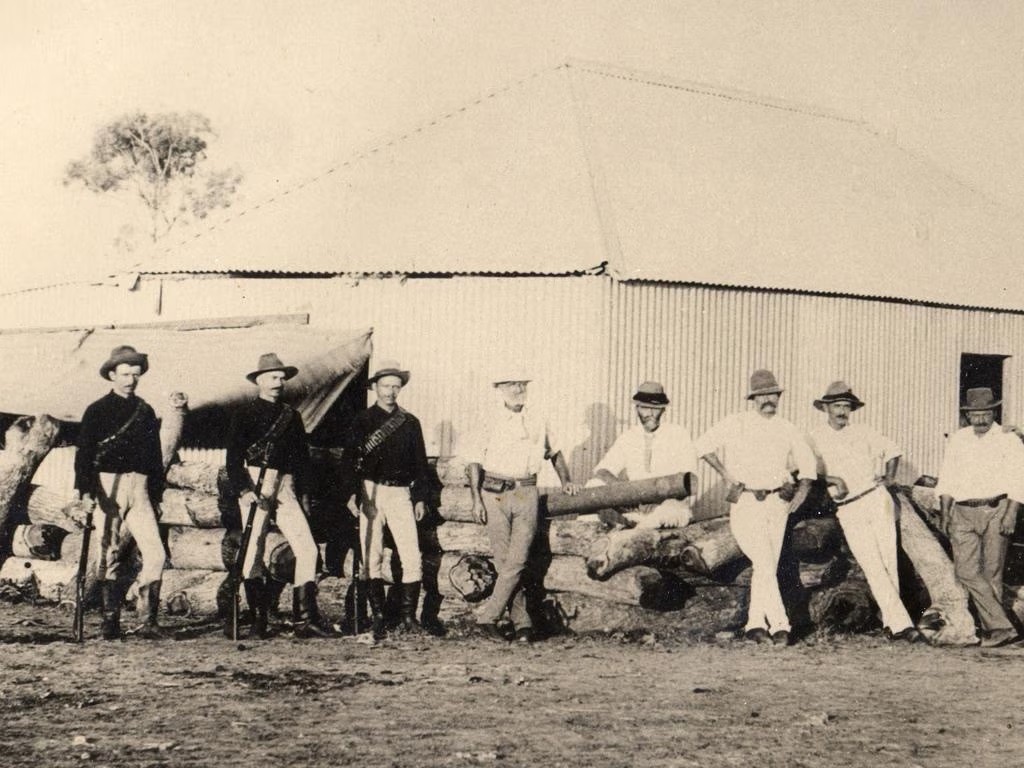
Bob Macpherson, 3rd from right, posing with the three policemen he rode out with in September 1894 to the striking shearer’s camp after they burnt down his woolshed.


Dave should read Richard Magoffin’s work, nobody ever drowned at Combo. The cops were after a bloke named Harry Ward for the murder of the boy, he was later captured in the Boulia district. A bloke named Pope fell into the Dagworth scour hole a little earlier and drowned, he was pissed, but it’s a red herring.
Paterson said himself he was inspired by the death of Hoffmeister in the transcript of his radio interview “on Golden Water” on P500 of Volume 2 of his collected works.
Dave de Hugard reply to Anonymous:
Yes it is quite so that in April 1893 a Constable Duffy and a tracker started off their search for Harry Ward, by poking around Dagworth. Ward had killed the aboriginal youth Charlie for not looking after the horses. In Sydney May’s ‘The Story of Waltzing Matilda’ 2nd edition 1955 (p.35/36) it is indicated that it was the presence of these police at the Combo waterhole that ultimately resulted in the drowning of a swagman. Bob Macpherson also has his own account of the drowning of the swagman on page 75.
Regarding Samuel Hoffmeister:
In the ‘Matilda Myth: Who’ll Come a Waltzing’ an ABC production, Richard Magoffin, in relation to the ‘historical events’ of the Matilda story as he understood it, states, ‘There was a swagman and his name was Frenchy Hoffmeister.’
Hoffmeister died from a bullet in September1894.
In the Paterson 1936 Radio interview, Paterson simply acknowledges that ‘in 1894 the shearers staged a strike by the way of expressing themselves and Macpherson’s shearing shed was burnt down, and a man was picked up dead.’ He then goes on to say, ‘This engendered no malice and I have seen the Macphersons handing out champagne through a pub window to these very shearers.’
Nowhere does Paterson indicate he was ‘inspired by the death of Hoffmeister’. And regarding the transcript referred to of this radio interview in ‘On Golden Water’, I wonder indeed why such a transcript would differ in any way from the radio interview that I heard.
At the end of the day, the impression I got from the 1936 radio interview is that Paterson really wasn’t much interested at all in talking about ‘Waltzing Matilda’.
Dave de Hugard 24/02/2026
Dave’s account of the ‘real’ story of Waltzing Matilda adds a novel twist to the oft debated origins of the song. Unfortunately, Dave’s unnamed swagman is only identified as the swagman who, in April 1893, spotted “Constable Pat Duffy and a tracker who were looking for a Dagworth stockman who had killed an aboriginal youth …[they] headed towards the Combo waterhole…[where] the swagman drowned.” Furthermore, Dave contends that “Banjo Paterson was aware of this event.” Can any of this be verified?
Dave seems to be referring to Constable Patrick Duffy who arrested Henry Ward on 4th May, 1893 on the boundary of Cork and Brighton Downs Station. After his arrest, Ward was taken to his camp about 300 yards from Elderslie Station where evidence was seized. He was then escorted to Winton lockup where he was charged with having murdered an aboriginal named Charley on 19th April, 1893. Ward was tried by Mr. Justice Harding and a jury of 12 in the Supreme Court. The proceedings were reported in The Morning Bulletin , Rockhampton, on 25 September, 1893, p6: https://trove.nla.gov.au/newspaper/article/52450432?searchTerm=Dagworth%20Station
The evidence of witnesses, including Constable Patrick Duffy, does not bear out many of Dave’s claims as to the identity of his unnamed swagman. While the ‘Dagworth stockman’ presumably was Henry Ward (in fact, a shearer), and the deceased was indeed an aboriginal youth (Charley), Constable Duffy said nothing of going anywhere near Combo waterhole either before, during or after arresting Ward. Constable Duffy did not say he happened upon a swagman, who fled from him into a billabong. That account is pure fiction. It was not “an event” of which Banjo Paterson could have been aware.
As for the account of Jane Black that Dave relies upon, in the first edition of “The Story of Waltzing Matilda, 1944, Sydney May notes at p.39 “Mrs Jane Black is convinced that the poem [ie. Waltzing Matilda] was written at Dagworth either Christmas 1896 or January 1897…[at p.40]…and I cannot believe the story could relate to a previous visit.” The lyrics were written in late August, 1895, not Christmas 1896 or January, 1897 at which time he was almost certainly in Sydney. He certainly was not at Dagworth Station, Queensland. Her account is unreliable and uncorroborated by anyone else said to have been present.
While Dave’s original lyrics are a welcome addition to the 1500 or so versions of Waltzing Matilda held by the Waltzing Matilda Centre, Winton, Queenland, his mis-identified swagman remains elusive. In Mark Twain’s immortal words, “Never let the Truth get in the way of a Good Story.” Dave’s story is a corker…and well sung.
Dave de Hugard says:
27th April, 2026
‘Untangling Matilda’ updating:
and
a reply to Anonymous:
regarding Jane Black & Constable Duffy
……………………………………………………………
After the 1944 publication of Sydney May’s ‘The Waltzing Matilda Story’ (first edition), Jane Black, a friend of the Macphersons, wrote a letter to Sydney May. In that letter she tells May that on the 16th March 1897, during a visit to Dagworth Station, she got a retelling from Bob Macpherson himself, of things that happened during the Paterson visit (‘The Story of Waltzing Matilda’ Sydney May, 2nd edition, 1955 p.75).
In that letter Jane Black writes that Bob Macpherson had told her that Banjo Paterson had been at a Combo waterhole picnic – and that during the picnic he (Bob Macpherson) had told the story about the drowning of a swagman in the billabong and also shared his belief that the billabong was haunted by the ghost of the swagman.
This is what Jane Black says in her own words:
‘…and particularly do I remember the story of the picnic at the Combo Waterhole, when the party included his sister, Mrs Riley, Banjo Paterson and others. Bob so impressed me with his story of the drowned swagman whose ghost haunted the waterhole, that we deviated a little next day on our way to Kynuna to get a good view of the magic waterhole (ibid. p.75)’.
What is of particular interest here, is that there is no mention at all of a squatter and three policemen being at the Combo waterhole or having anything at all to do with the drowning of the swagman. And the reason for this, I believe, is simple. It is because that event never actually happened. On the contrary, I believe there is a very different explanation altogether, how a squatter and three policemen came to find their way into the ‘Waltzing Matilda’ story.
This doesn’t mean though that Banjo’s recall of Bob’s story of the drowning of the swagman and the ghost that haunted the billabong, didn’t have a major part to play, when he was putting the lyrics of ‘Waltzing Matilda’ together.
As for the identity of the swagman who drowned in the billabong, we don’t know who he was or anything at all about his history. The shearers’ strike though was a very serious time. And it does seem that one thing that can be said about the swagman, is that he must have had a very good reason for attempting to make himself scarce in the manner that he did.
As for the identity of the policeman, trooper, or who ever it was that the swagman spotted, there are any number of possibilities. But at the end of the day, whether the policeman was or was not the Constable Duffy, would actually have made no difference at all to what Banjo Paterson had in mind when he was assembling the ‘Waltzing Matilda’ lyrics. At the time I was putting ‘Untangling Matilda’ together, Constable Duffy did though seem a likely candidate – that’s all. Constable Duffy had been on Dagworth in 1893 because Harry Ward, a Dagworth stockman, had killed an aboriginal youth for not looking after the horses properly.
But let’s now have a look at what Anonymous has to say about Jane Black.
First of all, we do need to know that there is an important part of the Jane Black story that Anonymous hasn’t bothered to mention. In 1891, Jane Black’s husband was appointed manager of Lolworth Station – some 450 km from Dagworth. As such, Jane Black had missed out completely on all of the earlier local ‘Waltzing Matilda’ happenings. And when she returned to the district in 1897, she had no idea at all when the song had been written. And for Jane Black, because ‘all the folk at Dagworth and Kynuna Stations’ were still ‘so full of the story of Waltzing Matilda’ (ibid. p.50), she had simply believed that the composition of the song had been a more recent event. And that’s really all there is to that.
But there is something else we really do need to be aware of, when we assess what Anonymous is really up to in his account of Jane Black:
Anonymous opens by claiming to be referring to ‘the account of Jane Black that Dave relies upon’. This of course is the earlier mentioned Jane Black letter, containing unequivocal affirmation from Bob Macpherson, about Banjo Paterson having been at the Combo waterhole picnic, about Bob telling the story of the swagman who had been camped there , and Bob’s belief about the billabong being haunted by the ghost of the swagman.
But then, before you know it, Anonymous is talking about a completely different ‘account’. And what ‘account’ is this? It is just Jane Black’s earlier misunderstanding about the date of the composition of the song – and that’s all.
So when Anonymous asserts, ‘Her account is unreliable and uncorroborated by anyone else said to have been present’, all the reader needs to know is that this has nothing whatsoever to do with ‘the account of Jane Black that Dave relies upon’.
And in these attempts to discredit Jane Black, there don’t seem to be any limits to the extent Anonymous is prepared to go. I say this, because in the very same letter Jane Black sent to Sydney May containing all the Combo waterhole information, she also acknowledges that she had been mistaken about that earlier ‘Waltzing Matilda’ composition date.
She says:
‘…there is no question of the earlier date of the song 1895.’ (Sydney May, second edition ‘The Story of Waltzing Matilda’ 1955 p.77)
And at the end of the day, Anonymous actually says nothing at all of any relevance about Jane Black’s letter or the Combo waterhole picnic – just evasions and misdirection. And all he has done, ultimately, is to demonstrate an ability to demolish Jane Black’s mistaken belief about the Matilda date.
And Anonymous, for good reason I’d say, clearly doesn’t want anyone to know who he is. But he may interested to know all the same, that he is not the only one for whom it is important, for some mysterious reason, that Banjo Paterson wasn’t at the Combo waterhole picnic. Benjamin Lindner is another. Lindner is the author of ‘Waltzing Matilda – Australia’s Accidental Anthem – A Forensic History’ – Boolerang Press 2019. And as far as Banjo Paterson and the Combo waterhole picnic is concerned, Anonymous and Lindner, really do share quite a lot in common.
Consider for example, the following categorical assertion by Lindner in the latter part of his book:
‘As for picnicking at the Combo waterhole, there is some opportunity to have done so, but Sydney May only refers to Jean and her future husband meeting each other during such an occasion. He did not mention Banjo, Christina or Sarah being present at that picnic. That story has no provenance at all (ibid. p.255)’.
So what then does Benjamin Lindner have to say about Jane Black’s letter to Sydney May (The Story of Waltzing Matilda’ Sydney May, 2nd edition, 1955 p.75)? Well he doesn’t have anything to say about Jane Black’s letter actually, because there is nothing about Jane Black’s letter included in the book – not a skerrick.
………………………………………………………………………………………………………
What I am interested in now though, is the photo of Bob Macpherson with the three policemen – this photo is attached to the ‘Untangling Matilda’ article. Bob Macpherson is third from the right. He is with his brothers, a couple of others and three policemen. Behind them is a stockade set up to protect the wool shed.
What ‘1893’ is doing there on the bottom of the photo I have no idea, because the National Library has attached, the following note:
‘Dagworth woolshed, before the fire 1894 ‘McArthur/Macpherson Family Papers’.
And on the reverse side of the photo someone has written that the photo was taken in late September 1894, before yet another and final attack apparently, on the woolshed in December.
Now when I was putting ‘Untangling Matilda’ together, I had actually believed that Bob Macpherson and three policemen had ridden out the day after the Dagworth fire, to confront the striking shearers who had burnt down the woolshed. But I’ve changed my mind completely about that now. I’m more inclined to believe that that event didn’t actually happen.
Nevertheless this is an important photo – because it gives a viewer a really good idea of what was going on at the time, at Dagworth. And for that reason alone I believe the photo would have been very much of interest to Banjo Paterson when he arrived at Dagworth, nearly a year later. And for that very same reason again, I have little doubt Bob Macpherson would have pulled that photo out and showed it to Banjo – Banjo taking note too, of everything Bob would have been telling him.
And now it’s time to have a look at the occasion when Bob Macpherson and Banjo Paterson were out riding one day, and they came across a killed sheep. As a result of the shearers’ strike, the usual amicable relations between swagmen and the homestead had quite broken down. Now, swagmen would just knock off one of Bob’s sheep in the paddock, take the best bits and leave the rest to go to waste. And if there was one thing that really bothered Bob Macpherson, it was that. And Banjo Paterson was undoubtedly also aware of this. Anyway, they were out riding one day and then, just like that…they came across one of these sheep.
And it was Christina Macpherson herself who would eventually point out the significance of this event. She had written a letter to Thomas Wood, the author of a book about Australia titled ‘Cobbers’, that had included words and music of ‘Waltzing Matilda’. And in that letter (National Library of Australia), Christina says that she thought ‘it might interest you to hear how ‘Banjo’ Paterson came to write it’. She goes on to say that swagmen had been ‘helping themselves without asking’ and that Bob and Banjo Paterson had come across the remains of one of these sheep. She then says, and I quote, ‘Mr Paterson made use of the incident’.
Christina doesn’t tell us any more than that – but that doesn’t matter really – because I believe we already have before us, all we need to know.
The incident Christina has referred to here, is Bob Macpherson, yet again, coming across another of his sheep that has been killed, the best bits taken, and the rest just left to go to waste. But on this occasion, Banjo Paterson is Bob Macpherson’s riding companion. And my understanding of Christina’s ‘Mr Paterson made use of the incident’, is that the occasion quite simply just provided an opportunity for Banjo to have a bit of fun and cheer Bob up a bit.
And with Bob’s story about the swagman at the Combo waterhole still had fresh in his memory, it wouldn’t have taken Banjo long at all to knock up some verses, that poetically at least, would finally ‘turn the table’ on the miscreants who had been knocking off Bob’s sheep.
And that’s where the photo of Bob Macpherson and the three policemen comes into the picture. Because with that image in mind, all Banjo had to do was to put Bob and the three policemen into the Combo waterhole story, make some appropriate adaptations, and the job would be done – simple as that. And that’s just what he did!
Down came the squatter a-riding his thorough-bred;
Down came policemen – one, two, three.
‘Whose is the jumbuck you’ve got in the tucker-bag?
You’ll come a-waltzing Matilda with me!’
And all of the Macphersons would have known exactly what Banjo Paterson had written and why. And it would undoubtedly have provided them with no small amount of amusement:
”So take note any more of you swagmen who think you can knock off Bob’s sheep and think you can get away with it!’
And that’s about it really. And it was in that form that the song took off and rapidly became very popular. The verse about the swagman jumping into the waterhole and drowning himself wouldn’t have appealed to everybody of course; and it wouldn’t have been long I’d say, before more preferable options for some, would begin to find their way into the song.
And I’ll just say in closing, as I already mentioned in ‘Untangling Matilda’, that as ‘Waltzing Matilda’ took off and became rapidly very popular, the story of a very real swagman who really been camped at that Combo waterhole was well on the way to becoming almost entirely forgotten.
And that’s the story I’ve been interested in for a long long time. And I finally got around to it. I’ve been calling the song ‘Waltzing Matilda’: the Real Swagman’s Story’, but I’m inclined to think now, that ‘Waltzing Matilda’: the Swagman’s Song’ would do just fine.
Anyway, I’m not under a Coolibah tree right now, but I’m going to put the ‘billy’ on all the same, and sit back and have a listen to what the swagman has to say. I might even join in with him, over a ‘cuppa’, in the final chorus:
Who’ll come a-waltzing, a-waltzing Matilda,
Who’ll came a-waltzing Matilda with me,
A billy, a swag, carrying a waterbag,
Who’ll come a-waltzing Matilda, with me?
Dave de Hugard, Castlemaine, 27th April 2026
………………………………………………..
Loving this continuing thread on Waltzing Matilda. Gets more mysterious with every post. Warren Fahey