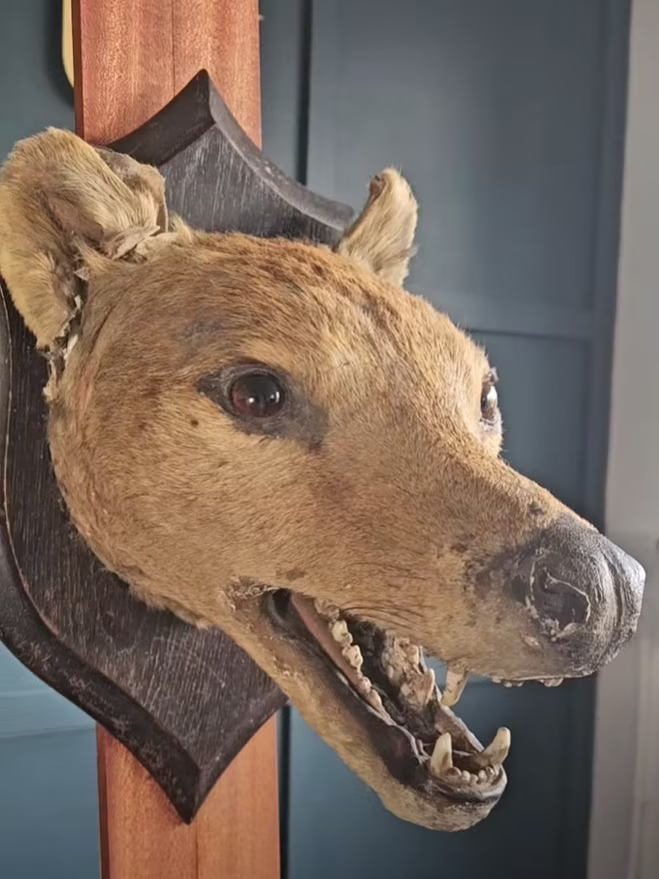
Another Tassie Tiger head has been found. Known as ‘Trevor’, this one was shot in the early 20th century. Like the previously discovered head, it is in the UK, along with lots of other stuff the British stole. It’s up for auction and could fetch almost 100K AUD, so hurry! Read all about here:
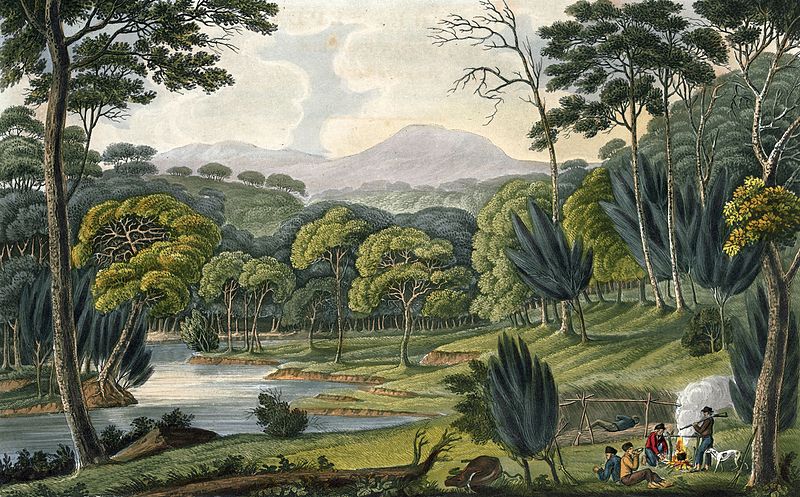
Convict artist Joseph Lycett’s 1825 painting of a gang of bushrangers on the Nepean River, NSW
The peculiar nature of modern Australia’s foundation and settlement produced a troubled politic consisting of the tension between gaolers and gaoled, the enmities of Ireland and England and the struggle over access to land and its resources. A distinctive version of the outlaw hero tradition developed across a number of boundaries – boundaries of ethnicity, religion, class as well as the physical divisions of property ownership. These began with the gulf between the incarcerating administration and those they were charged with punishing.
Later in the history of the colonies, the vague but contested nature of the boundaries between squatter properties and free selector’s blocks produced an ongoing conflict that underlay subsequent outbreaks of bushranging. From these events a select few individuals came to be celebrated by many, though hardly all, as heroic resisters of official oppression and injustice.
Brutality was the constant theme of the transported convict’s experience upon ‘the fatal shore’, particularly if involved in further crimes committed in the penal colony of New South Wales. From the first moments of European colonisation there was conflict between convicts and their keepers that initially led to attempts to escape. These ‘bolters’ as the escapees were called, fled into the unknown Australian bush, often to perish in ill-informed attempts to reach China, which, it was rumoured, was connected to the Australian landmass.
More practically minded bolters used the bush as their wilderness hideaways, established gangs of others like them and lived by highway robbery and raids on shepherds and isolated homesteads. Their freedom and their possession of stolen weaponry made them instant heroes to those of their kind still confined who saw them as avengers of their sense of oppression and brutalisation within a penal system that allowed violence and terror as everyday occurrences.
There were many escaped convicts who roamed the bush at this period, including Michael Howe, Martin Brady and Martin Cash in Tasmania, or Van Diemen’s Land as it was then known. Contemporary observers of these bushrangers were quick to make the connection with Robin Hood. In his Impressions of Australia Felix (1845), Richard Howitt wrote that ‘The more gentlemanly of them in Van Diemen’s Land are there what Robin Hood and Rob Roy were in Britain …’.
Just over a decade later the historian of the Van Diemen’s Land bushrangers described them as ‘ a sort of martyr to convictism’ and as men who were seen by their peers as ‘the bold Robin Hood of their morning songs, and he was now the unfortunate victim of legal oppression …’.
In the much larger colony of New South Wales there were also many convict escapees ranging through the bush, though one was destined to become the most famous of all. The Irishman Jack Donohoe was transported to New South Wales for life in 1824-5, found guilty of intent to commit an unspecified felony. Escaping in 1827 to range the bush, he was credited by the ballads and some witnesses with many of the attributes of the outlaw hero: he was courteous to women, never robbed ‘the poor’, in this case the convict and ex-convict population, was heroically daring and died ‘game’. He enjoyed the sympathy and the support of convict society, many of whose members provided the bushranger and his gang with information about trooper movements, food and shelter. This assistance kept Donohoe alive until 1830, when he was killed in a shoot-out with the troopers near Sydney.
A number of ballads were composed about Donohoe, though the one that has survived presents the bushranger in unabashed outlaw hero terms, drawing explicit comparisons with earlier outlaw heroes from Robin Hood, and the Irish Willie Brennan, Captain Freney (here appearing as ‘Freincy’) and Jeremiah Grant.
There were Freincy, Grant, bold Robin Hood, Brennan and O’Hare:
With Donahoe this highwayman none of them could compare…
As well, the ballad introduces a strong note of anti-authoritarianism, expressed as antagonism towards the representatives of the English government and Crown. This element recurs often in subsequent Australian manifestations of the outlaw hero tradition, including though not restricted to, Frank Gardiner, Ben Hall and Ned Kelly, and has also ensured the popularity of the ballad, in various versions.
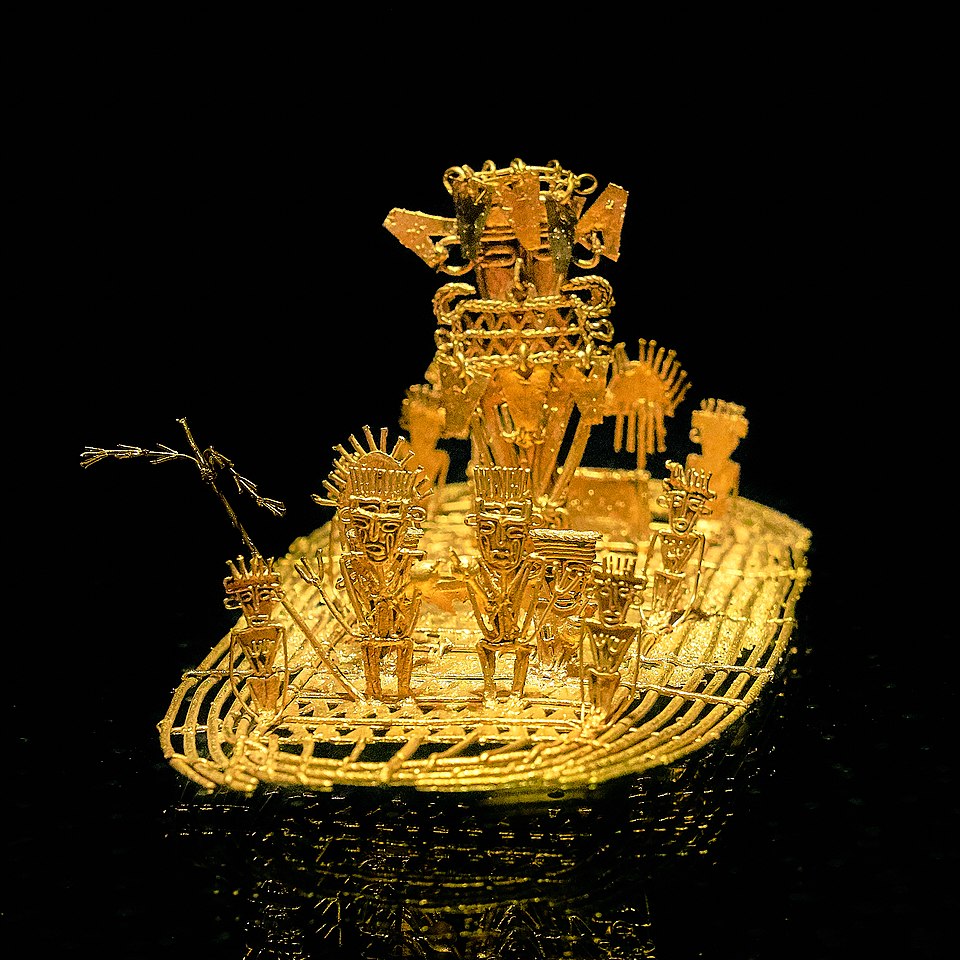
Muisca raft in the Gold Museum, Bogotá, Colombia. This raft made of gold was found in Pasca, Cundinamarca, in 1969, and is associated with the legend of El Dorado. CC Licence.
Ancient though their origins may be, the world’s many myths and legends have played an important role in history. Frightening fables of unknown southern lands, tales of lost cities and endless rumours of hidden hordes of gold motivated many of the world’s greatest explorations.
Five centuries before the common era, the Greeks knew the world was not flat. It was a globe and so, they reasoned, there must be a large landmass in the extreme south to balance the lands they knew in the northern hemisphere. The Romans embroidered the legend of a lost southern land by imagining it was peopled by strange beings who survived in great heat and necessarily walked upside down. By the Second century AD it was widely accepted that there was a southern land, probably inhabited, and laying at the bottom of the world – somewhere. It featured on beautifully crafted European maps and charts complete with sea monsters and winged serpents. The Muslim world also produced maps that seem to represent some of Australia’s northern coastline in the Ninth century AD.
Mariners began searching for the southland from early times. It was frequently discovered, the news triumphantly announced, only to be disproved by later explorers. Many voyages undertaken by the Spanish, Portuguese, Dutch, French and British were inspired by the desire to solve the riddle of the mysterious continent. It would be centuries before anyone did, but these many efforts provided the world with knowledge of distant places, unknown seas, new flora and fauna and contact with indigenous peoples previously unknown to Europeans.
Other beliefs also fuelled world exploration. Stories about the ‘River of Gold’, now thought to be the Senegal River, reached southern Europe through contact with the Muslim world from perhaps as early as the Thirteenth century. But from ancient times there had been great interest in the rumoured river. Pliny the Elder and Claudius Ptolemy write about it and the Carthaginians sailed there more than four centuries BCE. A number of Arab expeditions were reported to have sought the river during the Twelfth century. Despite the unknown terrors of sea voyages in that era, people heard these yarns and went looking for the treasure. Most never returned. Or, if they did, we know nothing about it.
Despite – or perhaps because of – these uncertainties, the legend of the River of Gold grew on the tongues of traders, sailors and adventurers. An expansion of this tale based on ninth century Arab writings claimed that there was not just a river and an island but ‘Lands of Gold’ in the chief city of which gold ‘grew in the sand like carrots’ to be harvested at sunrise. Three centuries later writers were describing the magnificent gold clad horses and gold and silver-collared dogs of the king of this place (probably modern Ghana). His sons boasted gold-plaited hair and lowly pages who hefted swords mounted in gold.
Wild though these legends were, they spurred expansion into new lands, gradually filling the map of the world with facts rather than fictions. We will never know how many adventurers and treasure seekers set out to find the objects of their desire though we can be sure that most of them died in their quests. But in one case we do know the explorer’s fate.
The Spanish began their occupation of South America when Cortez conquered the Aztecs from 1519. The astonishing amount of gold and other valuables the Spaniards found as they cut their way through the indigenous peoples rapidly established South America as a hot spot of fabled wealth. One of the most potent tales concerned an indigenous community whose kingship ritual involved covering the anointed man with gold dust – El Dorado, ‘the golden one’. Other items in the ceremony were also either made of gold or covered in the precious metal. Together with other valuables, the gold was thrown into Lake Guativita. The king went in as well, washing the gold dust from his body and adding to the riches carpeting the lake floor.
By the time the Elizabethan adventurer Sir Walter Raleigh first heard about El Dorado from a captured Spanish sailor it was no longer an individual but a place. A city of gold along an Amazonian river in the wilds of Guiana (Guyana). Slowly but steadily the lure of the golden city took hold of one of the greatest scholars and adventurers of the Elizabethan era. Raleigh had long been collecting relevant documents and maps and was well versed in the lore of the great treasure when he finally sailed to Trinidad and then to the mouth of the Orinoco River on his own quest for El Dorado in 1595. Previous unsuccessful attempts had been made from the east coast and Raleigh was not about to repeat the mistakes of others. Nor could he afford to fail.
It was a horror voyage. Raleigh’s passage through the “thick and troubled water” of the Orinoco and its endless tributaries was long, hot and arduous. Raleigh ended his account with a strong promise of untold riches. But the leaden truth was that “I gave among them [the Indians GS] many more pieces of gold than I received.” Raleigh’s quest had been a colossal failure – and he knew it. Although he did not find el dorado, his The Discovery of Guiana (1596), provided valuable anthropological, ecological and geographic knowledge of the region. Through it he also wrote himself out of immediate trouble with his Queen, Elizabeth I.
Still a believer, Raleigh tried again in 1617. His attempt was another failure and sealed his fate with a new monarch, James I. Soon after his empty-handed return to England the great Elizabethan and earnest seeker of El Dorado was beheaded at the Palace of Westminster on 29 October 1618. In his dying speech he admitted to being “a man full of all vanity, and having lived a sinful life, in all sinful callings, having been a soldier, a captain, a sea captain, and a courtier, which are all places of wickedness and vice …”.
Misty and murky though they were, these and the many other legends of unknown lands and golden treasures had very real consequences for individuals and for the greater sweep of world exploration and discovery.
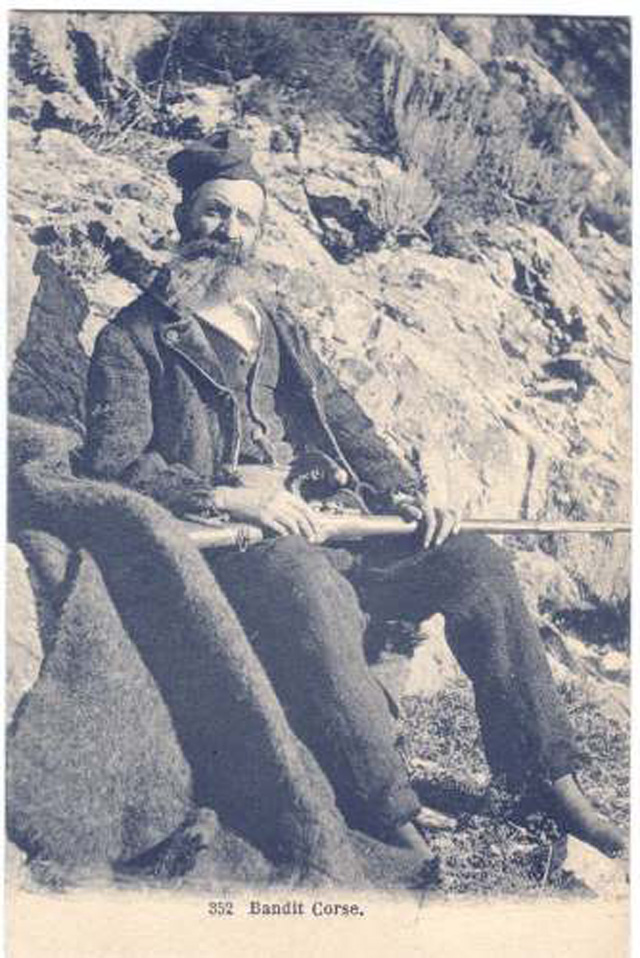
Corsican bandit early XX century. Author unknown. Wikipedia.
Nobody there despises the bandit; he is neither thief nor robber, but only fighter, avenger, and free as the eagle on the hills.[1]
In July 1932, newspapers reported a minor event in an out of the way part of the world. Referring, as usual, to ‘Robin Hood’, they conveyed the news that the ‘popular brigand’ Jean Ettori had been acquitted of murder. He was seen as a man who ‘robbed the rich and assisted the poor’ and had many supporters, some of whom presented him with a new rifle to commemorate the bandit’s acquittal.[2] It was not the first time that Ettori, known as ‘scicca’, the ‘slice’ or ‘cut’ had faced a court.
Born in 1880, Jean-Simon Ettori was a Corsican peasant who became a bandit through an act of violence involving payment of an old debt. Ettori accidentally wounded a young woman during a gunfight. One of his accomplices killed a man during the same incident and was later caught and sentenced to hard labour for life. Ettori decided that he would rather live in the macchia, or woods, than spend his life in prison. He later killed two gendarmes who got too close and was sentenced to death for these crimes in absentia in 1910.
Ettori disappeared to Venezuela for a year before returning to settle another dispute. In 1920 he murdered a local man who had tried to betray him to the authorities for the reward. For the next twelve years, he busied himself with his three wives and seven children, working occasionally as a shoemaker and spending time in the machia whenever necessary. He enhanced his reputation as an honourable bandit by settling local disputes. In 1930 the villagers of Petreto-Bicchisano were being oppressed by a bandit called Toma, not one of the ‘honourable’ or ‘noble’ kind. They sent a delegation to Ettori asking for help and he rid them of the problem.[3]
As he grew older, the bandit’s life was not as congenial as it once was for Ettori. After lengthy negotiations with the authorities, he surrendered himself in 1932 after twenty-six years on the run. His trial was a sensation. Anywhere other than Corsica, perhaps, he would have been punished.
The island that gave birth to Napoleon Bonaparte has a troubled history of conquest, oppression and poverty. Feuds and honour killings have been a notable aspect of Corsican life since medieval times and produced a never-ending array of outlaws.
… The Corsican bandit is not, like the Italian, a thief and robber, but strictly what his name implies—a man whom the law has banned. According to the old statute, all those are banditti on whom sentence of banishment from the island has been passed, because justice has not been able to lay hands on them. They were declared outlaws, and any one was free to slay a bandit if he came in his way. The idea of banishment has quite naturally been extended to all whom the law proscribes.[4]
The bandit who ruled the hills between Belgodere and Ponte alle Lecchia in the early nineteenth century was known as ‘Serafino’. According to a late nineteenth century traveller who visited the area, he was
… a man of war, as is every bandit; but he appears to have been of gentlemanly manners. His death occurred about thirty years ago, and many stories are preserved of his courtesy to women, and his protection of the poor. The Corsican bandit, as a rule, never robs: he is supported, either by the produce of his flocks, which he brings in by night to his native village, or by the voluntary contributions of his relations.[5]
Serafino was betrayed by someone and shot dead by the gendarmes while he slept in his cave.
Others of the vast number of individuals who took to the macchia[6] were recognised and celebrated as noble robbers. Andre Spada was active in the 1920s until captured in 1933. More recently, Yvan Colonna, given life in 2003 after being on run for 5 years, was protected by separatists who saw him as a Robin Hood figure.
Another was Felix Micaelli who operated in the Fiomorbo region undet the bandit alias of ‘Feliciolu’ in the early twentieth century. After kidnapping a girl he wished to marry and later murdering a tyrannical cousin, Micaelli fled to Argentina in 1908 and later joined the French Foreign Legion. He was said to have been a good soldier but was eventually recognised and again forced to flee. He returned to Corsica where he began building a Robin Hood reputation for settling disputes. During World War 1 he aided the authorities by capturing deserters and generally assisting in maintaining law and order. He apologised through a newspaper for an accidental killing he committed in 1917 but continued to enjoy the sympathy of local communities until at least the 1930s when he seems to disappear.[7]
Up to the middle of the nineteenth century the most celebrated bandit was Teodoro Poli. Impressed into the army, Poli deserted and took up banditry with gusto.
… He astonished all Corsica by his deeds of audacious hardihood, and became the terror of the island. But no meanness stained his fame; on the contrary, his generosity was the theme of universal praise, and he forgave even relatives of his enemies. His personal appearance was remarkably handsome, and, like his namesake, the king, he was fond of rich and fantastic dress. His lot was shared by his mistress, who lived in affluence on the contributions (taglia) which Teodoro imposed upon the villages.[8]
Betrayed and murdered, Poli died the defiant bandit of tradition, according to his ballad ‘he fell with the pistol in his hand and the firelock by his side, come un fiero paladino—like a proud paladin.’[9]
[1] Ferdinand Gregorovius, (trans. Alexander Muir), Wanderings in Corsica: Its History and its Heroes, Thomas Constable, Edinburgh, 1855, p.176
[5] Gertrude Forde, A Lady’s Tour in Corsica, Vol. I (of 2), Richard Bentley and Son, London, 1880, pp. 98ff.
[6] Gregorovius, p. 197 provides some astonishing statistics for victims of the vendetta and, therefore the outlawing of their murderers. Between 1359 and 1729 over 330 000 were killed and an equal number wounded. For the nineteenth century: ‘According to the speech of the Corsican Prefect before the General Council of the Departments, in August 1852, 4300 murders (assassinats) have been committed since 1821; during the four years ending with 1851, 833; during the last two of these 319, and during the first seven months of 1852, 99. The population of the island is 250,000.’
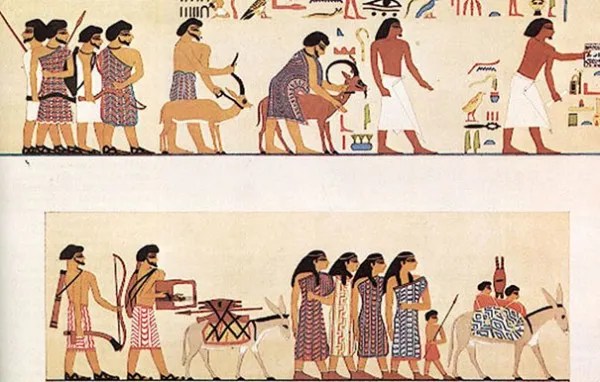
Egyptian tomb painting of nomads from about 1900BC. Tomb of Khnumhotep at Beni Hassan 12th Dynasty.
One of the world’s earliest known stories is a romance. A three and a half thousand-year-old fantasy of forbidden love between a high-born woman and a lowly outcast, the Sumerian tale of Adjuar and Martu pre-figures narratives like Romeo and Juliet and West Side Story, among many others.
Adjuar and Martu
Martu is a young nomad, from a people known as the Martu, who are considered barbaric and untouchable, let alone marriageable. But Martu needs a wife to keep his mother happy but is unable to find one among his own people.
On a feast day he goes into the city of Inab where he meets the beautiful Adjar-kidug, daughter of the city god (or ruler). They fall in love and Martu distinguishes himself in the feast games and sports by winning all the wrestling bouts. Asked what he wants for a prize, he rejects gold and jewels in preference for the hand of Adjar-kidug.
Her father sets him some tasks which, if completed, will guarantee his daughter’s hand. Martu does what he is asked and goes far beyond, gifting gold, fine cloths, silver jugs to everyone in the city, from the elders down to the slaves. Still, he received no permission to proceed even though Adjar-kidug is still deeply in love with him, as proven by her reply to a friend who warns her against marrying a barbarian:
Listen, the Martus, their hands are destructive and their features are those of monkeys; he is one who eats what Nanna forbids and does not show reverence. They never stop roaming about ……, they are an abomination to the gods’ dwellings. Their ideas are confused; they cause only disturbance. He is clothed in sack-leather ……, lives in a tent, exposed to wind and rain, and cannot properly recite prayers. He lives in the mountains and ignores the places of gods, digs up truffles in the foothills, does not know how to bend the knee, and eats raw flesh. He has no house during his life, and when he dies he will not be carried to a burial-place. My girlfriend, why would you marry Martu?”
But Adjar has been impressed by Martu’s efforts to be like her people and the efforts he has made to prove himself, rejecting wealth in preference for her love. She replies ‘with the certainty of a woman who knows her heart, her mind and her soul: “I will marry Martu!’
The story ends with the statement that ‘Adjar had seen the raw diamond in the nomad made civilised by her love’.[i]
We are not told whether the two lovers do marry or not, but their ancient story is as relevant today as it was over three millennia ago.
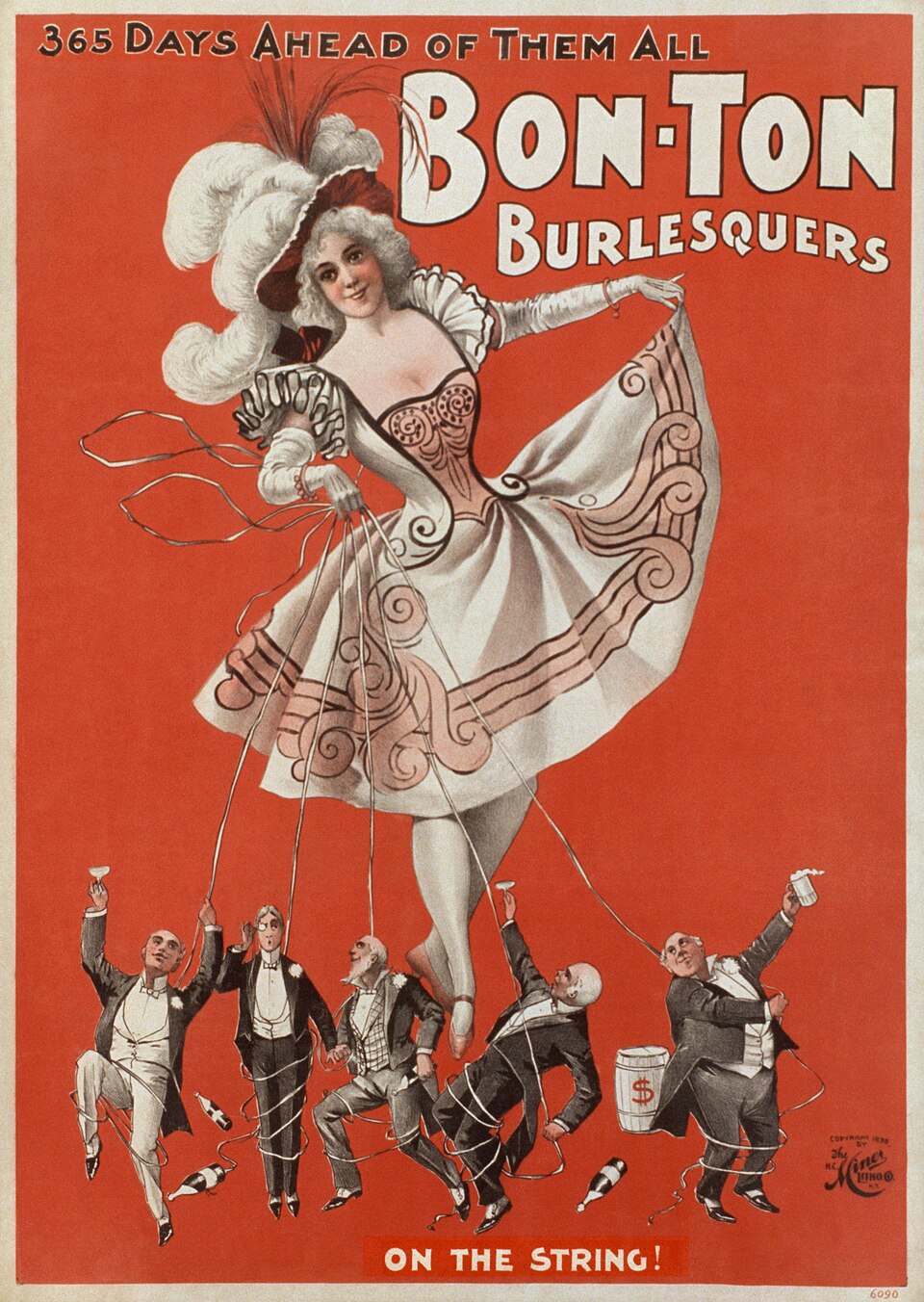
H.C. Miner Litho. Co. – Library of Congress[1]Bon Ton Burlesquers – 365 days ahead of them all.” Poster of U.S. burlesque show, 1898, showing a woman in outfit with low neckline and short skirts holding a number of upper-class men “On the string”. Color lithograph.
Burlesque comes from the Italian burla, for a joke or to mock – was characterised by the appearance of young women in relatively little clothing and what there was of that was designed to show their bodily form to best advantage. As well as this primary attraction for its mostly male audiences, Burlesque also had a strong element of social satire from its origins as lower class spoofs of high society diversions such as opera and ballet.
While Burlesque is usually associated with America it received its greatest boost in the 1860s when the famed showman P T Barnum imported a British Burlesque troupe led by Lydia Thompson. Lydia and her blonde ladies rapidly became superstars, although there was soon a strong moral backlash against this form of entertainment. As usual, this only increased the popularity of Burlesque and by the early twentieth century it operated through an extensive circuit of theatres, known as a wheel, with large troupes travelling the same show for up to forty weeks of the year. By then, the typical Burlesque show included many of the same style of acts found in Vaudeville, although the scantily clad ladies remained the primary attraction.
In burly-q speech the main player in a comic act was known as the top banana, a phrase that has entered the broader slang repertoire. Those supporting him or, less frequently her, were second banana, third banana and so on. These terms are said to derive from the comic’s last resort of slipping on an imaginary banana skin in order to get a laugh. In this form of slapstick (a term derived from pantomime rather than burlesque, though this very basic form of humour was common to both forms), the lower a performer ranked in the bunch the more likely he or she was to receive the pies in the face and the host of other undignified bits, or skits, that made up most comedy acts. Other terms related to the business of being funny were skull – to pull a funny face and the talking woman – one who delivers lines for the comic to joke about, equivalent to the straight man of a stage comedy act.
An oft-performed bit from the later Burlesque poked fun at business names. It doesn’t take much to see and hear a couple of the Marx Brothers banging this one out:
Man at Desk: (picks up phone) Hello, Cohen, Cohen, Cohen and Cohen. Caller: Let me speak to Mr. Cohen. Man at Desk: He’s dead these six years. We keep his name on the door out of respect. Caller: Then let me speak to Mr. Cohen. Man: He’s on vacation. Caller: (Exasperated) Well then, let me speak to Mr. Cohen. Man: He’s out to lunch. Caller: (Yells) Then let me speak to Mr. Cohen! Man: Speaking.
The occupational jargon of burly-q included colourful phrases like the asbestos is down – a reference to the fireproof stage curtain being down, making the audience unable to hear the jokes – which purportedly explained why they were not laughing. A mountaineer was a comic from the Catskill Mountains resort circuit and theBoston version referred to a sanitised rendition of an act with the blue elements removed or toned down. The term cover, meaning to take over another performer’s role, as in ‘Will you cover for Mac?’, has passed into the wider vernacular of the English-speaking world, its Burlesque origins known by few.
Despite the similarities between Burlesque and Vaudeville, there was a barrier between the forms, with Vaudevillians considering themselves superior to Burlesque. But the continual operating mode of the Burlesque circuit meant that it provided fairly reliable work and many Vaudeville acts also worked the Burlesque circuits under different names. As a result, there is a considerable overlap between Vaudeville and Burlesque lingoes. The olio was used in both forms to describe a mixture of short acts performed rapidly at the front of the stage with the main curtain, often an oilcloth, a technique probably borrowed from the earlier blackface minstrel shows. Other common terms included yock and milking an audience, the latter of which became a standard showbiz term and has moved beyond that into everyday slang.
Like Vaudeville, burly-q declined with the rise of the cinema. By the 1920s it had become largely a bump and grind strip show, with the comic acts little more than a hangover of the past. The striptease developed its own language as well. Strippers used pasties to cover their nipples. A G-string was a gadget, while a trailer was the provocative walk leading up to the strip itself. The breasts of a stripper were blisters to be quivered and her buttocks were cheeks to be shimmied for the titillation of the audiences, known in the business as jerks.
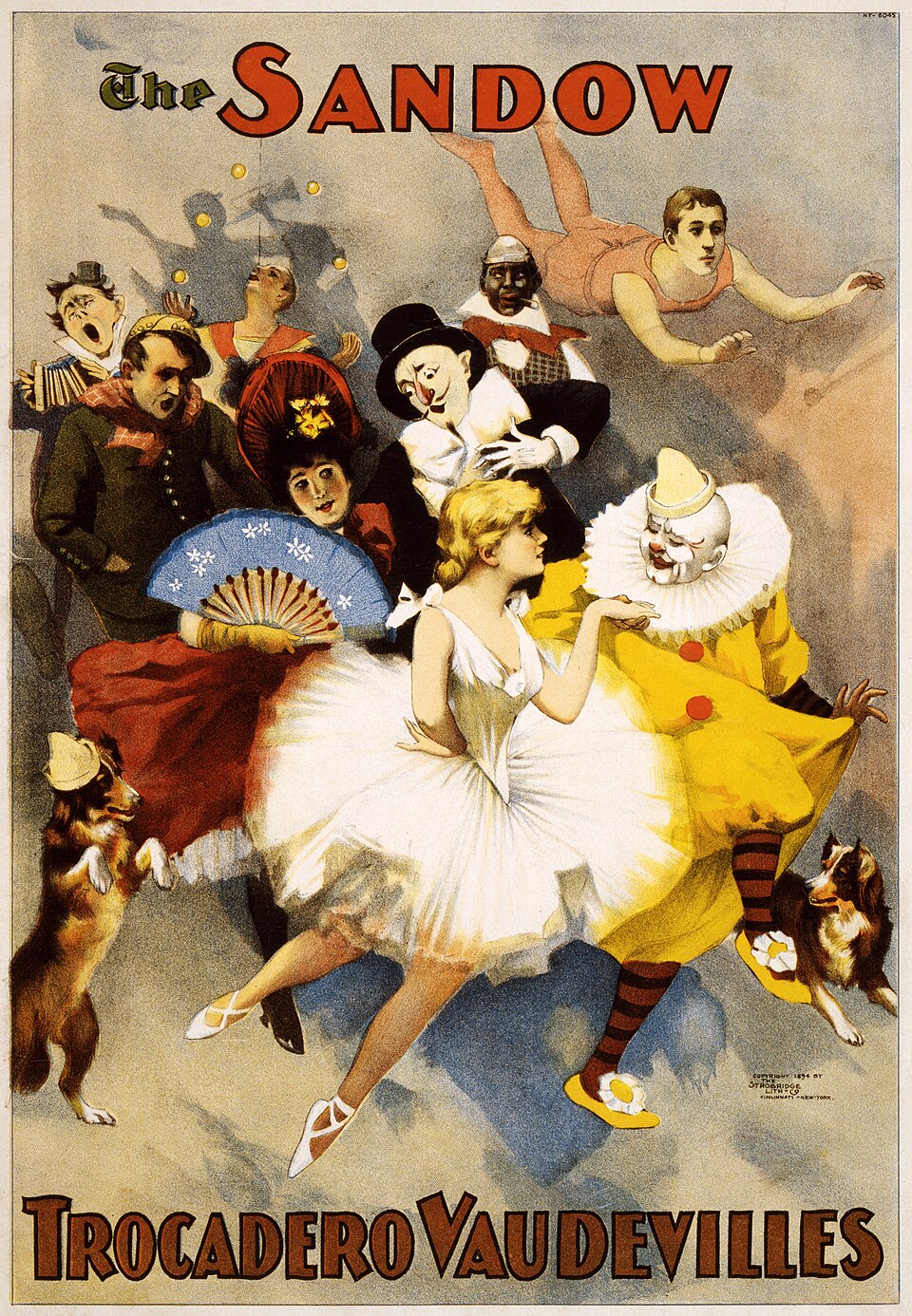
By Strobridge Lithographing Co., Cincinnati & New York – This image is available from the United States Library of Congress’s Prints and Photographs divisionunder the digital ID cph.3g12307. See Commons:Licensing., Public Domain, https://commons.wikimedia.org/w/index.php?curid=11158985
Always looking for a yock, a really big laugh from the audience, or a show stopper of any kind, the Vaudeville performer’s heyday was from the late nineteenth century until the 1920s. Originating in a variety of occasional performances in bars, theatres and wherever else a show could go on, its first appearance under that name is usually said to have been at a Boston saloon in 1840.
Vaudeville was essentially a travelling collection of comedy routines, musical acts, jugglers, acrobats, animal acts, ropers, (cowboy acts) and pretty well anything else that would play – and possibly pay. It became very popular throughout America and Canada, with around two thousand theatres by the start of the twentieth century. By the mid-1920s Vaudeville was destined for oblivion when the movies turned into the talkies. As Vaudeville was increasingly threatened, so many of the houses became blue, incorporating risqué items in an attempt to lure audiences away from the enticements of the silver screen. The overlapping entertainment form that came to be known as Burlesque suffered the same fate, its once glittering shows descending into little more than strip joints.
The name Vaudeville is said to derive from a French slang term for songs of the town – voix de ville, but there are a number of other stories, all of which have a French connection. There is a tradition in the carnival that a circus clown began Vaudeville, but this more likely reflects the close relationship between the two forms of entertainment, a relationship also reflected in the sharing of some lingo. Wherever the term came from, it was firmly established in the 1880s when a circuit of glittering Vaudeville theatres flourished in the northeastern states of America, providing non-stop daily performances for audiences keen to pay for the comedy and out-of-the-ordinary acts available.
Unlike more settled entertainments, such as revues, Vaudeville generally changed its acts each week or so. The acts were known by in-group names. An acrobatic or similarly physical act was called an alley-oop, allegedly from the fact that many of these acts were European in origin and spoke French. They would use a combined form of the French for everyone – ‘allez’ and the English ‘up’ as a command to begin their performance. A slapstick act was known as a baggypants comic. A blackout was a short comedy routine followed immediately by the houselights being turned off. The deuce spot was the least popular second act on a bill, straight after the opener which was usually the worst, but just before the best feature act, which meant that your number two performance was forgotten almost before it was over. Worse still, the audience might simply sit on their hands and decline to show their appreciation at all. The last act was called playing to the haircuts, meaning the performer was playing to the back of the departing crowd.
The vernacular of Vaudeville is full of terms for playing to an unappreciative house or bombing in front of an audience, a reflection of the difficulties of the business. A Brodie was a disaster, said to be named after a performer who survived a fall off the Brooklyn Bridge. As in other forms of showbiz, to flop or die was a common term for failure and an unappreciative house could be called a morgue. A poor act might be called a fish (because it stank). There was always a chance that the act could wow the stubholders, as the audiences were known, or if they were only applauding politely, milk them of more by reappearing onstage, or refusing to leave it until the bitter end.
Acts were often made up of shorter sections,called business. Soemetimes these wereso highlyexaggerated or overdone that they were described as Schtik, a term that moved beyond its original showbiz location and is now used to mean any kind of overly cloying presentation or approach.
Many Vaudeville terms were shared with the closely related entertainment known as Burlesque, or burly-q to its practitioners and aficionados, as expressed in my next post.
Renowned Australian folk musician and singer Dave De Hugard has been singing and researching ‘Waltzing Matilda’, in one version or another, for many years. He has now released the fruits of his labours – a different angle on the origins of the famous song and a compelling new composition based on the original.
Listen to Dave sing his new song, ‘Waltzing Matilda: The Real Swagman’s Story’ here. (scroll to bottom of page)
Coincidentally, Dave also has a couple of new album releases out and available here
Untangling Matilda: A clarification of the origin of the original lyrics of Banjo Paterson’s ‘Waltzing Matilda’
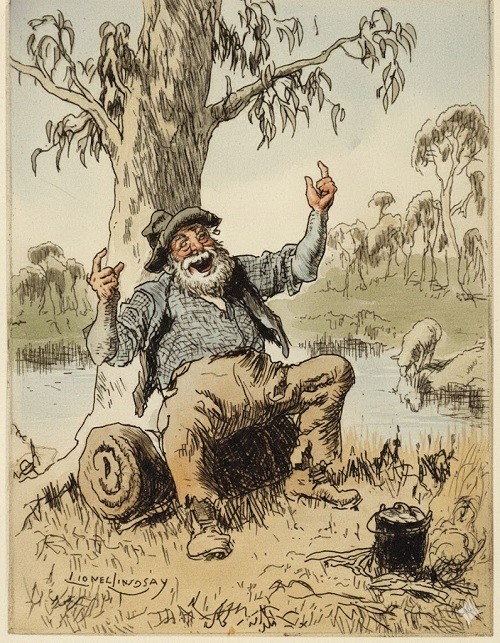
In 1895 as a guest at Dagworth, the Macpherson sheep station, Banjo Paterson, inspired by a tune Christina Macpherson was playing, said to Christina that he thought he could put some words to it. He then and there created in a few lines of verse, the image of a happy swagman, singing as he boiled up his billy by a billabong, ‘Who’ll come a-waltzing Matilda with me?’
This in time would become the first verse of the ‘Waltzing Matilda’ that many of us know. Other verses would follow later, but they would take a decidedly different turn. In this paper I will be looking closely at events and incidents that may have played a significant part in inspiring those later verses. But before we do that, there are some important things we need to know.
First and foremost we need to know that there really was a swagman who drowned at a billabong known as the Combo waterhole. This happened in April 1893, two years before Banjo Paterson arrived at Dagworth. We don’t know who the swagman was but we do know that he had knocked off one of Bob Macpherson’s sheep. This was during the seriously troubled times of the shearer’s strike. At that time, a Constable Pat Duffy and a tracker were looking for a Dagworth stockman who had killed an aboriginal youth, for not looking after the horses properly; and it just so happened they headed towards the Combo waterhole where the swagman was camped. The swagman spotted them and decided to make himself scarce. He tried to get across the billabong but he drowned in the attempt.
That’s one thing we need to know. But we also need to know that Banjo Paterson was aware of this event. The Combo waterhole had been a picnic spot from time to time for the local graziers. And it was at a picnic at that Combo waterhole that Banjo heard from Bob Macpherson, not only the story of the drowned swagman, but also Bob Macpherson’s belief that the billabong was haunted by the swagman’s ghost. This information is contained in the 2nd edition of Sydney May’s ‘The Story of Waltzing Matilda’ (1955). It comes from a Jane Black, a friend of the Macphersons. Jane Black tells us that on a visit to the MacPhersons, she got a retelling from Bob Macpherson of the events that happened during the Paterson visit. This included confirmation from Bob Macpherson that Banjo Paterson had been a guest at a Combo waterhole picnic; and that during that picnic, the story of the drowned swagman and the swagman’s ghost had been told. She tells us also, that she was so impressed with Bob’s story of the drowned swagman and the ghost that haunted the billabong, that ‘we deviated a little next day on our way to Kynuna to get a good view of the magic waterhole’.
With this information under our belt, we can now look at the rest of the verses that Paterson put together to complete his waltzing Matilda story. And what we find is not at all a straight retelling of the story that he had heard from Bob Macpherson. The main ingredients are there – the police, the jumbuck, the drowned swagman and the ghost – but the story has changed completely. Not only does Paterson have the swagman caught and interrogated by his captors but he then has the swagman jump into the billabong and drown himself. He keeps Bob Macpherson’s ghost, but it now sings through the billabong, with a very much less promising, ‘Who’ll come a-waltzing Matilda with me’.
And there is another change as well, and a particularly significant one. It is significant because it relates directly to what I believe Paterson’s original ‘Waltzing Matilda’ was all about. What he did was to remove the original police involved in Bob Macpherson’s account of the drowned swagman. And in their place he put a squatter on a thorough-bred with three policemen in tow. And this wasn’t just any squatter. This squatter was Bob Macpherson. And we know this, because in September 1894, the year before Paterson arrived at Dagworth, a band of striking shearers had burnt down the Macpherson wool shed with a 140 or so sheep inside. Many shots were fired during the night as well. And the next day, to his credit, Bob Macpherson rode out to the shearer’s camp with three policemen to confront the striking shearers. That is all understood and accepted. But what we really want to know is, what is Bob Macpherson doing, now popping up in the earlier drowned swagman story? There is an answer to this, but we first need to go back to the shearer’s strike.
One of the consequences of the strike was that there had been a major breakdown in the usual amicable relations between swagmen on the track and the homestead. Now, instead of calling into the homestead for the usual rations of sugar tea and flour, swagmen would just knock off a sheep in the paddock without a second thought; and this was still happening when Paterson was at Dagworth.
Bob Macpherson’s brother Gideon tells us for instance in some detail in the 2nd edition of Sydney May’s ‘The Story of Waltzing Matilda’ (1955), that Banjo & Bob Macpherson were out riding one day and they came across one of these sheep. It had been recently killed, the best bits taken and the rest just left to go to waste. Gideon then tells us that the completed ‘Waltzing Matilda’ followed soon after.
Christina Macpherson refers also to the same event, but she is more specific. Her reference is in an unsent letter (National Library of Australia) she wrote to Thomas Wood, the author of ‘Cobbers’. ‘Cobbers’ was a book about Australia and in it, Wood had included the words and music of ‘Waltzing Matilda’.
Christina says in her letter to Wood, that she is writing because she thought ‘it might interest you to hear how ‘Banjo’ Paterson came to write it’. She goes on to say that swagmen had been ‘helping themselves without asking’ and that Bob and Banjo Paterson had come across the remains of one of these sheep. She then says, and I quote, ‘Mr Paterson made use of the incident’. Christina doesn’t give us any more information, but that doesn’t really matter, because I believe we already have before us, all we really need to know.
The incident Christina is refering to here, is about Bob Macpherson, yet again, coming across another of his sheep that has been killed, the best bits taken, and the rest just left to go to waste. And it happened on this occasion that Bob Macpherson’s riding companion was Banjo Paterson – and Banjo, we know from his writings, had a good sense of humour. As such, my understanding of the incident Christina has just referred to, to put it quite simply, is that the occasion provided Banjo with an opportunity to have a bit of fun – and to cheer Bob Macpherson up in the process. It also just so happened that Banjo had at hand, still fresh in his memory, Bob’s earlier account of the drowned swagman at the Combo waterhole.
And it wouldn’t have taken Paterson long at all to put together some verses that poetically at least, would finally ‘turn the tables’ on the miscreants who had been knocking off Bob’s sheep! All he had to do was to have Bob Macpherson appear once again as that squatter on the thorough-bred with the three policemen in tow, and the job would be done! And that’s just what he did:
Down came the squatter a-riding his thorough-bred;
Down came policemen – one, two, three.
‘Whose is the jumbuck you’ve got in the tucker-bag?
You’ll come a-waltzing Matilda with me!
And this squatter that has now found its way into the Matilda story, has of course nothing whatsoever to do with an event the previous September, when Bob Macpherson did actually ride out with three policemen to confront the shearers who had burnt down his wool shed. And similarly, nor does this Matilda squatter have anything whatsoever to do with Samuel Hoffmeister, the probable suicide that Bob Macpherson and the police came across on that same occasion.
I also think it very likely indeed that all of the Macphersons would all have understood exactly what Banjo Paterson had written and why – and that what he had written, furthermore, would also very likely, have provided them all with no small amount of amusement:
”So take note any more of you swagmen who think you can knock off Bob’s sheep and think you can get away with it!’
And that’s about it. And it was in that form that the song took off and rapidly became very popular. The verse about the swagman jumping in the waterhole and drowning himself, wouldn’t have appealed to everyone and it probably wouldn’t have been long before more preferable options for some, began to find their way into the song.
In closing, I’ll just say that it does need to be known that as ‘Waltzing Matilda’ was becoming more and more popular, the real story of the very real swagman who actually had been camped at that Combo waterhole, was already well on the way to becoming almost entirely forgotten. And I for one, believe that that story, is way, long overdue for a retelling!
(c) Dave de Hugard, Castlemaine January 2026
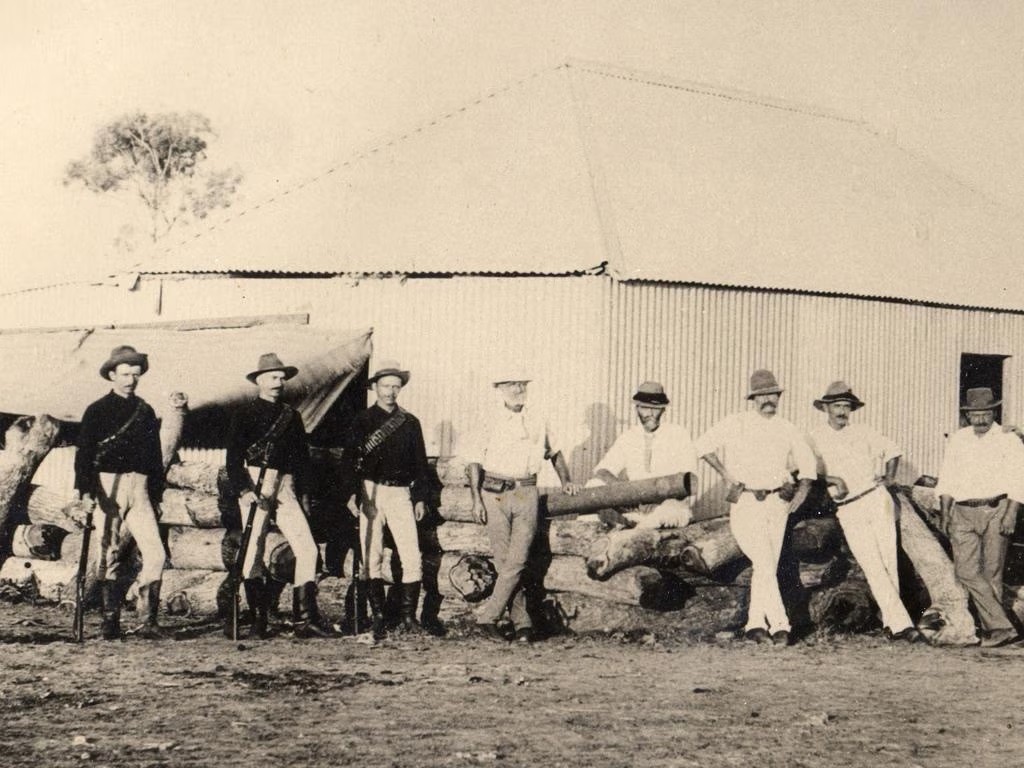
Bob Macpherson, 3rd from right, posing with the three policemen he rode out with in September 1894 to the striking shearer’s camp after they burnt down his woolshed.
Sea monsters have been seen for at least two thousand years. As well as giant squids and krakens, mermaids have featured in many legends and sightings. Hybrid beings of human female and fish, modern mermaids are generally presented as Disneyesque beauties rather than the often savage and dangerous sirens and other hybrids that appear from antiquity into at least the early modern era.
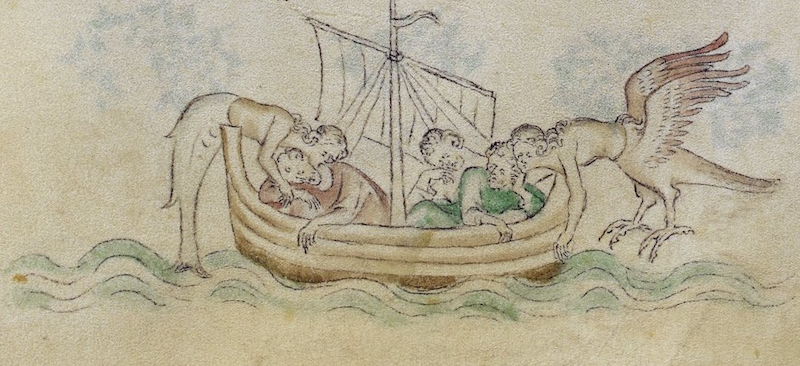
The year 1527 was a particularly bad one for mermaid attacks, it seems. According to Laurence Andrew’s, The Noble Lyfe and Natures of Man of Bestes, Serpentys, Fowles and Fisshes (British Library MS Royal 2 B VII, f. 97r):
The mermayde is a dedely beste that bringeth a man gladly to dethe. Frome the navyll up she is lyke a woman with a dredfull face, longe slymye here a grete body & is lyke the egle in the nether parte, havinge fete and talentis to tear asonder suche as she geteth. Her tayl is scaled like a fisshe and she singeth a maner of swete song and therwith deceyveth many a gode mariner for whan they here it they fall on slepe commonly & than she commeth and draweth them out of the shippe and tereth them asonder… but the wyse maryners stoppe their eares whan they se her for whan she playth on the water all they be in fear & than they cast out an empty tonne to let her play with it tyll they be past her. This is specifyed of them that have sene it.
These mermaids were ugly and murderous, singing passing sailors to sleep before tearing them asunder. Fortunately, the slimy-haired beings don’t seem to have been very bright and were easily distracted from their murderous intent by sailors throwing a barrel into the sea for the creatures to play with. How the barrels might be cast while holding one’s hands over one’s ears to ward off the singing spell was not specified.
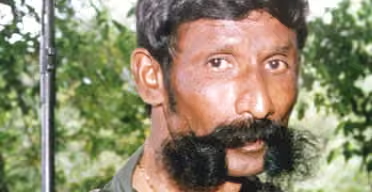
Veerappan stands with a gun in his jungle hideout in 1998. Photograph: AP
*
‘It was a pukka operation’ said Jyoti Mirgi, the head of the operation Cocoon force that had been pursing ‘the Jungle Cat’ since 1993. ‘We ordered him to surrender but he refused’.
Mirgi was referring to the gun battle between police and Koose Muniswamy Veerappan (1952-2004), ‘India’s most wanted bandit’ with a price on his head of 20 million rupees, approximately US 500 000 dollars. In October 2004 an undercover police informer working in what was left of the ageing dacoit’s gang tipped off the authorities that the famed bandit would be leaving his forest sanctuary and travelling to hospital for eye treatment. The ambulance that was to take him to the hospital was a police vehicle, as were others in the area.
Over thirty policemen ambushed Veerappan and three of his gang. According to the official report, the bandit was killed on the spot after refusing to surrender. Police gave thumbs up signs as they posed by the famous corpse, which was then was taken to Dharampuri hospital, where crowds reportedly numbering up to 20 000 gathered to see the remains of ‘India’s Robin Hood’, as the press dubbed the notorious outlaw.
Born in 1952, Koose Muniswamy Veerappan had by the time of his death led the authorities on the traditional merry outlaw’s dance for four decades, smuggling sandalwood and ivory, allegedly committing well over a hundred murders and conducting the traditional business of the dacoit, kidnapping politicians and celebrities. In trouble with the law from an early age, he became more active and violent from the 1980s, once allegedly claiming that he cut his victims into small pieces and fed them to fish.
His nickname of ‘The Jungle Cat’ was a linguistic acknowledgement of his ability to elude and outfox the large numbers of police and troops sent against him in his jungle hideaways in the southern Indian states of Tamil Nadu, Karanataka and Kerala. He was said to have the sympathy of the poor, a fact that made it difficult for the authorities to obtain reliable information about his activities and whereabouts.
His most ambitious crime was kidnapping an Indian movie star, Rakjumar, and extorting a ransom from the state government before returning the star unharmed. But he also kidnapped a former politician in 2002, murdering him when his demands for money were refused. The bandit’s own description of how he killed one enemy gives an insight into the realities of bandit life and death:
“I wanted to see the blood gushing out of Srinivas’ chest. I took out my gun before he knew what was happening and shot him. I then cut off his head and began hacking off his hands. These were the very hands that wanted to turn machineguns on me. I kept his head as a souvenir.”
As is often the case with elusive bandits, there were suspicions that Veerappan had contacts with political and security officials and with the separatist Tamil Nadu Liberation Army, a faction of which vowed to take revenge for his death, according to the Khaleej Times. His long dacoit career and the expensive operations eventually mounted to track him down suggest that he may have had more help than that available to him from his poor supporters, among whom he was said to distribute some of the proceeds of his many crimes and to shower the village children with sweets
Reporting Veerappan’s demise, the press lapsed immediately into the ambivalent rhetoric always associated with such figures. According to The Times, he was ‘an Indian Osama bin Laden and Robin Hood rolled into one: endlessly elusive, apparently uncatchable, evading troops sent to search for him even as he mocked them from his jungle lair.’ The Independent suggested India had a similar love-hate relationship with Veerappan as that of America with Billy the Kid, saying ‘if Veerappan was India’s blackest villain to some, to others he was a hero. He was able to survive in the jungle because villagers brought him and his men food, motivated by a mixture of respect and fear. The government forces sent to capture Veerappan were also said to have oppressed the local people: “At least, he does not hurt us,” they say.
The Indian newspapers were more condemnatory. The Telegraph of Calcutta quoted a former hostage saying he was glad that the outlaw was dead as he was a ‘cruel animal and vermin of the gutter’. The Indian Express referred to Veerappan’s ‘evil little empire’ and wondered how he was able ‘to mock the law for so long’. Elsewhere in India the press portrayed the dead bandit more in the manner of the outlaw hero with TheNew Indian Express quoting his aged mother to the effect that poverty had driven Veerappan to outlawry, though it also suggested that he commanded support more by fear than by sympathy.
Veerappan continued to be controversial and contradictory even in death. The director of the 1995 film of the outlaw’s life, boasting that Veerappan had approved the script, retitled it as Veerappan: The Original. He was reportedly responding to news that a rival director was preparing another film production to be titled Let’s Kill Veerappan. He became the subject of books and press articles and a long series on Indian television in 2007. Various legal actions ensued, keeping the bandit’s name in the public eye. It was also said that Veerappan stashed his loot somewhere in the jungle; people have been looking for it ever since.
In the facts and the fictions of Veerappan’s life and death echo those of other bandit heroes. He was forced into a life of crime by circumstances. He had the support and sympathy of his social group. He preyed mostly, if not totally perhaps, on the rich and powerful, he was betrayed and he died game. All these attributes, real or not, contributed to his being dubbed ‘the Indian Robin Hood’. In many ways, Veerappan’s life and legend are a link between the older style of bandit hero and more modern criminals who have understood the tradition and sought, in various ways to bend it to personal, ideological or commercial ends.