Children playing in the street Turnham Green, 1891. Catalogue Ref: COPY1/406 (149) National Archives UK
There are many children’s word games, including Pig Latin, Double Dutch and G-talk. They all arise, thrive and go in and out of fashion within the restricted sub-culture of children. This is a culture of the playground and the park that is to some extent in opposition to the world of grown-ups, teachers and formal education. It is a world that is made and maintained by children for children. Adults who may cling fondly to the more romanticised images of childhood often find the expressions of this world to be shocking, which children fully intend them to be.
After surveying children’s play and language across Britain, Iona and Peter Opie produced their classic work The Lore and Language of Schoolchildren (1959). It revealed a deep, vast and everchanging reservoir of kidspeak, resonant with creativity, colour and not a little mischief. Children from Newcastle and elsewhere used what they often called crook’s language, such as going for a ball and chalk, meaning to go for a walk and calling a thief a tea-leaf.
The Opies were also able to report on the varieties of backslang and related language tricks played by children on each other and on parents and teachers. Kids in different places had their own names for these secret languages, such as eggy-peggy and arague. Most of these involved moving the last sound in the word to the front, so that ‘bash you if you don’t shut your trap’ was rendered as Shba uyo fi uyo tedon teshu aryou petray.
Pig Latin, in which the initial consonants are moved to the end of the word while either ‘ay’ or sometime ‘ee’ was added, turning the same more or less standard English phrase given above into Ashbay ouyay ifay ouyay ontday utshay ouyay aptray. Other variations involved the addition of one, sometimes two syllables, before the vowel. This produced sentences like eg, known in some areas as stage slang and elsewhere as aygo-paygo language.
The Opies give a literary reference to the existence of such children’s languages at least as early as 1808. Around the same time similar language games were played by American children. One was called hog Latin and involved the addition of ‘gery’ to every word spoken.
The lexicographer, Eric Partridge, gives examples of a children’s language called ziph, which apparently had various levels of complexity. The intermediate form, as he calls it, was a simple addition of the suffix vis to each English word, a sentence like ‘Shall we go away in an hour’ becoming Shagall wevis govis awayvis invis andvis houris? The more complex form that inserted syllables such as ga, ge, gi and go into the words. The same English sentence then becomes Shagall wege gogo agawaygay igin agan hougour? Variations on these techniques are almost endless, limited only by the creativity, playfulness and needs of their speakers.
Such word games are also known to have been played by French children in the seventeenth century. One variety known as le javanaise, was eventually picked up by adults and became a craze during the 1860s. Expatriate Trinidadian musicians in 1970s London played with another variation of this word game. They called it ‘I Y’. It consisted of adding these sounds to the start and finish of words. Multi-syllabic words could also have these sounds inserted, the overall effect being a playful obfuscation of whatever was being said.
Another form of children’s speech is the nonsense oration, a variety of the stump speeches sometimes used by adults as a form of verbal amusement. Here is an example from American tradition:
Ladies and jellyfish, I come here not to dress you or undress you, but to address you as to how Christopher Cockeyed Cucumber crossed the Missisloppi River with the Declaration of Indigestion in one hand and the Star Speckled bannaner in the other.
Another whimsy from British children, highlights the fact that the common tongues of children are not bound by national boundaries:
Ladles and jellyspoons,
I stand upon this speech to make a platform,
The train I arrived in has not yet come,
So I took a bus and walked.
I come before you to stand behind you
And tell you something I know nothing about.
It hardly needs to be said that these expressions show the familiarity of children with the adult ways of the world and their delight in sending up those ways. The Opies called such expressions ‘tangletalk’, also providing some examples in verse form:
I went to the pictures next Tuesday
And took a front seat at the back.
I said to the lady behind me,
I cannot see over your hat.
She gave me some well-broken biscuits,
I ate them and gave her them back;
I fell from the pit to the gallery
And broke my front bone at the back.
An important element of the adult world is the insult, in which skills children also serve a linguistic apprenticeship. Children also have inventive repertoires of name-calling and other insults designed to bring other children into line with whatever is considered to be the norm at any particular time or place. In Scotland children who were conceited were known as swankpots, in England as Swankypants or Swanky Liz, a porky prig and a puff bag, among other derogations.
Moody types were cross-patches, oldgrousey, grumpy, misery, mardy-baby, sourpuss or sulky Sue. Unusually bright children were clever-Dicks, clever–guts, clever-pot or clever-sticks, among other half admiring, half-demeaning terms. Inquisitive children were nosey parkers, peep-eyes, flap-ears and keyhole Kates. In Australia such people are known as stickybeaks. And so it went on through cry babies, toadies, blabber-mouths, snitches and wide-mouths, just a few among the amazing number and diversity of children’s insults recorded by the Opies.
In her collection of children’s speech from Australia, Kidspeak (2000), June Factor identified over 4500 terms used by children. These included words related to toilet functions (poo, bum), sex (a tonguey is a French kiss), insult (dweeb, dork, vege head) play (chasey, the truce term barley and its variants, names for marbles, such as cat’s eye, peewee and stonk, among many others), friends (pals, buddys, dudes) and enemies (scrags, square bears and the reviled dobber).
The languages are not only Australian-English but also varieties of Aboriginal-English, including fully-developed Creoles such as to get proper wild or angry, and gury, a Kimberley Creole for ‘greedy’. There are also words taken from the many non-English languages of the community, including Greek (malaca, an insult), Italian (putana, an insult. Factor also highlighted the sheer creativity and verbal vibrancy of childisms like snot block (vanilla slice) and over-shoulder boulder-holder (bra) as well as a few rhyming slang terms such as horse and cart for fart and backslang, as in gaff for a fag, or cigarette.
Foolishness, stupidity and ineptitude are a constant theme of folk humour. The astoundingly silly actions of the residents of certain towns, real or not, feature in many traditions. But beneath the apparent craziness of some stories, there are some serious points being made. Communities of fools, sometimes known as ‘Fooltowns’ are located in Chelm (Poland) Schilda in Germany and Lols in Denmark, among others. In England the Nottinghamshire town of Gotham is one of several settlements with an unenviable reputation of being peopled with the commonsensically challenged.
Twelve Fools Go Fishing
On a certain day there were twelve men of Gotham that went to fish, and some stood on dry land; and in going home one said to the other, ” We have ventured wonderfully in wading: I pray God that none of us come home and be drowned.”
“Nay, marry,” said one to the other, ” let us see that; for there did twelve of us come out.” Then they told {i.e., counted) themselves, and every one told eleven.
Said one to the other, “There is one of us drowned.” They went back to the brook where they had been fishing, and sought up and down for him that was wanting, making great lamentation.
A courtier, coming by, asked what it was they sought for, and why they were sorrowful. ”
Oh,” said they, “this day we went to fish in the brook twelve of us came out together, and one is drowned.”
Said the courtier, “Tell [count] how many there be of you.”
One of them said, ” Eleven,” and he did not tell himself.
” Well,” said the courtier, ” what will you give me, and 1 will find the twelfth man?”
“Sir,” said they, “all the money we have got.”
” Give me the money,” said the courtier, and began with the first, and gave him a stroke over the shoulders with his whip, which made him groan, saying, ” Here is one,” and so served them all, and they all groaned at the matter. When he came to the last, he paid him well, saying, ” Here is the twelfth man.”
“God’s blessing on thy heart,” said they, “for thus finding our dear brother! ” [i]
Versions of this tale are also told in Iceland, India and further afield. Here is one from the ancient province of Hainaut in what is now Belgium:
The Six Sillies
Once upon a time there was a young girl who reached the age of thirty-seven without ever having had a lover, for she was so foolish that no one wanted to marry her.
One day, however, a young man arrived to pay his addresses to her, and her mother, beaming with joy, sent her daughter down to the cellar to draw a jug of beer. As the girl never came back the mother went down to see what had become of her, and found her sitting on the stairs, her head in her hands, while by her side the beer was running all over the floor, as she had forgotten to close the tap. ‘What are you doing there?’ asked the mother.
‘I was thinking what I shall call my first child after I am married to that young man. All the names in the calendar are taken already.’
The mother sat down on the staircase beside her daughter and said, ‘I will think about it with you, my dear.’
The father who had stayed upstairs with the young man was surprised that neither his wife nor his daughter came back, and in his turn went down to look for them. He found them both sitting on the stairs, while beside them the beer was running all over the ground from the tap, which was wide open.
‘What are you doing there? The beer is running all over the cellar.’
‘We were thinking what we should call the children that our daughter will have when she marries that young man. All the names in the calendar are taken already.’
‘Well,’ said the father, ‘I will think about it with you.’
As neither mother nor daughter nor father came upstairs again, the lover grew impatient, and went down into the cellar to see what they could all be doing. He found them all three sitting on the stairs, while beside them the beer was running all over the ground from the tap, which was wide open.
‘What in the world are you all doing that you don’t come upstairs, and that you let the beer run all over the cellar?’
‘Yes, I know, my boy,’ said the father, ‘but if you marry our daughter what shall you call your children? All the names in the calendar are taken.’
When the young man heard this answer he replied:
‘Well! good-bye, I am going away. When I shall have found three people sillier than you I will come back and marry your daughter.’
So he continued his journey, and after walking a long way he reached an orchard. Then he saw some people knocking down walnuts, and trying to throw them into a cart with a fork.
‘What are you doing there?’ he asked.
‘We want to load the cart with our walnuts, but we can’t manage to do it.’
The lover advised them to get a basket and to put the walnuts in it, so as to turn them into the cart.
‘Well,’ he said to himself, ‘I have already found someone more foolish than those three.’
So he went on his way, and by-and-by he came to a wood. There he saw a man who wanted to give his pig some acorns to eat, and was trying with all his might to make him climb up the oak-tree.
‘What are you doing, my good man?’ asked he.
‘I want to make my pig eat some acorns, and I can’t get him to go up the tree.’
‘If you were to climb up and shake down the acorns the pig would pick them up.’
‘Oh, I never thought of that.’
‘Here is the second idiot,’ said the lover to himself.
Some way farther along the road he came upon a man who had never worn any trousers, and who was trying to put on a pair. So he had fastened them to a tree and was jumping with all his might up in the air so that he should hit the two legs of the trousers as he came down.
‘It would be much better if you held them in your hands,’ said the young man, ‘and then put your legs one after the other in each hole.’
‘Dear me to be sure! You are sharper than I am, for that never occurred to me.’
And having found three people more foolish than his bride, or her father or her mother, the lover went back to marry the young lady.
And in course of time they had a great many children.[ii]
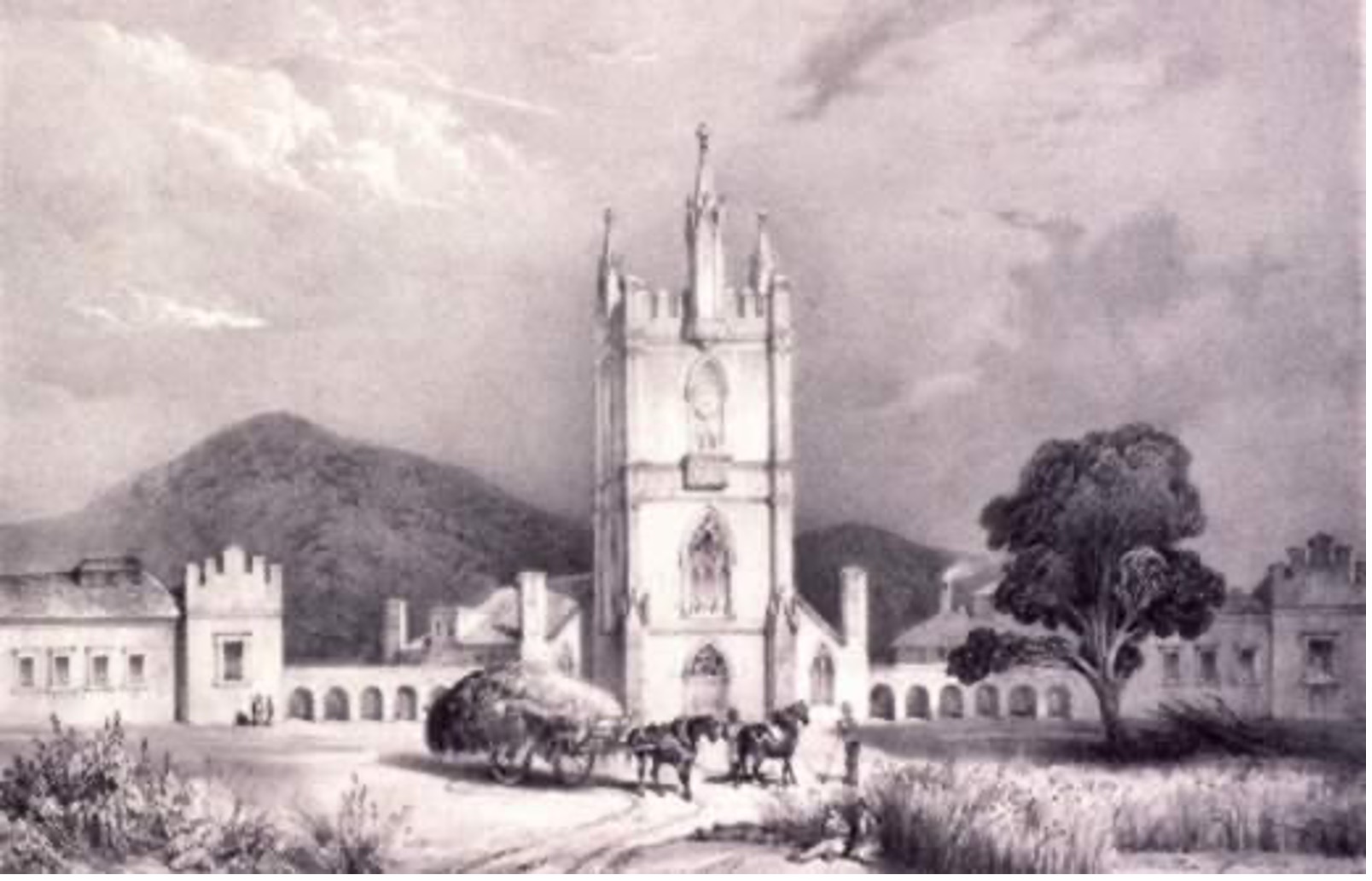
The King’s Orphan Asylum, later known as the Queen’s Orphan Schools, the girls’ school to the left of the chapel, boys’ school to the right, Mount Wellington in the background. The idyllic scene masked the horrors which were imposed on its inmates.
Bruce Lindsay has researched and written about the life and times of his great grandfather, John Lindsay. John was the son of Scots highland Traveller parents, transported to Van Diemen’s Land (Tasmania) at the age of three with his mother, Mary, in the mid-1830s. Mary had been one of a group of travellers who invaded a home-based store at Sweetie Hillock (just outside Aberdeen), and stole a number of items, including clothing, food and drink. Mary was transported for fourteen years, accompanied by young John. His story throws much light on the little-known life experiences of transports to Australia (whether convicted or not) and is a valuable historical record. Below is an edited version of a chapter from Bruce’s fascinating colonial family history.
*
John Lindsay is thought to have been born at Inverness on 15th January 1832, in the year following the marriage of Isaac Williamson and Mary Lindsay. Common Scots naming practice at the time was for the bride to retain her maiden name, although children generally adopted their father’s surname. However, children of female convicts travelled under their mother’s name, and without this convention, we may have never established the connection to our family line.
John first appears in our records sitting in the tinkers’ horse-drawn cart in March 1835, while his parents and the rest of the troupe confronted the shopkeepers at Sweetie Hillock. After his safe arrival in Hobart with his mother on 25th April 1836, and following a decision by Lt Governor Arthur on 4th May 13 children of mothers confined at the Cascades Female Factory were admitted on 5th May to what was then known as King’s Orphan Asylum (from 1837, upon assumption of the British throne by Queen Victoria, as the Queen’s Orphan Schools). Surviving records show John was listed as “#341, John Linsay (sic), Age 3 at Sept 5 1836, Father unknown, Mother a Prisoner”. Routine practice was to remove children from convict women, either for the term of their mothers’ servitude, or until they reached the age of 14.
The orphanage is described by contemporary and later observers as a severe and uncaring place, in which young John may well have felt intimidated and alone. Robert Hughes, in his seminal work The Fatal Shore, quotes the Reverend Robert Crooke – catechist with the Van Diemen’s Land Convict Department at the time – as saying:
“The slightest offence, whether committed by boy or girl, was punished by unmerciful flogging and some of the officers, more especially females, seem to have taken a delight in inflicting corporal punishment… The female superintendent was in the habit of taking girls, some of them almost young women, to her own bedroom and for trifling offences… stripping them naked, and with a riding whip or a heavy leather strap flagellating them until their bodies were a mass of bruises” (p. 525).
A surviving Report on the state and conduct of the orphan schools dated 30th August, 1848, by the Inspector of Schools, Charles Bradbury, provides depressing details of the physical and educational conditions under which John and the other inmates lived. He said:
“The punishments employed are the cane, solitary confinement, and in extreme cases the birch; few of the latter only have occurred during the last four years. Solitary confinement is inflicted perhaps once in the course of a fortnight; 48 hours have been resorted to as a severe punishment, but the customary time is about two or three hours. The offences, so far as I could ascertain, appear to be those ordinarily incident to large schools; there are none of a flagrant character, petty stealing, violence, and oppression towards each other; occasional indecent and blasphemous language are the chief varieties of misconduct.”
(This report was part of a despatch from Lt. Governor Sir William Denison to Earl Grey and was copied from the British Parliamentary Papers Volume 8, pp356-374, held at the University of Tasmania Library).
In her comprehensive study of children’s lives at the orphanage, Joyce Purtscher (Children in Queen’s Orphanage, Hobart Town, 1828-1863) describes a daily regimen beginning at 5.00am in Summer or 6.00-6.30am in Winter, with a mix of play and classroom instruction. Inspector Bradbury recorded that:
“The industrial training is on a very limited scale: the trades taught are only those of the tailor, shoemaker, and baker. Not one of the boys is employed in farming or gardening. The boys in the shoemaker’s shop are taught repairs alone, not one can cut out, or is acquainted with the making of a shoe. The shoes in the first instance are supplied from the Ordinance Storekeepers’ Department”.
Since internal records from the orphan schools do not survive, if indeed they were ever kept, we cannot confirm whether John may have undertaken basic training in shoemaking during his time there, even though he later practised the trade with his stepfather, William Higgs.
Schooling took place in large single rooms 50’ X 30’, heated by one small fireplace. Bradbury noted that the only teachers in the boys’ school, girls’ school and infants’ school were unqualified and had never previously been engaged as teachers. This was reflected in the children’s typically poor reading and writing skills, of which Bradbury was scathingly critical.
Of the children’s very limited scholastic abilities he observed somewhat laconically:
“I found the members of the upper classes with reference to secular information very deficient, far below the average of the primary schools I am accustomed to visit. Several, especially in the first class, can read with tolerable correctness, though with no expression; but they cannot explain the meanings of many of the commonest words…”, “There is nothing attractive, stimulating, or strengthening in the whole routine, and, at the same time, little actual information is given, that the memory may possibly retain. It would seem, indeed, that, for the ages of the children, their mental capacity and intelligence, are, as a general result, in inverse proportion to the duration of their attendance in the school”.
He further noted that the children’s capacity to learn was not helped by the fact that they were required to stand in class, there being no seating.
Care of the boys’ physical wellbeing was apparently as peremptory as their schooling. They slept in hammocks 80 to a dormitory, and bathed their upper bodies in cell-like rooms paved with flagstones, with stone water troughs in their centre. There was no hot water. Once a week, winter and summer, they were taken to the Derwent River to bathe. Bradbury observed
“In the personal habits of the boys, I think cleanliness and order might to a much greater extent be enforced. In their dress they are mostly untidy, and in some instances so dirty, that it is unpleasant to stand near them, from the odour arising from their outer clothes”.
The orphanage was always overcrowded, hastening the spread of any disease, and in 1843 (while John was there) 56 children died from Scarlet Fever. Even the handsome convict-built stone chapel – St John’s Anglican Church – was heated only by four small fireplaces, one of which was located conveniently abreast of the Governor’s pew. The children could freeze, but not His Excellency.
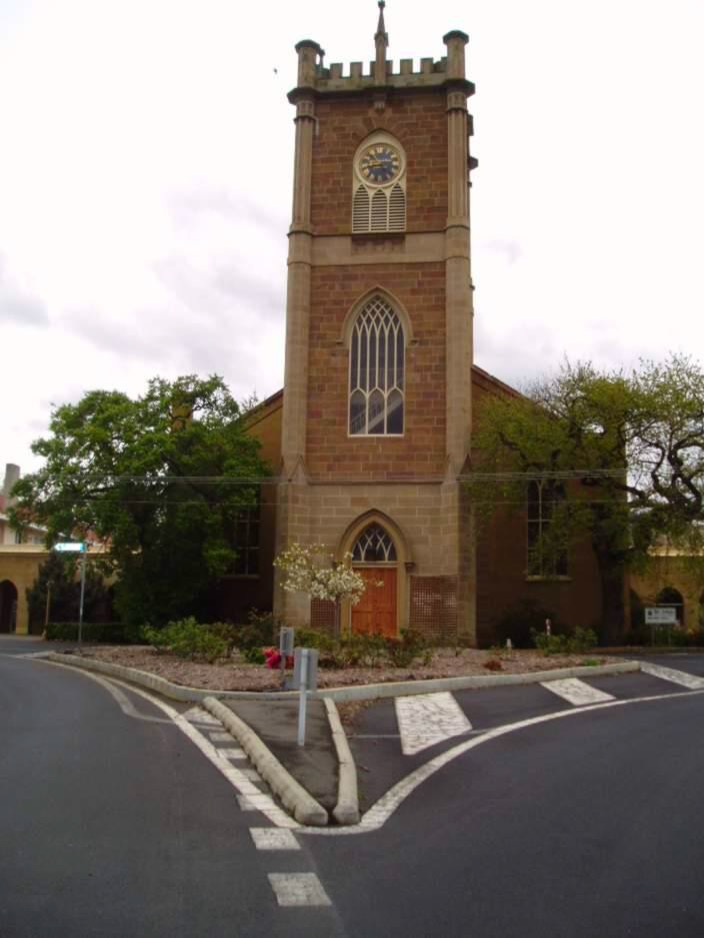
The interior (2014) of St John’s Anglican Church, New Town, which doubled as the chapel for the Orphan Schools. The gallery shown was used to accommodate the orphans, girls to the left of the monitors’ enclosure, boys to the right. Free settlers rented named and lockable pews on the ground floor (now replaced with standard movable pews facing the sanctuary).
Given several damning assessments of the incompetence of the orphan schools’ provision neither of physical care, nor of any stimulating curriculum or training, it is heartening that young John not only survived the time he spent there, but appears to have emerged ready to take his place in the world. From such unpromising parentage, and such inadequate schooling, he appears to have become a sober, hard-working young man with strong ethics and family values. His later service to his large family was augmented by a willingness to become involved in community affairs (when living at Winslow in Victoria), and the generation by the community of genuine respect and affection for the man.
Originally the Chapel for the orphan schools, this handsome building, designed by Colonial Architect John Lee Archer, and built with convict labour in 1835, is now St John’s Anglican Church, New Town – WITH heating.
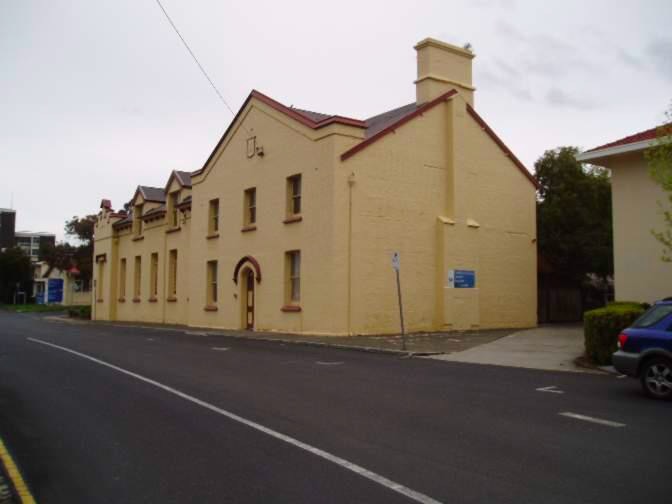
Boys’ section of the Queen’s Orphan Schools, where John survived 11 years from 1836 to 1847. Photographed in 2012, and externally largely unchanged, it then housed the “Meals on Wheels” organisation.
Joyce Purtscher further tells us:
“When children turned 14 years of age, they were apprenticed out. They had to work for no money until they were 18. They were at the mercy of their masters regarding food, clothing and housing”.
John was released from the orphanage on 26th August 1847, and apprenticed to Mrs Mary Cox, a remarkable woman who had operated several businesses in Launceston. Her late husband, John Edward Cox, was licensee initially of the Macquarie Hotel in Hobart, and later the Cornwall Hotel in Launceston, owned by John Batman – the co-founder of Melbourne. He also initiated Tasmania’s first coaching service between Launceston and Hobart, and fathered nine children, eight of whom survived. Upon his death in 1837, responsibility for management of family and businesses fell to his wife.
Assuming that, as outlined by Joyce Purtscher above, John was required to work for Mrs Cox without payment until he was 18 years old, by 1851 he would have been free to live and work where he pleased. We know from the 1848 Census that Mary Lindsay and William Higgs were then living together in Adelaide Street, Westbury (after marrying there in 1844), and Higgs had resumed his trade as a shoemaker. John probably joined them after leaving Mrs Cox. Surviving records do not tell us in what trade or capacity John was indentured, but it is possible that he learned the basics of shoemaking when at the Orphan School. Since on the title to his Westbury property later in the 1850s he is listed as a shoemaker, he evidently joined his stepfather in the trade, although this possibility has not been confirmed by searches for business registrations or commercial advertisements. But we know that at that time he adopted his stepfather’s surname, becoming known as John Lindsay Higgs.
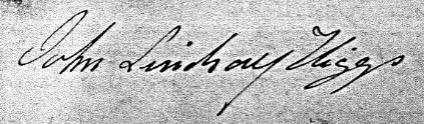
John’s signature on the title deed for 1 Reid Street, Westbury, which he sold on 28.5.1862
Under that name he married Charlotte Wells at Westbury on 3rd July 1857. Charlotte was the free-born daughter of former convicts Robert Wells and Margaret Casey. They married in her parents’ private home “according to the Rites and Ceremonies of the Wesleyan Church”. Although born of convict parents on 13th January 1839, Charlotte never suffered the horrors of the Queen’s Orphan School, having been raised by her parents in Longford and Launceston.
John appears to have been industrious and successful in his trade, since he managed to acquire property in Westbury, and ultimately to sustain a large family. It seems that the married couple lived on a block of land in what is now Reid Street, Westbury, purchased on John’s behalf by Higgs, where Charlotte gave birth to their first child – John – on 5th July 1858. In 1859, with Higgs subsiding into alcoholism, John acquired the nine-acre block owned by him on Suburb Road, Westbury, from the mortgagees to whom it had been surrendered. They continued to live at Reid Street, where Charlotte produced their second child – Alexander – on 28th October 1859. Their third child – Robert – was born on 5th May 1861.
John was devastated by his step-father’s suicide on 17th December, 1861. For reasons unknown, he shortly thereafter sold the Reid Street property and acquired a 160-acre rural block at Liffey Plains, near Westbury, from where we presume he continued his shoemaking business. He also deleted “Higgs” from his surname, reverting to “Lindsay”. In the absence of Title records, we must presume he sold the Liffey Plains property late in 1862, then embarked from Launceston with the family aboard the Western for Portland, Victoria, arriving there on 9th August 1862. It is possible that he sought to remove himself from the strong social stigma attaching to suicide at the time, and make a new start with his wife and family.
They settled at Winslow, a small town north of Warrnambool in Victoria’s Western District, where John probably established a shoemaking business in his own name, and from 1883 he and Charlotte assumed management of the local Post Office. Their family continued to grow and Charlotte produced 14 healthy children over a period of 28 years – the last when she was 48 years old – a quite remarkable achievement now, and even more so on the cusp of the 20th century.
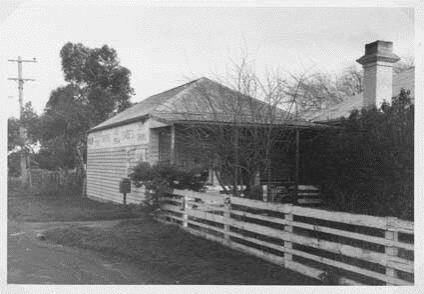
The Winslow Post Office and store, attached to the south east front corner of the house in which John, Charlotte and their family resided from 1893 to 1922.
John died on 20th November 1890, when drawing water from a freshwater lake about 100 metres from the back of the family home in Winslow. To reach the water, it was necessary to descend steps, from which newspaper accounts reported John slipped and fell. One of his daughters discovered his hat and coat floating on the surface, and raised the alarm. By the time help arrived, John could not be revived. His age was given as 56 years, though if his assumed birth-date of 1832 is correct, he would have been 58.
The sometime freshwater lake in which John drowned while drawing water for his family. The house is off to the left of this picture, about 100m away. Since that time, a tannery operated on the lake’s shore, and the water is now brackish.
So ended the last direct family connection to the redoubtable Mary Lindsay. The large family produced by John and Charlotte developed in ways that Mary as a Highland Traveller could never have imagined. John’s wife Charlotte lived until 7th January 1922, dying at Winslow from a cerebral haemorrhage and pneumonia, aged 83.
John Lindsay, wife Charlotte and infant daughter, Eliza rest at Tower Hill cemetery near Warrnambool.
*
Readers may also be interested in my book Condemned: The Men, Women and Children Who Built Britain’s Empire, which includes the Van Diemen’s Land experience, though not the King’s Orphanage story. My thanks to Bruce for bringing it to my attention and for allowing this part of his family history research to appear on Gristly History.
Large collections of bones and body parts lie in dark corners of Australian, American and European scientific institutions. They are the remains of First Nations people acquired during colonisation and shipped to medical establishments, private collectors and museums for preservation, study or exhibition. It is thought that 10 000 or more of these corpses or part corpses were sent to Britain alone and possibly thousands more to other countries.
This grisly catalogue, sometimes called ‘the first stolen generation’, was assembled during the nineteenth and mid-twentieth centuries by a puzzling assortment of individuals with a variety of motivations. Sometimes the impetus was money. Sometimes it was what is now seen as a misguided sense of contributing to the advancement of science. Always it was simple racial prejudice based on the flawed belief that Indigenous Australians were some sort of ‘missing link’ between modern and prehistoric humanity.
One of the most active body thieves was William Ramsay Smith, a Scottish doctor who became the coroner of South Australia in the 1890s. He gathered Indigenous remains from many sources, including asylums, prisons and elsewhere. Skeletons, heads and other body parts were sent to Ramsay Smith’s alma mater, Edinburgh University, where his friend, D J Cunningham, Professor of Anatomy, further desecrated them in the name of science.
When the body of a popular local Ngarrindjeri man known as ‘Tommy Smith’ ( Poltpalingada Booboorowie) disappeared while under Ramsay Smith’s control, an inquiry was established in 1903. Ramsay Smith, or someone under his authority, had filled Tommy’s coffin with sandbags. He had then dissected the body and sent the parts to Edinburgh.[i] Gruesome evidence was also given of heads kept in kerosene tins and of a going black market body snatching rate of ten pounds for a skeleton. Ramsay Smith was reprimanded but suffered no lasting damage to his reputation and continued as the state coroner. He also continued his close interest in First Nations bodies. When he died in 1937 more than a hundred human skulls were discovered at his house.
Ramsay Smith was only one of many bone collectors either trading or acquiring remains for what they usually claimed were scientific, medical or anthropological research. Beneath this delusion lurked the pernicious idea, derived largely from Charles Darwin’s theories on evolution, that European culture was the most developed and advanced ‘civilisation’ in the world. First Nations people were considered to be at the beginning of a hypothetical chain of evolution and so, went the scientific thinking of the time, should be closely studied. Researchers needed body parts to investigate and there was also a morbid curiosity among private collectors for examples of what they considered exotic lifestyles, including skins displaying customary markings, pieces of skeleton – one man’s skull was made into a sugar bowl – and, of course, heads. Full skeletons of adults and children were taken from graves and morgues, boxed up and despatched to waiting recipients across the seas.
Dark as these practices were, even more reprehensible parts of the Indigenous body trade depended on frontier violence. In April 1816, a group of Gandangara people was attacked by a military force at Appin, NSW. Fourteen or more men, women and children died, including the leader, Cannabayagal. According to an eyewitness, he and two other warriors were hanged from a tree. The soldiers then ‘cut off the heads and brought them to Sydney, where the Government paid 30s and a gallon of rum each for them.’[ii] When the National Museum of Australia received three repatriated skulls from the University of Edinburgh, one was that of Cannabayagal.[iii]
The unsanctioned removal of remains is a source of ongoing grief and trauma for First Nations communities. Many are anxious to have the remains of their ancestors returned so they can be given proper burials according to law and custom. Ongoing efforts to ensure that stolen body parts are returned to their country have had limited success. While the Australian government supports repatriation, some overseas institutions have been uncooperative in agreeing to returns. There are also practical difficulties in identifying remains and in deciding on the most appropriate way to honour them should they be returned to their First Nations descendants.
Here are some links to news stories about some recent repatriations:
In the seventeenth century, those unfortunate enough to be transported from Britain to the American colonies were sometimes sold to their colonial masters in exchange for cattle or corn. They were not slaves but the conditions in which they laboured were slave-like. Some fought back.
Will Downing and Phillip Welch were before the Salem Quarterly Court of June 26, 1661. They were there for ‘absolutely refusing to serve’ their master, Samuel Symonds, any longer. Seven years earlier, Symonds agreed to pay the master of the ship Goodfellow ‘26li.[pounds] in merchantable corn or live cattle’ due before the end of the following October for the two young men kidnapped from their beds in their own country. They were neither convicts or indentured servants and were almost certainly sold illegally into servitude. Nevertheless, Will and Phillip had worked their master’s fields ever since. And he insisted that he had paid good value for them to do so for nine years, not seven.
One Sunday evening in March 1661, Will and Phillip joined the Symonds family in the parlour for prayer, as usual. Before the family and their servants began to worship, Phillip declared to his master ‘We will worke with you, or for you, noe longer.’ Symonds sarcastically inquired if they were not working what would they do – ‘play?’
Phillip and Will stood their ground. They had served Symonds and his family for the seven years they believed to be their penance for simply being in the wrong place at the time Cromwell’s soldiers were scouring their area for victims. Symonds told them that they were obliged to work for him unless they ran away, a crime with severe punishment. They did not wish to flee; instead they pleaded ‘If you will free us, we will plant your corne, & mende your fences, & if you will pay us as other men, but we will not worke with you upon the same termes, or conditions as before.’
This must have been a memorable moment in the life of the family and its servants. All had been living and working cheek-by-jowl and praying regularly together for seven years. There was some talk about business difficulties as Symonds sought to make his servants see what he considered to be sense. His wife backed him up, saying this was not a good time to bring up the subject of money. But the young men remained adamant. When their master asked them to begin prayers together, they refused. Next morning Symonds summoned the local constable to his home, demanding that the rebellious servants be ‘secured.’ The constable wondered whether it was necessary for the men to be taken away, but Symonds insisted a warrant be served on them and that they should be paraded before the court. Which they duly were.
Now William and Phillip had a chance to state their case: ‘We were brought out of or owne Country, contrary to our owne wills & minds, & sold here unto Mr. Symonds, by ye master of the Ship, Mr. Dill, but what Agreement was made betweene Mr. Symonds & ye Said master, was neuer Acted by our Consent or knowledge, yet notwithstanding we haue indeauored to do him ye best seruice wee Could these seuen Compleat yeeres …’
William and Phillip considered they had already served their time, and more, because the usual practice of transport ship masters was to sell their stolen human cargoes in Barbados for only four years servitude. But now for seven years the two men had labored on Samuel Symonds’ ten acres of corn ‘And for our seruice, we haue noe Callings nor wages, but meat & Cloths.’
For his part, Symonds testified that he had made a bargain with the shipmaster and he had the ‘covenant’, or contract, to prove it. There was a supporting deposition from the shipmaster who said he had sold Symonds ‘two of the Irish youths I brought over by order of the State of England.’
Some other servants gave evidence. One man who had been kidnapped and transported with Will and Phillip described how they had all been rounded up against their will ‘weeping and Crying, because they were stollen from theyr frends.’ Some of Symonds’s own servants testified to the resentment of Phillip and Will against their situation and their determination to be free. Phillip reportedly said at one point that if Symonds would give him the same share of his estate as he would give his own children, then he would continue to serve.
The intensely personal nature of the relationships of master, family and servants in the Symonds household is clear in these testimonies. But the court, rightly or not, found the arrangement was legal and decreed that Will and Phillip should continue to serve until May 1663. An appeal was notified immediately but the two men agreed to work for Symonds until a date for the hearing could be set. He was bound to give them leave to attend.[i]
Whether this appeal was ever heard is not known. Possibly the full nine years were served before it could be and Will and Phillip were finally unbound. If so, they could then sell their labour in an open market and start the families they wished for in the New World.
[i] Salem Quarterly Court. Salem, Massachusetts. June 25, 1661. Records and Files of the Quarterly Courts of Essex County, Massachusetts, vol. II, 1656-1662, pp. 298ff at https://archive.org/stream/recordsandfiles00dowgoog#page/n307/mode/2up, accessed December 20, 2017. Welch’s proper forename was Phillip, as noted in the court records. Some references to these records claim that the youths were referred to as ‘slaves’ – they were not, see Jennie Jeppesen, ‘Within the protection of law’: debating the Australian convict-as-slave narrative’, History Australia, vol 16, issue 3, 2019, at https://www.tandfonline.com/eprint/TYGCVFDNDUFDAY5NSGNN/full?target=10.1080%2F14490854.2019.1636674&, accessed November 2019.
Irish stonemasons used a secret language known as bearlager na saor (also as Bearla lagair)., said to have come down from the great ancestor of masons, Goban Saor (variously spelt and pronounced gabawn seer). The mythic Goban Saor – Goban the builder – was, and is, the subject of a body of folktale traditions that present him as a clever and greatly skilled artisan who always outwits those who try to harm him or to refuse his rightful fee for work done. It was he who handed down the closely guarded skills of the stonemason, together with their confidential speech.
Towards the end of the nineteenth century, American word sleuths became aware of a curious language spoken by itinerant Irish workers, particularly stone masons. It was neither Old Irish, Gaelic or even Shelta, but seemed to have some similarities to all of these, as well as its own characteristics. One companion of itinerants, named A T Sinclair, inquired further into this among older Irish stone masons in Massachusetts and discovered that ‘On mentioning the subject to some old Irish masons here in Allston, I was surprised to find they could speak this language which they called “Bearla lagair na saor … a large number of other old Irishmen knew there was such a mason’s talk called ” Bearla lagair” ‘[1]
Sinclair’s informants told him this was a language known only to stonemasons and that no apprentice could claim his ‘indenture’, or trade qualification, without being able to speak it. Masons were forbidden to mention this speech to anyone who was not one of their guild, including their own families. The trade secrets also included special signs, skills and ways of using their tools, together with a variety of rules that must be followed and through which a mason could identify himself to another adept of the craft. Sinclair also collected stories about the Goban Saor, including this one which gives the origin of a famous stone mason’s mark:
Sometimes a love of adventure led the Goban Saor to wander incognito as a common workman. His renown as an architect and artistic sculptor was widespread. One simple story which amuses these workingmen is this. The Goban Saor once, in a foreign land, applied to the master- builder of a cathedral for work. ” What can you do? ” asked the master. “Try me and see,” was the laconic reply. Then the builder placed him in a work-shed alone by himself, and, pointing to a block of stone, said facetiously, “Carve from that a cat with two tails.” The shed was fastened at night, and the next morning Goban had disappeared. When the master unfastened the shed and looked in, he found that the block of stone had been most beautifully carved into a cat with two tails. With an exclamation of surprise, he ejaculated, “It was the Goban Saor himself! No other human being could do such superb work, or so quickly.”[2]
Sinclair gave a selection of Bearla lagair words, mostly those similar to the travellers’ language of Shelta, including:
Un twede dut na bini – do you speak Mason’s talk?
Minkur – low people
Shin – sing
Eolor – mortar
Glom -yell
Miar – devil, bad luck
Shihukh – whisky, with Sinclair’s comment ‘a large number of other words also’
Skrugal – throat
(NB – diacriticals removed here and throughout)
Bearla lagair was still being spoken by older Irish stonemasons resident in London during the 1970s and was reported to have been widely spoken among Cork stonemasons.[3]
In short, no one really knows exactly where this cryptolect comes from. But we do know that it existed as a secret language among Irish stonemasons and, perhaps, still does. The Stonemason’s Guild of St Stephen and St George maintains a ‘cosmopolitan’ version of Bearla lagaire developed around London and said to be a more sophisticated speech than the ‘argot used by rural rough masons’. The Guild says that the language, which they call ‘bine’, was regularly used in the UK and Ireland until the 1980s and that there are still stonemasons ‘who still hold and use the language today.’[4]
[3] Mudcat Café thread, ‘Goban Saor’, May and August 2002. See also Brian Cleeve, ‘The Secret Language’, Studies: An Irish Quarterly Review, Vol. 72, No. 287 (Autumn, 1983), pp. 252-262, 363.
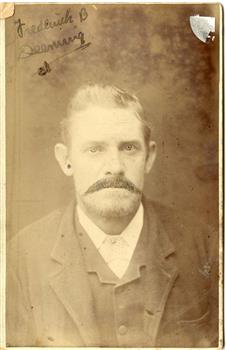
Frederick Deeming with a moustache drawn on the image in ink, Victoria Police Museum
Could he have been ‘Jack the Ripper? The remarkably evil life of Frederick Deeming is one of the most chilling stories of Australian, and global, crime. Even if he did not commit the Whitechapel murders of 1888, his known slayings make him one of the worst serial killers of the nineteenth century.
Beaten by his unstable father and imbued with fear of damnation by his God-obsessed mother, Frederick Bailey Deeming got off to a bad start in life almost as soon as he was born in Leicestershire, England in 1853. He was already known as ‘Mad Fred’ when he went to sea around the age of sixteen and soon became a cunning criminal. Fraud and false pretences were his favoured offences, though he also thieved from time to time.[i]
With an ability to turn on the charm and a persuasive way with words, the ruggedly handsome young sailor with blue eyes, fair hair and a ginger moustache had little trouble forming serious relationships with respectable women. In 1881 he married Marie James in England. By the middle of the next year he was in Sydney where he had jumped ship and started work as a plumber and gas fitter. By the time Marie arrived to join him he had already served a six-week sentence for stealing gas-burners. The couple would have four children over the next few years during which Deeming briefly ran his own plumbing business until he was declared bankrupt and serving two weeks for committing perjury. In January 1888 he turned up, alone, in Cape Town, South Africa where, using the alias Henry Lawson, he conducted several successful swindles.
Back in England in 1890, and still calling himself Henry Lawson, Deeming bigamously married Helen Matheson, using the proceeds of a fraud to pay for the wedding. Soon after, he had to quickly leave the country and escaped to Uruguay, South America. He was later arrested there, returned to England and given nine months in prison for fraud, though he avoided any charge of bigamy.
After release in 1891, Deeming took another alias, Albert Williams, and rented a house in Rainhill, Lancashire. By this time, his deserted wife and children had tracked him down and Marie revealed her husband’s bigamy to Helen. Apparently too embarrassed at the social stigma this would bring upon her, Helen did not inform the authorities. Deeming, now fearing what else Marie night reveal about him, made an elaborate pretence of reconciliation and convinced her and the children to join him at Rainhill. It was a fatal error.
Shortly after the reconciliation ‘Williams’, now posing as an army officer, married for a third time. The unlucky woman was Emily Mather who, after the expensive wedding, sailed with her new husband to India where he said he had a posting. But Deeming changed the arrangements and the newlyweds went to Melbourne instead. Here they rented a house in Windsor. Always ostentatious, even if mostly with other peoples’ money, the outwardly charming ‘Druin’, as Deeming was now styling himself, soon became well known in the suburb. But in January 1892, he and his third wife disappeared.
Now, a chain of events began that would lead to Deeming’s eventual downfall. The next tenant in the Windsor house complained of a foul smell in the premises. A hearthstone in the bedroom was pulled up to reveal Emily’s badly decomposed remains. She had been beaten around the head and her throat slashed. In the house police also found a copy of the invitation to the wedding banquet of A O Williams and Helen.
In a little over a week, the police tracked Deeming down to the Western Australian mining town of Southern Cross where he was calling himself Baron Swanston and posing as an engineer. After murdering Emily he had committed some further frauds and sailed to Sydney. There the apparently personable murderer soon convinced another young woman to become his fiancée. He then left for Western Australia, arranging with her to follow him when he was settled.
Deeming’s arrest ignited what would become a national and international press sensation. An English journalist used details from Australian sources to backtrack Deeming to his previous rented premises in Lancashire. The authorities there were prompted to investigate. Under the kitchen floor they found the bodies of Marie and the four children, all with their throats cut. The enormity of Deeming’s crimes was now apparent.
The press certainly thought so and went into one of the regular ‘feeding frenzies’ that have become all too familiar since. A kind of mass public hysteria arose, known as ‘Deemania’. The accused was called ‘a human tiger’ and his actions dubbed ‘the crime of the century’. He would also be described, inaccurately, as ‘ape-like’ and a forensic expert would later claim that his skull was similar to that of a gorilla.[ii]
Although entitled to the presumption of innocence, Deeming was effectively tried and found guilty in the newspapers of the English-speaking world. He was tried for the murder of Emily under the name of ‘Williams’. His defence, which included Alfred Deakin, destined to be an early Australian Prime Minister, argued that the accused had been denied a fair trial, which was probably true. Deeming was almost certainly an epileptic, having suffered from fits for much of his life. He may also have been a schizophrenic fantasist who actually became the identities he invented as he committed his crimes. But after an unwise address to the jury from the dock and some unconvincing psychiatric testimony, he was quickly found guilty and sentenced to death.
After being refused leave to appeal by the Privy Council, Edward Bailey Deeming, alias Albert Williams and at least four other pseudonyms, was hanged on 23 May 1892. Always a poser, he walked to the gallows smoking a cigar. His last words were reportedly ‘Lord, receive my spirit’. Outside the prison wall, twelve thousand people assembled to await the news that the monster was dead.
His death was celebrated in an English children’s street rhyme based on the then popular belief that Deeming was Jack the Ripper:
On the twenty-first of May, Frederick Deeming passed away; On the scaffold he did say — “Ta-ra-da-boom-di-ay!” “Ta-ra-da-boom-di-ay!” This is a happy day, An East End holiday, The Ripper’s gone away.[iii]
Deeming was undoubtedly guilty of the horrendous murders of his children and two wives, with the likely intent to kill another. But could he have been ‘Jack the Ripper?
In the overheated press speculations on the case, the fact that Deeming’s movements in 1888 were murky, together with the grisly nature of his crimes, led to speculation that he might have been the Whitechapel killer. Some credibility was attached to the claim when Deeming told fellow prisoners that he was the ripper and also expressed a murderous dislike of women. This was based on his venereal infection, probably of syphilis, contracted from a prostitute during his extensive travels. When directly questioned about this on the eve of his execution, deeming refused to confirm or deny the possibility.
But the theory has so many flaws that it is taken seriously by very few.[iv] A major problem is that Deeming’s murders bore little resemblance to the butchery of most of the Whitechapel victims. Nor were the women he killed prostitutes. Unlike the Whitechapel murderer, Deeming was not known to have taken trophies of his victims. Finally, wherever Deeming was during those bloody months of 1888 – probably South Africa – there is no evidence that he was anywhere near London, let alone the east end.
But there is no doubt that he slew Emily, the crime for which he eventually hanged, and that he also killed Marie and his children. He never confessed to any of these murders but while in prison during the lead up to his trial and as he awaited execution, Deeming wrote his autobiography, later destroyed, and poetry, which included the lines:
[iv] Over fifty books have been written about Deeming, often revolving around the unlikely belief that he was Jack the Ripper. See Worldcat Identities, ‘Deeming, Frederick Bailey 1853-1892, https://worldcat.org/identities/lccn-n2007021186/, accessed July 2022.
Ritratto di Giovanni Tolu eseguito a Sassari dal fotografo Averardo Lori e tratto dal libro di Enrico Costa del 1897
As a boy, the neo-Marxist philosopher and writer, Antonio Gramsci was fascinated by the tales he heard of Giovanni Tolu, the Sardinian bandit. Gramsci went on to a celebrated career, dying in a fascist prison in 1937. Amongst other things, he was an influential theorist of power. Tolu was one of the powerless. Little-known, today, his story is a classic example of the outlaw hero, or ‘social bandit’.
The lofty granite mountains of Sardinia, groves of olives and grapes, scrubland and forested pathways are impenetrable to those who do not know them. Steep valleys and chasms complete this lonely landscape, ideal for bandits. But it was the fractured politics and economic conditions of the island that for centuries made it a byword for bandits.
Giovanni Tolu’s (1822-1896) banditry began in 1850. He was a hard-working and respectable farmer who came into conflict with the local priest, a man named Pittui. Smitten by the priest’s maid, Maria Francesca Meloni Ru, Tolu eloped with her in 1850. Marriage and almost everything else was controlled by the church then and when Pittui found the couple, the pregnant Maria was dragged back to her parents’ home. Enraged and insulted, Tolu later attacked the priest in the street, beating him almost to death. This dire act initiated his thirty or-so year bandit career.
Despite beating up the priest, Tolu was deeply religious and superstitious. He used violence like a good social bandit should – only when necessary and to defend himself. Like many other bandits in Catholic cultures, he also claimed to have always sought divine guidance before murdering, as his biographer described:
‘One day he decided to murder a certain Salvatoro Moro. As I went to his house … I begged the Mother of God to enlighten me and to show me whether this man really deserved death. I also commended my soul to God in case I should be surprised and killed by my enemy’. Tolu apparently received the answer he sought: ‘After I had slain Moro I loaded my gun afresh, after which I said a ‘Hail Mary’ and prayed for the repose of the departed soul. In this way I learned that I had killed the body but not the soul of my enemy.’[1]
Tolu also murdered one of his accomplices who betrayed him. Despite these killings, he had the reputation of a good bandit. He was pursued for thirty years but managed to elude all those who came after him, killing several Carabinieri. He was later reunited with his and Maria’s grown-up daughter and lived a more or less respectable, and highly respected, life among a supportive regional community until his arrest in 1880. He was tried in a local court for murder but acquitted because he was acting in self-defence.
Shortly before his death, Tolu is said to have delivered his life story to the Sardinian lawyer and writer, Enrico Costa. As Costa tells it, he was sitting in his garden one sunny day when the then 74-year-old brigand appeared and handed him a manuscript, saying ‘I want … to give in this way a warning to my colleagues, a lesson to flighty young men and a word of advice as to the manner ln which the government should treat the poor people’.
Unlikely as this incident is – Tolu was illiterate – Costa turned his story into a book that was popular throughout Italy. Although much romanticised, there is no doubt that Tolu was considered a friend of the Sardinian poor and that they actively supported him in his bandit life. Tolu did not leave to see his life in book form, he died in 1896, the year before Costa’s book appeared[2] and became a popular hit in Italy.
The murderer’s knife seems to hang o’er their head,
This demon is hiding in a mysterious way,
Pray Heaven the villain is taken today.
These verses are from one of a number of street, or ‘broadside’, ballads produced about the Whitechapel murders, perpetrated by someone known only as ‘Jack the Ripper’.
When the Ripper first struck, London’s east end was already a byword for depravity and crime. From its origins and later development into a seething dockland and sailortown the district was rookery of sin which frequently proved everybody right about the bad things it was commonly said to spawn. But this was something especially grotesque.
Perhaps twenty minutes before 4am on 31 August 1888, a passing workman discovered the still warm body of ‘Polly’ Nichols in Buck’s Row, not far from Bethnal Green. It was a dreadful sight. Her head was almost severed by a savage slash through the throat and her abdomen was deeply gashed with a very sharp instrument. Her dress was pulled up to her waist, possibly related to her work as a prostitute. The attending surgeon noted a wine glass and a lot of blood in the gutter.
‘Polly’ was the street name of Mary Ann Nichols. She was forty-three years old, though looked ten years younger, and stood just over five feet tall with greying brown hair and grey eyes. An alcoholic, Polly was seen staggering drunk an hour earlier and spoke of her intention to find a client to pay for her night’s doss.
Eight days later, another dead prostitute was found. Annie Chapman has been sliced up much like Polly Nichols, but this time the killer had removed and taken away some internal organs. Alongside her right shoulder lay her small intestine. The uterus and part of the bladder had been removed. The mutilated remains lay in a yard in Hanbury Street and were discovered just before 6am. The attending surgeon thought the horrific wounds must have been inflicted by someone with ‘great anatomical knowledge’.
On 30 September, the remains of ‘Long Liz’ Stride and Catherine Eddowes are found. Swedish-born Stride, 45 years old, has her throat sliced open. She is not mutilated, unlike poor Catherine, whose body is not far away in Mitre Square. In her forties and just five feet tall, her intestines have been sliced out and placed over her right shoulder; the killer has taken a kidney for a souvenir, or worse, along with her uterus. Many of her other organs are also mutilated, including her lower eyelids. When the remains arrive at the mortuary, ‘A piece of deceased’s ear dropped from the clothing’.
These murders were committed in the streets, giving the killer little time to perform whatever dark urges drove him. The next one took place in a lodging house bed in Miller’s Court. With no one to disturb him the serial murderer now dubbed ‘Jack the Ripper’ thoroughly mutilated twenty-five-year-old Mary Kelly, scattering most of her body parts around her and on the bedside table. Both her breasts had been removed.
Several other women had been murdered in the Whitechapel area before Polly Nichols died. The circumstances of their deaths were not the same as those of the five women who are generally accepted as bona fide Ripper victims, but the press, the police and the public all speculated about a serial killer at work in the area. And there were other murders after the death of Mary Kelly, fueling a hysteria and a macabre mystery that persists to the present. These events were also featured in several street ballads.
The ballad business was in decline by now, finally bested by the superior technology and more effective distribution of newspapers and the sensational ‘penny blood’ magazines. But by the following year, if not long before, at least two Ripper ballads were being sold in Scotland, where a couple of gents were regaled by a ballad seller on his route to Inverness with no less than two classics of the genre. ‘The Demon Jack the Ripper’ focused on the fate of the last victim:
“The demon Jack the Ripper,
Has begun his work once more,
His hate for women is bitter,
He delights in human gore,
The last victim Mary Kelly,
But twenty-six year of age,
Has been served much worse by London’s curse,
You will say I will engage.
Chorus
The demon Jack the Ripper,
Is at work once more,
In Spitalfields Mary Kelly he killed
and left her in her gore.
The rough and ready verses gave a fair account of the state of Mary’s remains:
In the room where she was living.
Her naked body was found,
The Ripper no clue was giving
To those who lived around.
Her body was cut in pieces,
And portions taken away,
Her flesh ’tis shown stripped from her bones,
A terrible sight she lay.
There were some details of Mary’s Irish background and how she ‘fell into shame when to London she came’. Finally, the ballad voiced the question on every mind – when were the police – now considering the use of bloodhounds – going to catch the Ripper?
Where’s the noted bloodhounds,
That such wonders were to do,
That Jack the Ripper is not found
It must seem strange to you.
The authorities in London,
must adopt some more secret plan
Without bloodhounds to hunt him down
For he must be Satan and not a man.
The other song offered by the peddler was ‘The London Murderer’, a catalogue of the Ripper’s crimes and their instant notoriety:
This murderous history has spread thro’ the world.
Of all these poor women to Eternity hurled.
Again, the question why ‘the great men of our modern times’ ‘fail to discover these cowardly crimes’ and the fear in the streets:
Five millions of people cannot rest in their bed,
The murderer’s knife seems to hang o’er their head,
This demon is hiding in a mysterious way,
Pray Heaven the villain is taken today.
The world has ne’er known such cruelty before,
Not even abroad on some savage shore,
Tho’ for a time this monster may flee,
Burnt at the stake this fiend ought to be.
The ballad seller was rewarded with the sale of a shillings-worth of his stock, and a nice tip from his listeners.[1] His songs perfectly reflected the combined fascination with the grisly murders and the fear they produced in the streets of London and much further afield. And they probably helped it to multiply and spread.
[1] From The Inverness Courier, 15 February 1889. See also Paul Slade’s excellent Planet Slade site for more on murder ballads and much more besides at http://www.planetslade.com/index.html. Interestingly, Catherine Eddowes may have been involved with the street ballad trade herself in and around her hometown, see








 GRISTLY HISTORY