Another lost treasure legend. This one is a beauty, it has pirates, gore, a map and two generations of seekers:
More on proverbs in action today
OLD WISDOM
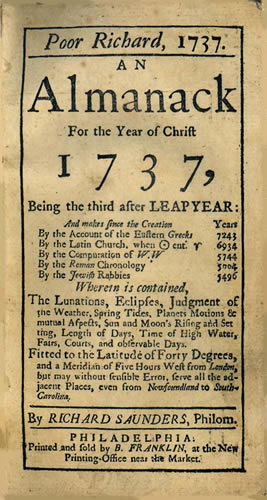 |
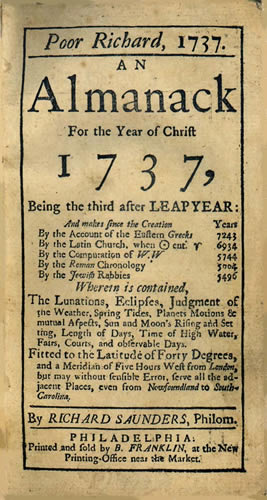
| One of Ben Franklin’s famous almanacs |
The humble proverb is a form of traditional wisdom and practical advice that has been around for centuries. Often described as ‘the wisdom of many’, proverbs are shared solutions to problems that beset most people most of the time which probably explains why cultures thousands of miles and thousands of years apart have developed remarkably similar proverbial wisdom about many of the same matters.
‘The root of all evil’ has not surprisingly, attracted many aphorisms and adages. Many of these counsel caution in financial dealings. The familiar ‘A fool and his money are soon parted’ is complemented by the Italian ‘Better give a penny than lend twenty’. Other money proverbs expound the wisdom that ‘Money is not everything’.
In fact, money is far from everything in many traditional philosophies, including the Persian, where it is said that ‘The larger a man’s roof the more snow it collects’. An old Greek proverb goes ‘A miser is ever in want’. The Japanese have a saying that indicates the virtues of poverty – ‘The poor sleep soundly’.
The need for caution and shrewdness in everyday life is the subject of much proverbial wisdom around the world. ‘Look before you leap’ is a venerable old saying known to many. Yet the same warning is echoed in the Nigerian saying ‘When the mouse laughs at the cat there is a hole nearby’. Many other societies have similar advice. ‘Do not rejoice at one who goes before you see the one who comes’, say the Japanese, while the Russians point out that ‘If you put your nose into the water you will also wet your cheeks’ (Russian).
‘Too many cooks spoil the broth’, goes the well-worn advice of the English proverb. The difficulty of getting agreement with more than one person and the likely consequences of this are also treated in the Turkish proverb ‘Two captains will sink the ship’. In Japan, the saying is even more concise – ‘Ten men, ten minds’.
Perhaps the largest number of international proverbs deal with the universal desire for contentment. The Spanish say ‘If you have a good harvest do not begrudge a few thistles’. The Chinese saying ‘A bird can perch on only one branch, a mouse can drink only its fill from the river’ has equivalents in many languages. In English there is the familiar ‘A bird in the hand is worth two in the bush’ and the lesser-known ‘a feather in the hand is better than a bird in the air’. The Greeks say ‘Nothing will content him who is not content with a little’.
The meaning of these proverbs of contentment is that it is better to have less of something that is certain than to have only the promise of something more. This is a powerful reminder that we should be satisfied with what we have now.
That ‘thief of time’, procrastination, is also a popular subject for proverbial pronouncement in many countries. ‘Don’t put off until tomorrow what you can do today’ is the message of the Yiddish ‘Tomorrow your horse may be lame’, of the Arabic ‘Today it may be fire, tomorrow it may be ashes’ and of the dryly perceptive French saying, ‘Life is made up of tomorrows’.
The ‘better part of valour’, discretion, is not exclusive to English-language proverbs like ‘Let sleeping dogs lie’. Indians say ‘Be first at the feast and last at the fight’ while the Japanese wisely advise us ‘not to rejoice at one who goes before you see the one who comes’. The Greeks have many proverbs on discretion and caution, including ‘Add not fire to fire’ and ‘A word out of season may mar a whole lifetime.’
Most universal and profound of all emotions – and so the source of innumerable problems – is love. ‘Never love with all your heart, it will only end by breaking’ runs one true saying. The course of love never runs smooth in anyone’s language, but there are proverbs in many to ease the pain a little. ‘Try to reason about love and you will lose your reason’, say the French. In Spain ‘love is like war – begin when you like and finish when you can’.
Other cultures have even more down-to-earth advice for the lovelorn. In Sweden they suggest you ‘Choose your bedfellow while it is daylight’ , while ‘Love is sweet but tastes best with bread’, according to the Yiddish proverb. Given their reputation for ‘amour’, we should let the French have the last word on this subject: Love’s pleasure lasts a moment, love’s pain lasts a lifetime.’
There are not too many aspects of human life and frailty that have not been treated in proverbs somewhere, sometime. There is much to be gained from the traditional wisdom of different lands. ‘Anger without power is folly’, say the Germans. ‘Never cut what can be untied’ warn the Portuguese. ‘An indispensable thing never has much value’, according to Russian tradition. ‘Vows made in storms are forgotten in calms’ say the French of good intentions.
Are they simply a form of folk consolation for the inequities of all political and social systems and the impact of bad luck? Probably. But the message of proverbs is an affirming one for those without the power to change things:
· the secrets of a happy life are simple
· keep business and personal affairs in proportion
· be moderate in fulfilling needs and desires
· treat others as you would wish to be treated yourself
· Above all, be content with what you have if that is enough for your essential needs.
As the great American philosopher and purveyor of the proverb, Benjamin Franklin (1706-90), put it: ‘If you desire many things, many things will seem but a few’.
HISTORY’S FIRST GRUMPY OLD MAN
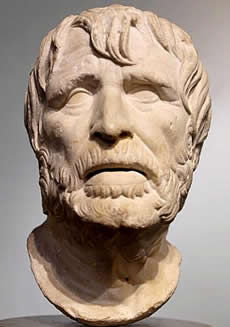 |
| Traditional representation of Hesiod as a blind bard |
He was history’s first grumpy old man. He complains, boasts, offers gratuitous advice and is a complete misogynist. His name was Hesiod and he lived over two and half thousand years ago in Ancient Greece.
Probably. No one really knows if he existed. Like Homer, a close contemporary, Hesiod might not be a real human being at all, just a convenient pen name for a poet, mythologist, farmer and irritating smart arse.
Whether there was a real Hesiod or not, his words speak directly to us from the deep past in surprisingly modern modes. He tells us very clearly what he likes (not a lot) and what he doesn’t like (a lot more). Women are a big problem for him:
Do not let a flaunting woman coax and cozen and deceive you: she is after your barn. The man who trusts womankind trust deceivers.
He gives us a few selected slices of his life and lineage to make points about others and much better ones about himself.
Then I crossed over to Chalcis, to the games of wise Amphidamas where the sons of the great-hearted hero proclaimed and appointed prizes. And there I boast that I gained the victory with a song and carried off an handled tripod which I dedicated to the Muses of Helicon, in the place where they first set me in the way of clear song . . . for the Muses have taught me to sing in marvellous song.
In some senses, Hesiod’s Works and Days is the first self-help book. He is certainly keen to point out to his brother Perses the many errors of his ways and to provide other advice to all and sundry about how to live their lives. Here he is on the wayward Perses who, among other sins, Hesiod accuses of stealing a part of their father’s inheritance:
Perses, lay up these things in your heart, and do not let that Strife who delights in mischief hold your heart back from work, while you peep and peer and listen to the wrangles of the court-house. Little concern has he with quarrels and courts who has not a year’s victuals laid up betimes, even that which the earth bears, Demeter’s grain. When you have got plenty of that, you can raise disputes and strive to get another’s goods. But you shall have no second chance to deal so again: nay, let us settle our dispute here with true judgement which is of Zeus and is perfect. For we had already divided our inheritance, but you seized the greater share and carried it off, greatly swelling the glory of our bribe-swallowing lords who love to judge such a cause as this. Fools! They know not how much more the half is than the whole, nor what great advantage there is in mallow and asphodel.
While the feckless Perses is the focus of much of Hesiod’s ire, he is not shy of telling everyone else what to do, or not. He hands out surely unneeded advice about where to go to the toilet:
Never make water in the mouths of rivers which flow to the sea, nor yet in springs; but be careful to avoid this. And do not ease yourself in them: it is not well to do this.
Hesiod also had his own take on the gods and heroes of Greek mythology. So did everyone else, of course. Mythology is full of variants of variants of the same stories. What distinguishes Hesiod though is that he links his myths with a theory of historical evolution. It’s a pretty bleak philosophy, but that’s in character for the gloomy poet.
According to Hesiod there have been five ages or generations of human history. The first is the age of ‘a golden race of mortal men’ crated by the gods of Olympus.
… they lived like gods without sorrow of heart, remote and free from toil and grief: miserable age rested not on them; but with legs and arms never failing they made merry with feasting beyond the reach of all evils. When they died, it was as though they were overcome with sleep, and they had all good things; for the fruitful earth unforced bare them fruit abundantly and without stint. They dwelt in ease and peace upon their lands with many good things, rich in flocks and loved by the blessed gods.
But the next generation was of silver and much less noble:’
It was like the golden race neither in body nor in spirit. A child was brought up at his good mother’s side an hundred years, an utter simpleton, playing childishly in his own home. But when they were full grown and were come to the full measure of their prime, they lived only a little time in sorrow because of their foolishness, for they could not keep from sinning and from wronging one another, nor would they serve the immortals, nor sacrifice on the holy altars of the blessed ones as it is right for men to do wherever they dwell. Then Zeus the son of Cronos was angry and put them away, because they would not give honour to the blessed gods who live on Olympus.
The third generation were:
… a brazen race, sprung from ash-trees and it was in no way equal to the silver age, but was terrible and strong. They loved the lamentable works of Ares and deeds of violence; they ate no bread, but were hard of heart like adamant, fearful men. Great was their strength and unconquerable the arms which grew from their shoulders on their strong limbs. Their armour was of bronze, and their houses of bronze, and of bronze were their implements: there was no black iron. These were destroyed by their own hands and passed to the dank house of chill Hades, and left no name: terrible though they were, black Death seized them, and they left the bright light of the sun.
After the passing of this generation Cronos, son of Zeus, made another
… which was nobler and more righteous, a god-like race of hero-men who are called demi-gods, the race before our own, throughout the boundless earth. Grim war and dread battle destroyed a part of them, some in the land of Cadmus at seven- gated Thebe when they fought for the flocks of Oedipus, and some, when it had brought them in ships over the great sea gulf to Troy for rich-haired Helen’s sake: there death’s end enshrouded a part of them. But to the others father Zeus the son of Cronos gave a living and an abode apart from men, and made them dwell at the ends of earth. And they live untouched by sorrow in the islands of the blessed along the shore of deep swirling Ocean, happy heroes for whom the grain-giving earth bears honey-sweet fruit flourishing thrice a year, far from the deathless gods, and Cronos rules over them; for the father of men and gods released him from his bonds. And these last equally have honour and glory.
After the passing of the fourth generation, Zeus made a fifth, ‘of men who are upon the bounteous earth.’ Hesiod is not happy to be among this generation and waxes apocalyptic:
… would that I were not among the men of the fifth generation, but either had died before or been born afterwards. For now truly is a race of iron, and men never rest from labour and sorrow by day, and from perishing by night; and the gods shall lay sore trouble upon them. But, notwithstanding, even these shall have some good mingled with their evils. And Zeus will destroy this race of mortal men also when they come to have grey hair on the temples at their birth. The father will not agree with his children, nor the children with their father, nor guest with his host, nor comrade with comrade; nor will brother be dear to brother as aforetime. Men will dishonour their parents as they grow quickly old, and will carp at them, chiding them with bitter words, hard-hearted they, not knowing the fear of the gods. They will not repay their aged parents the cost their nurture, for might shall be their right: and one man will sack another’s city. There will be no favour for the man who keeps his oath or for the just or for the good; but rather men will praise the evil-doer and his violent dealing. Strength will be right and reverence will cease to be; and the wicked will hurt the worthy man, speaking false words against him, and will swear an oath upon them. Envy, foul-mouthed, delighting in evil, with scowling face, will go along with wretched men one and all. And then Aidos and Nemesis, with their sweet forms wrapped in white robes, will go from the wide-pathed earth and forsake mankind to join the company of the deathless gods: and bitter sorrows will be left for mortal men, and there will be no help against evil.
Hesiod doesn’t say if he thinks there are any more ages to come. But going by his progression from gold, silver, bronze, the heroes of Troy and down to his own era of iron and misery, if there are they won’t be a whole lot of fun.
Despite his dismal view of almost everything, Hesiod seems to know how to enjoy himself. When the seasons turn warm again and the grasshopper sings:
… then goats are plumpest and wine sweetest; women are most wanton, but men are feeblest, because Sirius parches head and knees and the skin is dry through heat. But at that time let me have a shady rock and wine of Biblis, a clot of curds and milk of drained goats with the flesh of an heifer fed in the woods, that has never calved, and of firstling kids; then also let me drink bright wine, sitting in the shade, when my heart is satisfied with food, and so, turning my head to face the fresh Zephyr, from the everflowing spring which pours down unfouled thrice pour an offering of water, but make a fourth libation of wine.
In the end, the most important thing about Hesiod is his humanity. We clearly see his foibles and flaws, his prejudices, his blind spots and his intelligence. He is just like all of us – past, present and, hopefully, future.
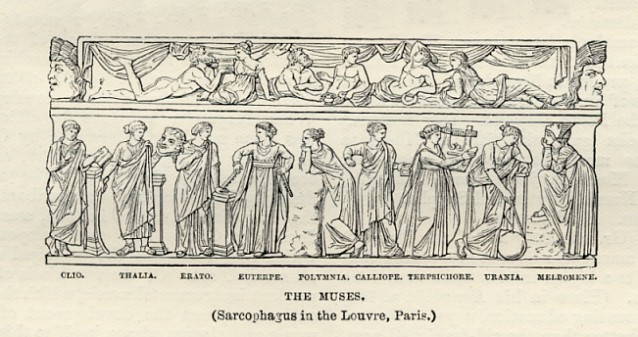 |
| The Muses |
Translations by Hugh G. Evelyn-White (1914) at Sacred Texts
FRUMMAGEMMED, NOOZED AND SCRAGGED – THE LANGUAGE OF EXECUTION
 |
| The Tyburn Tree – the permanent gallows at Tyburn, which stood where Marble Arch now stands, about 1680 |
These evocative words all described execution by hanging, the frequent fate of the Elizabethan and Jacobean criminal. There were many other terms describing the same mode of exit, including to be tucked up, stretched and crapped, an indication that a criminal career in these times was likely to be short. But at least the victim went out in a blaze of glory, celebrated in excited gossip and street ballads like this canting song published in 1676:
But when we come to TyburnFor going upon the budge,There stands Jack Catch, that son of a whore,That owes us all a grudge.And when that he hath noosed us,And our friends tip him no cole,Oh then he throws us in the cartAnd tumbles us in to the hole.
The budge was stealing, or more generally any kind of criminal activity. Jack Catchis a variation of Jack Ketch, the generic name for the hangman and tipping him no cole refers to the friends of the condemned failing to bribe the hangman. The hole was the drop into eternity.
Public executions were a major form of entertainment in the seventeenth and eighteenth centuries. Known as Tyburn Fair or The Hanging Match, the day was often a ribald and intoxicated spectacle of death in which the sufferer was expected to play his, or sometimes her role, along with the topsman and the screeching mobcome to see the show. The executed would take the condemned procession to Tyburn or another tree by way of taverns for the traditional parting cup. Not surprisingly this final quaff often became another, then another, and many reportedly went to meet their maker in a state of inebriation.
Regardless of their sobriety they were expected to die game like a fighting cock and preferably to give a flowery and defiant final speech before being turned offto dance the Tyburn jig. The famous highwayman Dick Turpin played his role well, according to a contemporary report of 1739, behaving:
…in an undaunted Manner; as he mounted the ladder, feeling his right Leg tremble, he stamp’d it down, and looking round about him with an unconcerned Air, he spoke a few Words to the Topsman, then threw himself off, and expir’d in five Minutes.
Turpin was unrepentant and bold, an important factor in his status as a proper man, the term of approbation given by the crowd to those who died well. But many other malefactors chose to give dying speeches of repentance and cautioned others not to do as they had done. Early in the sixteenth century, if not before, the phrase to preach at Tyburnwas a widespread euphemism for being hanged. The opposite of dying well was dying dunghill, a term also derived from the language of the brutal custom of the cockfight in which a dunghill cock was one that would not fight.
But whether defiant or repentant, many others turned in notable final performances. And if, through alcohol or fear, they failed their final act, then the street literature and broadside publishers of the day had their final words already printed and ready for sale in the form of their last confessions and feisty ballads about their real and mostly imagined doings.
This ritual had its own elaborate street language. In a cart, the condemned was brought up to the gallows, known by many names such as the trining cheats or derrick. The hangman placed the rope halter or Tyburn tippet around the malefactor’s neck and the cart was driven out from beneath, leaving the condemned to swing at the end of the rope to dance the Paddington frisk or the hempen jig. Death was effectively by strangulation and often had to be assisted by relatives and friends either pulling down on the feet of the condemned or throwing heavy rocks at his chest to hasten the end. When the sufferer was done, the hangman cut down the body, often selling it to the surgeons keen to practice their anatomical skills. Occasionally the execution was so ineptly managed that the condemned, if removed quickly enough from the noose, might be brought back to life by friends administering whacks and alcohol in a local pub.
Another of the terms that evolved within this spectacle of death included nub, meaning to be hung. It had a number of variations, including nubbing cheat, as in one who escapes the gallows. This was in use from at least 1676 and was still spoken by convicts transported to Australia up to the middle of the nineteenth century. Other uses of the term were a nubbing ken, meaning the courthouse where the sentence of death was pronounced and the nubbing cove who was, naturally enough, the hangman.
Jack Ketch (also Catch) was still being publicly employed in the Victorian era until legislation of 1868 put an end to public executions. Before then a hanging match might attract tens of thousands of spectators who, even if a little better behaved than their earlier counterparts, still revelled in an air of festivity and anticipation. Food, drink and the still popular last lamentationsof the condemned were hawked through the crowds. These ballads and verses seem to have been even more profitable in the later era than previously. According to one ballad seller interviewed by Henry Mayhew in the mid-nineteenth century, the earlier practice of ‘sentence o’ Friday and scragging o’ Monday’ had not left the hacks and the printers enough time to supply the ready market. In the more enlightened practice of allowing a week or more between sentence and suffering, there was plenty of opportunity to churn out the required souvenirs for the enthusiastic crowds.
Among the keenest attendees of executions were criminals themselves. Public hangings were events where pickpockets filled their pockets from those of the gawpers. Large numbers of harlots, cadgers, thieves and youthful miscreants jostled their way to the front of the crowd in order to be as close to the gallows as possible. The attraction of public execution for those on the slippery slope of serious crime led many to conclude that these festivals of death had little or no deterrent effect. In response to this perception and the increasing distaste for the savagery of public executions, the gallows were eventually moved inside prison walls. Crime, of course, continued nevertheless.

THE LOST COLONY OF ROANOKE
 |
|
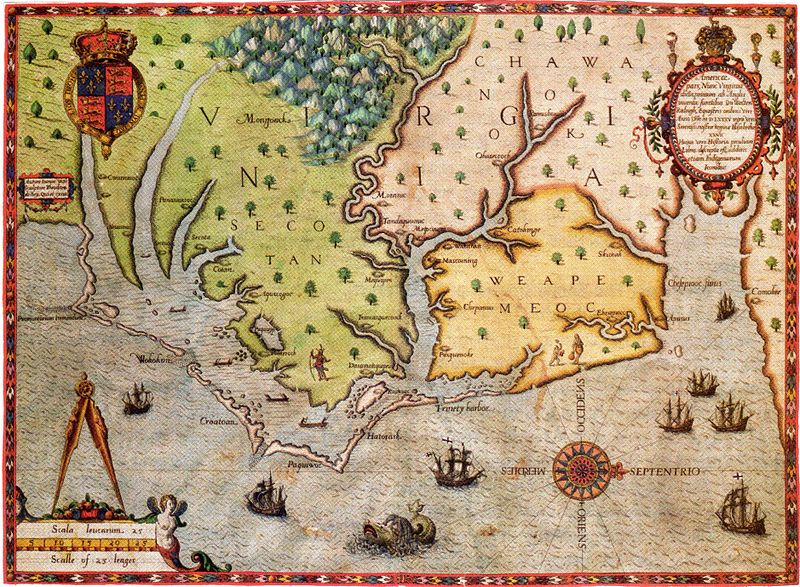
“The Carte of All the Coast of Virginia,” engraved by Theodor de Bry based on John White’s own map, published in Thomas Hariot’s A Briefe and True Report of the New Found Land of Virginia, 1588.
|
In 1584 Sir Walter Raleigh sent an expedition to the east coast of North America. The expedition landed on Roanoke Island in what is now the state of North Carolina. Good relations were established with the indigenous inhabitants, the Croatans, two of whom accompanied the expedition back to England to meet Raleigh and to describe their country and its ways. Next year a fleet of ships under the command of Sir Richard Grenville established a settlement on the island.
Despite the positive start made with intercultural relations through the initial expedition, the colonists and local people soon fell into violence, much as they would in the Southland. Grenville left for England, leaving a 108 men to establish the colony, promising to come back with reinforcements and desperately needed food by the following April. He did not return and the colonists were forced to defend themselves from indigenous attack. Fortunately, Sir Francis Drake called in at the colony on his return journey from plundering the Spanish in the Caribbean. He took them back to England. Grenville’s relief party finally arrived at Roanoke soon after, only to find an abandoned settlement. He left a small group on the island and sailed back to England.
When the next group of colonists sent by Raleigh arrived at Roanoke they found only a single skeleton. It was one of the men Grenville left there the previous year. Under the command of John White, the new colonists decided to return to England but the master of their ship refused to take them home. White’s group now had to try to re-establish the colony and to mend relations with the local inhabitants. These attempts were a failure. Late in the year of 1857, White sailed to England for help, leaving around 115 men, women and children to await rescue.
White tried to get back to Roanoke but was prevented by the difficulty of obtaining vessels as all sizeable craft had been commandeered to fight the Spanish Armada. When he did manage to find and supply two small boats, the Spanish stole their cargoes and he was forced to return to England. White was not able to get back to Roanoke until August 1590. The colony was deserted. The buildings had been dismantled and there was no evidence of fighting or violence. They found the word ‘Croatoan’ carved into a post and ‘Cro’ cut into a tree. There was no sign of the prearranged signal of distress, a Maltese Cross. White concluded that the colonists had simply moved to a neighbouring island, then known as ‘Croatoan Island.’ A storm prevented him visiting the island immediately. The tempest finally blew itself out but unaccountably, White did not visit the island and instead sailed away. Ever since, the fate of the Roanoke colonists has mystified and intrigued generations of researchers. The many speculations about Roanoke have echoes in the legends of the Southland.
One of the most persistent and likely theories is that at least some of the Roanoke colonists made alliances of convenience with one or more of the local Native American groups. As well as repelling newcomers, many of these groups were in a state of more or less continual warfare. There is evidence of cohabitation including sightings of Europeans living with Native American groups. The most compelling of these stories is that of four English men, two boys and a young woman living and working for a local chief. The story was that the colony had been attacked but they had escaped into the wilderness, eventually to become virtual slaves.
There are also well-documented accounts of Native Americans with English ancestry. As early as 1709, the Croatoans were acknowledging English ancestry:
A farther Confirmation of this we have from the Hatteras Indians, who either then lived on Roanoke-Island, or much frequented it. These tell us, that several of their Ancestors were white People, and could talk in a Book, as we do; the Truth of which is confirmed by gray Eyes being found frequently amongst these Indians, and no others. They value themselves extremely for their Affinity to the English, and are ready to do them all friendly Offices.
There are many other colonial accounts of grey-eyed or blue-eyed Native Americans with fair hair as well as related legendary traditions and linguistic evidence of the integration of Roanoke colonists with Native Americans. But just how this happened continues to excite a variety of theories. One is that the colonists did indeed move from Roanoke but were subsequently massacred. Another is that they escaped on a small ship that White had left behind but were all drowned at sea.
Archaeological surveys of the area have uncovered the usual miscellany of enigmatic artefacts. A map of the colony made by John White in 1585 and known as the ‘Virginia Pars Map’ has revealed some new evidence. Researchers have recently re-examined it and found obscured beneath a paper patch repair, the site of what could be another fort built by the colonists. Investigations into this possibility are proceeding, along with a project to confirm if the Roanoke colonists did merge into the local Native American groups.
This is an early example of the genesis and spread of an ‘urban’ or contemporary legend. The initial concept of a lost white tribe is well established in European culture. The unknown nature of the great south land and events related to it provided the ideal seed bed for the genesis of the fiction that Maslen, or someone else, kicked off in 1834. Subsequent ostensibly accurate details were added as the story moved through the nineteenth century press and from mouth to mouth along the channels of hearsay and speculation. By the time the story reaches modern times, it has also gained apparent credibility simply by being ‘old.’
Researchers interested in the lost white colony have assiduously garnered apparently supporting evidence from various places and the well-spun narrative we now have starts to look almost convincing at first glance. But, as with urban legends, despite the insistence of their tellers on their veracity, investigation rarely turns up credible evidence for their existence. The persistence of such stories – despite the evidence against them – tells us a good deal about the human need for a good yarn, one that appears to explain and sometimes vindicate mysteries, fill information voids or perhaps even provide some cultural vindication for colonisation.
SOURCES:
John Lawson, A New Voyage to Carolina, London, 1709.
Giles Milton Big Chief Elizabeth: The Adventures and Fate of the First English Colonists in America, Hodder & Stoughton, London, 2000.
The Lost Colony Centre for Science and Research for connections to the extensive popular and academic research interest in Roanoke.
National Geographic December 2013 at http://news.nationalgeographic.com.au/news/2013/12/131208-roanoke-lost-colony-discovery-history-raleigh/
 |
|
‘The towne of Pomeiock’ by John White (British Museum).
|
THE LAST GREAT ACT OF DEFIANCE – A BRIEF HISTORY OF WORKPLACE HUMOUR

It sure is!
The history and folklore of the workplace is long and often unhappy, as the crude cartoon above strongly suggests. But one aspect of working life that has remained constant is the need to laugh off the impositions and aggravations of earning a crust. From the inanities of the ‘system’ to the bastardries of ‘the boss’, workplace humourists have always found ways to lighten things up – though not in ways necessarily appreciated by the management.
Since the industrial revolution delivered the typewriter we have found creative ways to satirise, criticize and take the piss out of work through fake forms, satirical memos, cartoons and a host of other send ups that have brought a smile to the harried faces of employees everywhere.
This form of covert humour was well developed by World War 1, and continued to evolve. When photocopier or Xerox technology came into general use from the 1950s this way of getting back at the boss exploded with the ability to quickly and surreptitiously make as many copies as required for distribution to fellow sufferers and posting on tea room notice boards. The facsimile machine, or ‘fax’ that came towards the end of the 20th century allowed you to send these mirthful missives far and wide. ‘The Problem-Solving Flow Chart ‘was a firm favourite (and still is in one form or another):

Then, as now, stress was a feature of the workplace:

The development of the World Wide Web from the late 20th century into the present has opened up vast new possibilities for creating, recreating and distributing items like this:

Or maybe this one:

This kind of humour is perhaps best understood as laughter that bites – usually to the discomfort of someone else. It operates through transgression, satire, parody, even cruelty. It is the voice, pen or computer of the workaday underdog biting back at the system that controls many waking hours. Most of us have to work for a living, but we don’t have to like it!

And finally, in a modern take on Aesop, proof positive of what you long suspected:
When God made man all the parts of the body argued over who would be the BOSS.
The BRAIN explained that since he controlled all the parts of the body, he should be the BOSS.
The LEGS argued that since they took the body wherever it wanted to go, they should be the BOSS.
The STOMACH countered with the explanation that since it digested all the food, it should be BOSS.
The EYES said that without them, the body would be helpless, so they should be BOSS.
Then the ARSEHOLE applied for the job.
Then other parts of the body laughed so hard that the arsehole got mad and closed up.
After a few days the BRAIN went foggy, the LEGS got wobbly, the STOMACH got ill and the EYES got crossed and unable to see.
They all conceded defeat and made the ARSEHOLE the BOSS.
This proves that you don’t have to be a brain to be a BOSS …
JUST AN ARSEHOLE.
BUT THE TOWN STRIKES IT RICH …
Walbrzych, centre ofthe Nazi gold train hunt, is very pleased with the results
NO NAZI GOLD …
Latest dig in Poland again strikes – nothing. But gold hunters will keep trying. Watch this space.
PIED PIPER STILL PIPING
 |
| From a window of the Market Church in Hameln/Hamelin Germany (c.1300-1633), thought to be the earliest representation of the legend. |
A well-known story of German, and now global, tradition is a constant reminder of what might happen if a helper is not properly rewarded for his assistance. The Pied Piper of Hamelin is the ambivalent focus of an enduring medieval legend. In 1284 the town of Hamelin in Saxony is disturbed by a plague of rats. The piper, dressed in motley, hence the term ‘pied’, pipes the rats into the River Weser where they drown. But the people of the town refuse to pay him and so he pipes their children inside Koppenberg Hill, from where they have never emerged. Only one lame child, too slow to keep up with the others, survived.
This is the most familiar version of this enigmatic legend today, though its original form, as far as can be known, was a little different. One of the earliest and most significant accounts of the event is the fourteenth century version appearing in the Latin chronicle Catena Aurea (The Golden Chain) and written by a monk known as Heinrich of Hereford. This account has nothing about a plague of rats but simply tells of a handsome and well-dressed young man appearing in the city on the Feast of Saints John and Paul (26 June). He went through the streets playing a magnificent silver pipe, attracting about 130 children to follow him out of the city to the execution ground known as Calvary. There they all vanished without trace. Heinrich gives an earlier written source for this information and also refers to the testimony of an eye-witness relayed to him through the witnesses’ son.
As well as the absence of the rats and the reluctance of the townspeople to pay the piper’s fee, there is nothing ‘pied’ about the piper in Heinrich’s version of events, and no children returned. By the mid-1550s, though, an account written in Bamberg elaborated the story with such details as the threat of the piper to return in three hundred years and take more children away and the return of two naked children, one blind and one mute. Another account from around the same period identifies the piper as the devil and the fate of the children a result of God’s retribution for human sin. The return of the one lame child seems to appear first in the English translation made by Richard Verstegan in 1605.
The detail of the rat plague is first heard of in the Swabian Zimmer Chronicle of 1565. However, it is known that by this time there were other legends involving rat and mouse-catchers attached to other parts of Europe and it may be that these became mixed with the basic Hamelin story. By whatever and various ways the story evolved, it was already a popular item of print entertainment by the early seventeenth century and, in one version or another, continued to attract the interest of poets like Robert Browning (‘The Pied Piper of Hamelin’, 1842) and of folklorists like the Brothers Grimm as well as carrying on a busy life in oral tradition, including a number of German folksongs.
This disturbing legend has attracted a good deal of scholarly speculation through the succeeding centuries. Some suggest the legend is derived from the eastward migrations of young Germanic peoples during the thirteenth century. Others relate the story to the disastrous Children’s Crusade in which many children left their homes, never to return. There are also suggestions that the story is related to the medieval dance epidemic known as ‘St John’s Dance’ or ‘St Vitus’ Dance’ or to a major bubonic plague outbreak. Others have looked to mythological and historical sources for enlightenment and explanation.
Whatever its source, the tale has been continually in oral tradition and, later, in literature, theatre, children’s books, advertising, cartoons, political propaganda, films and, of course, in the tourism industry of the city of Hamelin. The many-faceted legend of the Pied Piper is largely due to the ambiguity of the piper’s character, both good and evil, and the ingratitude and stupidity of the burghers of Weser. As well as all the other many uses to which the tradition has been put, in the end it is perhaps primarily an appealing moral tale about just rewards (‘you must pay the piper’s fee’) and being careful about which processions you follow.
From Graham Seal and Kim Kennedy-White, Folk Heroes and Heroines Around the World

