PRIMAL EVIL


The ancient fear of what dwells without is invoked in this ballad, together with the dread of home invasion. Horrifyingly, the fear turns into reality as the bog-dwelling Lankin and the treacherous nurse combine to harm those inside the castle.
Beware.
*
Long Lankin, the stonemason, builds Lord Wearie’s castle high and strong. But when Lankin asks the Lord for the payment due, Wearie will not give him money.
‘I have nothing for you’, he says, ‘unless I sell my lands, and that I will never do.’
‘You will rue the day you did not pay my fee’, threatens Lankin darkly as he shuffles off to his home in the moss bog.
The next day, Lord Wearie leaves for London, trusting his lady and newborn son to the safety of his fine stone castle and the care of a nurse and the maid. As he mounts his horse, he tells his Lady: ‘Beware of Long Lankin that lives in the moss.’ He gives instructions to bolt the doors and pin the windows ‘And leave not a hole for a mouse to creep in.’ Then he kisses his fair lady and rides away, content that his house is protected from evil.
But it is not. The mason has built one little window into an out-of-the-way part of the castle, so small that everyone has forgotten it is there. But not Lankin. And not the false nurse, who was secretly in league with the mason. She makes sure the shutters on the window are unbolted. That night, Lankin creeps up close to the dark castle walls. The window is just large enough for him to slither through. Once inside the castle he speaks with the ‘false nurse’.
‘Where’s the Lord of this house?
The nurse tells him that the Lord is away in London.
‘Where’s the Lady of this house?’ he demands.
‘Asleep in her chamber.’
Knowing he now has command of the situation, Lankin hisses: ‘Where’s the little heir of this house?’
‘Asleep in his cradle’, the nurse is quick to tell him. But it is not fear or love that makes her betray her mistress. She has her own reasons for colluding with the creature.
‘Fetch the baby’, Lankin orders the nurse. ‘We’ll prick it with a pin until its cries bring the Lady downstairs’.
The false nurse gives the mason a large pin and Lankin pierces the helpless baby. The false nurse holds a basin ‘for the blood to flow in.’ The Lady hears her child screaming and calls out:
O nurse, how you slumber, O nurse how you snore,
You leave my poor baby to cry and to roar.
The nurse calls back, saying she has tried to comfort the child with an apple, a pear and:
I’ve tried him with milk and I’ve tried him with pap,
Come down, my fair lady, and rock him in your lap.
The Lady replies that she dare not come down in the dead of night without a fire kindled and no candle light. The false nurse calls back, her voice thick with envy of her mistresses’ beauty, wealth and finery:
You have three silver mantles as bright as the sun,
Come downstairs, my lady, all by the light of one.
Reluctantly, the Lady at last comes down the stairs. In the darkness at the bottom of the staircase, Lankin lies in wait. She reaches the bottom stair and suddenly:
There’s blood in the kitchen. There’s blood in the hall,
There’s blood in the parlour where the lady did fall.
Hearing these dreadful deeds from her own sleeping quarters, the Lady’s maid fearfully locks herself in the tower. As the grey light of dawn streaks the morning sky, she sees the Lord returning from London. She cries out the dreadful news of what Lankin and the false nurse have done:
O master, O master, don’t lay the blame on me,
‘Twas the false nurse and Lankin that killed your lady.
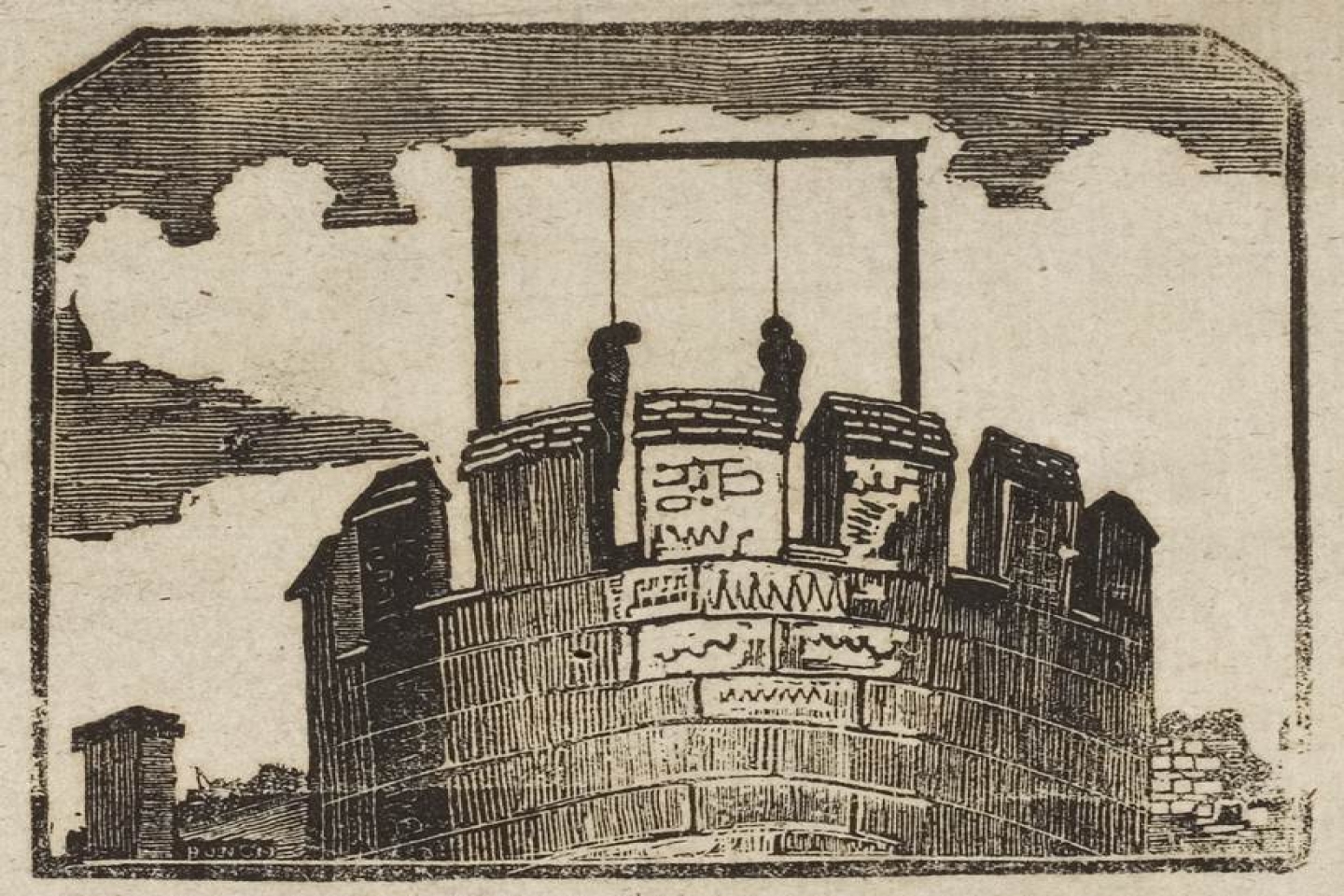
And now, although too late for the Lady and the child, justice must be done and order restored. The murderous mason is taken and hanged by the neck while the false nurse is burned to death ‘in a fire close by.’
*
NOTES
Based mainly on a version collected from Sister Emma Clewer, Berks., 1909 by Cecil Sharp.
First print version Bishop Percy, 1775 (from Kent, England).
This ballad is widespread in Britain and America.

Recorded by, among others, Steeleye Span on Commoner’s Crown and by Martin Carthy & Dave Swarbrick on But Two Came By.

KEYWORDS: Long Lankin, Child ballads, folksong

THE ROBIN HOOD FACTOR


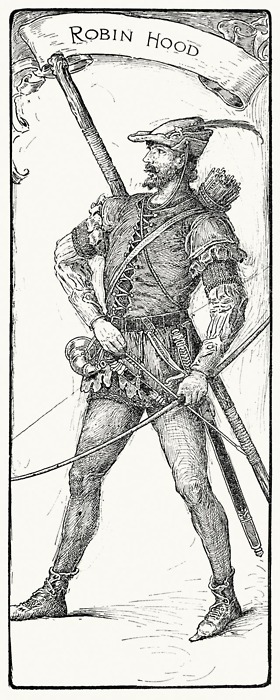
Known to generations of English-speaking peoples, and beyond, as the forest archer in Lincoln green, Robin Hood is the undisputed model of the outlaw hero. His image has undergone many transformations since his first brief mention in medieval manuscripts and has come to embody all the essential elements of the noble robber. Whether we see Robin Hood as a shadowy guerrilla fighter, a cast-out noble or as a wisecracking and nimble-limbed Errol Flynn, he is the righter of wrongs, friend of the poor and foe of the corruptly powerful. In one version or another he has been, and continues to be, celebrated in literature, art, folklore, film and television, board games, placenames and tourist ventures. His progress from a few passing references to international symbol of resistance and justice has been achieved through more than six centuries of defying authority, eluding capture and escaping death. His most important activity is to rob the rich and to redistribute their wealth to the poor.
This record is especially impressive for a man who never was, or at least, who has never been found. Robin Hood’s appropriately elusive existence has been researched by many over the centuries, with nothing more to show than a few theories, suppositions and intriguing references to someone who might have been the real Robin Hood. The truth, of course, is that the ‘real’ Robin Hood is not in history but in our heads, hearts and hopes. He is a myth. Even if someone can prove that he lived and carried out just a few of the things with which he is credited, it would make no difference to the way we understand Robin Hood today. He is so engraved into the well-worn cultural grooves that sustain his image, and those of others in the same mould, that he seems likely to remain with us for a very long time.
Ever since Robehood’ or ‘Robinhood’ is first mentioned in early thirteenth century legal records the outlaw has existed in a shadow world between history and fantasy. The first passing literary mention of a hero by that name is in Langland’s 1377 poem, Piers Ploughman.  Further references appear in various chronicles and Robin Hood gradually emerges as a fully-fledged defier of authority. A 1439 petition to Parliament concerned one Piers Venables of Derbyshire, a fugitive who had gathered a band around him which “beyng of his clothinge, and in manere of insurrection went into the wodes in that county like it hadde be Robyn Hode and his meynee”.  In Southacre, Norfolk, during 1441 labourers and yeomen threatened to kill a Sir John Harsyk. They blocked the road and chanted ‘We are Robynhodesmen. War, war, war’.
By the mid-1550s Robin Hood had become a troublesome enough character to require official suppression. The Scots Parliament of 1555 banned the presence of figures representing the outlaw and his gang in public festivities such as May Day games. Those who persisted were threatened with banishment. This was a disproportionately strong punishment for the brawling, drinking and nuisance-making that purported to be the reason for banning the outlaw from a major form of revelry.
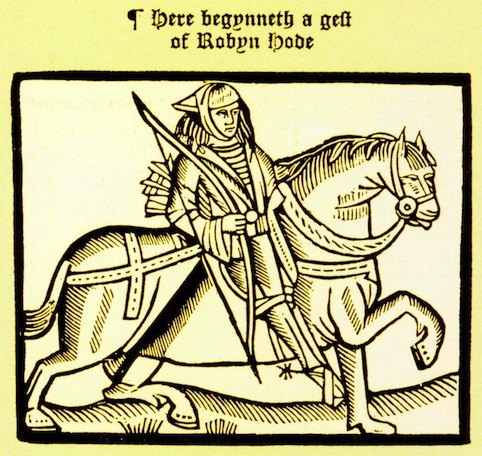
Although the notion of robbing the rich and giving the proceeds to the poor is a later refinement, the portrayal of Robin Hood as the friend of the poor is an early element of his image. In the various versions of the fifteenth century romance, A Geste of Robyn Hode, Robin is a heroic figure and ‘a good outlaw’ who ‘dyde pore men moch god’. By the early seventeenth century Robin Hood has become not just a friend of the poor but also a man who deliberately targets the rich on behalf of the poor.  In a 1622 poem by Thames waterman John Taylor, the poet writes:
…Robin Hood with little John agreed
To rob the rich men, and the poore to feed.
In ‘The True Tale of Robin Hood’ (1632) Robin is a morally upright friend of the poor – ‘all poore men pray for him,/And wish he well might spede.’ He helps distressed travellers on the road, assists widows and orphans, protects women, generally operates against the established power and corruption of the church and robs the rich, particularly those who ‘did the poore oppresse’. He does not harm the humble workers nor harm any man ‘That him invaded not’.  The outlaw is finally betrayed to death by ‘A faithlesse fryer’.
Robin Hood’s status as a commoner, one of ‘us’ is also powerful, despite the seventeenth and eighteenth-century resurrection of the medieval version of the outlaw as a wronged aristocrat. In the ballad ‘Robin Hood and the Potter’, the potter bests the outlaw, after which Robin symbolically exchanges clothes with him and in this trickster disguise goes off to Nottingham for further encounters with the Sheriff and, as it turns out, his wife. This is similar in some ways to the later ‘Robin Hood and the Pedlar’ in which a pedlar defeats Robin in a fight and is symbolically incorporated into the ‘band of merry men’, an incident echoed in the ballad of the eighteenth century English outlaw hero, Dick Turpin.
Robin Hood passed from street literature and ballads into the more respectable form of the novel from 1819 when Walter Scott’s Ivanhoe was first published. Ever since he has been the subject of countless treatments. He has featured in operas and musicals since the mid- nineteenth century, in film and television since 1908 when a silent film was produced and has a strong presence in the video gaming industry and in comic books.
Robin Hood has continued to be connected with political discontent and action. The Poll Tax rioters of 1990 who invaded Nottingham Council Chambers disguised themselves in hoods of Lincoln green and dissident French electricity workers borrowed the mantle in 2004, specifically identifying with the English outlaw. The Robin Hood mantle has been claimed by many anti-capitalist organisations and initiatives since.

The county of Nottinghamshire vigorously promotes the mythology for tourism and there is even an American charity named the Robin Hood Foundation, as well as a hedge fund named for the outlaw. There is no end to the presence of Robin Hood in modern culture.

The combined effect of this weight of history, myth, romance and commercial and media exploitation has produced a global icon. The man who never was is everywhere. He belongs to everyone and his name is known around the world. But the image of the ‘good robber’ is not his alone. Thousands of brigands, bandits and outlaws in many different times and different places have also been celebrated as friends of the poor and definers of the strong. Some recent examples include ‘the Greek Robin Hood’, Vassilis Palaiokostas, currently on the run, ‘the Barefoot Bandit’, Colton Moore and even the chainsaw charmer drug lord, Pablo Escobar. He was killed in 1993 but lives on in his legend as a friend of the poor in his home country of Colombia.

NOTE: For a more detailed look at the enduring mythology of the green archer, see ‘The Robin Hood Principle’.


KEYWORDS: Robin Hood, outlaw hero


THE VITUPERATIVE TONGUE – Insults Through the Centuries

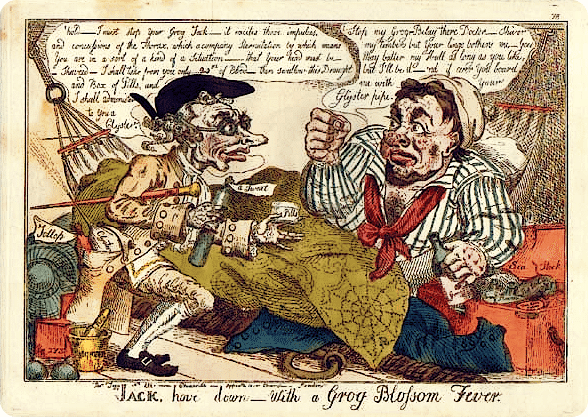
In the medieval period, it was an offence to take the Lord’s name in vain or to otherwise blaspheme. A first offence could mean a fine, but if you did it again there were a variety of nasty punishments up to and including burning at the stake. Since the nineteenth century swearing has more usually involved references to sexual activity or to bodily functions and usually attracts no more than disapproval unless one is unwise enough to direct your ire against an official of some kind or to insult someone in the hearing of another. Even then, using ‘bad language’ is still a minor infringement of civility.
The history of swearing cursing, invective and associated maledictions is possibly older than the development of widely communicable languages. Before speech communication was developed it is not hard to imagine our ancestors grunting and roaring unintelligible but definite expressions of pain, anger and frustration. The only thing that has changed since the first expletives were uttered or muttered is that they have become organised into a mutually comprehensible system. Not only do we know how to insult, we also know when we are being insulted. While this may not be a giant step in the progress of humankind, it has left the language with a rich and colourful body of profanity. Hurled from tongues and clenched teeth since time immemorial the oath, the curse and the sacrilegious insult smoulder their way through our linguistic history.
The Elizabethans had an outstanding armoury of abuse, some of which Shakespeare made good, or bad, use of in many of his plays. At that time, one might be called a barber-monger, one-trunk-inheriting, a worsted-stocking, a varlet, a caitiff, a churl or a coistril. If those insults were not bad enough, there were plenty more that might be thrown. You might be a lurdane, a recreant, a runagate, a pander or even a cocklorel!
 
As well as straightforward insults, to be expelled in whatever configuration the speaker felt to be appropriate to the situation and the target, the Elizabethans had many standardised curses and oaths. These were fairly carefully graded as to the situations in which they might or might not be spoken. Fie upon thee was at the mild end of the scale and oaths such as by my troth and so God mend me were generally acceptable in mixed company. Further up the ladder of offensiveness came curses such as a pox upon thee, Devil take thee and morraine (disease) sieze thee. Stronger oaths included coads-nigs, By’r Lady (the origin of the modern bloody) and pretty well anything that included ‘God’, as in God’s wounds, God’s precious blood, God’s blessed will, and the like. The humorous sounding codso, possibly a reference to a codpiece and so not unlike being called a ‘jockstrap’, was also at the duel-inviting end of the swearing scale.
 
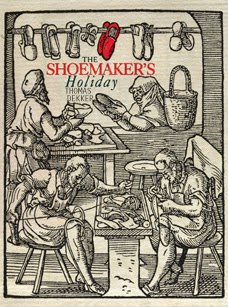
Thomas Dekker, collector of colloquial speech and author of Canting texts was also a playwright. He put his knowledge of the underworld and everyday language to especially good effect in his play The Shoemaker’s Holiday (1599), in which the character who becomes Lord Mayor of London, Simon Eyre, vents this reasonably representative spleen across the stage:
 
Where be these boys, these girls, these drabs, these scoundrels? They wallow in the fat brewis of my bounty, and lick up the crumbs of my table, yet will not rise to see my walks cleansed. Come out you powder-puff queans! What, Nan! What, Madge Mumble-Crust! Come out, you fat midriff swag-belly whores, and sweep me these kennels that the noisesome stench offend not the nose of my neighbours …
 
Good servants were apparently as hard to get in Dekker’s time as in any other.
 
So broad, colourful and various was the range of Elizabethan abuse that there are even available on the internet a number of Elizabethan curse and oath generators. These allow you to combine a number of these terms to automatically generate new and exciting insults. Some even generate such bile on a random basis. Try hurling these some time: you loggerhead base-court dewberry, you wenching fool-born rabbit-sucker, you fobbing hasty-witted hedge-pig or you currish lily-livered gudgeon. A personal favourite is thou puking spur-galled malignancy, and the scope for creative cursing in Elizabethan English is clearly considerable.
The tradition of foul language continued lustily into the industrial revolution, and beyond. In Peter Gaskell’s survey of The Manufacturing Population of England published in 1833, the coarse speech of the workers was directly linked to their brutalising way of life. According to Gaskell, young and old, spoke foul and low:
Coarse and obscene expressions are their household words; indecent allusions are often heard proceeding from the lips of brother to sister, and from sister to brother. The infant lisps words which, by common consent, are banished from general society. Epithets are bandied from mother to child, and from child to mother, and between child and child, containing the grossest terms of indecency. Husband and wife address each other in a form of speech which would be disgraceful to a brothel …
Gaskell thought what he considered from his height of middle-class respectability to be indecent language was due to ‘the promiscuous way in which families herd together’. The impoverished conditions of working class life at this time were the main cause of these conditions, as Gaskell and other reform-minded commentators observed. He calculated there were upwards of twenty thousand Irish living in the cellars of Manchester, tenement houses were dangerously under-sanitised, with ‘fifty, or more even than that number, having only a single convenience common to them all’ and this was, ‘in a very short time completely choked up with excrementious matter.’ The staple diet was potatoes wheat bread, tea and coffee, with milk hardly used. Smoking tobacco and drinking alcohol were endemic and Gaskell also described the horrors of lodging house accommodation as ‘deplorable in the extreme’, and ‘occupied indiscriminately by persons of both sexes, strangers perhaps to each other, except a few of the regular occupants. Young men and young women; men, wives, and their children – all lying in a noisesome atmosphere, swarming with vermin, and often intoxicated …’
Little wonder that they swore and that the almost affectionately inoffensive eighteenth-century term for a silly person – a Nigmenog – had long fallen into obsolescence
A study of cases of sexual slander and defamation in the Ecclesiastical Courts of England during the nineteenth century reveals some rare examples of foul language in sexual insults hurled at that time. In the court records are verbatim transcripts of what was said to whom, including such things as ‘I’ve bulled thy wife’, one man boasted to the cuckolded husband bringing the case. ‘Yes, damnthee, I’ve fucked her scores of times and she’s fetched me to fuck her when thy pillockwouldn’t stand.’ Other accusations included ‘You have been rode by all Cheltenham’ and ‘All the crofters at Dunstead have shag’d thee’. Men came in for their share of insults, being called thieves, rogues, robbers, buggers and rascals. Women, though, seemed to be getting the worst of it. As well as being simply called whores, one was described as burnt arsed, or diseased, while another of alleged easy virtue was said to have been married by parson prick.[1]
The wives of London’s Billingsgate fishmongers were notorious for the ability to hurl sharp-edged invective when provoked, something that was apparently easy to accomplish. Some recorded examples of fishwives’ insults include ‘a health to mine A—s and a fart for those that owe no money’ and ‘You white-livered son of a Fleet Street bum sitter, begot upon a chair at noonday’, which appears to mean that the accused is lazy.
An insult that has a chequered history, as they say, is the once-taboo son-of-a-bitch. This one has its possible origins in medieval French and was given a boost by none other than Shakespeare in King Lear where ‘son and heir of a mongrel bitch’ is hurled. As son-of-a-bitch it was well established by the middle of the eighteenth century, from which time it was widely employed in America, especially in the west. A certain Wells Fargo stagecoach robber known as Black Bart used the term effectively in a ditty he left at the scene of one of his robberies, one verse of which went:

I’ve laboured long and hard for bread,For honor and for riches,But on my corns too long you’ve tred,You long-haired sons of bitches.

The poetic villain signed himself ‘Black Bart, the PO8’.
Son-of-a-bitch was banned from Hollywood films for many years and remained in the limbo of euphemism (S.O.B, son of a gun, so-and-so, etc.) until around the 1980s. By that time even a President could use the term without being censured, as did the folksy Ronald Reagan in describing journalists.
The tradition of insult and invective continues strongly today. Often referred to as slams, slam sayings, put-downs or full-deckisms, these insults are designed to humiliate their targets in much the same way as their predecessors. A few random examples give the general tenor of these slurs:


Don’t feel bad, many people have no talent!

She’s like train tracks – she’s been laid across the country.

I hear you were born on April 2 – a day too late!

You wouldn’t be elected dogcatcher in a ward full of cats.


And if you really want to make a point, try:
I’ve come across decomposed bodies that are less offensive than you.
 
Phew!

[1] Waddams, S., Defamation in Nineteenth Century England: Sexual Scandal in the Ecclesiastical Courts, 1815-1855, University of Toronto Press, 2000.

GREAT CONVICT STORIES

 Here’s the cover and Prologue from my just-released new book, Great Convict Stories:


LASHLAND
I saw a man walk across the yard with the blood that had run from his lacerated flesh squashing out of his shoes at every step he took. A dog was licking the blood off the triangles, and the ants were carrying away great pieces of human flesh that the lash had scattered about the ground. The scourger’s foot had worn a deep hole in the ground by the violence with which he whirled himself round on it to strike the quivering and wealed back, out of which stuck the sinews, white, ragged, and swollen.
The infliction was 100 lashes, at about half-minute time, so as to extend the punishment through nearly an hour. The day was hot enough to overcome a man merely standing that length of time in the sun, and this was going on in the full blaze of it. However, they had a pair of scourgers who gave each other spell and spell about, and they were bespattered with blood like a couple of butchers.’ 


LINES OF LIGHT – How Jewish children’s art survived the darkness of the Prague ghetto and Nazi death camps.


It was one tragedy among many millions. But the story of Friedl Dicker-Brandeis and the children of Prague’s Terezin (Theresienstadt) ghetto shows how creative expression can defy the everyday horrors of totalitarian regimes.
When Nazi Germany occupied Czechoslovakia from 1939, Prague’s Jewish population was quickly interned in what was called a ‘model ghetto’ in the city’s Terezin quarter. Many Jews, young and old, were brutalised, starved and then deported from the ghetto to extermination camps. But through one woman’s selfless dedication, drawings made by children in the ghetto survived the war and Adolph Hitler’s Third Reich.
Friedl Dicker-Brandeis (born 1898) was a Viennese artist who came to Prague to escape Nazi persecution in her home city. Unfortunately, it followed her. She and her Czech-born husband, Pavel Brandeis, were eventually ordered to the Terezin ghetto in December 1942. Here Friedl devoted much of her time, energy and considerable creative skills to teaching art – and more – to the ghetto children. With no children of her own she became a mother of sorts to her students, encouraging them to express themselves through creative work as a form of escapist therapy for their traumatic experiences.
Friedl lived at the girls’ boarding home L410, where children forcibly separated from their parents stayed. She organised exhibitions of the children’s work as well as theatre performances for which she designed the sets and costumes. Much of the teaching had to be conducted in secret and was based on Friedl’s theory that art should ‘unlock and preserve for all the creative spirit as a source of energy to stimulate fantasy and imagination and strengthen children’s ability to judge, appreciate, observe, [and] endure.’
It all came to an end in October 1944. Pavel was deported in September and Friedl volunteered to be taken away. She was deported to the Auschwitz-Birkenau camp on transport EO-167, apparently with some of the children she taught. Perhaps they were able to take some comfort in being together as they met whatever end the Nazis inflicted. Before she left, Friedl gathered up into two suitcases over four thousand of the works the children had created and entrusted them to L410 tutor Raja Engländerova for safekeeping, in the hope that they might somehow escape the Holocaust.
The war finished in 1945. Pavel Brandeis was a lucky survivor but only around 100 of more than 600 Terezin child artists escaped the ghetto and the camps. There are various accounts of how the preserved drawings were rediscovered, but in any event they were eventually passed to the Jewish Museum in Prague where they can be seen today, together with some others in the Pinkas Synagogue in Terezin. The pictures testify to the resilience of children in the most extreme circumstances and are a memorial to the courage and dedication of a remarkable woman. Their plain lines of crayon and paint stand for light and love against the darkness of evil.
Those of Friedl’s students who lived on after the war remembered her as an inspiring teacher and human being. Eva Dorian wrote: ‘I believe that what she wanted from us was not directly linked to drawing, but rather to the expression of different feelings, to the liberation from our fears…these were not normal lessons, but lessons in emancipated meditation’.
Another former student, Erna Furman, would later write: ‘Friedl’s teaching, the times spent drawing with her, are among the fondest memories of my life. Terezin made it more poignant but it would have been the same anywhere in the world… Friedl was the only one who taught without ever asking for anything in return. She just gave of herself.’
The children’s work, together with what survives of Friedl’s own art, have been exhibited around the world from time to time. Daisaku Ikeda, founder of the Fuji Art Museum, took the 1999 exhibition to Japan, noting that:
‘The various artworks left behind by this great woman and the children of Terezin are their legacy to the present, to all of us today. They demand that we continue in our quest for a society that truly treasures human life, transcending all differences of race, religion, politics and ideology. It remains my heartfelt hope that this exhibit may provide a moment of introspection for its viewers, a moment for us to reaffirm the importance of our rights as human beings and the value of life itself.’

A couple of follow-ups to ‘The Bullshit Detection Bureau’:

 
The triage of truth: do not take expert opinion lying down | Aeon Ideas
How Fiction Becomes Fact on Social Media – The New York Times

THE BULLSHIT DETECTION BUREAU


Finding Truth in the Age of Obfuscation


The unwelcome ability of the WWW to amplify error, delusion and straight-out lying has made us all potential victims of falsehood and flimflam. This includes, but is not limited to, disinformation, misinformation, propaganda, fake news, urbanmyths, rumour, moralpanics advertorials, and more!


Thereare a fewthings you can doto protect yourself from thenonsense.


SOURCES


Wheredoes the informationcome from? Howcan you knowit is it a reliable source andnot someone or somethinghoping to hoodwink you?


Someproviders of information are morereliable than others, usually because they havesome form ofbuiltin checkingprocess, such as peerreview in the caseof academic research or factchecking carried out by reputablemedia sources.


Itfollows that the bestsources of independently researched (not unsupported and uninformedopinion or biased market surveys) and objectively evaluated information are universitiesand quality print and/or digital media. Theseare increasingly being broughttogether in quality platforms such asThe Conversation, Aeon and other operationsthat publish quality research with alevel of editorialoversight.


Openslather platforms like Facebook, Instagram, Twitter and thelike are finefor chatting but docarry not reliableinformation. They are easilymanipulated by governments wishing to spreadpropaganda or rig elections,by vested commercialinterests and ideological zealots, as recent events have demonstrated.


INTENT


Whenyou access anitem of information,try to workout the intentionof the author/s. Does thewriting try to putyou, the reader,into a particularposition or mindset? Ask yourselfwhy. Are theytrying to convince you ofa point ofview, sell youa product or anidea? Alarm youeven?


Aclassic giveaway in digital messages attempting to frightenyou into doingsomething, like chain letters,drug or otherscares LINK, are these– ! ! ! ! !. Themore of themthat follow a statement, themore you shouldignore it.


Andnever pass themon, as theyalways insist you should. Theirintent is to spreadfear, uncertainty and panic. Why certain individals have aneed for thissort of behavioris a mysterybest left topsychologists. They have alwaysbeen with usbut, again, theWeb has greatlyincreased their ability to spreadthe nonsense they getoff on.


TONE


Thelanguage and style ofthe message are relatedto its intent. If the languageis overheated, intemperate or otherwiseover the topyou can besure the individualwho composed and distributedit is likewise. These messages are designedto play uponour perfectly reasonable fears andare presented as actualexperiences, as in thisemail example from Australiain 2007 (Slightly edited for coherence on thepage):


I was approached yesterday afternoon around 3.30 PM in the Coles parking lot at Noranda by two males, asking what kind of perfume I was wearing. Then they asked if Id like to sample some fabulous Scent they were willing to Sell me at a very reasonable rate. I probably would have agreed had I not received an email some weeks ago, warning of this scam.
 The men continued to stand between parked cars, I guess to wait for someone else to hit on. I stopped a lady going towards them, I pointed at them and told her about how I was sent an email at Work about someone walking up to you at the malls, in parking lots, and Asking you to sniff perfume that they are selling at a cheap price.
 THIS IS NOT PERFUMEIT IS ETHER! When you sniff it, youll pass out and theyll take Your wallet, your valuables, and heaven knows what else. If it were not for this email, I probably would have sniffed the perfume, but thanks to The generosity of an emailing friend, I was spared whatever might Have happened to me, and wanted to do the same for you. These guys hit Sydney and Melbourne 2 weeks ago and now they are doing it in Perth and Queensland.
 IF YOU ARE A MAN AND RECEIVE THIS PASS IT ON TO ALL THE WOMEN YOU KNOW!!!
 I called the police when I got back to my desk. Like the email says, LET EVERYONE KNOW ABOUT THIS, YOUR FRIENDS, FAMILY, COWORKERS,whoever!!!!!
 Have the best day of your life!!!!!


Notice how this one begins calmly and with a matter-of-fact, reporting tone. This draws the reader in. But the gradually increasing tone of exclamation mark-assisted hysteria in this message is a reliable indicator of bullshit.


‘FACTS’AND STATS


Accuratenames, numbers, dates and other‘factual’ data have alwaysbeen hard tocome by, whichis why theencyclopedia was invented. Tomes likeEncyclopedia Brittanica and the likehave largely done theway of thedinosaurs. Despite its virtues and crowdediting model, Wikipediais no substitutefor ancient but usuallyaccurate authorities and is susceptibleto special interests, ideologies and goodoldfashioned errors offact.


Infact, Wikipedia represents the best andthe worst ofthe Web. Itsstrengths are also itsweaknesses. Use it withdiscretion. Always check at leasttwo other sourcesof information before committingto information on Wikipedia, especially anything faintly statistical. Preferably find anoldstyle printsource, useful for facts upto around 2000. Thesewere written by expertsand exhaustively factcheckedbefore the internet made allinformation slippery.


AUTHORITY


Acommon way of validatinginformation is to haveheard it froma ‘friend’, a friendof a friend’or other apparentlytrustworthy source. We invest highcredibility in those weknow, often unwisely,as they areas susceptible to receivingand transmitting bullshit as anyoneelse.


Urbanmyths (or contemporarylegends) are spread byword of mouth,through the media (printand digital) and throughemail and socialmedia in general. Their validation is oftenthat the storyis true becauseI heard itfrom a friendof a friend’, or something similar. There are innumerableyarns of thistype in circulationand many havebeen for avery long time,providing them with theveneer of authenticity and ‘truth’. How often haveyou heard that antiVietnam War protesters spat onreturning veterans? Not only isthere no evidence of this ‘fact’,what information does existsuggests that nothing of thesort ever happenedor, even ifit did, wason a minisculescale.


Legendsof this typeoften provide apparent validation of theirclaims by referring to ahospital, police department, local government authority, etc. (Seethe kidney legendabove, which mentions the police). If you takethe trouble to check and youshould if you are concerned you’ll discoverthat these authoritieswill have no record of the allegedevent.


TRUSTNOTHING


Noteven this article. The best defenceagainst obfuscation is a criticalview of everything. Don’t take anyone’s word for anythingwithout validating it for yourself. Even experts make mistakesand suffer fromunconscious biases. Always look for a range of sources and views.


In the end, we are all our own best bullshit detectors.

WRAITH OF THE COPENHAGEN

Copenhagen, 1921


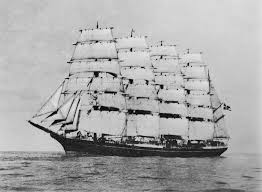
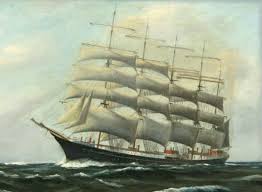
She was the largest sailing ship in the world. When the Copenhagen (Kobenhavn) was launched in 1921 she was immediately dubbed ‘The Great Dane’, her 131 metre hull supporting five masts towering nearly twenty stories into the winds that would bear the barque twice round the world before her still inexplicable disappearance en route for Melbourne, Australia.
The Copenhagen carried some cargo but was primarily a training vessel for young sailors between fifteen and twenty years of age seeking an officer’s ticket. Her voyages provided an opportunity for seasoned mariners to teach young men the many skills they would need to make a career in sail, still a serious option in Scandinavian countries at that time. 
On her tenth voyage, the Copenhagen sailed from Northern Jutland bound for Buenos Aires with a cargo of cement and chalk. Aboard was the experienced Captain Hans Anderson together with 26 crew and 45 cadets from many of Denmark’s leading families. Unloading at Buenos Aires, the ship was unable to find another cargo for Australia and so Anderson decided to set sail without one. Now with a crew of only fifteen, they set a course to Adelaide (then Melbourne) eleven days before Christmas, a trip expected to take just under seven weeks. On December 22 the Copenhagensignalled ‘all is well’ to a passing Norwegian steamer around 1500 kilometers from the island of Tristan da Cunha. 
Captain Anderson was known not to make much use of radio and often went for long periods without signalling. In those days, marine radios had a very limited range. The Danish East Asiatic Company who owned the ship were not unduly concerned when they had no word. But as the weeks slipped by and there was no sound from their magnificent vessel, nor any sight of her, they became increasingly alarmed. The Australian press echoed Danish fears for sons, brothers, fathers and uncles. ‘Where is the Kobenhaven’, asked the Adelaide Advertiser in mid-March, initiating a lengthy chronicle of newspaper articles in the Australian press and around the world.
A search vessel was sent to Tristan da Cunha. A large sailing ship with a broken foremast had been sighted in late January. With her sails only partly set and low in the water, the drifting vessel showed no signs of life. Locals were unable to reach her because of bad weather but had found no wreckage and thought she must have passed by the island. With the assistance of a small Australian intestate steamer, the Junee,  the search continued for some months, but without result. At one point it was surmised that wreckage might drift to the Western Australian coast. A plane was chartered to fly from Fremantle to Northwest Cape, but again nothing was found. The Danish government declared theCopenhagen, her captain, crew and cadets lost. Another mighty ship joined the untold others foundered in the world’s ocean deeps.
But then the sightings began. Over the next few years Chilean fishermen reported a five-masted ship in their waters. Sailors aboard an Argentinian freighter saw a what they called a ‘phantom ship’ fitting the Copenhagen’s description as they fought a gale. Other sightings came from Easter Island and the coast of Peru. It was also reported that a ship’s stern section with the name København had washed up on a West Australian beach.
And then they found the bottle. In 1934, the son of Argentina’s President visited the United States telling a strange story. Men from a whaler working off Bouvet Island in the South Atlantic had found a sealed bottle containing a ‘log’ or diary of a surviving cadet of the Copenhagen. The log told a grim story. The Copenhagen struck an iceberg. There was no option for those aboard but to take to the lifeboats. In the distance they saw their fine ship crushed between two icebergs. The diary ended with ‘It is snowing and a gale blows. I realize our fate. This sea has taken us beyond the limits of this world.’
Whatever the authenticity of this now-missing document, the story fitted the predominant theory about the disappearance of the Copenhagen, like the Titanic, victim to a drifting iceberg. The following year another grim find appeared to provide further support for this explanation. It was reported that the remains of a ship’s boat with seven skeletons had been found on the southwest coast of Africa, over 600 kilometers north of the city of Swakopmund in Namibia. Nautical experts ridiculed the suggestion that this might be a boat from the Copenhagen. “It is a far- fetched theory, absolutely without justification, said Captain Davis, Victorian Director of Navigation.
Other speculations abounded. The Copenhagen might have encountered a tidal wave. As her holds were empty and she sailed only in ballast she might have capsized in bad weather. Rumours, theories and searches for the lost barque have continued ever since. In 2012 divers found a wreck on Tristan da Cunha that some believe might be the missing ship. The Danish government and the Danish East Asiatic Company were reportedly taking the suggestion seriously enough to establish the truth of this possibility. But nothing has since been reported and today, the fate of the Copenhagen and her crew is regarded as one of the world’s greatest unsolved maritime mysteries.