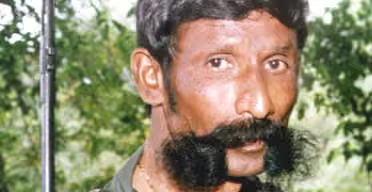
Veerappan stands with a gun in his jungle hideout in 1998. Photograph: AP
*
‘It was a pukka operation’ said Jyoti Mirgi, the head of the operation Cocoon force that had been pursing ‘the Jungle Cat’ since 1993. ‘We ordered him to surrender but he refused’.
Mirgi was referring to the gun battle between police and Koose Muniswamy Veerappan (1952-2004), ‘India’s most wanted bandit’ with a price on his head of 20 million rupees, approximately US 500 000 dollars. In October 2004 an undercover police informer working in what was left of the ageing dacoit’s gang tipped off the authorities that the famed bandit would be leaving his forest sanctuary and travelling to hospital for eye treatment. The ambulance that was to take him to the hospital was a police vehicle, as were others in the area.
Over thirty policemen ambushed Veerappan and three of his gang. According to the official report, the bandit was killed on the spot after refusing to surrender. Police gave thumbs up signs as they posed by the famous corpse, which was then was taken to Dharampuri hospital, where crowds reportedly numbering up to 20 000 gathered to see the remains of ‘India’s Robin Hood’, as the press dubbed the notorious outlaw.
Born in 1952, Koose Muniswamy Veerappan had by the time of his death led the authorities on the traditional merry outlaw’s dance for four decades, smuggling sandalwood and ivory, allegedly committing well over a hundred murders and conducting the traditional business of the dacoit, kidnapping politicians and celebrities. In trouble with the law from an early age, he became more active and violent from the 1980s, once allegedly claiming that he cut his victims into small pieces and fed them to fish.
His nickname of ‘The Jungle Cat’ was a linguistic acknowledgement of his ability to elude and outfox the large numbers of police and troops sent against him in his jungle hideaways in the southern Indian states of Tamil Nadu, Karanataka and Kerala. He was said to have the sympathy of the poor, a fact that made it difficult for the authorities to obtain reliable information about his activities and whereabouts.
His most ambitious crime was kidnapping an Indian movie star, Rakjumar, and extorting a ransom from the state government before returning the star unharmed. But he also kidnapped a former politician in 2002, murdering him when his demands for money were refused. The bandit’s own description of how he killed one enemy gives an insight into the realities of bandit life and death:
“I wanted to see the blood gushing out of Srinivas’ chest. I took out my gun before he knew what was happening and shot him. I then cut off his head and began hacking off his hands. These were the very hands that wanted to turn machineguns on me. I kept his head as a souvenir.”
As is often the case with elusive bandits, there were suspicions that Veerappan had contacts with political and security officials and with the separatist Tamil Nadu Liberation Army, a faction of which vowed to take revenge for his death, according to the Khaleej Times. His long dacoit career and the expensive operations eventually mounted to track him down suggest that he may have had more help than that available to him from his poor supporters, among whom he was said to distribute some of the proceeds of his many crimes and to shower the village children with sweets
Reporting Veerappan’s demise, the press lapsed immediately into the ambivalent rhetoric always associated with such figures. According to The Times, he was ‘an Indian Osama bin Laden and Robin Hood rolled into one: endlessly elusive, apparently uncatchable, evading troops sent to search for him even as he mocked them from his jungle lair.’ The Independent suggested India had a similar love-hate relationship with Veerappan as that of America with Billy the Kid, saying ‘if Veerappan was India’s blackest villain to some, to others he was a hero. He was able to survive in the jungle because villagers brought him and his men food, motivated by a mixture of respect and fear. The government forces sent to capture Veerappan were also said to have oppressed the local people: “At least, he does not hurt us,” they say.
The Indian newspapers were more condemnatory. The Telegraph of Calcutta quoted a former hostage saying he was glad that the outlaw was dead as he was a ‘cruel animal and vermin of the gutter’. The Indian Express referred to Veerappan’s ‘evil little empire’ and wondered how he was able ‘to mock the law for so long’. Elsewhere in India the press portrayed the dead bandit more in the manner of the outlaw hero with The New Indian Express quoting his aged mother to the effect that poverty had driven Veerappan to outlawry, though it also suggested that he commanded support more by fear than by sympathy.
Veerappan continued to be controversial and contradictory even in death. The director of the 1995 film of the outlaw’s life, boasting that Veerappan had approved the script, retitled it as Veerappan: The Original. He was reportedly responding to news that a rival director was preparing another film production to be titled Let’s Kill Veerappan. He became the subject of books and press articles and a long series on Indian television in 2007. Various legal actions ensued, keeping the bandit’s name in the public eye. It was also said that Veerappan stashed his loot somewhere in the jungle; people have been looking for it ever since.
In the facts and the fictions of Veerappan’s life and death echo those of other bandit heroes. He was forced into a life of crime by circumstances. He had the support and sympathy of his social group. He preyed mostly, if not totally perhaps, on the rich and powerful, he was betrayed and he died game. All these attributes, real or not, contributed to his being dubbed ‘the Indian Robin Hood’. In many ways, Veerappan’s life and legend are a link between the older style of bandit hero and more modern criminals who have understood the tradition and sought, in various ways to bend it to personal, ideological or commercial ends.





 GRISTLY HISTORY