THE LOST COLONY OF ROANOKE


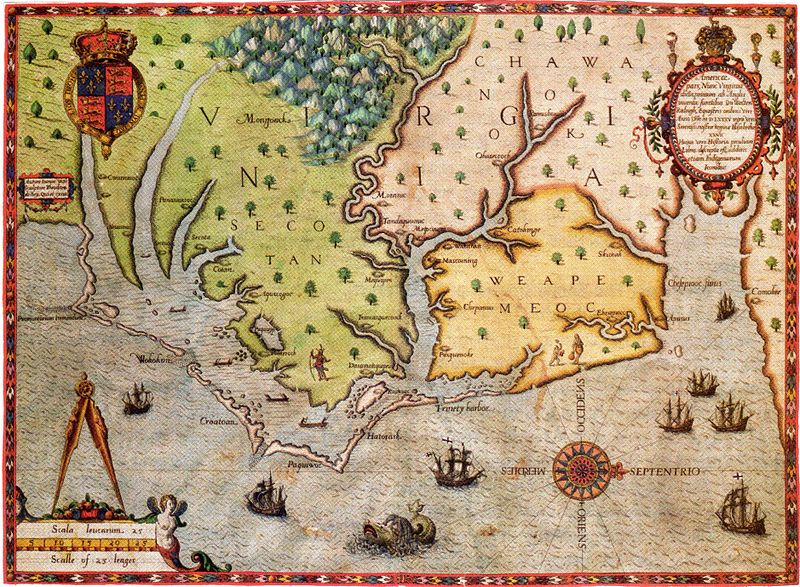
“The Carte of All the Coast of Virginia,” engraved by Theodor de Bry based on John White’s own map, published in Thomas Hariot’s A Briefe and True Report of the New Found Land of Virginia, 1588.


In 1584 Sir Walter Raleigh sent an expedition to the east coast of North America. The expedition landed on Roanoke Island in what is now the state of North Carolina. Good relations were established with the indigenous inhabitants, the Croatans, two of whom accompanied the expedition back to England to meet Raleigh and to describe their country and its ways. Next year a fleet of ships under the command of Sir Richard Grenville established a settlement on the island. 
 
Despite the positive start made with intercultural relations through the initial expedition, the colonists and local people soon fell into violence, much as they would in the Southland.  Grenville left for England, leaving a 108 men to establish the colony, promising to come back with reinforcements and desperately needed food by the following April. He did not return and the colonists were forced to defend themselves from indigenous attack. Fortunately, Sir Francis Drake called in at the colony on his return journey from plundering the Spanish in the Caribbean. He took them back to England. Grenville’s relief party finally arrived at Roanoke soon after, only to find an abandoned settlement. He left a small group on the island and sailed back to England.
 
When the next group of colonists sent by Raleigh arrived at Roanoke they found only a single skeleton. It was one of the men Grenville left there the previous year. Under the command of John White, the new colonists decided to return to England but the master of their ship refused to take them home. White’s group now had to try to re-establish the colony and to mend relations with the local inhabitants. These attempts were a failure. Late in the year of 1857, White sailed to England for help, leaving around 115 men, women and children to await rescue.
 
White tried to get back to Roanoke but was prevented by the difficulty of obtaining vessels as all sizeable craft had been commandeered to fight the Spanish Armada. When he did manage to find and supply two small boats, the Spanish stole their cargoes and he was forced to return to England. White was not able to get back to Roanoke until August 1590. The colony was deserted. The buildings had been dismantled and there was no evidence of fighting or violence. They found the word ‘Croatoan’ carved into a post and ‘Cro’ cut into a tree. There was no sign of the prearranged signal of distress, a Maltese Cross. White concluded that the colonists had simply moved to a neighbouring island, then known as ‘Croatoan Island.’ A storm prevented him visiting the island immediately. The tempest finally blew itself out but unaccountably, White did not visit the island and instead sailed away. Ever since, the fate of the Roanoke colonists has mystified and intrigued generations of researchers. The many speculations about Roanoke have echoes in the legends of the Southland.
 
One of the most persistent and likely theories is that at least some of the Roanoke colonists made alliances of convenience with one or more of the local Native American groups. As well as repelling newcomers, many of these groups were in a state of more or less continual warfare. There is evidence of cohabitation including sightings of Europeans living with Native American groups. The most compelling of these stories is that of four English men, two boys and a young woman living and working for a local chief. The story was that the colony had been attacked but they had escaped into the wilderness, eventually to become virtual slaves.
 
There are also well-documented accounts of Native Americans with English ancestry. As early as 1709, the Croatoans were acknowledging English ancestry:
 
A farther Confirmation of this we have from the Hatteras Indians, who either then lived on Roanoke-Island, or much frequented it. These tell us, that several of their Ancestors were white People, and could talk in a Book, as we do; the Truth of which is confirmed by gray Eyes being found frequently amongst these Indians, and no others. They value themselves extremely for their Affinity to the English, and are ready to do them all friendly Offices.
 
There are many other colonial accounts of grey-eyed or blue-eyed Native Americans with fair hair as well as related legendary traditions and linguistic evidence of the integration of Roanoke colonists with Native Americans. But just how this happened continues to excite a variety of theories. One is that the colonists did indeed move from Roanoke but were subsequently massacred. Another is that they escaped on a small ship that White had left behind but were all drowned at sea.
 
Archaeological surveys of the area have uncovered the usual miscellany of enigmatic artefacts. A map of the colony made by John White in 1585 and known as the ‘Virginia Pars Map’ has revealed some new evidence. Researchers have recently re-examined it and found obscured beneath a paper patch repair, the site of what could be another fort built by the colonists. Investigations into this possibility are proceeding, along with a project to confirm if the Roanoke colonists did merge into the local Native American groups.
 
This is an early example of the genesis and spread of an ‘urban’ or contemporary legend. The initial concept of a lost white tribe is well established in European culture. The unknown nature of the great south land and events related to it provided the ideal seed bed for the genesis of the fiction that Maslen, or someone else, kicked off in 1834. Subsequent ostensibly accurate details were added as the story moved through the nineteenth century press and from mouth to mouth along the channels of hearsay and speculation. By the time the story reaches modern times, it has also gained apparent credibility simply by being ‘old.’ 
 
Researchers interested in the lost white colony have assiduously garnered apparently supporting evidence from various places and the well-spun narrative we now have starts to look almost convincing at first glance. But, as with urban legends, despite the insistence of their tellers on their veracity, investigation rarely turns up credible evidence for their existence. The persistence of such stories – despite the evidence against them – tells us a good deal about the human need for a good yarn, one that appears to explain and sometimes vindicate mysteries, fill information voids or perhaps even provide some cultural vindication for colonisation.
 
SOURCES:
 
John Lawson, A New Voyage to Carolina, London, 1709.
Giles Milton Big Chief Elizabeth: The Adventures and Fate of the First English Colonists in America, Hodder & Stoughton, London, 2000.
The Lost Colony Centre for Science and Research for connections to the extensive popular and academic research interest in Roanoke.

‘The towne of Pomeiock’ by John White (British Museum).

THE LAST GREAT ACT OF DEFIANCE – A BRIEF HISTORY OF WORKPLACE HUMOUR


It sure is!

The history and folklore of the workplace is long and often unhappy, as the crude cartoon above strongly suggests. But one aspect of working life that has remained constant is the need to laugh off the impositions and aggravations of earning a crust. From the inanities of the ‘system’ to the bastardries of ‘the boss’, workplace humourists have always found ways to lighten things up – though not in ways necessarily appreciated by the management.

Since the industrial revolution delivered the typewriter we have found creative ways to satirise, criticize and take the piss out of work through fake forms, satirical memos, cartoons and a host of other send ups that have brought a smile to the harried faces of employees everywhere.
This form of covert humour was well developed by World War 1, and continued to evolve. When photocopier or Xerox technology came into general use from the 1950s this way of getting back at the boss exploded with the ability to quickly and surreptitiously make as many copies as required for distribution to fellow sufferers and posting on tea room notice boards. The facsimile machine, or ‘fax’ that came towards the end of the 20th century allowed you to send these mirthful missives far and wide. ‘The Problem-Solving Flow Chart ‘was a firm favourite (and still is in one form or another):
Then, as now, stress was a feature of the workplace:


The development of the World Wide Web from the late 20th century into the present has opened up vast new possibilities for creating, recreating and distributing items like this:

Or maybe this one:


This kind of humour is perhaps best understood as laughter that bites – usually to the discomfort of someone else. It operates through transgression, satire, parody, even cruelty. It is the voice, pen or computer of the workaday underdog biting back at the system that controls many waking hours. Most of us have to work for a living, but we don’t have to like it!

 And finally, in a modern take on Aesop, proof positive of what you long suspected:
 
 
When God made man all the parts of the body argued over who would be the BOSS.
The BRAIN explained that since he controlled all the parts of the body, he should be the BOSS.
The LEGS argued that since they took the body wherever it wanted to go, they should be the BOSS.
The STOMACH countered with the explanation that since it digested all the food, it should be BOSS.
The EYES said that without them, the body would be helpless, so they should be BOSS.
Then the ARSEHOLE applied for the job.
Then other parts of the body laughed so hard that the arsehole got mad and closed up.
After a few days the BRAIN went foggy, the LEGS got wobbly, the STOMACH got ill and the EYES got crossed and unable to see.
They all conceded defeat and made the ARSEHOLE the BOSS.
This proves that you don’t have to be a brain to be a BOSS …
JUST AN ARSEHOLE.

PIED PIPER STILL PIPING

From a window of the Market Church in Hameln/Hamelin Germany (c.1300-1633), thought to be the earliest representation of the legend.
 
A well-known story of German, and now global, tradition is a constant reminder of what might happen if a helper is not properly rewarded for his assistance. The Pied Piper of Hamelin is the ambivalent focus of an enduring medieval legend. In 1284 the town of Hamelin in Saxony is disturbed by a plague of rats. The piper, dressed in motley, hence the term ‘pied’, pipes the rats into the River Weser where they drown. But the people of the town refuse to pay him and so he pipes their children inside Koppenberg Hill, from where they have never emerged. Only one lame child, too slow to keep up with the others, survived.
 
This is the most familiar version of this enigmatic legend today, though its original form, as far as can be known, was a little different. One of the earliest and most significant accounts of the event is the fourteenth century version appearing in the Latin chronicle Catena Aurea (The Golden Chain) and written by a monk known as Heinrich of Hereford. This account has nothing about a plague of rats but simply tells of a handsome and well-dressed young man appearing in the city on the Feast of Saints John and Paul (26 June). He went through the streets playing a magnificent silver pipe, attracting about 130 children to follow him out of the city to the execution ground known as Calvary. There they all vanished without trace. Heinrich gives an earlier written source for this information and also refers to the testimony of an eye-witness relayed to him through the witnesses’ son.
 
As well as the absence of the rats and the reluctance of the townspeople to pay the piper’s fee, there is nothing ‘pied’ about the piper in Heinrich’s version of events, and no children returned. By the mid-1550s, though, an account written in Bamberg elaborated the story with such details as the threat of the piper to return in three hundred years and take more children away and the return of two naked children, one blind and one mute. Another account from around the same period identifies the piper as the devil and the fate of the children a result of God’s retribution for human sin. The return of the one lame child seems to appear first in the English translation made by Richard Verstegan in 1605.
 
The detail of the rat plague is first heard of in the Swabian Zimmer Chronicle of 1565. However, it is known that by this time there were other legends involving rat and mouse-catchers attached to other parts of Europe and it may be that these became mixed with the basic Hamelin story. By whatever and various ways the story evolved, it was already a popular item of print entertainment by the early seventeenth century and, in one version or another, continued to attract the interest of poets like Robert Browning (‘The Pied Piper of Hamelin’, 1842) and of folklorists like the Brothers Grimm as well as carrying on a busy life in oral tradition, including a number of German folksongs.
 
This disturbing legend has attracted a good deal of scholarly speculation through the succeeding centuries. Some suggest the legend is derived from the eastward migrations of young Germanic peoples during the thirteenth century. Others relate the story to the disastrous Children’s Crusade in which many children left their homes, never to return. There are also suggestions that the story is related to the medieval dance epidemic known as ‘St John’s Dance’ or ‘St Vitus’ Dance’ or to a major bubonic plague outbreak. Others have looked to mythological and historical sources for enlightenment and explanation.
 
Whatever its source, the tale has been continually in oral tradition and, later, in literature, theatre, children’s books, advertising, cartoons, political propaganda, films and, of course, in the tourism industry of the city of Hamelin. The many-faceted legend of the Pied Piper is largely due to the ambiguity of the piper’s character, both good and evil, and the ingratitude and stupidity of the burghers of Weser. As well as all the other many uses to which the tradition has been put, in the end it is perhaps primarily an appealing moral tale about just rewards (‘you must pay the piper’s fee’) and being careful about which processions you follow.


From Graham Seal and Kim Kennedy-White, Folk Heroes and Heroines Around the World

ON THE CASTAWAY CONTINENT, 1727

From the Log of Adriaan van de Graaf …
Secunda Etas Mundi (Second Age of the World) Nuremberg Chronicle,1493, by Hartmann Schedel


On Monday, April 26, 1728 the Council of the Netherlands Indies in Batavia received a desperate letter:
 
My High Excellency, together with the Council of the Netherlandish India, I pray of you most urgently to send me help and assistance against these robbers of the money and the goods of the wreck Zeewyk, who have divided the money and goods among themselves. I am stark naked; they have taken everything from me. 0, my God! They have behaved like wild beasts to me, and everyone is master. Worse than beasts do they live; it is impossible that on board a pirate ship things can be worse than here, because everyone thinks that he is rich, from the highest to the lowest of my subordinates. They say among themselves, “Let us drink a glass to your health, ye old ducats!” I am ill and prostrate from scurvey.
 
Jan Steyns, the skipper, and Jan Nebbens (Nobbens, Nibbens) the under-merchant had been wrecked with their crew when the near-280 ton Zeewijk went aground on the treacherous reefs off Western Australia now known as the Houtman Abrolhos. On her maiden voyage from Flushing in Zeeland, Zeewijk’s passage to Capetown was marked by sickness, twenty-six deaths and a close shave with pirates. Reprovisioned and with her crew strengthened to over two hundred, she left Capetown for Batavia on 21 April. Another eleven men died on this leg of the voyage. In defiance of his VOC orders and over the protest of his steersman, Steyns set a course straight towards the western coast of the southland, or the Land of Eendracht as the Dutch were generally calling it at this time. The ship’s master also entered a false note in the ship’s log to the effect that the decision of the ship’s council to sail ENE was ‘decided unanimously.’ It was not, and this act would eventually ruin Steyns.
 
 
Half Moon Reef
 
It was during the first watch of the evening of June 9. The lookout on the ship’s foreyard noticed white flecks on the sea before the ship. He watched them for half an hour or so and decided that they were reflections of the moon. But around 7.30pm the Zeewijk struck and foundered in heavy surf around a reef shaped like a half-moon. The under steersman, Adriaan van de Graaf described the disaster:
 
At dusk, therefore, we were running under small sail, i.e. foresail and both topsails double- reefed, but at about 7.30 in the evening Jan Steyns, the master, together with the under-merchant Jan Nebbens came up on to the quarterdeck from the master’s cabin and asked the third mate Joris Forkson who had the watch at the time ‘What was that which could be seen ahead?’ answering himself at the same time ‘My God, it is surf, lay your helm to starboard!’ and called the first and second mates who were in the former’s cabin setting out the course on the charts. The under merchant came to warn us, coming to meet us from the awning. We had heard the shout in the cabin and jumped into the waist to the sheets and braces, but before the foresails had been braced to the wind, the ship crashed with a great shock into the cliff on her starboard side and turning her head in the wind round the SW knocked her rudder out of the helm port.
 
Hearing and heeding the master’s orders
 
I, Adriaen v.d. Graeff, second mate, made my way to the steerage and found there to be 8 feet of water in the ship, whereupon our main mast fell overboard. We then decided to cut away our fore and mizzenmasts and found our ship to be lying in 10 to 11 feet of water, so that we prayed the Almighty for a propitious outcome. While terrible waves washed over us constantly we attempted to cut away the top hamper. A seaman named Yuriaen Roelofsen was washed overboard together with the fore mast and bowsprit, so that we looked at one another sorrowfully and prayed for surcease from the terrible punishment which the Almighty was sending us. We asked the lookout who had been sitting on the foreyard whose name was Pieter de Klerck van Apel, whether he had not seen the surf; he confessed at once that he had seen it for at least half an hour, but had imagined that it was caused by the sky or the moon.
 
The men of the Zeewijk were trapped aboard. ‘We could see nothing but surf, which washed over the ship in an awful way’, recollected van der Graeff. Attempts to get off were dashed by the sea and they soon found their craft was beginning to come apart. They began making life rafts and, on a Black Friday, only just saved the life of a crewman who volunteered to swim ashore with a rope. Next day some of the men began breaking into the stores and rampaging drunkenly through the wreck. The officers, soldiers and many of the crew swore an ‘oath to God to be loyal to one another and to be faithful to the authorities and to punish together, be it even with death, all evildoers and malignant.’
 
They managed to get a line from the grinding wreck to the reef through the bravery of some of the crew who at first swam through the deadly surf and then managed to get ashore on a small catamaran they had roped together. There were now four men on the reef with the rest still stranded on the shifting wreck, unable to help them further. One seaman died aboard the wreck in the afternoon and at sunset they managed to drift some supplies to those on the reef. But that night the seas rose again and shifted the rapidly disintegrating ship from one side to the other, ‘so that now the surf assaulted the larboard side so much more that we thought we would be overturned with each sea. We therefore fell at the feet of the Almighty and prayed together for His help and succor.’ Their prayers were answered and the wind dropped. Next day various attempts were made to launch small boats with men and supplies. Eight men drowned and they lost more supplies but they managed to establish twenty-two survivors on the reef. Ominously, during these tragic events, those on the reef ‘found a filled hand-grenade, also old rope and ship’s skin, these belonging to a ship or ships which the same fate had struck here.’
 
The following day, the weather improved. Fresh water was found on an island near the reef and more men and provisions ferried over. By Wednesday, only three officers and sixty-nine crew remained on the wreck. The senior officer was van der Graeff. As he sat in the master’s ruined cabin that night, dutifully writing up the ship’s journal, a crewmember was discovered stealing knives and sharpening them for unknown purposes. The man, presumably addled from shock, was put in irons. But it was another gloomy hint of what was to come.
 
On Thursday, Van der Graeff planned to float the remaining survivors off the Zeewijk onto the reef. But many of the crew mutinied, refusing to leave the wreck and ‘we could not move the hardened hearts of many of the crew, since about half of those malignants would not help us, saying that they wanted to remain on the wreck, so that we found ourselves compelled to help one another of those who had decided to leave the wreck. Therefore we threw overboard the victuals which we had barrelled, lowered away our rafts and so floated to the reef at God’s mercy, which we reached with the help of God Almighty without any of us being lost.’
 
By Saturday the 21st, ninety-six survivors shivered together on the island, including the master, officers and a good number of petty officers, most of whom were tradesmen with useful skills. They also had meat, bread, butter, wine and brandy. These they began rationing and van der Graeff noted that there were plenty of seals on the island, together with enough scrub to build cooking fires.
 
On Monday they were able to revisit the reef, secure one of their boats, find some more supplies and pick up a few stragglers. One, a boy, refused to go back to the island in the longboat. On Wednesday, survivors began dying. On Thursday the carpenter began to improvise a mast for the longboat’s voyage to Batavia. ‘I am hoping for the rescue of us all’, van de Graeff wrote. On Saturday one of the soldiers died at dawn. Next day a seaman died in the morning. The survivors on the island could see two others walking round on the reef but ‘we could not help them.’
 
It was Monday again and another week of misery and death had passed. They took the longboat to the reef ‘with great difficulty.’ There they found the reluctant boy still alive. The men left aboard the wreck had floated some supplies to him. They waved and signaled to the wreck for more supplies, including sailcloth. Some wine, brandy and butter were delivered, together with a sail they could fit to the newly built mast of the longboat.
 
Next morning at 7 the tent in which the officers were sheltering on the island was invaded by ‘all petty officers and the common hands, most of whom were drunk.’
 
The men walked into our tent with a great deal of clamour and confusion of argument and counter-argument, all shouting at the same time, telling the master that they wanted the long boat to sail to Batavia and that they wish to appoint as her chief the 1st officer Pieter Langeweg and no one else, and 10 of the best seamen with him whom we are to select. They would hear of no further counsel, saying that they will carry on their affairs and that they have collected some good seamen whom they deem to be capable of handling a long boat and have made them draw lots and have appointed 10 of them according to the lots drawn to sail in the boat…
 
No more is heard about this incident and its aftermath but van der Graeff’s journal goes on to describe negotiations with those still on the wreck. They now wanted to be taken off with the longboat. But the conditions were so bad that this was impossible. However, they had lost most of the remaining supplies needed by those on the island. A deal was done and some more alcohol, butter and kegs of salted fish were floated across on Thursday the 3rd of July. That day, the sail maker also began to make the sails for the longboat.
 
The seal population was now disappearing. By Monday the 7th they were down to a pitifully small list of victuals
 
 8 barrels of bread
4 aums of wine
3 ½ aums of brandy
4 aums of sweet oil
1 aum of wine
7 kegs of butter
6 kegs of anchovy
9 cheeses
4 sides of bacon
3 hams
 
That day another man died on the island. By Wednesday they were stocking the longboat for its arduous trip and at sunset the next day, it set sail with ‘12 souls in all.’ Peter Langweig was in command, as the men had demanded earlier. There was a probably unofficial distribution of wine and their remaining boat, the scow, came back from a hunting trip to the other islands around the reef with 24 seals ‘at which we rejoiced greatly.’
 
There were now eighty-six men on the island and an unknown but probably significant number still on the wreck or otherwise unaccounted for. They were within sight of the mainland though had no desire or need to attempt to reach it. Instead, the survivors began fighting among themselves. Under the stress of the situation, excess alcohol and fear, men began to draw knives against each other and some began to act irrationally, throwing scarce victuals into fires and threatening their fellows. The council had four manacled and marooned on another island ‘as we fear that, staying here, they will persist in their recalcitrant behaviour, which they had affirmed incessantly to me and to several other people during the past night while they were in irons…’
 
On Sunday 13th the scow went to the reef and came back with another frightened boy and a small amount of ham and wet bread. Over the following days, the wine ration was finished up but edible vegetation began to sprout on the island, making a welcome addition to the sparse diet. The survivors established a routine of taking the scow to the reef to bargain for supplies with those still in the wreck. They also used the little boat for seal hunting and transport between the islands. On Wednesday 23rd, the four men marooned on one of these were flogged ‘and at the intercession and request of the common hands they were permitted to remain here in the island, upon their promise to lead henceforth a Christian life.’
 
The following day saw the second mate and eight men float off the wreck on a small scow they had fashioned. Now there were eighty-five souls on the island. It was August and becoming colder. On Monday 4th they discovered that their freshwater supply had dried up. They prayed for rain, cleaning out the small wellspring to find seven live crabs in it, a certain sign that any water that might bubble from it would be undrinkable. Next day five men took one of the scows without permission and rowed to another island about two miles away. On the 7th, while most of the officers were away fishing, the ‘hands’ and petty officers took away to their own tents the water previously held by the officers on behalf of all. The authority of the officers was now under serious challenge from the crew. From now on, the ‘hands’ and petty officers doled out the water to the master and other officials rather than the other way around. The men also insisted on maintaining the daily ration of half a loaf of bread a day, rather than accept the master’s recommendation that they cut it to a quarter loaf. Fortunately, it rained the next day and further supplies were obtained from the wreck, together with some seals from the surrounding islands.
 
The days dragged by with much the same routine, punctuated by occasional acts of disobedience and hoarding of supplies. The occasional additional man also arrived on the island having forsaken the wreck. On the 22nd another man died. There were now ninety-five on the island.
 
The situation was severe enough for the survivors to send out an expedition to the mainland in search of possible future supplies. Six men left for the southland on the 24th of August, returning at sunrise three days later. What they had taken to be the mainland was in fact an oblong island about 4 miles long by half-a-mile at its widest point. They had found another one of the Zeewijk’s boats that had become separated during the grounding. They had also come across ‘a piece of a ship or wreck, finding the figurehead lying under a cliff, of which they could discern that it had been the figure of a woman.’
 
Two more men died on 29th. There were now ninety-three survivors on the island. There was a dwindling but significant number aboard the wreck controlling the supply of food and drink, other than that available naturally, mainly the declining seals and flocks of dark birds the size of a small duck.
 
There was alarm among the men when the master proposed taking both scows to explore the other nearby islands. He placated them by promising he would return as quickly as possible and bring more seals. He and eighteen others were allowed to leave. They returned as promised four days later, together with the gig that had escaped the wreck, a valuable addition to their chances of survival. Steyns, apparently in confidence, also told van der Graeff that they had found another wreck, along with other items washed there from the stricken Zeewijk.
 
On the 10 September, Steyns and a small crew of ten managed to get out to the wreck and establish a line to the reef, enabling the transfer of provisions. A week later they were able to bring off the five remaining chests of VOC money, the rest having apparently been salvaged earlier. By the 21stall ten of the money chests were together on the island. But supplies of food and water were again dwindling ‘so that we beseech the Almighty for rain from the sky.’ Three days later another sailor died, bringing the island group to ninety-two.
 
The next Saturday the regular expedition to the reef for further supplies from the ship results only in a letter thrown overboard in a container. It is from Jan Steyns the master and states that there will be no further supplies coming from the ship until someone rows across and gets them and, presumably, Steyns and the other men who had earlier accompanied him to the Zeewijk. The letter is taken to the under-Merchant who has command of the sailors on the island in the absence of the master. He pens a testy reply:
 
I under-merchant Jan Nebbens, after the boatswain and the boatswain’s mate have again returned without victuals, having read the letter brought from you and understanding there from that you wish to have us come aboard in spite of weather and violent surf on the reef, which was impossible as the men tell me, wish that you on board were here on the island to make the easy trip to the wreck, this we, the undersigned, declare together, and master Steyne and your men ought to know that we officers in the island were requested by the hands to issue the wine and the brandy as long as there was any left, the reason for which being, as you know, that so far it has not pleased the Good Lord to grant any rain, for it is as dry on the island as it has not been before, for the little water which is left in the well is not potable, it being as salty as seawater, and this is the cause that there is no longer any water in the tents, and we declare together that this is the truth, which we are ready to affirm on oath at all times…
 
The letter was co-signed by Van Der Graeff and over fifty others. The next day another sailor on the island died. He was probably not much lamented as his death meant there was one less mouth to feed from the dwindling supplies. Van Der Graeff went to the reef to ask those on the ship for victuals on the Monday 29thbut was refused. Instead, he was given a signal that Steyns wanted to leave the wreck. Fresh water had now become an urgent issue ‘for we are at our wits’ end with thirst.’ Fortunately, drinkable water was found on another island ‘so that now, God be thanked, we need not ration one another any longer.’ But it was too late for one of the boys and another sailor who died over the following few days. ‘We now number 89’ Van Der Grief recorded in his stoically non-committal way.
 
Even with reduced numbers, supplies were consumed quickly. There was further pressure from the men for larger rations and by the 6th they were down to a little bread, some groats, oil, butter, cheese and some tobacco. They were subsisting mostly on the small birds. That day the master and men returned from the wreck, having built a scow on board and floated across. Next day Steyns and van der Graeff took the new scow and gig to the reef. As usual, they hauled the craft over the corals hoping to launch into the sea beyond in order to reach the Zeewijk. They were unable to do this but some provisions were thrown into the sea for them by those still on board.
 
On Friday 10th, van der Graeff and the third mate managed to get across to the broken ship in the gig and to organise some substantial transshipments of food, tools and sailcloth. The good weather went on for days, during which a great deal of provisions were either rowed or floated to the reef. A few of those who had never left the Zeewijkwere also brought ashore. On the 21st one of the soldiers aboard the wreck died but the work continued unabated. Still the weather held. They now began to cannibalise the ship itself for all usable materials, even including the ship’s bell. Another sailor died on the 26th. Van der Graeff was relieved three days later and proudly recounted how much he had been able to send ashore. He also apologised for the alleged loss overboard of that part of his journal relating to his weeks back aboard the Zeewijk.
 
The survivors were now in the best situation since the wrecking. They had sufficient food, a supply of fresh water and enough timber and materials to build a new boat, a large scow. By the 30th of October, by now accepting that the boat that had left months earlier had not made it to Batavia, they resolved to build a new one and to rescue themselves. They laid the keel on November 7 and the stem the following day. In their journal Steins and Nebbens noted: ‘We called it the Sloepie, that is, the little sloop, made up from the wreck of the Zeewyck.’
 
 
You can read the rest of the story in The Savage Shore  

MYTHS THAT MAKE HISTORY

Ancient though their origins may be, the world’s many myths and legends have played an important role in history. Frightening fables of unknown southern lands, tales of lost cities, and endless rumors of hidden hordes of gold have motivated many of the world’s greatest explorations.
Five centuries before the common era, the Greeks knew the world was not flat. It was a globe and so, they reasoned, there must be a large landmass in the extreme south to balance the lands they knew in the northern hemisphere. The Romans embroidered the legend of a lost southern land by imagining it was peopled by strange beings who survived in great heat and, out of necessity, walked upside down.  By the second century AD, it was widely accepted that there was a southern land, probably inhabited, and laying at the bottom of the world – somewhere. It was featured on beautifully crafted European maps and charts complete with sea monsters and winged serpents. The Muslim world also produced maps that seem to represent some of Australia’s northern coastline in the ninth century AD.
From early times, Mariners began searching for the southland. It was frequently discovered, the news triumphantly announced, only to be disproved by later explorers. Many voyages undertaken by the Spanish, Portuguese, Dutch, French and British were inspired by the desire to solve the riddle of the mysterious continent. It would be centuries before anyone did, but these many efforts provided the world with knowledge of distant places, unknown seas, new flora and fauna and contact with indigenous peoples previously unknown to Europeans.
Other beliefs also fueled world exploration. Stories about the ‘River of Gold’, now thought to be the Senegal River, reached southern Europe through contact with the Muslim world as early as the Thirteenth century. But from ancient times, there had been great interest in the rumoured river. Pliny the Elder and Claudius Ptolemy wrote about it and the Carthaginians sailed there more than four centuries BCE. A number of Arab expeditions were reported to have sought the river during the Twelfth century. Despite the unknown terrors of sea voyages in that era, people heard these yarns and went looking for the treasure. Most never returned. Or, if they did, we know nothing about it.
Despite—or perhaps because of—these uncertainties, the legend of the River of Gold grew on the tongues of traders, sailors and adventurers. An expansion of this tale based on ninth century Arab writings claimed that there was not only a river, but also an island called the ‘Lands of Gold’ in the chief city of which gold ‘grew in the sand like carrots’ to be harvested at sunrise. Three centuries later, writers were describing the magnificent gold clad horses and gold and silver-collared dogs of the king of this place (probably modern-day Ghana). His sons boasted gold-plaited hair and lowly pages who hefted swords mounted in gold.
Wild though these legends were, they spurred expansion into new lands, gradually filling the map of the world with facts rather than fiction. We will never know how many adventurers and treasure seekers set out to find the objects of their desire, although we can be sure that most of them died in their quests. But, in one case, we do know the explorer’s fate.
The Spanish began their occupation of South America when Cortez conquered the Aztecs in 1519.  The astonishing amount of gold and other valuables the Spaniards found as they cut their way through the indigenous peoples rapidly established South America as a hot spot of fabled wealth. One of the most potent tales concerned an indigenous community whose kingship ritual involved covering the anointed man with gold dust – El Dorado, ‘the golden one’. Other items in the ceremony were also either made of gold or covered in the precious metal. Together with other valuables, the gold was thrown into Lake Guativita. The king went in as well, washing the gold dust from his body and adding to the riches carpeting the lake floor.
By the time the Elizabethan adventurer Sir Walter Raleigh first heard about El Dorado from a captured Spanish sailor, it was no longer an individual, but rather a place: a city of gold along an Amazonian river in the wilds of Guiana (Guyana). Slowly but steadily, the lure of the golden city took hold of one of the greatest scholars and adventurers of the Elizabethan era. Raleigh had long been collecting relevant documents and maps and was well versed in the lore of the great treasure when he finally sailed to Trinidad and then to the mouth of the Orinoco River on his own quest for El Dorado in 1595. Previous unsuccessful attempts had been made from the east coast, and Raleigh was not about to repeat the mistakes of others. Nor could he afford to fail.
It was a horrific voyage. Raleigh’s passage through the “thick and troubled water” of the Orinoco and its endless tributaries was long, hot, and arduous. Raleigh ended his account with a strong promise of untold riches. But, the leaden truth was that “I gave among them [the Indians GS] many more pieces of gold than I received.” Raleigh’s quest had been a colossal failure – and he knew it. Although he did not find el dorado, his The Discovery of Guiana (1596), provided valuable anthropological, ecological and geographic knowledge of the region. Through it he also wrote himself out of immediate trouble with his Queen, Elizabeth I.
Still a believer, Raleigh tried again in 1617. His attempt was yet another failure and sealed his fate with a new monarch, James I. Soon after his empty-handed return to England, the great Elizabethan and earnest seeker of El Dorado was beheaded at the Palace of Westminster on 29 October 1618. In his dying speech he admitted to being “a man full of all vanity, and having lived a sinful life, in all sinful callings, having been a soldier, a captain, a sea captain, and a courtier, which are all places of wickedness and vice …”.
Misty and murky though they were, these and the many other legends of unknown lands and golden treasures had very real consequences for individuals, and for the greater sweep of world exploration and discovery.