
BANDIT LANDS 13 – VEERAPPAN, THE JUNGLE CAT

Veerappan stands with a gun in his jungle hideout in 1998. Photograph: AP

*

‘It was a pukka operation’ said Jyoti Mirgi, the head of the operation Cocoon force that had been pursing ‘the Jungle Cat’ since 1993. ‘We ordered him to surrender but he refused’.

Mirgi was referring to the gun battle between police and Koose Muniswamy Veerappan (1952-2004), ‘India’s most wanted bandit’ with a price on his head of 20 million rupees, approximately US 500 000 dollars. In October 2004 an undercover police informer working in what was left of the ageing dacoit’s gang tipped off the authorities that the famed bandit would be leaving his forest sanctuary and travelling to hospital for eye treatment. The ambulance that was to take him to the hospital was a police vehicle, as were others in the area.

Over thirty policemen ambushed Veerappan and three of his gang. According to the official report, the bandit was killed on the spot after refusing to surrender. Police gave thumbs up signs as they posed by the famous corpse, which was then was taken to Dharampuri hospital, where crowds reportedly numbering up to 20 000 gathered to see the remains of ‘India’s Robin Hood’, as the press dubbed the notorious outlaw.

Born in 1952, Koose Muniswamy Veerappan had by the time of his death led the authorities on the traditional merry outlaw’s dance for four decades, smuggling sandalwood and ivory, allegedly committing well over a hundred murders and conducting the traditional business of the dacoit, kidnapping politicians and celebrities. In trouble with the law from an early age, he became more active and violent from the 1980s, once allegedly claiming that he cut his victims into small pieces and fed them to fish.

His nickname of ‘The Jungle Cat’ was a linguistic acknowledgement of his ability to elude and outfox the large numbers of police and troops sent against him in his jungle hideaways in the southern Indian states of Tamil Nadu, Karanataka and Kerala. He was said to have the sympathy of the poor, a fact that made it difficult for the authorities to obtain reliable information about his activities and whereabouts.

His most ambitious crime was kidnapping an Indian movie star, Rakjumar, and extorting a ransom from the state government before returning the star unharmed. But he also kidnapped a former politician in 2002, murdering him when his demands for money were refused. The bandit’s own description of how he killed one enemy gives an insight into the realities of bandit life and death:

“I wanted to see the blood gushing out of Srinivas’ chest. I took out my gun before he knew what was happening and shot him. I then cut off his head and began hacking off his hands. These were the very hands that wanted to turn machineguns on me. I kept his head as a souvenir.”

As is often the case with elusive bandits, there were suspicions that Veerappan had contacts with political and security officials and with the separatist Tamil Nadu Liberation Army, a faction of which vowed to take revenge for his death, according to the Khaleej Times.  His long dacoit career and the expensive operations eventually mounted to track him down suggest that he may have had more help than that available to him from his poor supporters, among whom he was said to distribute some of the proceeds of his many crimes and to shower the village children with sweets

Reporting Veerappan’s demise, the press lapsed immediately into the ambivalent rhetoric always associated with such figures. According to The Times, he was ‘an Indian Osama bin Laden and Robin Hood rolled into one: endlessly elusive, apparently uncatchable, evading troops sent to search for him even as he mocked them from his jungle lair.’ The Independent suggested India had a similar love-hate relationship with Veerappan as that of America with Billy the Kid, saying ‘if Veerappan was India’s blackest villain to some, to others he was a hero. He was able to survive in the jungle because villagers brought him and his men food, motivated by a mixture of respect and fear. The government forces sent to capture Veerappan were also said to have oppressed the local people: “At least, he does not hurt us,” they say.

The Indian newspapers were more condemnatory. The Telegraph of Calcutta quoted a former hostage saying he was glad that the outlaw was dead as he was a ‘cruel animal and vermin of the gutter’. The Indian Express referred to Veerappan’s ‘evil little empire’ and wondered how he was able ‘to mock the law for so long’. Elsewhere in India the press portrayed the dead bandit more in the manner of the outlaw hero with The New Indian Express quoting his aged mother to the effect that poverty had driven Veerappan to outlawry, though it also suggested that he commanded support more by fear than by sympathy.

Veerappan continued to be controversial and contradictory even in death. The director of the 1995 film of the outlaw’s life, boasting that Veerappan had approved the script, retitled it as Veerappan: The Original. He was reportedly responding to news that a rival director was preparing another film production to be titled Let’s Kill Veerappan. He became the subject of books and press articles and a long series on Indian television in 2007. Various legal actions ensued, keeping the bandit’s name in the public eye. It was also said that Veerappan stashed his loot somewhere in the jungle; people have been looking for it ever since.

In the facts and the fictions of Veerappan’s life and death echo those of other bandit heroes. He was forced into a life of crime by circumstances. He had the support and sympathy of his social group. He preyed mostly, if not totally perhaps, on the rich and powerful, he was betrayed and he died game. All these attributes, real or not, contributed to his being dubbed ‘the Indian Robin Hood’. In many ways, Veerappan’s life and legend are a link between the older style of bandit hero and more modern criminals who have understood the tradition and sought, in various ways to bend it to personal, ideological or commercial ends.

THE LADY ON THE SAND

Rose Marie Pinon, later de Freycinet, Paris, 1812, aged 17. From an engraving of the original portrait in the possession of Baron Claude de Freycinet.

The slight figure boarding Louis de Freycinet’s Uranie hardly attracted a second glance. Ship’s boys as young as ten were not uncommon in the early nineteenth century. But this ‘boy’ was the beautiful wife of the captain dressed as a man. The year was 1817 and 23 year old Rose and 35 year-old Louis had just married. It was a truly romantic marriage for love. Rose was a commoner and de Freycinet an aristocrat. So helplessly in love were the couple that they could not bear to be separated and Louis broke every rule of the French navy to have her with him on what they knew would be a very long journey.

De Freycinet needed to modify his ship to cater for a female passenger and it was not long before word escaped ashore, causing great official consternation. But by then Uranie had sailed. The story delighted the French public and the de Freycinet’s became celebrities in their absence. The authorities decided to allow the romantic voyage to proceed. They were bound for the great south land via the Cape of Good Hope and Mauritius on a round-the-world voyage of scientific discovery. 

A year after leaving France the expedition anchored in Shark Bay to conduct scientific observations and map the area. But Rose’s husband also had some unfinished business in this part of the great south land. In 1802 de Freycinet had been with the Baudin expedition when they discovered the plate left by Willem de Vlamingh to mark his visit to the unknown land in 1697. De Freycinet and other officers wanted Baudin to remove the plate and take it back to France. But Baudin refused. De Freycinet swore that he would one day return and take the plate. His justification for doing this was ‘that such a rare plate might again be swallowed up by the sands, or else run the risk of being taken away and destroyed by some careless sailor, I felt that its correct place was in one of these great scientific depositories which offer to the historian such rich and precious documents. I planned, therefore, to place it in the collections of the Académie Royale des Inscriptions et Belles-Lettres de L’Institut de France …’ [i], which he duly did. The plate immediately disappeared and was not seen again until 1940 when it was found in the basement of the Académie, reportedly in a box of old junk.

Rose kept a journal of her travels, recounting the sights she saw and the adventures she experienced with her husband. She also wrote many letters home. Her first view of New Holland, as the west coast of Australia was known at the time, did not impress her. She saw a ‘low and arid coast’ with ‘nothing in the sight to ease our minds, for we knew we would find no water in this miserable land…’ She would later go ashore with Louis and spend a few nights under canvas butThat stay on land was not a pleasant one for me, the country being entirely devoid of trees and vegetation…’ In the cooler part of the day she collected shells and read in her tent.

Here Rose had her first contact with Indigenous people. She went ashore in a small boat but was unable to land because the water was too shallow. A couple of sailors had to carry the captain’s wife to the beach in all her finery. When they reached it a group of ten or so Aborigines approached, making strong signals for the intruders to return to their ship. ‘I was afraid, and would willingly have hidden myself’, she wrote home. The Aborigines retreated, leaving Rose, Louis and some officers to picnic on the beach beneath a canvas shade they had brought from the ship along with food. This they supplemented with some local oysters ‘far tastier than all those I had, sitting at a table in comfort, in Paris.’ 

What the people of the region might have made of this strange scene is not recorded. They may have thought that the strangers picnicking on their beach, Rose in her fashionable finery and the sailors in their colourful uniforms, did not present a very serious threat. In any case, just a few days later, friendly contact with the locals was established when they exchanged some of their weapons in return for tin and glass trinkets. Not likely to have been a fair exchange, setting the tone for much that was to come.

The French sailed north to Timor, then to the Moluccas, the Carolines, the Marianas and the Sandwich islands. In November 1819 they arrived in the growing colony at Port Jackson. Here the de Freycinet’s were welcomed enthusiastically by almost everyone. The Governor sent a military band to play them along the river to meet him at his Parramatta residence. There were endless parties and the French were provided with a house and facilities to pursue their scientific work. But on their first night in the house they were robbed of their silver service, table linen, the servants’ clothing and other items. Rose wrote home: ‘You know the purpose of this colony and what sort of people are to be found here in plenty; you will therefore not be astonished at this misdeed: might one not say it is roguery’s classic shore.’

Rose departed on the Uranie on Christmas morning. Aboard were two merino rams, adding to the black swans and emus they had already collected on their journey. Also aboard was a convict stowaway suffering the effects of too much Christmas cheer. He was handed over to the pilot but when they got out to sea another ten escapees were found. They joined the crew and one lady on board as they set a course for the Falkland Islands in search of an abandoned French settlement. 

Here the Uranie was wrecked, though the expeditioners managed to save their notes and around half of their samples. They eventually made it back to France where Louis was court martialled for losing his ship. He was cleared of the charge and then feted for his scientific achievements. Rose and Louis were a celebrated couple until Rose died of cholera in 1832. Louis died in 1841. The de Vlamingh plate was gifted to Australia in 1947. [ii]


[i] De Freycinet, Voyage Historique, Vol. I, 449.

[ii]  Marc Serge Rivière (trans & ed), A Woman of Courage: The Journal of Rose de Freycinet on her voyage around the world 1817-1820, National Library of Australia, Canberra, 1996, pp. 51-52.

THE FLYING DUTCHMAN DOWN UNDER

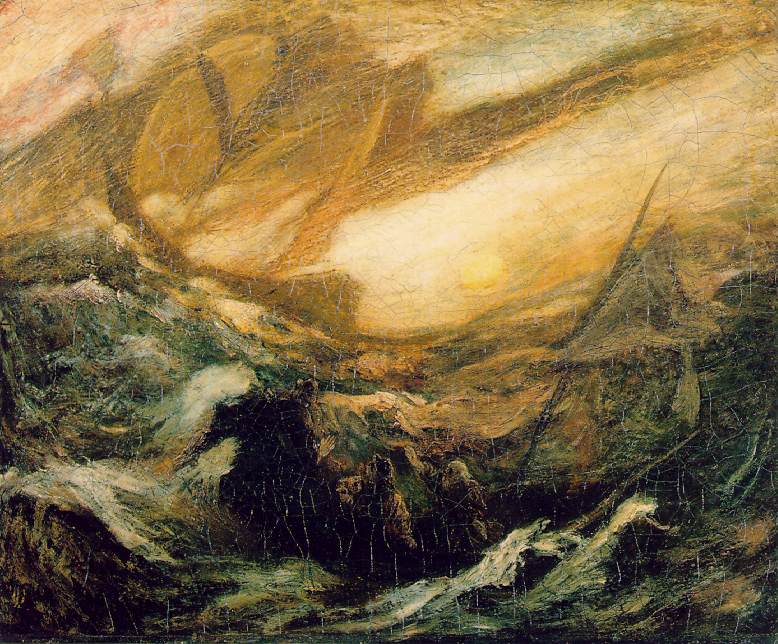
The Flying Dutchman by Albert Pinkham Ryder c. 1887 (Smithsonian American Art Museum)

The legend is first recorded in 1790, but it was already old in sailors’ lore. Undoubtedly the most famous nautical yarn of all, the enigmatic tale of the Flying Dutchman is known around the world. And the spectral sailing ship has been sighted in many oceans, including in Australian waters.

At first, the story was a short yarn about a distressed Dutch ship seeking safe harbour at the Cape of Good Hope during a raging storm. A pilot to guide the vessel to safety was not avail­able and the ship was lost with all her crew. Ever since then, the glowing apparition has been seen during stormy weather. Sighting the Flying Dutchman was considered to be an omen of doom.

The Cape of Good Hope was a regular port of call for ships on the Australian run from Europe and although the legend was initially a Dutch story and largely restricted to sailors, it flowed into the broader community in the late eighteenth century. One of the earliest accounts is that of the ‘Prince of Pickpockets’, George Barrington, on his way to serve a sentence in Australia in 1795. Barrington’s version of the story is a little more elaborate than the basic legend (though he was a notori­ous confidence trickster with a silver tongue): 

. . . it seems that some years since a Dutch man-of-war was lost off the Cape, and every soul on board perished; her consort weathered the gale, and arrived soon after at the Cape. Having refitted, and returning to Europe, they were assailed by a violent tempest nearly in the same latitude. In the night watch some of the people saw, or imagined they saw, a vessel standing for them under a press of sail, as though she would run them down: one in particular affirmed it was the ship that had foundered in the former gale, and that it must certainly be her, or the apparition of her; but on its clearing up, the object, a dark thick cloud, disappeared. Nothing could do away the idea of this phenomenon on the minds of the sailors; and, on their relating the circumstances when they arrived in port, the story spread like wild-fire, and the supposed phantom was called the Flying Dutchman. 

Barrington did not see the apparition, but he met a sailor who did. About 2 a.m. he was woken by the boatswain ‘with evident signs of terror and dismay in his countenance’ and begging for a drink of spirits. The man claimed to be ‘damnably scarified’ because he had just seen: 

the Flying Dutchman coming right down upon us, with everything set—I know ’twas she—I cou’d see all her lower-deck ports up, and the lights fore and aft, as if cleared for action. Now as how, d’ye see, I am sure no mortal ship could bear her low-deck ports up and not founder in this here weather. Why, the sea runs mountains high. It must certainly be the ghost of that there Dutchman, that foun­dered in this latitude, and which, I have heard say, always appears in this here quarter, in hard gales of wind.

After a few deep draughts, the boatswain ‘grew a little composed’, admitting that he was prone to seeing ghosts. Barrington went on deck with him to see for himself but ‘it had cleared up, the moon shining very bright, and not a cloud to be seen; though, by what I could learn from the rest of the people who were on deck, it had been very cloudy about half an hour before, of course I easily divined what kind of phantom had so alarmed my messmate’.

A more respectable figure who did see the Flying Dutchman in Australian waters was no less a personage than Prince George of Wales, destined to be King George V. Sometime before dawn on 11 July 1881, while travelling through Bass Strait, the prince (or his brother travelling with him) recorded:

At 4 a.m. the Flying Dutchman crossed our bows. A strange red light as of a phantom ship all aglow, in the midst of which light the masts, spars and sails of a brig 200 yards distant stood out in strong relief as she came up on the port bow. The look-out man on the forecastle reported her as close as on the port bow, where also the officer of the watch from the bridge clearly saw her, as did also the quarterdeck midshipman, who was sent forward at once to the forecastle; but on arriving there was no vestige nor any sign whatever of any material ship was to be seen either near or right away to the horizon, the night being clear and the sea calm. Thirteen persons altogether saw her . . .

Just over six hours later, the sailor who had first reported seeing the Flying Dutchman fell to his death from the foretopmast and ‘was smashed to atoms’.

Another Australian connection with the Flying Dutchman comes from John Boyle O’Reilly, the famous Irish rebel. While being transported with his fellow Fenians to Western Australia in 1867, O’Reilly wrote a poem for the ship’s newspaper. The poem uses the Flying Dutchman tale to give expression to  O’Reilly’s forebodings at what was going to be a long exile from his homeland: 

They’ll never reach their destined port 

They’ll see their homes no more, 

They who see the Flying Dutchman 

Never, never reach the shore. 

Since then the legend has grown, gathering more detail and depth through endless accounts, books, films and artworks that feed from it. The Flying Dutchman soon fused with another piece of world folklore known as the ‘Wandering Jew’. This is said to be a man who refused to help Christ bear the burden of the cross as he struggled towards his crucifixion. In a bit of Old Testament revenge, the man was condemned to wander the Earth forever in eternal life. In the Flying Dutchman version, the captain of a Dutch merchantman attempting to enter Table Bay was frustrated by a change in the wind. The captain swore to be eternally damned if he did not enter the bay and that he would sail these waters until Judgement Day. He did not and he does. 

In another version it is said that the crew of the Dutch ship committed some atrocious crime and are condemned to never enter a port and must voyage onwards until their penance is done. This echoes a theme of Coleridge’s famous poem, The Rime of the Ancient Mariner (1797–98). A few years later the arch-romancer Walter Scott made the Flying Dutchman a pirate ship, in which guise the tale may be most familiar to modern audiences in the Pirates of the Caribbean movies.[i]It’s not surprising that such a compelling legend is told again and again and that the cursed ship has been seen even in Australian waters.


[i] George Barrington, A Voyage to Botany Bay, with a description of the country, manners, customs, religion, &c. of the natives, sold by H.D. Symonds: London, 1795. 

Prince Albert Victor and Prince George of Wales, The Cruise of Her Majesty’s Ship ‘Bacchante’ 1879–1882. Compiled from the private journals, letters, and note-books of Prince Albert Victor and Prince George of Wales, with additions by J. D. Dalton, Vol. 1, Macmillan and Company: London, 1886, p. 551. 

Buy me a coffee!

A$5.00