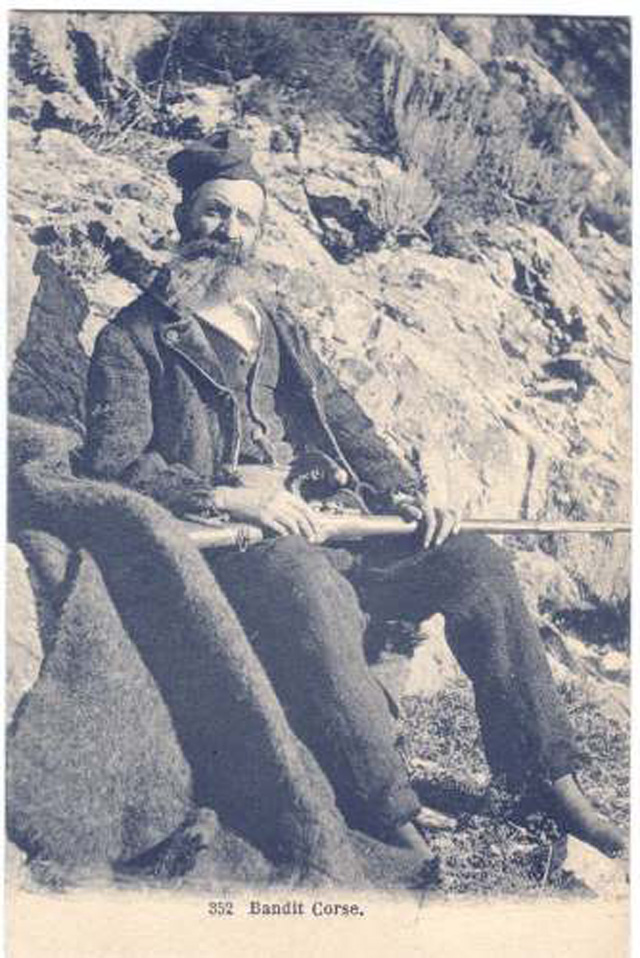
Corsican bandit early XX century. Author unknown. Wikipedia.
Nobody there despises the bandit; he is neither thief nor robber, but only fighter, avenger, and free as the eagle on the hills.[1]
In July 1932, newspapers reported a minor event in an out of the way part of the world. Referring, as usual, to ‘Robin Hood’, they conveyed the news that the ‘popular brigand’ Jean Ettori had been acquitted of murder. He was seen as a man who ‘robbed the rich and assisted the poor’ and had many supporters, some of whom presented him with a new rifle to commemorate the bandit’s acquittal.[2] It was not the first time that Ettori, known as ‘scicca’, the ‘slice’ or ‘cut’ had faced a court.
Born in 1880, Jean-Simon Ettori was a Corsican peasant who became a bandit through an act of violence involving payment of an old debt. Ettori accidentally wounded a young woman during a gunfight. One of his accomplices killed a man during the same incident and was later caught and sentenced to hard labour for life. Ettori decided that he would rather live in the macchia, or woods, than spend his life in prison. He later killed two gendarmes who got too close and was sentenced to death for these crimes in absentia in 1910.
Ettori disappeared to Venezuela for a year before returning to settle another dispute. In 1920 he murdered a local man who had tried to betray him to the authorities for the reward. For the next twelve years, he busied himself with his three wives and seven children, working occasionally as a shoemaker and spending time in the machia whenever necessary. He enhanced his reputation as an honourable bandit by settling local disputes. In 1930 the villagers of Petreto-Bicchisano were being oppressed by a bandit called Toma, not one of the ‘honourable’ or ‘noble’ kind. They sent a delegation to Ettori asking for help and he rid them of the problem.[3]
As he grew older, the bandit’s life was not as congenial as it once was for Ettori. After lengthy negotiations with the authorities, he surrendered himself in 1932 after twenty-six years on the run. His trial was a sensation. Anywhere other than Corsica, perhaps, he would have been punished.
The island that gave birth to Napoleon Bonaparte has a troubled history of conquest, oppression and poverty. Feuds and honour killings have been a notable aspect of Corsican life since medieval times and produced a never-ending array of outlaws.
… The Corsican bandit is not, like the Italian, a thief and robber, but strictly what his name implies—a man whom the law has banned. According to the old statute, all those are banditti on whom sentence of banishment from the island has been passed, because justice has not been able to lay hands on them. They were declared outlaws, and any one was free to slay a bandit if he came in his way. The idea of banishment has quite naturally been extended to all whom the law proscribes.[4]
The bandit who ruled the hills between Belgodere and Ponte alle Lecchia in the early nineteenth century was known as ‘Serafino’. According to a late nineteenth century traveller who visited the area, he was
… a man of war, as is every bandit; but he appears to have been of gentlemanly manners. His death occurred about thirty years ago, and many stories are preserved of his courtesy to women, and his protection of the poor. The Corsican bandit, as a rule, never robs: he is supported, either by the produce of his flocks, which he brings in by night to his native village, or by the voluntary contributions of his relations.[5]
Serafino was betrayed by someone and shot dead by the gendarmes while he slept in his cave.
Others of the vast number of individuals who took to the macchia[6] were recognised and celebrated as noble robbers. Andre Spada was active in the 1920s until captured in 1933. More recently, Yvan Colonna, given life in 2003 after being on run for 5 years, was protected by separatists who saw him as a Robin Hood figure.
Another was Felix Micaelli who operated in the Fiomorbo region undet the bandit alias of ‘Feliciolu’ in the early twentieth century. After kidnapping a girl he wished to marry and later murdering a tyrannical cousin, Micaelli fled to Argentina in 1908 and later joined the French Foreign Legion. He was said to have been a good soldier but was eventually recognised and again forced to flee. He returned to Corsica where he began building a Robin Hood reputation for settling disputes. During World War 1 he aided the authorities by capturing deserters and generally assisting in maintaining law and order. He apologised through a newspaper for an accidental killing he committed in 1917 but continued to enjoy the sympathy of local communities until at least the 1930s when he seems to disappear.[7]
Up to the middle of the nineteenth century the most celebrated bandit was Teodoro Poli. Impressed into the army, Poli deserted and took up banditry with gusto.
… He astonished all Corsica by his deeds of audacious hardihood, and became the terror of the island. But no meanness stained his fame; on the contrary, his generosity was the theme of universal praise, and he forgave even relatives of his enemies. His personal appearance was remarkably handsome, and, like his namesake, the king, he was fond of rich and fantastic dress. His lot was shared by his mistress, who lived in affluence on the contributions (taglia) which Teodoro imposed upon the villages.[8]
Betrayed and murdered, Poli died the defiant bandit of tradition, according to his ballad ‘he fell with the pistol in his hand and the firelock by his side, come un fiero paladino—like a proud paladin.’[9]
[1] Ferdinand Gregorovius, (trans. Alexander Muir), Wanderings in Corsica: Its History and its Heroes, Thomas Constable, Edinburgh, 1855, p.176
[2] The West Australian, 11 July 1932, p.13.
[3] Stephen Wilson, Feuding, Conflict and Banditry in Nineteenth-Century Corsica, CUP 2003, p. 351.
[4] Gregorovius, p. 186
[5] Gertrude Forde, A Lady’s Tour in Corsica, Vol. I (of 2), Richard Bentley and Son, London, 1880, pp. 98ff.
[6] Gregorovius, p. 197 provides some astonishing statistics for victims of the vendetta and, therefore the outlawing of their murderers. Between 1359 and 1729 over 330 000 were killed and an equal number wounded. For the nineteenth century: ‘According to the speech of the Corsican Prefect before the General Council of the Departments, in August 1852, 4300 murders (assassinats) have been committed since 1821; during the four years ending with 1851, 833; during the last two of these 319, and during the first seven months of 1852, 99. The population of the island is 250,000.’
[7] https://www.corsicamea.fr/bandits/autres-bandits-corses.htm
[8] Gregorovius, p. 191.
[9] Gregorovius, p. 191.

