THE AGE OF CON

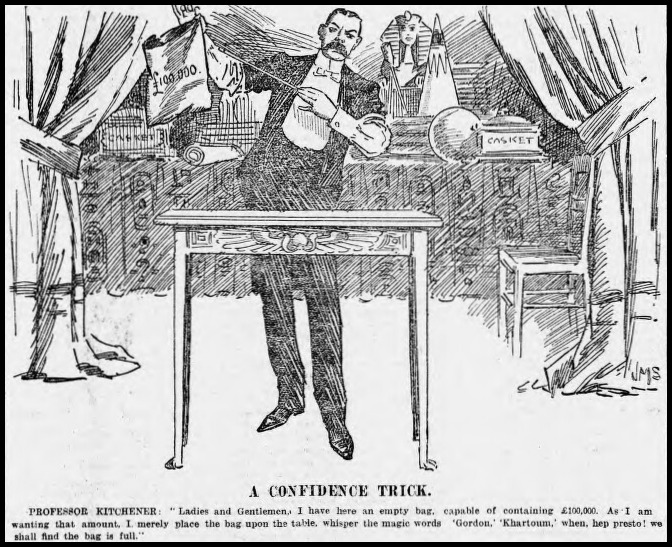
A Confidence Trick by J.M. Staniforth, 1898

As the story goes, Detective Chief Inspector Harry (Henry) Mann of the Western Australian police was wined and dined at London’s swanky Cafe Monaco in the early years of the twentieth century. His genial hosts were from a group of Australian con men with records longer than the arms of everyone at the table. The cafe was their London hangout and distribution centre for the proceeds of crime. Cop and crims were obviously well known to each other and this strange moment says a lot about the relationship between the police and the Down Under dupers who dominated Britain’s confidence games for decades.

In the years directly before the Great War of 1914–18, right through to the end of World War II in 1945, there were more Australian con men on British police registers than those of any other nationality—by a long shot.[i] They were recognised as highly skilled exponents of their nefarious schemes and were very successful. When caught, many had what amounted to small fortunes in their bank accounts and stuffed into the upholstery of their expensive furniture and cars—and they were just the stashes the police found. No self-respecting trickster would be without a secret hidey-hole or two for the inevitable emergencies. Bags of cash were essential to set up the bigger cons and to fund the lavish lifestyles needed to impress rich marks.

And there were plenty of them. Especially after World War I, Britain, Europe and the United States were awash with money flowing through newly opened international financial channels and connections. Business deals and schemes were being rolled out around the world in oil, minerals and a hundred other lucrative enterprises. A lot of people made a lot of money—and often spent it lavishly and ostentatiously. Perfect pigeons for gangs like London’s Hanley Mob, among others working the same rackets.

Sometimes the wealthy individuals suckered in were themselves con men of a kind, wheeling and dealing in the white-collar areas of finance and investment. But they were rarely found out and, if they were, could usually buy their way out of trouble. Eventually, their activities would play a part in the great stock market crash of 1929 and the deep depression that followed. But, for now, it was not only an era of excess and indulgence, it was also the golden age of the con.

The fix was in.

Just how and why Australians became the main exponents of the con in Britain, and sometimes Europe, is a mystery. Operators like Bludger Bill Warren, Dictionary Harry (Harry Harrison) and Dave the Liar (David John Lewis) excelled in new and clever versions of classic cons. These included the infallible betting system (and its variant known as ‘the brass’), ‘the pay-off’ (and an adaptation known as ‘the rag’), and other scams large and small also perfected by the cons from Oz. In one celebrated operation, Bludger Bill and some accomplices took down the immensely wealthy English shipping magnate, Sir Walter Cockerline, for more than £20,000—just under $2 million—in 1923.

At the time for—let’s say—professional reasons, Bill was sojourning on the continent. He’d fleeced a businessman in Portugal of £15,000 and found it necessary to fade away, turning up on the French Riviera. Here, the normally foul-mouthed Bill with his strong Australian accent became the owner of a South African diamond mine or three. Employing his practised skills, Bill checked into the same expensive hotel as Sir Walter, and soon made a good friend of him. Only a day or two later, Bill introduced Sir Walter to an acquaintance who was, quite coincidentally, a guest at the same hotel. The acquaintance was an American oil king. 

After getting to know each other a little more, the convivial trio visited Monte Carlo for some wagering at the tables. As they refreshed themselves with a coffee, the oil king noticed a man he described as ‘the biggest bookmaker in the United States’. The bookmaker, whose betting limit was said to be ‘the blue sky’, was invited to the table and was soon a member of the affable group. 

It wasn’t long before the conversation was about betting on the gee-gees. Bill and the oil king placed big bets through the bookmaker and invited Sir Walter to join the fun. By day’s end, the bookmaker was pleased to tell the informal syndicate that they had netted £170,000 in winnings. 

It was time for the sting.

When settlement of the bets was due, Bill, very annoyed, informed Sir Walter that the bookmaker’s club through which he had laid their bets would only pay up when the punters proved they could show they were men of substance. ‘But’, said Bill, flashing a large wad of cash, ‘I’ll put up the “cover”’, as it was called. Being gentlemen, of course, the others couldn’t allow Bill to pony up the full amount of their joint obligation so they each wrote personal cheques for £25,000. 

Sir Walter then had to return to England before the group’s winnings were drawn. Soon after he arrived, he received a wire from France. Bill was embarrassed, naturally, but he’d had a spot of bad luck and was temporarily short of £12,000 of his share of the cover. Would Sir Walter possibly be so good as to advance him that sum until the winnings were available? Completely conned, Sir Walter obligingly wired the money to Bill and never heard from the diamond magnate again.

Until the French police caught up with Bill and his wife in Paris. They had fled there in a newly purchased luxury car after another mark had complained to the authorities. When the police raided the con man’s apartment they found stashes of bank notes in various European currencies, as well as share certificates and a lot of diamonds being worn by Bill’s wife. The expensive car was also full of loot.

One of the advantages of being a confidence trickster was that the risk of being caught was very low compared with most other forms of crime. Victims were often too embarrassed to admit they had been so easily fooled and often reluctant to report their loss to police. Even when they did, it was often difficult for prosecutors to make winnable cases because the nature of the transactions could often be represented as commercial business deals, gambling wins and losses, or gifts. There was rarely a paper trail documenting what happened, whatever that had been. In the case of Bludger Bill, the French court in which he was brought to book was at first reluctant to admit the case at all, as the prosecution failed to establish Bill’s true identity, even with help from Scotland Yard. The wily fraudster also maintained that his arrangement with Sir Walter had been a commercial matter.[ii]

This and the odd loophole in the laws of the various countries in which the Aussies operated meant that they often escaped conviction. The only recourse available was to prosecute them for fraud under civil law, a course taken by several victims who had the financial resources required. No that this made much difference to their finances. Bill and his accomplices were tried and convicted, spending some more years in a French prison. It’s unlikely any of their victims ever saw their money again.

Confidence tricksters are a special type of criminal. They depend on their wits, powers of persuasion, and the gullibility and greed of their ‘marks’, or victims. They have been fleecing the foolish forever and will never stop. Their wiles and ploys are complex and clever, as well as despicable. As one writer on the subject put it in 1935: ‘in its higher reaches the art of the confidence trick is a subtle science demanding more than common qualities of nerve and brain—or if you like a front of brass and a fertile cunning. Steal a fiver and you get thrust into gaol; steal a million and they build you a monument. That is the creed of the master of craft.’[iii]

Con artists are generally considered to be elite criminals who avoid violence in favour of elaborately researched and constructed frauds usually perpetrated against those who most people think are too wealthy for their own good. That includes the averagely paid police officers tasked with tracking con artists down. Chief Inspector Mann was in London to visit colleagues at Scotland Yard and swap intelligence on the roots and scams of the con men well known to them all. They were few enough in number to be recognised by police who often had an ambivalent relationship with them. The hunters and the hunted shared a bond of common interest in crime, even if from different perspectives. The diners at Cafe Monaco were all aware of their roles that night but suspended hostilities for a few convivial hours, each no doubt hoping to learn something to his advantage from the event. 

Confidence tricksters also need to keep up with changing times. The Australians were at the forefront of the new, twentieth-century breed of operators. A few gentlemen thieves and suave manipulators of an earlier age were still around but had largely been succeeded by a brasher, often more proletarian crim, better suited to the world of self-made millionaires, often with colonial connections. The same skills of deceit and manipulation were used to rob the rich and had evolved, from the lowliest short con to the most sophisticated long con, into finely staged performances in which the star was also the mark.

The con men, and some women, weren’t exactly benefiting the poor but they did not batten onto everyday mugs. Not worth the trouble, of course. Since that time, scams and cons have increasingly targeted you and me through the internet and mobile phones. We’re not filthy rich but there are an awful lot more of us and it’s all so easy to play the Nigerian money scam, for example: simply the modern form of an ancient con known as ‘the Spanish prisoner’. These tawdry rorts employ the tricks of deception, diversion and persuasion used by the earlier fraudsters, but they are crude echoes of a much cleverer and more artistic form of criminality. The old-time operators weren’t known as ‘con artists’ for no reason.


[i] W. Meier, Property Crime in London, 1850–Present, Palgrave MacMillan, Basingstoke, UK, 2011.

[ii] ‘Warren’s arrest’, The Evening Star (Dunedin), 10 July 1923, p. 4. According to this report, Bill netted £23,000 from Sir Walter. Dilnot, below, also says £23,000. 

[iii] George Dilnot, Getting Rich Quick: An outline of swindles old and new with some account of the manners and customs of confidence men, Geoffrey Bles, London, 1935.

FOGLE-HUNTERS, WIRE-TOOLERS AND BUZZERS


caveat

Picking pockets is an ancient and still-prevalent form of robbery, a criminal craft complete with its own cryptolect, or secret language. Read on to develop your lexicon of wicked words used by, and about, pickpockets through the ages.

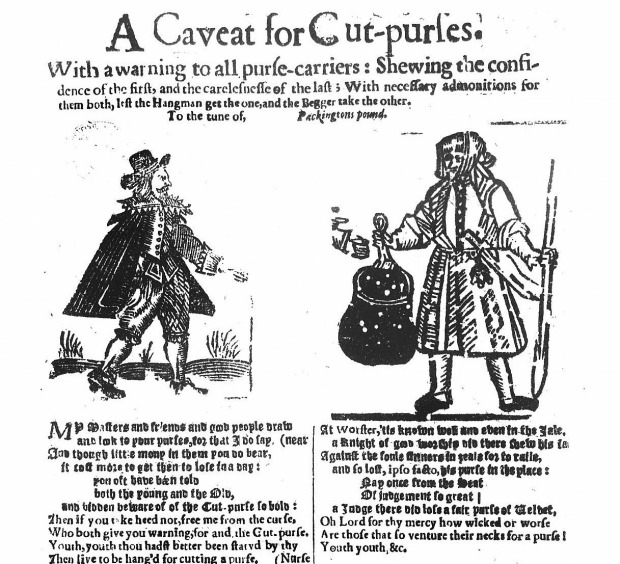
In the sixteenth century and later, the term fig was used to denote the picking of pockets, and the one who did the deed was a figger. There were various classes of figger, depending on skill. The most basic was a nip or cutpurse who simply used a knife to separate money from victim. The more skilled practitioner was a foist. Greene observed in his The Second Part of Conny-catching (1592), that ‘The foist is so nimble-handed, that he exceeds the jugler for agilitie, and hath his legiar de maine as perfectly.’

Leger de maine, or sleight of hand, would still be in use to describe skilled criminality in colonial Australia during the 1840s. By this time, a favoured pickpocket target was a fogle – the elaborate and expensive pocket-handkerchiefs favoured by gentlemen and those who wished to appear as such – and the craft had become known as fogle-hunting or fogle-getting. Fogle lived on in criminal Cant until about 1930 in Britain and perhaps 1940 in the United States, by which time the value of handkerchiefs to the pickpocket had greatly declined. By the early twentieth century pickpockets in Britain, America and Australia were known as whizzers.

Ancient or modern, pickpockets by whatever monikers they used (they were often known as files in the seventeenth century) have always been highly organised with an extensive trade argot to conceal their crimes. In 1552 Gilbert Walker’s underworld exposé, Diceplay, mentioned the figging law, or pick-purse craft, and almost forty years later Robert Greene’s A Notable Discovery of Coosnage provided a helpful list of the craft terms related to ‘the figging law’:

The Cutpurse, a Nip

He that is halfe with him, the Snap

The knife, the Cuttle boung

The pick pocket, a Foin

He that faceth the man (i.e. the victim), the Stale

Taking the purse, Drawing

Spying of him, Smoaking

The purse, the Boung

The monie, the Shels

The Act doing, Striking

By the late seventeenth century the figging law had become the figging lay, but pickpockets were just as active and organised. As early as 1608 Dekker’s The Belmen of London observed of figgers that they parcelled out territories among themselves and their supposedly Biblical secret language was an effective form of communication and identification:

The language which they speak is none of those that came in at the confusion of the Tongues, for neither infidell nor Christian (that is honest) understands it, but the Dialect is such and so crabbed, that seven yeeres study is little enough to reach to the bottom of it, and to make it run off glib from the tongue: by means of this Gibrish, they knowe their owne nation when they meet, albeit they never sawe one another before …

Oliver

In the early Victorian era pick pocketing was perhaps the most common form of urban crime. So profitable had the game become that the best wire toolers and fine toolers became known as the swell mob and sported the trappings of wealth, and lived lives to match, further enhancing the possibility for ill-gotten gain. Dippers attended race meetings, fairs, shows and hangings in droves, running the old tricks along with a few new variations developed for the growth of public transport, such as the railway carriage and the omnibus. Maltoolers, often female, deprived middle class women travellers of their purses a pogue, slipped the booty to their stickman who rapidly exited the vehicle, leaving the maltooler with no incriminating evidence should the victim discover her loss before journey’s end.

At this time, men still used large and valuable handkerchiefs as an accompaniment to the fashionable habit of taking snuff. Known as kingsmen, these decorated and colourful squares of cloth were greatly prized on the black market and easily pulled by even child smatter haulers. As with much other Cant speech, there was a complex hierarchy of butterfly-like descriptions for different kinds of handkerchiefs. A watersman was made of blue silk, a randlesman was white and green, while a white and yellow handkerchief was a fancy yellow. From the middle of the nineteenth century it became fashionable to use black handkerchiefs during mourning, a central Victorian obsession, and these items, known as black fogles, became the most valuable for lifting.

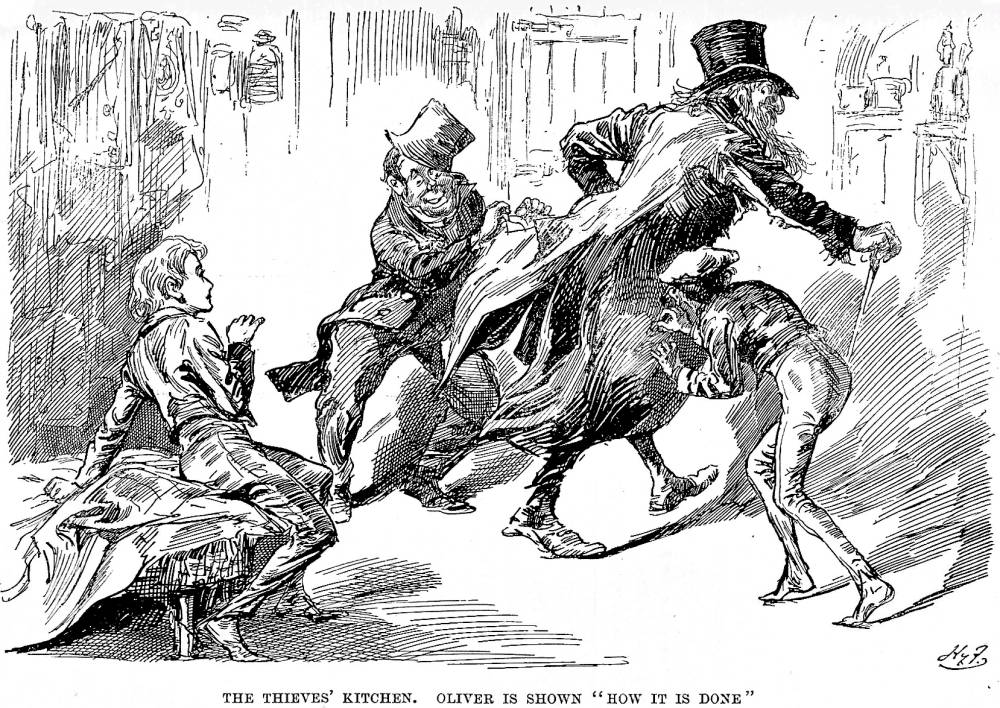
So great were the labour demands of this illicit occupation that children were trained in groups by kidsmen to become buzzers from an early age. The celebrated depiction of such an academy in Oliver Twist is very close to reality. The real-life models for the fictionalised characters of Fagin and the Artful Dodger were commonplace in Victorian England where children were made to practice dipping skills on tailor’s dummies to which small bells were sewn, tinkling at the slightest insensitivity of a small hand. Despite this training, many were caught and sometimes transported.

‘You’ve got to pick a pocket or two’, as the famous song went. Maybe not.


THE SECRET SPEECH FROM THE DEVIL’S ARSE


Mollcutpurse

Moll Cutpurse (BL)

What were the King of the Gypsies and Cock Lorel doing in the Devil’s Arse?

They were meeting in the Derbyshire cave with the memorable name to concoct a new language, the tongue of crime and criminals. The Gypsy King of the 1520s and 30s was Giles Hatherley and Cock Lorel was the mythical head (cock) of the rogues (lorels). Mostly referred to as ‘Cant’, the secret speech they allegedly created would last for centuries and some of its words are still spoken today.

Cant was a fluid amalgam of criminal codewords and street slang of the past and present, enriched with Romani and Parlary. Robert Copland’s Highway to the Spittal-House, published around 1536 contains the first record of this tongue. It included bousy cove, meaning a man under the influence of alcohol, a meaning still preserved in some slang. Another cant term that survived the centuries was patrynge (pattering) cove, meaning one who lived by some line of verbal deceit or other dubious activity. Others did not last so well, including dell for a virgin, pek for eat and jere for shit.

A dictionary of cant by ‘B.E. Gent.’ was published in the late 1690s under the exhaustive title A New Dictionary of the Terms Ancient and Modern of theCanting Crew, in its Several Tribes, of Gypsies, Beggars, Thieves, Cheats, &c. with an Addition of Some Proverbs, Phrases, Figurative Speeches, &c. Useful for all sorts of People, (especially foreigners) to secure their Money, and preserve their Lives; besides being very Diverting and Entertaining, being wholly new. This early example of multi-marketing by whoever the gentlemanly ‘B E’ might have beenechoed the speech of a vast underworld of vagabondage, thievery and deception. A New Dictionary, and the many publications like it, were mostly written to pander to the insecurities and curiosities of the literate classes and so often exaggerated aspects of the lives and language of conny-catchers and sturdy beggars.

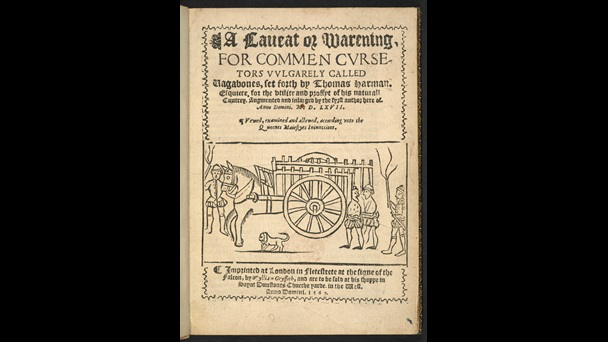
Another early example of this publishing fad was The Third and Last Part of Conny-Catching. With the new devised knavish art of Foole-taking by ‘R G’, Robert Greene, which tells a number of cautionary tales of those who have fallen victim to the wiles of ‘this hellish crew’ who ‘cheate, cosen, prig, lift, nippe and such like tricks now used in their Conie-catching Trade’. The book ends with the warning ‘let each take heed of dealing with anie such kind of people’. There were no police forces at this time, so the honest citizen was generally responsible for his or her own safety and security. Similar works such as Thomas Harman’s A Caveat or Warening for Common Cursetors (1566), The Defence of Begging by ‘Cuthbert Cunny-catcher’ (1592) and Thomas Dekker’s The Belman of London (1608), among many other similar titles allow us to hear this tongue and know something of the lives and crimes of those who spoke it.


image

The Tudor period experienced increasing numbers of masterless men and other vagrants wandering the roads. By the time of Elizabeth’s reign, vagrancy and crime had become major issues for society and government. The poor – which meant the vast majority of the population – were seen as a possible source of disaffection and political violence. This was held to be especially so of those who would not or could not work, preferring instead a life of crime and, it seemed to the authorities and the respectable classes, of dissipation. In 1596 an Order by the Privy Council to the Justices of the Peace of Middlesex described the activities of such people:

a great number of dissolute, loose and insolent people harboured and maintained in such and like noysom and disorderly howses, as namely poor cottages and habitacions of beggars and people without trade, stables, ins, alehowses, tavernes, garden howses converted to dwellings, ordinaries, dicying howses, bowling allies and brothell howses. The most part of which pestering those parts of the citty with disorder and uncleannes are either apt to breed contagion and sicknes, or otherwize serve for the resort and refuge of masterless men and other idle and evill dispozed persons, and are the cause of cozenages, thefts, and other dishonest conversacion and may also be used to cover dangerous practizes.

Almost twenty years earlier the author of a polemical pamphlet had made similar complaints aimed at “Dauncers, Fydlers and Minstrels, Diceplayers, Maskers, Fencers, Bearewardes, Theeves, Common Players in Enterludes, Cutpurses, Cosiners, Maisterlesse servauntes, Jugglers, Roges, sturdye Beggers, &c.”

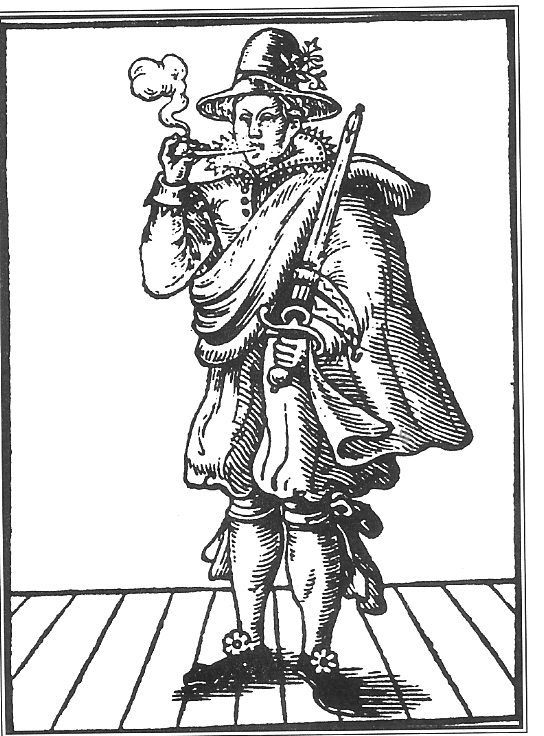
These light-fingered (from at least the 1570s) Canting Crews involved themselves in a bewildering variety of criminal specialisms and sub-specialisms. Cozenage was an Elizabethan version of the con trick, from the name that such people gave to their prospective victims, cousins or cozens. To prig was to steal, also used as a term for the stealer. To liftwas to steal goods from a shop, as in shoplifter, or to practice a form of robbery in which the lifter assumed the identity of a servant to gain access to luggage or other belongings. The nippe was a form of cutpurse thief who stole purses by slicing them from their owners clothing with a knife. A more refined nippe was the foyst, who used pickpocket skills to achieve the same ends.

From the sixteenth century Conie-catching also referred to deceptive practices, conie (conny, connie) being a term for a rabbit or, as we might say today, a bunny, who is caught by a con man. These swindles involved the catchers making the acquaintance of their intended conie, winning his trust then cheating him of his money or other possessions. In one variant or another the word has had a continuing presence in criminal tongues. In the nineteenth century a coney, coney dealeror coniacker was one who dealt in counterfeit money and the term eventually produced con man in all its English-speaking variations during the late nineteenth century and on into the twentieth and the twenty-first. These include con artist,con game, con girl, con woman, con head, con mob, con job, con racket and simply a con.

A slice of Cant from what is usually said to be its first record in print was written by Copland around 1536. While this is a contrived piece of verse conversation, it well suggests the difficulty of comprehending such talk for anyone not schooled in its complexities. The speaker is a porter of whom Copland has asked whether pedlars ‘with broken hose and breche’ pass this way:

Ynow, ynow; with bousy cove maund nace,

Teare the patryng cove in the darkeman cace

Docked the dell for a coper meke;

His watch shall feng a prounce’s nob-chete,

Cyarum, by Salmon, and thou shall pek my jere

In thy gan, for my watch it is nace gere

For the bene bouse my watch hath a coyn …

Copland admits that even he has difficulty understanding this ‘babble’, or ‘pedlyng frenche’.

A-New-Canting-Dictionary-626_b_35_tp

The canting crews (BL)


1808 mermaid tattoo


GREAT CONVICT STORIES

 Here’s the cover and Prologue from my just-released new book, Great Convict Stories:


LASHLAND
I saw a man walk across the yard with the blood that had run from his lacerated flesh squashing out of his shoes at every step he took. A dog was licking the blood off the triangles, and the ants were carrying away great pieces of human flesh that the lash had scattered about the ground. The scourger’s foot had worn a deep hole in the ground by the violence with which he whirled himself round on it to strike the quivering and wealed back, out of which stuck the sinews, white, ragged, and swollen.
The infliction was 100 lashes, at about half-minute time, so as to extend the punishment through nearly an hour. The day was hot enough to overcome a man merely standing that length of time in the sun, and this was going on in the full blaze of it. However, they had a pair of scourgers who gave each other spell and spell about, and they were bespattered with blood like a couple of butchers.’