Sea monsters have been seen for at least two thousand years. As well as giant squids and krakens, mermaids have featured in many legends and sightings. Hybrid beings of human female and fish, modern mermaids are generally presented as Disneyesque beauties rather than the often savage and dangerous sirens and other hybrids that appear from antiquity into at least the early modern era.
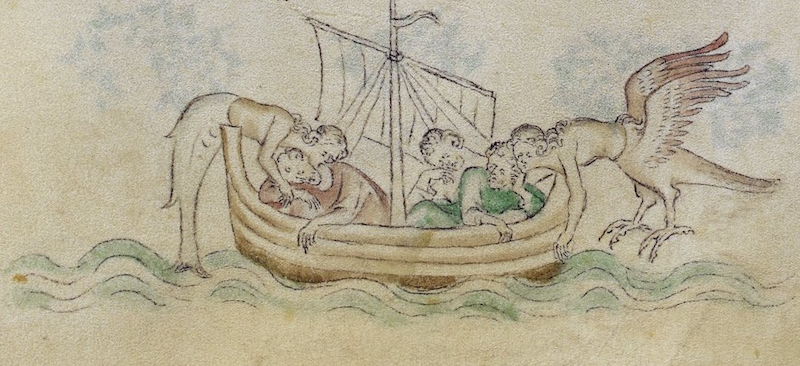
The year 1527 was a particularly bad one for mermaid attacks, it seems. According to Laurence Andrew’s, The Noble Lyfe and Natures of Man of Bestes, Serpentys, Fowles and Fisshes (British Library MS Royal 2 B VII, f. 97r):
The mermayde is a dedely beste that bringeth a man gladly to dethe. Frome the navyll up she is lyke a woman with a dredfull face, longe slymye here a grete body & is lyke the egle in the nether parte, havinge fete and talentis to tear asonder suche as she geteth. Her tayl is scaled like a fisshe and she singeth a maner of swete song and therwith deceyveth many a gode mariner for whan they here it they fall on slepe commonly & than she commeth and draweth them out of the shippe and tereth them asonder… but the wyse maryners stoppe their eares whan they se her for whan she playth on the water all they be in fear & than they cast out an empty tonne to let her play with it tyll they be past her. This is specifyed of them that have sene it.
These mermaids were ugly and murderous, singing passing sailors to sleep before tearing them asunder. Fortunately, the slimy-haired beings don’t seem to have been very bright and were easily distracted from their murderous intent by sailors throwing a barrel into the sea for the creatures to play with. How the barrels might be cast while holding one’s hands over one’s ears to ward off the singing spell was not specified.
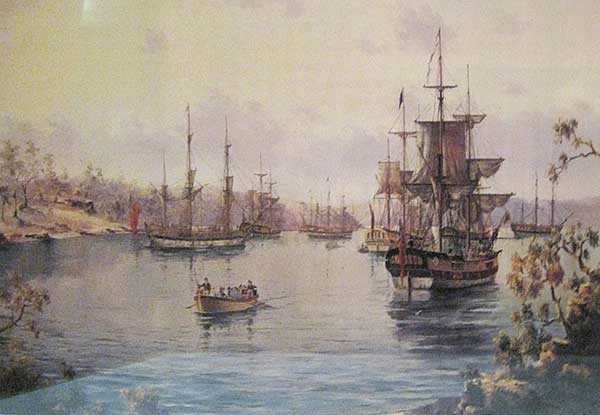
The women convicts of the First Fleet’s Lady Penrhyn went ashore at Sydney Cove on February 6, 1788. Most had seven or fourteen year terms and there were a few ‘lifers’ among them. The surgeon aboard the former slave ship that had brought them to the ends of the earth, Arthur Bowes Smyth, wrote ‘The Men Convicts got to them very soon after they landed, & it is beyond my abilities to give a just discription [sic] of the Scene of Debauchery & Riot that ensued during the night.’ According to subsequent writers, a wild orgy of rum, sex, storm and lightening followed, a fitting act for the foundation of a colony of convicts.
Popular as this story has become, in one version or another, historians have found little evidence of it ever happening. Bowes Smyth was nowhere near the scene of the alleged orgy, he was on the Lady Penrhyn quite a long way out in the harbour. None of the other keen diarists of the First Fleet, such as officers Watkin Tench or Ralph Clark seem to have noticed the orgy either. They certainly did not mention it in their accounts, an unlikely omission, especially for Ralph Clark who believed women convicts were all ‘damned whores.’
Why Bowes Smyth believed that ‘Debauchery & Riot’ occurred as soon as the women set foot in New South Wales is worth considering. He was certainly glad to see the women leave the ship: ‘we had the long wish’d for pleasure of seeing the last of them’, he wrote. The Lady Penrhyn’s voyage from England had been tedious and troubled with illness, lack of food and indiscipline. Many of the women were prostitutes and suffered from venereal disease. Although attempts were made to keep men and women separate, cohabitation quickly became commonplace. In April 1787, a month or so before they set sail for Botany Bay, five women were chained up for having relations with crewmen. There is no record of the sailors being punished.
During the voyage seventy year-old Elizabeth Beckford died of ‘dropsy’, or oedema, her bloated corpse buried at sea. She was not the last. Jane Parkinson died as they sailed from Cape Town to New Holland, as Australia was often known. Off Van Diemen’s Land the lumbering transport was lashed by a storm so fierce that the women fell to their knees praying for deliverance. Short of food once again, the Lady Penrhyn finally made Botany bay in late January 1788, only to discover that Arthur Phillip had decided the place was unsuitable for settlement. He had departed for Port Jackson.
By the time the Lady Penrhyn finally anchored in the great body of water that would become known as Sydney Harbour, the 101 women and more than 70 male crew and Marines had been cooped up on the thirty by eight metre vessel, in some cases for over a year. The women were flogged, chained, punished with thumb screws and had their heads shaved bare. Bowes Smyth wrote in his journal:
‘I believe I may venture to say there was never a more abandon’d set of wretches collected in one place…The greater part of them are so totally abandoned & callous’d to all sense of shame & even common decency that it frequently becomes indispensably necessary to inflict Corporal punishment upon them…’[i]
The doctor was clearly not well disposed towards his female charges. When he finally did ‘see the last of them’ he was predisposed to assume that they would behave in what he considered their typically debauched manner. Bowes Smyth was a product of his time and circumstances, as were all those who arrived on the First and subsequent fleets.
The double standard that masqueraded as respectability and punished only women for acts that involved a male partner continued in the colony. Four of the convict women of the Lady Penrhyn became the de facto partners of officers and the Judge Advocate. Esther Abrahams and Lieutenant George Johnston began what would become a lifelong relationship during the voyage. They did not marry for another quarter of a century.
Bowes Smyth also recorded an incident when one of the sailors was caught in the women’s tents. His hands were tied and he was publically drummed out of camp to the tune of ‘The Rogue’s March’, a ceremony used for dishonorable discharge from the army and usually followed by a flogging.
These more domestic relationships and official attempts to maintain propriety are not the stuff of myth. They lie forgotten in history while the more salacious story lives on. Historians have been trying to scotch the orgy myth ever since one of their own mistakenly set the yarn spinning in 1963. Manning Clark wrote of it though soon withdrew the assertion after a more careful look at the available evidence. But it was too late. The lewd rumour neatly captured popular views of early colonial society and the image of degraded convicts that had grown up over the generations. ‘The orgy that wasn’t’ gathered further currency from a procession of later writers and television shows repeating and embellishing the alleged scene.[ii] A yarn of ribald abandonment still resonates with a common view of the founding of Australia. No matter how often and convincingly historians demolish the myth, many still prefer to believe it.
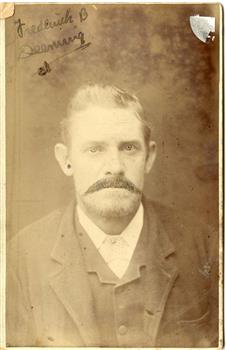
Frederick Deeming with a moustache drawn on the image in ink, Victoria Police Museum
Could he have been ‘Jack the Ripper? The remarkably evil life of Frederick Deeming is one of the most chilling stories of Australian, and global, crime. Even if he did not commit the Whitechapel murders of 1888, his known slayings make him one of the worst serial killers of the nineteenth century.
Beaten by his unstable father and imbued with fear of damnation by his God-obsessed mother, Frederick Bailey Deeming got off to a bad start in life almost as soon as he was born in Leicestershire, England in 1853. He was already known as ‘Mad Fred’ when he went to sea around the age of sixteen and soon became a cunning criminal. Fraud and false pretences were his favoured offences, though he also thieved from time to time.[i]
With an ability to turn on the charm and a persuasive way with words, the ruggedly handsome young sailor with blue eyes, fair hair and a ginger moustache had little trouble forming serious relationships with respectable women. In 1881 he married Marie James in England. By the middle of the next year he was in Sydney where he had jumped ship and started work as a plumber and gas fitter. By the time Marie arrived to join him he had already served a six-week sentence for stealing gas-burners. The couple would have four children over the next few years during which Deeming briefly ran his own plumbing business until he was declared bankrupt and serving two weeks for committing perjury. In January 1888 he turned up, alone, in Cape Town, South Africa where, using the alias Henry Lawson, he conducted several successful swindles.
Back in England in 1890, and still calling himself Henry Lawson, Deeming bigamously married Helen Matheson, using the proceeds of a fraud to pay for the wedding. Soon after, he had to quickly leave the country and escaped to Uruguay, South America. He was later arrested there, returned to England and given nine months in prison for fraud, though he avoided any charge of bigamy.
After release in 1891, Deeming took another alias, Albert Williams, and rented a house in Rainhill, Lancashire. By this time, his deserted wife and children had tracked him down and Marie revealed her husband’s bigamy to Helen. Apparently too embarrassed at the social stigma this would bring upon her, Helen did not inform the authorities. Deeming, now fearing what else Marie night reveal about him, made an elaborate pretence of reconciliation and convinced her and the children to join him at Rainhill. It was a fatal error.
Shortly after the reconciliation ‘Williams’, now posing as an army officer, married for a third time. The unlucky woman was Emily Mather who, after the expensive wedding, sailed with her new husband to India where he said he had a posting. But Deeming changed the arrangements and the newlyweds went to Melbourne instead. Here they rented a house in Windsor. Always ostentatious, even if mostly with other peoples’ money, the outwardly charming ‘Druin’, as Deeming was now styling himself, soon became well known in the suburb. But in January 1892, he and his third wife disappeared.
Now, a chain of events began that would lead to Deeming’s eventual downfall. The next tenant in the Windsor house complained of a foul smell in the premises. A hearthstone in the bedroom was pulled up to reveal Emily’s badly decomposed remains. She had been beaten around the head and her throat slashed. In the house police also found a copy of the invitation to the wedding banquet of A O Williams and Helen.
In a little over a week, the police tracked Deeming down to the Western Australian mining town of Southern Cross where he was calling himself Baron Swanston and posing as an engineer. After murdering Emily he had committed some further frauds and sailed to Sydney. There the apparently personable murderer soon convinced another young woman to become his fiancée. He then left for Western Australia, arranging with her to follow him when he was settled.
Deeming’s arrest ignited what would become a national and international press sensation. An English journalist used details from Australian sources to backtrack Deeming to his previous rented premises in Lancashire. The authorities there were prompted to investigate. Under the kitchen floor they found the bodies of Marie and the four children, all with their throats cut. The enormity of Deeming’s crimes was now apparent.
The press certainly thought so and went into one of the regular ‘feeding frenzies’ that have become all too familiar since. A kind of mass public hysteria arose, known as ‘Deemania’. The accused was called ‘a human tiger’ and his actions dubbed ‘the crime of the century’. He would also be described, inaccurately, as ‘ape-like’ and a forensic expert would later claim that his skull was similar to that of a gorilla.[ii]
Although entitled to the presumption of innocence, Deeming was effectively tried and found guilty in the newspapers of the English-speaking world. He was tried for the murder of Emily under the name of ‘Williams’. His defence, which included Alfred Deakin, destined to be an early Australian Prime Minister, argued that the accused had been denied a fair trial, which was probably true. Deeming was almost certainly an epileptic, having suffered from fits for much of his life. He may also have been a schizophrenic fantasist who actually became the identities he invented as he committed his crimes. But after an unwise address to the jury from the dock and some unconvincing psychiatric testimony, he was quickly found guilty and sentenced to death.
After being refused leave to appeal by the Privy Council, Edward Bailey Deeming, alias Albert Williams and at least four other pseudonyms, was hanged on 23 May 1892. Always a poser, he walked to the gallows smoking a cigar. His last words were reportedly ‘Lord, receive my spirit’. Outside the prison wall, twelve thousand people assembled to await the news that the monster was dead.
His death was celebrated in an English children’s street rhyme based on the then popular belief that Deeming was Jack the Ripper:
On the twenty-first of May, Frederick Deeming passed away; On the scaffold he did say — “Ta-ra-da-boom-di-ay!” “Ta-ra-da-boom-di-ay!” This is a happy day, An East End holiday, The Ripper’s gone away.[iii]
Deeming was undoubtedly guilty of the horrendous murders of his children and two wives, with the likely intent to kill another. But could he have been ‘Jack the Ripper?
In the overheated press speculations on the case, the fact that Deeming’s movements in 1888 were murky, together with the grisly nature of his crimes, led to speculation that he might have been the Whitechapel killer. Some credibility was attached to the claim when Deeming told fellow prisoners that he was the ripper and also expressed a murderous dislike of women. This was based on his venereal infection, probably of syphilis, contracted from a prostitute during his extensive travels. When directly questioned about this on the eve of his execution, deeming refused to confirm or deny the possibility.
But the theory has so many flaws that it is taken seriously by very few.[iv] A major problem is that Deeming’s murders bore little resemblance to the butchery of most of the Whitechapel victims. Nor were the women he killed prostitutes. Unlike the Whitechapel murderer, Deeming was not known to have taken trophies of his victims. Finally, wherever Deeming was during those bloody months of 1888 – probably South Africa – there is no evidence that he was anywhere near London, let alone the east end.
But there is no doubt that he slew Emily, the crime for which he eventually hanged, and that he also killed Marie and his children. He never confessed to any of these murders but while in prison during the lead up to his trial and as he awaited execution, Deeming wrote his autobiography, later destroyed, and poetry, which included the lines:
[iv] Over fifty books have been written about Deeming, often revolving around the unlikely belief that he was Jack the Ripper. See Worldcat Identities, ‘Deeming, Frederick Bailey 1853-1892, https://worldcat.org/identities/lccn-n2007021186/, accessed July 2022.

 GRISTLY HISTORY