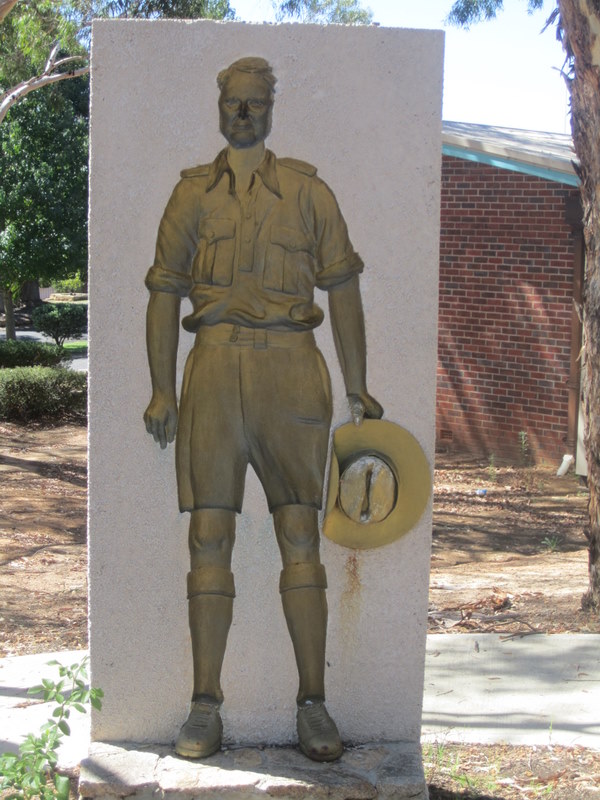
Sandakan death march memorial, Boyup, Western Australia
This post briefly outlines the origins, development and significance of the Anzac legend for Australians[i]since 1915. The initial reception of Anzac as symbolizing ‘the birth of a nation’ is followed by an outline of the development of the concept during the First World War and over the decades since. The current identification of Anzac with popular perceptions of national identity is briefly highlighted and the article concludes by noting the early and continuing legislative proscriptions surrounding the use of the term ‘Anzac’ and its continuing acceptance by many Australians as the central element of national identity.
Introduction
Although the Anzac tradition originated in 1915, there was little serious scholarship on the subject until the 1960s.[ii] Since then there has been ongoing interest by historians, anthropologists, sociologists and creative artists.[iii]While Anzac was widely said to be losing its popular appeal from the late 1960s, in the late 1980s and early 1990s there was an unexpected upsurge of community interest in the Anzac tradition – or ‘legend’, ‘myth’, ‘spirit’ – it is called all these things – and scholars have sought to understand this.[iv]Today, Anzac is very much a popular Australian institution and observance, with thousands of Australians journeying to sites of related significance around the world to commemorate its day or to visit the places in which it was created and developed. It has been described as a secular national religion,[v]an indication of its cultural power. As well as having a popular dimension, Anzac has long been the subject of political and official interest, intensively so in the lead-up to the centenary of the Gallipoli landings in 2015.
‘The Birth of a Nation’
Anzac has become a central aspect of Australian national identity and military history since the term was coined in 1915. An acronym of ‘Australian and New Zealand Army Corps’, the exact circumstances of the word’s origin are murky, with claims for its invention made by and for Sir William Birdwood (1865-1951), General Sir Ian Standish Monteith Hamilton (1853-1947) and a Lt A.T. White RASC. Whoever invented it, the term rapidly came into wide use during the Gallipoli campaign.[vi]It has remained in both official and popular parlance ever since.
The term moved beyond its origin as a military and clerical convenience to become a signifier of Australian nationhood and cultural identity in association with the reception of the Gallipoli landings from April 25, 1915. A combined Australian and New Zealand force began landing on the Gallipoli peninsula at the start of the ill-fated Dardanelles campaign at dawn on April 25. Although under British control, this was the first large-scale military action of the Commonwealth of Australia, formally constituted from a number of separate colonies in 1901. When press reports of the achievements of the Australians and New Zealanders reached Australia, they painted a glowing picture of courage and sacrifice expressed in the conventional views of the time about nationhood and military glory. On May 8, 1915 Australian dailies published a report of the Gallipoli landings by the English journalist Ellis Ashmead-Bartlett (1881-1931). He had witnessed the landing from a ship out at sea but nevertheless provided a laudatory report that read, in part:
‘There has been no finer feat in this war than this sudden landing in the dark and the storming of the heights, and above all, the holding on whilst reinforcements were landing. These raw colonial troops in these desperate hours proved worthy to fight side by side with the heroes of Mons, the Aisne, Ypres, and Neuve Chapelle. …[vii].
It was another nine days before Australia heard from the official war correspondent, Charles Bean (1879-1968). His account had been held up by military red tape but it confirmed the glory already admired by Bartlett. All the more so as Bean took part in the actual landing: ‘They all fought fiercely and suffered heavily; but considering that performed last Sunday, it is a feat which is fit to rank beside the battle of the heights of Abraham.[viii]
An Australian public, largely eager for news of their troops generally received these glowing accounts rapturously. The idea that this event was the real ‘birth of a nation’ was immediately established in the public discourse and organisations and communities began searching for ways to signify the moment and the meanings they attributed to it. To some extent, pre-existent attitudes derived from the pioneering era, including an emphasis on masculine prowess, manual labour and anti-authoritarianism, provided a cultural basis for the reception of the Gallipoli landings.
Soon, groups and committees in suburban and regional Australia embarked on memorial projects to mark the magnitude of the landings and the new concept of Anzac. A memorial was erected in South Australia in 1915. Early in 1916 an ‘Anzac Cottage’ was erected on donated land and with donated goods and labour in a Perth suburb through the efforts of the local council. It was for a returned ‘Anzac’ and his family to dwell in.[ix]Soon, a ‘homes for heroes’ movement was in full swing in many parts of the country, together with a wide range of usually patriotically inspired activities in support of the Australian troops, inspired by widespread commemorative sentiment. This was fuelled by pride in the reported actions of Australian troops, by personal and family mourning and by many community activities in support of the war effort by churches, charities and other groups.
As the war progressed and casualties mounted on the Western Front and in the Middle East, these meanings of Anzac became increasingly acute. More and more families lost loved ones, became involved in the ever more intense war effort and, like all civilian populations of the various theatres of combat, became enmeshed in the new realities of total war, even if in Australia’s case, at a considerable distance from most of the fighting.
Development through the Great War
A central figure of the Anzac tradition soon evolved in the shape of the civilian foot soldier, known from 1917 as the ‘digger. Roughly synonymous with the French ‘Poilu’ and the British ‘Tommy’, the digger is an idealised Australian infantryman who conflates the tough but usually compassionate soldier and the mythic aspects of the bushman and larrikin. The bushman image derives from the frontier pioneering experience and is a stereotype white, male manual bush worker of independent spirit. These attributes are overlain with those of another stereotypical Australian figure, the larrikin. Primarily a phenomenon of developing cities from the mid-nineteenth century, the larrikin image was that of a rough, fun-loving and irreverent working class male youth.
While the realities of the bushman and larrikin figures were often less than positive, their romanticised attributes quickly became fused in the digger image, particularly through popular literature, illustration and in folklore. The outcome was a characteristically ambivalent figure who was not a soldier yet fought hard and well; did not take military rank and hierarchy very seriously and was more than a bit of a gambler, brawler, drinker and womaniser.[x]Despite these pardonable blemishes, the digger was a genuine ‘rough diamond’ who represented and actualised all that was believed to be best about the typical Australian character. The essential equation was simple but powerful: the digger was Anzac and Anzac was the Australian spirit, ethos and identity.
In the unprecedented experience of total warfare, arguably sharpened by the effects of large distance, Australians remaining on the home front immediately sought to find ways to recognize and to commemorate the sacrifice of their ‘boys’ in faraway Europe and the Middle East. The first attempt to publicly acknowledge the significance of the Gallipoli landings took place on October 1915 when the South Australian (Labor) government decided to change the Labour Day celebration into ‘Anzac Day’. This was followed in 1916 by official commemorative events in London, among serving Australian troops abroad and around the country in citizen-generated memorial services, marches and related events. In 1917, 1918 and 1919, April 25 was increasingly observed at home and abroad. Through these acknowledgments, the digger became an increasingly potent symbol of Australia and its most cherished ideals, aspirations and myths.
The loss of over sixty-one thousand soldiers and the wounding of almost 170 000 more had an especially broad impact in Australia. Very few families were unaffected by these tragedies and, in many cases, the ongoing burdens of repatriation. While the digger was in his contextual origins a military figure, his links with the legend of the busman and the larrikin and his primarily civilian status (all Australian troops were volunteers), also made him a civic figure. In essence, a culture hero whose warrior features dovetailed with the contemporary need for a heroic national stereotype.
This figure conveniently combined the young country’s need for military glory with existing popular notions of national and cultural identity, derived from historical experience and folklore. In his official and military guise, the digger appears as a tough, no-nonsense soldier exemplifying the Australian versions of combat courage, loyalty, sacrifice and duty. In his folkloric form, the digger is an offhanded, anti-authoritarian rascal, uncaring of military discipline and etiquette and with the attitude of an average ‘bloke’ just getting on with the job of fighting wars on behalf of the national population rather than the generals and the politicians.
Since the Great War
In the immediate postwar years, Anzac evolved into Australia’s most important cultural discourse. Once politicians – at first slowly – realised this, the tradition became politicised. It evolved along with the modes of commemoration felt to be appropriate for the observance of Anzac Day as a national public holiday, with the building of the elaborate shrine and museum known as the Australian War Memorial. Returned soldier organisations, notably the entity now known as the Returned and Services’ League (RSL), also played a central role in the evolution of Anzac, particularly in controlling participation in public observance of the tradition and in proselytizing a particular version of it in schools, the community and, for a considerable period, among state and federal governments.[xi]There has also been ongoing military interest in a valuable symbol of fighting spirit, mobilised again in World War 2 and in every conflict in which Australia has since been involved. Despite the official appropriation of Anzac, it also – incomprehensibly and regrettably to some[xii]– remains a popular manifestation of national sentiment.
Despite ups and downs in Anzac Day attendances and numerous controversies in the years since, Anzac has generally retained this popular understanding and appeal, reinforced through school curricula, the annual observances on 25 April, the central institutional presence of the Australian War Memorial and endless speeches, articles, books, films, television shows and other effusions. Anzac Day has become a de facto national day for many, perhaps most Australians. While these developments have expanded and intensified since the end of the war, the basic significance of Anzac was initiated between 1915 and 1919, by which time Australian troops had been finally repatriated.
Because the casualties and aftermath of World War 1 had such a deep impact on Australian society, a large number of Australians with no direct connection to the experience of World War 1, or even World War 2, have discovered links with these pasts through the burgeoning family history movement. An Anzac ancestor has become as prized an antecedent as a transported convict in the popular discourses of national identity.
Conclusion
The intriguing ambivalence of Anzac has been briefly outlined here, mainly in its origins and the first few years of its existence. A full appreciation of its significance for Australians requires a longer view than can be given within the chronological framework of the First World War. However, the importance and continuing power of this cultural tradition can be indicated through some actions of the Commonwealth government. From 1916, the term ‘Anzac’ was officially protected from unauthorised uses for commercial, partisan or other unsuitable purposes. This legislation has been amended from time to time since, always with the intention of strengthening it.[xiii]Anzac thus remains an official term and concept as well as a popular focus for what many Australians continue to understand as their national identity. And it remains controversial.[xiv]But despite the best efforts of historians and other scholars to divest Anzac of its considerable mythology, broad community acceptance of these myths ensures its continuing touchstone for a particular but potent idea of Australian cultural identity.
Selected Bibliography
Beaumont, Joan: Broken Nation: Australians in the Great War, Sydney, 2013.
Butler, A.G: The Digger: A Study in Democracy. Sydney 1945.
Cochrane, P: Simpson and the Donkey: The Making of a Legend. Melbourne 1992. New edn. 2013.
Ely, Richard: The First Anzac Day: Invented or Discovered? in: Journal of Australian Studies17 1985.
Fewster, Kevin (ed):Gallipoli Correspondent: The Frontline Diary of C.E.W. Bean. Sydney 1983.
Flaherty, C. & Roberts, M: The Reproduction of Anzac Symbolism, in: Journal of Australian Studies24, May 1989.
Gammage, Bill: The Broken Years: Australian Soldiers in the Great War. Canberra 1974.
Gammage, Bill: The Crucible: The Establishment of the Anzac Tradition, 1899-1918, in McKernan, Michael & Browne, Margaret (eds), in: Australia Two Centuries of War and Peace. Canberra/Sydney 1988.
Gerster, Robin: Big-Noting: The Heroic Theme in Australian War Writing. Melbourne 1987.
Inglis, K.S: The Australians at Gallipoli, parts 1 & 2, in: Historical Studies14:54, 1970 – 14:55 1970.
Kent, David: The Anzac Book and the Anzac Legend: C.E.W. Bean as Editor and Image-maker. Historical Studies21:84, April 1985.
Robertson, John: Anzac and Empire: The Tragedy and Glory of Gallipoli. Port Melbourne 1990.
Peter Stanley: Bad Characters: Sex, Crime, Mutiny, Murder and the Australian Imperial Force, Sydney, 2010.
Thomson, Alistair: Anzac Memories: Living with the Legend. Melbourne 1994.
Winter, Dennis (ed):Making the Legend: The War Writings of C.E.W. Bean. St Lucia 1992.
References
i Used here in the lower case form that denotes the term’s distinctiveness from its originating upper case acronymic form of ‘ANZAC.’ Some argue passionately that the word should always be completely capitalised, another indication of the importance of all things ‘Anzac’ in Australian society.
ii Anzac is also important for New Zealand history and culture, if in a less acute form. See Hopkins-Weise, Jeff: Blood Brothers: The Anzac Genesis. Kent Town SA 2009.
[iii]Inglis, Ken: The Anzac Tradition, in: Meanjin24 1965; Serle, Geoffrey: The Digger Tradition and Australian Nationalism, in Meanjin24:2 1965.
[iii]There was some anthropological ethnography of Anzac Day observances in the 1970s and 80s, see Kitley, Philip: Anzac Day Ritual, in:Journal of Australian Studies4, 1979, pp. 58-69; Sackett, Leigh: Marching into the Past: Anzac Day Celebrations in Adelaide, in: Journal of Australian Studies17 1985; Peter Weir’s film Gallipoli(1981), the play The One Day of the Year (1958) by Alan Seymour, among many lesser-known artistic representations and productions.
[iii]Scates, Bruce: Returnto Gallipoli: Walking the Battlefields of the Great War. Melbourne 2006; Seal, Graham: Inventing Anzac: The Digger and National Mythology. Brisbane 2004; Seymour, Alan/Nile, Richard: AnzacMeaning Memory and Myth. London 1988. Scates, Bruce et al: Anzac Day at Home and Abroad: Towards a History of Australia’s National Day, in: History Compass10: 2012, 523–536. doi: 10.1111/j.1478-0542.2012.00862.x.
[iii]Shaw, Brian: Bush Religion: A Discussion of Mateship, in: Meanjin Quarterly12:3 1953; Inglis, Ken, assisted by Jan Brazier: Sacred Places: War Memorials in the Australian Landscape, Carlton, Vic. 1998; Seal, Graham:Anzac: The Sacred in the Secular in Paranjape, Makarand (ed), in: Sacred Australia: post-secular considerations. Melbourne, 2009.
[iii]See Bean, C E W (ed): The Anzac Book, p. ix; Joan Hughes (ed): Australian Words and their Origins. Melbourne 1989.
[iii]Ashmead-Bartlett’s dispatch was published in Australian newspapers from 8 May, 1915.
[iii]Bean’s report was transmitted through the Prime Minister’s Department in The Commonwealth of Australia Gazette39, 17thMay 1915 ‘… published for general information.’
[iii]Seal, Graham: Remembering and forgetting ANZAC Cottage: interpreting the community significance of Australian War Memorials since World War in Bennett, et al (eds), in: People, Place and Power: Global and Regional Perspectives. Perth 2009.
[iii]Stanley, Peter: Bad Characters: Sex, Crime, Mutiny, Murder and the Australian Imperial Force. Sydney 2010.
[iii]Hills, L: The RSSILA. Its Origin, History, Achievement and Ideals, Melbourne, 1927; Kristianson, G.L: The Politics of Patriotism: The Pressure Group Activities of the Returned Servicemen’s’ League. Canberra 1966; Ross, Jane: The Myth of the Digger. Australian Soldiers in Two World Wars. Sydney 1985.
[iii]Lake, Marilyn et al: What’s Wrong With Anzac? The Militarisation of Australian History. Sydney 2010.
[iii]See Anzac Day Act 1995 http://www.comlaw.gov.au/Series/C2004A04877and Protection of the Word ‘Anzac’ Regulations http://www.comlaw.gov.au/Series/F1997B02175, which also contains some details of previous legislation governing the use of the word ‘Anzac.’
[iii]Brown, James: Anzac’s Long Shadow: The Cost of our National Obsession. Melbourne 2014.


 GRISTLY HISTORY