UNPLEASANT LETTERS FROM NED LUDD AND CAPTAIN SWING

Ned Ludd


The businessman who received the following note from Ned Ludd would have been in no doubt that the writer intended to do serious harm.

Mr H

at Bulwell

Sr,

Sir if you do not pull don the Frames

or stop pay [in] Goods onely for work

extra work or m[ake] in Full fashon

my Companey will [vi]sit yr machines

for execution agai[nst] [y]ou–

Mr Bolton the Forfeit–

I visitd him–

Ned Lu[d]

Kings [illegible]

Nottinghm—Novembr 8 1811

It was one of many similar semi-literate threatening letters sent to factory owners and employers of weavers by Ned Ludd. The letter commands Mr H to stop paying his weavers in ‘truck’, meaning in poor quality goods instead of cash, one of the frequent complaints of the workers. Or else…

Another letter from a Nottinghamshire knitter was sent to Richard Dennis, farmer and framework knitter, in 1819:

Richad Denniss

If you keep that Rouge in you house Ned shall viset you and we shall be acpt too give you A little could led and you cattle too if you dont get shoot ove him very soon and Need will set you all on Fire And you Promess Need will send them too Hell and Hall ove you too and you sheep Ned will ham string And if you don thay will send me word in the course ove of day

March the 12

I GENRALL LUD.

But Ludd, also sometimes titled ‘General Ludd’, as here, and ‘Captain Ludd’, did not exist. He was a mythical leader of a diffuse group of mainly northern English insurrectionaries angry at the threat to their livelihoods posed by the introduction of labour-saving machines into the framework knitting industry. ‘Luddites’, as they came to be known, formed clandestine groups who swore secret oaths and destroyed and damaged the feared new machines that were taking their jobs. The sabotage tactics of the Luddites failed, many were executed, imprisoned or transported. But their actions, and consequences, did bring their plight to the attention of the wider public.

In 1830, much the same situation, this time in agriculture, triggered the most serious rioting, mostly across southern England. Led by a ‘Captain Swing’, rural workers rose in large numbers to break threshing machines and to demand what they thought were their rights. They also said so in caustic correspondence, such as this note delivered to King’s College, Cambridge on December 8, 1830:

Dr Agnus

The college that thou holdest shalt be fired very shortly. Thou shalt here further from me when it is in flames.

Swing

Head Quarters

A more detailed and oddly polite letter detailing the rioters’ grievances arrived at the Goodwood estate of the Duke of Richmond in December 1830:

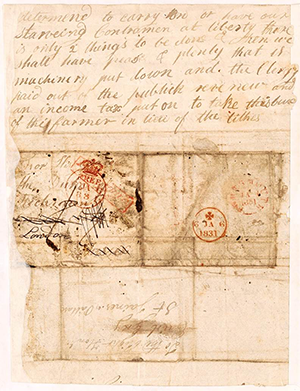
We beg to say that if the sentences of the men in kent & all others for rioting is not reduced to 3 months imprisonment & all those taken heairafter to 1 months ditto all the woods to a hedge stick on the duke of richmans estate with that of the other ministere [of] the crown lands magestrates constables &C engaged in takeing & triing the said men shall be all burnt up even to a furse bush but we promis faithfully if you comply with our request we will refrain from it all we want is Work & fair wages don’t think that the reward will induse our party to split we have all put our hands to the match so we cannot fear each other and are determind to carry on or have our starveing Contramen at liberty there is only 2 things to be done & then we shall have pease & plenty that is machinery put down and the Clergy paid out of the publick revenew and an income tax put on to take this burden of the farmer in lieu of the tithes’

swing 2 goodwood-mss-1446-fa18-backThese revolts were all put down with the ruthless force usually unleashed by the British establishment against those who dared challenge it. Rioters were perceived and presented as dangerous revolutionaries and criminals rather than starving workers. Some were shot, some hanged, many imprisoned and transported. Mechanisation of their livelihoods proceeded apace.

Neither Ned Ludd or Captain Swing existed. They were convenient fictions drawn from the traditions of underclass revolt stretching back to the Peasants’ Revolt of 1381 in which a shadowy character named ‘Jack Straw’ appeared. At least one of the rebels in this revolt took this name, but historians are uncertain if such a person ever existed. His name is certainly suspiciously folkloric!

To some extent, the threatening letters, the dressing up and the blackened faces of the rioters can be seen as part of the ‘theatre of protest’. This does not mean that the rioters’ issues were not genuine and serious, but that there was an underlying assumption that the societal ties between workers and their employees would deliver justice. Naïve as this seems, a ‘moral economy’ as historian E P Thompson famously perceived, underlay the economic transactions between workers and employers.

The tragedy of this perception by the rioters – weavers or farm labourers – was that it was no longer true (if it ever was in any effectual rather than symbolic sense). Their bosses had moved on from the traditions and assumptions that underlay the moral economy ideal and embraced the improving agrarian mode of capitalism. Now, workers were no longer essential parts of a rural community but simply one element in a broader, more predatory economy in which calculations were made on the basis of profit and loss and not any obligation that the better-off might once have had towards their less affluent neighbours.


SOURCES:

Home Office archive (HO 42/118

The Nottingham Review 6 August 1819 – the sender of the letter had a grudge against the ‘Rouge’ mentioned

National Archives Catalogue ref: HO 52/6

‘Swing Riots letter’, 2 Dec 1830, West Sussex Record Office, Goodwood Mss 1446 fA18


BANDIT LANDS 2 – WITH HIS PISTOL IN HIS HAND: GREGORIO CORTEZ

Gregorio_Cortez_Pictured_in_1901

Gregorio Cortez Pictured in 1901


Perhaps the most surprising fact in the extensive folklore that surrounds the figure of Cortez is that his outlawry lasted only ten days. Action-packed though those ten days were, they would perhaps only have given rise to such a legend in a region like the Border. While the existing legendry of Cortinas was strong in the years immediately after the earlier bandit’s death, the discontents and tensions that originated the legend and kept it alive were also still smouldering.

The incident that turned Gregorio Cortez from an obscure small farmer and vaquero was not unlike that which had set Cortinas upon his influential path. Nor was it unlike the situation in other places, such as Australia, where stock theft was the background to many bushranging outbreaks. Cortez and his family had been involved in stealing horses, which explains why Sheriff W Morris and two deputies wanted to question him about a missing horse one day in June, 1901. The lawmen arrived at the small plot Cortez and his brother, Romaldo, rented near Kennedy. According to the court evidence there were language difficulties during the questioning which led the Sheriff to draw his pistol and fire on the brothers, wounding Romaldo. Cortez returned fire and killed the Sheriff.[i] Cortez fled on foot and began walking towards Austin, eighty miles away.

A manhunt was quickly initiated and Cortez’s wife and children, his mother and sister-in-law were illegally gaoled, a tactical error frequently made by authorities during episodes of outlawry. During the manhunt Cortez shot and killed another two lawmen and embarked on another walking feat, this time a 100-mile journey from Belmont towards Laredo. With the newspapers referring to Cortez as ‘an arch-fiend’ and a $1000 reward on his head, Mexican-Americans instead saw Cortez as one of their own making a heroic stand against American oppression and injustice. At the same time, Anglos in a number of towns rioted and a number of Mexican-Americans were killed. Despite this there was some admiration in the English language press for Cortez’s endurance and his ability to elude pursuers through his excellent knowledge of the country. Eventually he was captured on June 22, 1901 when a friend led the posse to his hiding place. The Judas in this case was the ironically named Jesús González, later vilified by some Mexican-Americans as a traitor.

There followed a number of trials and verdicts and a lynching attempt on Cortez. He eventually began serving a life sentence for the murder of the Sheriff in 1904. Cortez had become a cause celebre, his case attracting attention throughout the Hispanic world. Agitation for his release continued until 1913 when he was freed on a conditional pardon. He then fought in the Mexican revolution and died of pneumonia in February 1916.

The legendry of the man ‘with his pistol in his hand’ is extensive and still powerful in the folk traditions of the Border. Américo Paredes documented and interpreted these, noting his Robin Hood-like attributes:

In some of his feats the Cortez of the legend resembles folk heroes like Robin Hood. Like Robin he surprises his enemy and provisions himself from them, taking food, arms, and other necessaries and letting them go unharmed. In a way reminiscent of Robin Hood, Pancho Villa, and the Saxon King Alfred, Cortez comes into town in disguise while the chase after him is on, mingles with the townspeople and listens to the tales told about him.[ii]

The corrido of Gregorio Cortez, in its numerous variants, concentrates mainly upon the bravery of Cortez in the face of the hated Texas Rangers, the rinches:

Then said Gregorio Cortez,

With his pistol in his hand,

‘Don’t run you cowardly Rangers,

From a real Mexican.’[iii]

In 1982 a feature film on the outlaw’s life and legend reached the silver screen, as the mass media picked up on another suitable storyline. This was just another stage in the evolution of the Cortez legend, one that graphically demonstrates the interaction of fact and folklore, as noted by Paredes:

            … one of the most striking things about Gregorio Cortez is the way the actual facts of his life conformed to pre-existing legend. In his free, careless youth, in the reasons for his going outside the law, in his betrayal, his imprisonment, and release and even in the somewhat cloudy circumstances surrounding his death – the actual facts of Cortez’s life (so far as we know them) follow the Border-hero tradition that was already well established before Cortez made his celebrated ride.

Paredes goes on to describe how the facts of Cortez’s life fitted the outlaw hero legend, and vice versa:

It was as if the Border people had dreamed Gregorio Cortez before producing him, and had sung his life and deeds before he was born.[iv]

The brevity of his outlaw career meant that Gregorio Cortez had little time to generate and nurture a Robin Hood reputation for himself. Nevertheless, his legend developed quickly among his supporters and sympathisers. He is compelled to go outside the law by unjust treatment; he acts only against the representatives of the oppressive American laws; he skilfully eludes his pursuers and is finally betrayed by a friend. He is certainly brave, even though he does not die game. In the circumstances of his time and place, even his ten-day defiance of authority was sufficient to turn him into an outlaw hero among the disaffected Mexican-American population of the border region.


SOURCES

[i] Mertz, R., ‘No One Can Arrest Me: The Story of Gregorio Cortez’, Journal of South Texas 1, 1974.

[ii] Paredes, A., With His Pistol in His Hand: A Border Ballad and Its Hero, University of Texas Press, Austin, (1958), 1990, p. 120.

[iii] Paredes, p. 164 (variant C)

[iv] Paredes, p. 125.

BANDIT LANDS 1 – CORTINAS

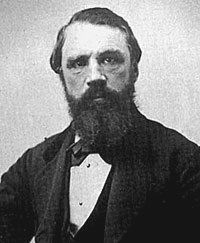
Juan_Nepomuceno_Cortina

Juan Nepomuceno (Cheno) Cortina (1824-1894), aka ‘Cortinas’


Bandit lands are places where outlaws can base themselves and their confederates, operate their criminal enterprises and also hide from the law or other antagonists. These secret spaces can be mountains, forests, river valleys, marshes, or along borderlands – wherever access is difficult and solitude assured. They have existed everywhere since ancient times. Some still do.
 
Quite a few of the outlaws who have inhabited these wild areas have become, rightly or wrongly, popular heroes, celebrated in rousing songs and fiery stories. Here’s the first of an occasional Gristly History series about them titled ‘Bandit Lands’.


CORTINAS – ALONG THE RIO GRANDE

The ‘Border’, being the contested land between America and Mexico, has a long, unsettled history. Incursions, lynchings, riots, wars, smuggling and ongoing antagonism between Anglos and Mexican-Americans have produced some celebrated outlaw heores. The earliest of these was a well-born man who became known as ‘Cortinas’.

Juan Nepomuceno (Cheno) Cortina (1824-1894) was known from the time of his outlawry as ‘Cortinas’. His family had aristocratic origins and a large landholding in the lower Rio Grande Valley, particularly around the south Texas city of Brownsville, across the border from Matamoros. After fighting in an irregular unit during the Mexican American War of 1846-1848, Cortinas returned to the family farm which he appears to have used as a base for rustling. He was twice indicted for these offences but was able to escape arrest through the family political connections.

After the Treaty of Guadalupe Hidalgo officially declared the border between Mexico and the United States in 1848, relations between the Anglos and Mexican Americans in the Brownsville area deteriorated. One of the major issues was the belief that Americans were using their superior knowledge of the legal system to enable them to procure ever-greater amounts of land at the expense of Mexican-Americans new to the country.

One day in July 1859 Cortinas witnessed the Brownsville Marshall, Bob Spears, arresting and pistol-whipping a man who had worked on his mother’s farm. There was a confrontation in which Cortinas shot and killed the Marshall and escaped with the prisoner. Cortinas was outlawed and from then on became a guerrilla, fighting the Americans and also operating in the politics and conflicts within Mexico itself. In September 1859 he and his men attacked and occupied Brownsville, shooting five locals. Cortinas eventually retreated to the family ranch from where he later issued a proclamation defending the rights of Mexican-Americans and demanding that any who infringed them be punished.

There was ongoing violence between Cortinas’ men and various groups of Texas Rangers sent against him. Cortinas issued a second proclamation, calling on Governor Sam Houston to recognise and protect the legal rights of Mexican-Americans. By this time the outlaw’s numbers had expanded to around 400-armed men. There was further fighting with Texas Rangers in December which resulted in Cortinas retreating to Mexico and finally to the Burgos Mountains where he holed up for a year.

He returned to the American side of the Border during the Civil War, fighting against the Confederates. He then became embroiled in the politics and turmoils of Mexico, returning again to the Border in 1870. Despite attempts to have him pardoned for his crimes, based on his support of the victorious Union during the Civil War, Cortinas was forced to return to Mexico in 1871.

In later years the cattle ranchers of the Nueces Strip accused him of being the ringleader of a large rustling operation and he was eventually removed to Mexico City through American diplomatic pressure. From this time Cortinas passes from the large events of his time. He spent the sixteen years between 1877 and his death from pneumonia in 1894 in prison and under house arrest.

Despite obscurity, neglect and vandalism of his grave, Cortinas’ legend among Mexican- Americans is firmly established.[i] He is the subject of a famous corrido, or ballad, that portrays him as a great hero and friend of the Mexican people, whose death caused the gringos to celebrate:

That famed General Cortinas
is quite sovereign and free,
the honor due him is greater
for he saved a Mexican’s life.
The Americans made merry,
they got drunk in the saloons,
out of joy over the death
of the famed General Cortinas.[ii]

Cortinas was, and still is, a hero of the Mexican-American people. Stories and songs of his real and fanciful actions remained strong in oral tradition and prepared the way for the greatest of all the Border outlaws, Gregorio Cortez.

NOTES

[i] Thompson, J. (ed), Juan Cortina and the Texas-Mexico Frontier 1859-1877, The University of Texas at El Paso, El Paso, Texas, Southwestern Studies 99, 1994, pp. 93.

[ii] Hispanic American Almanac, Gale, 1997.

MYTH-MAKING IN THE TIME OF THE VIRUS


Virus ok

Alissa Eckert, MS, Dan Higgins, MAMS, Centers for Disease Control and Prevention (CDC), ID 23312, 2020


In general usage, a ‘myth’ is a statement or fact believed to be true, a falsehood. Myths are given credence and spread by rumours and, increasingly, as ‘fake news’ or ‘memes’.

They usually arise as misunderstandings of historical events, statements, and sometimes as deliberate lies invented and spread for political, commercial or religious purposes

A well-known example of a misunderstood statement is an observation once made by the eminent anthropologist, Franz Boas, about the Inuit words for snow. The myth is that the Inuit people of Southwestern Alaska have more words for snow than any other language.

What Boas actually observed, in relation to the linguistic complexities of Inuit and its dialects, was that there were four root words for snow that might be vastly expanded by their use in a variety of linguistic combinations, or lexemes, that might also include individual semantic flourishes.

This fundamental subtlety was subsequently misunderstood by many to mean that the Inuit did have one hundred distinct words for snow. In fact, they might have one hundred or more lexemes for snow but not one hundred individual words, as the myth has it.

A more significant issue than the number of Inuit words for snow is this: what was it about the Inuit people (then termed ‘Eskimo’), their language and its cultural meanings, that led to the spread of this misstatement and its perpetuation to the present day?

The answer is that it’s all about ‘us’, not ‘them’.

When Boas and others were studying the Inuit in the late nineteenth and early twentieth centuries, there was a widespread fascination with these indigenous people and their inconceivably hard way of life. For a few decades, the Inuit, and other indigenous groups in polar regions, were the darlings of folklorists, anthropologists, filmmakers and journalists. In short, the Inuit were seen through western eyes as ‘exotic others’. ‘Their’ lives were so drastically different from the western norm that something that so clearly and conveniently represented that difference made sense to ‘us’. Of course, such different people somehow surviving in perpetual ice and snow would have lots of words to describe their situation. Makes sense. Mmm.

This small popular delusion is pretty harmless, unlike many other prejudiced and pernicious myths western culture has evolved about exotic others. Perceptions of black people as monkey-like have a long history and have not gone away, for the same reason the Inuit words for snow myth has not. ‘They’ are not like ‘us’ whites.

One popular perception of human evolution is that non-Europeans are further down the evolutionary scale and therefore closer to the apes. Obvious, isn’t it? That’s what Darwin said.

Of course, Darwin said no such thing, but his biological ideas were applied to culture in the perversion usually called ‘social Darwinism, and it was asserted by experts that just as the plant and animal kingdoms evolved through natural selection, popularly understood as ‘survival of the fittest’, so did people. Obviously western culture was the preeminent result of this process and any culture that didn’t have our technological, religious, organisational and (supposedly) moral attainments was obviously at a lower stage of evolution and, therefore, inferior. Closer to monkeys than clever us. Science proves it. Mmm.

Despite the overwhelming abundance of evidence to the contrary, this apparently authoritative explanation provided an expert validation of a prejudice that had existed in European society since at least the medieval era. *

As well as the story itself, mythmaking also depends on those who tell the tale. The role of the ‘expert’ in confirming and spreading myth has recently expanded. Unqualified celebrities, politicians and those with usually fringe political agendas have increasingly taken over from experts as arbiters of opinion, masquerading as ‘fact’. The reasons for this are complex and include the erosion of trust in civil institutions and traditionally prominent influencers since the 1960s. In this century, the internet has accelerated and amplified this trend to its currently dangerous levels.

Right now, we are seeing the influence of the new storytellers in the context of the Corona virus pandemic. Large numbers of people prefer to believe random commentators and opinionists in the mainstream and social media about medical and scientific matters, particularly those related to so-called ‘cures’.

Alongside this we have another example of negative perceptions of exotic others, in this case, the Chinese, who have been blamed for the outbreak due to their culinary habits, alleged poor hygiene, incompetence or, the conspiracy theory version, by deliberately manufacturing and spreading the virus.

There are many other prejudicial myths that originate, evolve, and proliferate through these complex processes of history, ignorance and delusion. They persist because they fill a cultural and psychological need to perceive otherness in usually negative terms.* The particular combination of the progressive erosion of trust, the proliferation and consequences of new communication technology, and the always existing compulsion for humans to see things in terms of ‘us and them’, has now reached a potentially disastrous moment for us all.


* For a useful overview of this process see https://theconversation.com/comparing-black-people-to-monkeys-has-a-long-dark-simian-history-55102

* For a more detailed look at the complex psychological and cultural processes involved in mythmaking, see David Robson’s The Intelligence Trap: Why Smart People Make Dumb Mistakes https://davidrobson.me/the-intelligence-trap/


CACKLING FARTS, TALLYWAGS AND OTHER GROSE WORDS


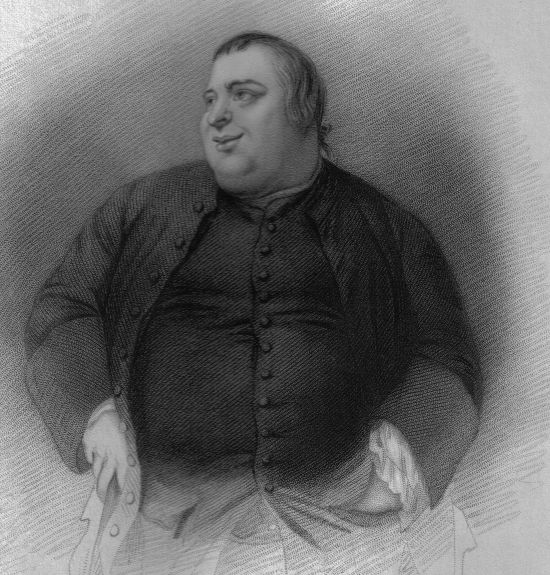
1920px-Captain_Francisa_Grose,_FSA

Captain Francis Grose, antiquarian, some-time soldier and all-round roisterer used his knowledge of lowlife to compile a dictionary of eighteenth-century slang. Assisted by Tom Cocking, Grose frequented and enjoyed the fleshpots of London, eating, drinking and taking notes of what was said and by whom. The fruits of this devoted study appeared only three decades after Dr Johnson’s famous dictionary but, unlike that great work, documented the unofficial, earthy and bawdy language spoken by the workers of the era.

Grose was so fat – a gundiguts, according to his own dictionary – that his assistant, Tom, had to strap him into bed each night to make sure he didn’t roll out. But he was an apparently amiable man who was able to move easily in different social circles, putting his inquiring mind to good use wherever he went and with whoever he met. His encounters included one with the Scots poet Robert Burns, who contributed prose and poetry to one of Grose’s many antiquarian works on castles and other ancient buildings.

Not only does A Classical Dictionary of the Vulgar Tongue (1785) present a vast number of raffish and often amusing words and phrases, but it also gives some idea of those who spoke them. Many of these were criminals who, as in earlier and later periods, found considerable use for linguistic obfuscation. Others were those who followed more or less respectable trades and occupations. Grose’s dictionary is crammed with the speech of thieves, beggars, prostitutes, soldiers, sailors, gamblers, cockfighters, horse traders and a range of other dodgy operators.

Grose also includes terms related to trades, professions and callings, including:

Draper, an ale-housekeeper;

Duck fucker man in charge of poultry aboard a war ship

Fart catcher – a valet

Finger post – parson

Knight of the rainbow – a footman, from the gaudery of his apparel

A maggot-boiler was a tallow merchant

Monks and friars, printers’ terms describing blotted or dark printed sheets and faint sheets, respectively

Nimgimmer a doctor, especially one able to treat venereal diseases

Pontius Pilate  a pawnbroker

The dictionary includes multitudinous names for different kinds of alcohol, especially gin and is also good on insults, including Captain queernabs, a shabby ill-dressed fellow; Dicked in the nob meaning silly, crazed; a dog booby is an awkward lout and Just-ass was a punning name for a justice [judge], an official who many of Grose’s speakers often encountered.

A few of the words and terms immortalised by Grose and Cocking are still in use today, including screw, to copulate; bum fodder for toilet paper and to kick the bucket, meaning to die, which Captain Francis Grose did in 1791. His legacy is a magnificent compendium of everyday talk that people used as they went about their business, whether that was respectable or otherwise.

Oh, and a cackling fart is an egg and tallywags are testicles.

Enjoy more online at https://publicdomainreview.org/collection/a-classical-dictionary-of-the-vulgar-tongue-1788

A TIME FOR HEROES Anzac Day 2020

poppy-1479509759UKR

This year, no public events will mark Anzac Day. The COVID-19 pandemic has done what only a world war has previously accomplished, when the event was cancelled in 1942.

These random coincidences remind us that today, as then, Australia has been fighting a war, in fact, several wars. The disastrous bushfires of 2019-20 and the Corona virus pandemic, have taken on some of the characteristics of mass conflict. They include the language of war, emergency coordination between the Commonwealth and the states, deployment of the defence forces and a range of restrictions on personal and civil liberties and activities.

Like all wars, these have produced heroes.

Over a summer of flame, ash and smoke, tens of thousands of firefighters, mostly volunteers, battled infernos in New South Wales, Victoria and Queensland, as well as in other states with fewer serious blazes. Some – ‘the fallen’ –  lost their lives. Many of the survivors will have ongoing health issues due to burns, smoke inhalation and trauma. Heroes.

These brave men and women were supported by emergency services of all kinds and by doctors, nurses, paramedics and all other hospital staff. Neighbors and strangers also performed acts of dangerous generosity, saving properties and people. Heroes

Then, just as the fire wars were easing, an insidious virus began felling people around the world and in our country. Once again, medical and hospital professionals, police and other services were called to the front line as infectious passengers were unfathomably allowed to depart cruise ships and others jetted in from foreign parts. As often happens in wars, there was a shortage of equipment – masks and gowns, as well as ventilators and beds – but they went to the fight, regardless. They are at the front as I write this. Heroes.

The mostly volunteer diggers of World War 1 and World War 2 were the founders and bearers of the Anzac tradition, subsequently carried by Australian soldiers up to the present. Whatever else Anzac might be about and whatever your personal views of it might be, there is no denying that it is the predominant bearer of Australian notions of heroism. It happens that these ideas were formed in war, but it now seems that the same ideals – glorified and mythologized though they often are – have become attached to ordinary men and women just doing their jobs, or as civilians volunteering.

So, let the ‘silent Anzac Day’ of 2020 be dedicated to the unique recognition and long remembrance of our new heroes.

Graham Seal


IN PRAISE OF SMALL THINGS


1992.1.6_1.tif

Unidentified Artist
Luce Center Label
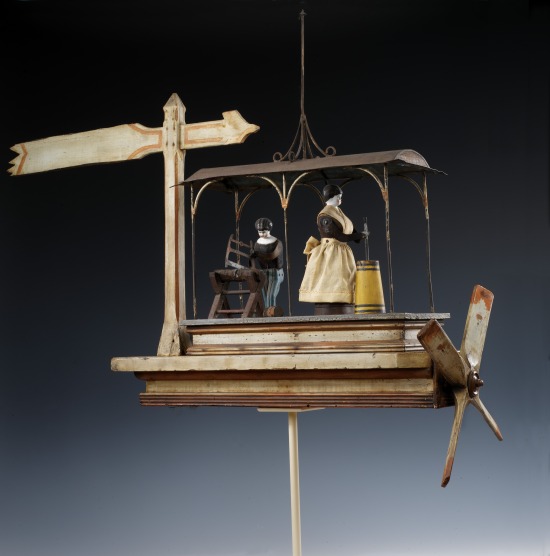
Farmers created whirligigs to entertain their children and decorate their gardens. These colorful, animated devices also added an element of fun to an otherwise demanding life in rural America. This piece shows the everyday activities of churning butter and sawing wood. When the wind blows, the lady’s arms move up and down and the man’s saw moves back and forth. The large painted arrow on the back of the whirligig suggests it was also used as a weather vane.
Smithsonian American Art Museum, Museum purchase from the folk art collection of David L. Davies
1920s


Consider the unremarked knowing and ways of doing and saying that lie beneath even the most trivial of everyday activities.

Plants in our gardens have their unofficial names that have nothing to do with their tin scientific labels. ‘Foxglove’s, ‘kangaroo paws’, ‘Christmas bush’, etc. The list is almost endless and often varies from place to place. What is known as a ‘diaper’ in America is a ‘nappy’ in Britain and Australia. The same goes for the folk names of fish and of different types of rain. You know about these things only if you are a gardener, fishing person and/or live in a particular place, usually from childhood, or at least over a long time.

Inhabitants of the English city of Canterbury and surrounds will be familiar with the local whimsy: ‘Why kill ‘em and cart ‘em to Canterbury?’ Understanding this fragment of apparent folk nonsense proves your indigenous credentials. The saying depends on knowing that the towns of Wye, Chilham and Chartham are all located in the countryside around the county town of Kent. What does it mean? Nothing. Except to identify belonging to a place and the people who do, and have, called it ‘home’.

Natives of Hamburg have a similar trick. When the words ‘Hummel, Hummel’ are spoken, those in the now must respond with ‘Mors, Mors’. This whimsy involves yarn about a man who moved into the home of a former soldier named Hummel and was made the butt of derision by local children calling out the former resident’s name. The squatter would retort ‘Mors, Mors’. This exchange became a form of greeting between Hamburgers.

These small wordplays are the trivial tips of extensive pyramids of knowledge, identity, sense of place and belonging. For those in the know, their significance is much deeper and more intense than their apparent superficiality suggests. And so it is with many small things. The taken-for-granted banalities of all our lives actually carry vast reservoirs of fundamental meaning that, if we lost, we would find ourselves bereft. Not to have the dandling songs and play rhymes of childhood to distract and amuse our children and grandchildren and the making of the whirligig pictured above would leave an interactive hole that it is hard to imagine being filled by anything else. The rituals of birth, anniversaries, coming-of-age, marriage and our inevitable endings, all subtly structure all our lives.

The small things are almost endless. The cooking and recipes, sewing, knitting and other domestic skills we perhaps picked up in childhood. Proverbs, sayings and superstitions are things we just ‘know’. Home remedies, some more folk belief than efficacious, but nonetheless known and practiced or recommend, as required by coughs, insect stings or warts. Ways to tend the garden, what tools to use for which chores and how to drive a nail or use a saw, what knots are best and how to tie them.

There may be family and community traditions of song, music, dance or other everyday arts and crafts, not to mention feasts and festivals, sacred and secular, such as Guy Fawkes Night, Blessing of the Fleet and the dozens of other saints’ days, commemorations and folk frolics that dot the calendars of every faith.

Now, in the time of the COVID-19 pandemic, these and the many small things of life will come to mean a great deal.


THE WORLD FAIR IN THE DESERT


Camels Coolgardie

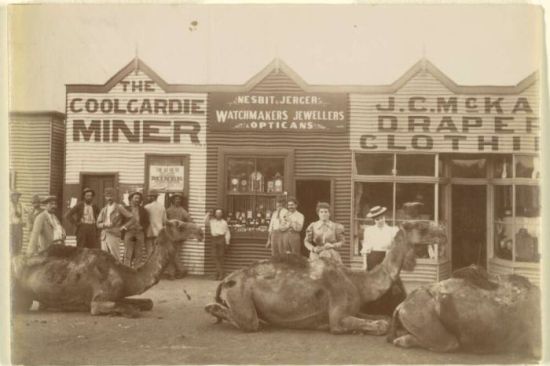
Three camels in front of commercial buildings in Coolgardie in the 1890s. (National Library of Australia)


It was nothing but desert in 1892. Seven years later Coolgardie was the third-largest town in Western Australia. Shops lined the extraordinarily wide main street, there were seven newspapers, six banks and two stock exchanges, schools, theatres, churches, a synagogue and a mosque for the ‘Afghan’[i] cameleers who kept the 5000-or-so inhabitants supplied with goods. And much of their water. Two cemeteries held over a thousand underground residents, while three breweries and twenty-six hotels slaked the prodigious thirst of the miners. In 1896 the railway arrived and just a few years later ‘the mother of the Western Australian goldfields’ hosted a World Fair.

The first of the grand celebrations of industry and technology that began the World’s Fair movement was held in Paris in 1844. Fifty years later they were an international fad and no self-respecting country or industry could not have one. The Coolgardie event was officially titled ‘The Western Australian International Mining and Industrial Exhibition’. Nothing like it had been seen in the west and there would never be anything quite like it again.

On 21 March, the special train from Perth arrived carrying one hundred and fifty VIPs, including the Governor and the Premier with their respective families and entourages. They were welcomed by the mayor and all the dignitaries that Coolgardie boasted, together with the Mayor of Melbourne, an Archdeacon and the vice-consul of Denmark. The triumphal arch of flowers on Bayley Street had only just been completed in the early hours of the morning and there were: ‘festoons at the end of the street facing the exhibition, and these, with profuse displays of bunting at the hotels and other establishments along Bayley Street, comprised the decorations with which the town had arrayed itself for the occasion. Interwoven with the arch were the words, ‘Welcome to Coolgardie’, while similarly hospitable greetings appeared on the walls of buildings along each side of Bayley Street.’

Anyone who was anyone was there, as well as many who were not. The speeches, toasts and backslapping were almost endless. The shortest was made by a colourful entrepreneur named Jules Joubert, manager of the event. Joubert was an early example of a global organiser that we have become familiar with through international sporting networks and affiliations. He had parlayed an earlier involvement with the World Fair movement into a position of control and influence. Not surprisingly, he was happy. He claimed to have ‘managed fifty exhibitions, and the present one was therefore his jubilee. He would have liked to have stopped the sun for a fortnight, for then they would have had one of the best exhibitions ever seen in Australasia.’

And everyone else was in good spirits, especially when the official opening of the grand Exhibition Building finally took place. There were more speeches, of course. Premier Forrest was overflowing with praise, emphasising that the government was in full support of the Exhibition and ‘were most anxious that the Exhibition should do all its promoters desired it should do. There had been a great many sceptics and unbelievers, and people who threw cold water on the project, and if it had not been for the people of Coolgardie – supported, he thought, by himself and he might say the Government – this Exhibition would not have been in the position it was now.’

And there was more, rather a lot. But the topic that every miner and business-owner in the goldfields finally came:

There was one thing he missed, which he had hoped to see, and that was a river of water coming into the town-(cheers)-a river he had promised he would do his best to bring. And they were bringing it. People might say what they liked, they might be sceptical or disbelievers, but he could tell them that the great water scheme was raising itself up like the Temple of Jerusalem was raised silently. (Cheers.) There was no great sound of hammers going on. These hammers were, however, being applied, and in a very short time, like that magnificent edifice, this great water scheme would rear itself up, and fresh water would flow into the town. (Cheers).

A strike of wharfies at Fremantle meant that loads of exhibits being waggoned from Perth were still wending their way towards the glittering event. Despite this, the show went on with balls, orchestras and entertainments of all kinds – ‘Dancing was indulged in till after midnight.’ Over five thousand people attended on the first day and more than 60 000 were estimated to have visited by the time it ended almost three and a half months later. The Exhibition was pronounced a great success, particularly in the circumstances, as the press pointed out:

it may be safely asserted that no event of this nature has been attempted under more discouraging circumstances than those which have attended the present undertaking in this remote portion of the Australian continent, where eight years ago there was not a vestige of civilisation, and when the aboriginal, like Robinson Crusoe, was monarch of all he surveyed, but which through the discovery of gold has become a great mining centre and a hive of industry. It was undoubtedly a bold undertaking to induce the manufacturers of the old world to unite in displaying their wares and products to the population of these fields. Coolgardie being in the heart of a wilderness, and at a distance of nearly 400 miles from the sea coast, presented almost an insurmountable difficulty in this respect alone.[ii]

The city in the desert was on its way to even greater things!

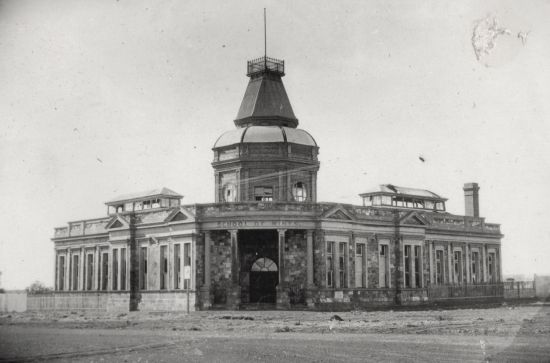
But it was not to be. Rich as Coolgardie’s lodes of gold might be, they were outdone by the even richer and more abundant ores of Kalgoorlie and Boulder, not much further down the track, now known as the ‘Super Pit.’ Combined with the slump in gold prices at this period, Coolgardie began a slow decline. A School of Mines was opened in 1902 but closed a year later, supplanted by Kalgoorlie’s own school. In the 1930s the Grand Exhibition Building burned down, by which time the town was in terminal decline. Not quite a ghost town, Coolgardie today has around 900 people living there, but its glory days have long faded and its mainstay, like many bush towns, is tourism.


CoolgardieSchoolOfMines_WEFretwellCollection

William E. Fretwell (1874 – 1958)W.E. Fretwell Collection Photographs of William Edward Fretwell (1874 – 1958). Burned down 1929.

NOTES:

[i] The cameleers also came from various regions of India and what is now Pakistan; ‘Afghan’ was a colloquial term.

[ii] Quotations from The West Australian 22 March 1899, p. 5; see also Lynne Stevenson, ‘The Coolgardie International Exhibition, 1899’ in: Lenore Layman and Tom Stannage (eds). Celebrations in Western Australia, Studies in Western Australian History, No. 10, April 1989, pp. 100-106.

THE RETURN OF TYPHOID MARY

Mary_Mallon_(Typhoid_Mary)

‘Typhoid Mary’


Now she is called ‘Public Harm Auntie’ – in South Korea. In the 1980s and 90s she was known in the western world as ‘AIDS Mary’, a virulent and reckless transmitter of the HIV virus. In the twentieth-century America she was known as ‘Typhoid Mary’.

These creatures of twisted history and folklore were – and are – said to be spreading deadly disease. In early 2020, Public Harm Auntie is wantonly infecting South Koreans with Corona virus, or COVID-19.

How durable are these mass delusions, the spawn of fear and misinformation? Mary Mallon, born in Ireland in 1869 migrated to the USA where she worked as a domestic and cook for wealthy households. In 1906, it was discovered that the families she worked for had developed typhoid. It turned out that Mary was a carrier of the disease, and immune to it herself. Authorities quarantined her and later let her free on condition she never worked as a cook again. Unfortunately, Mary did. When she was discovered, she was again quarantined – for twenty-three years until her death in 1938.

Over this period, a worldwide typhoid epidemic raged, killing one in ten victims. Assisted by the press, panic erupted in America centred on Mary’s grim reaper status. Hysteria, misinformation and prejudice did their usually dirty work and Mary became the cause of untold typhoid deaths across the country.

As always, the reality was much different. Mary was a carrier who never contracted the disease herself, as were about fifty others. Mary only infected 33 people, three of whom died of the disease.

AIDS Mary (sometimes ‘Harry’) was, according to popular belief, at least as lethal. But, unlike Mary Mallon, she never existed. And while Public Harm Auntie appears to be an actual person, the alleged number of her infections with COVID-19 is undoubtedly swelled through the transmission of rumour as much as the virus.

Typhoid May, AIDS Mary (Harry) and Public Harm Auntie were [products of the pre-digital era. Now we have the greatest transmitter of falsehood, ignorance and fake news ever invented. The World Wide Web will ensure that this information virus spreads much faster than the disease itself.

REFERENCE:

David Mikkelson, ‘Did Typhoid Mary Cause the Deaths of Thousands of People?’, https://www.snopes.com/fact-check/typhoid-mary/. The Snopes investigative and fact checking site is highly recommended as a vaccination against bullshit.