WIVES FOR SALE


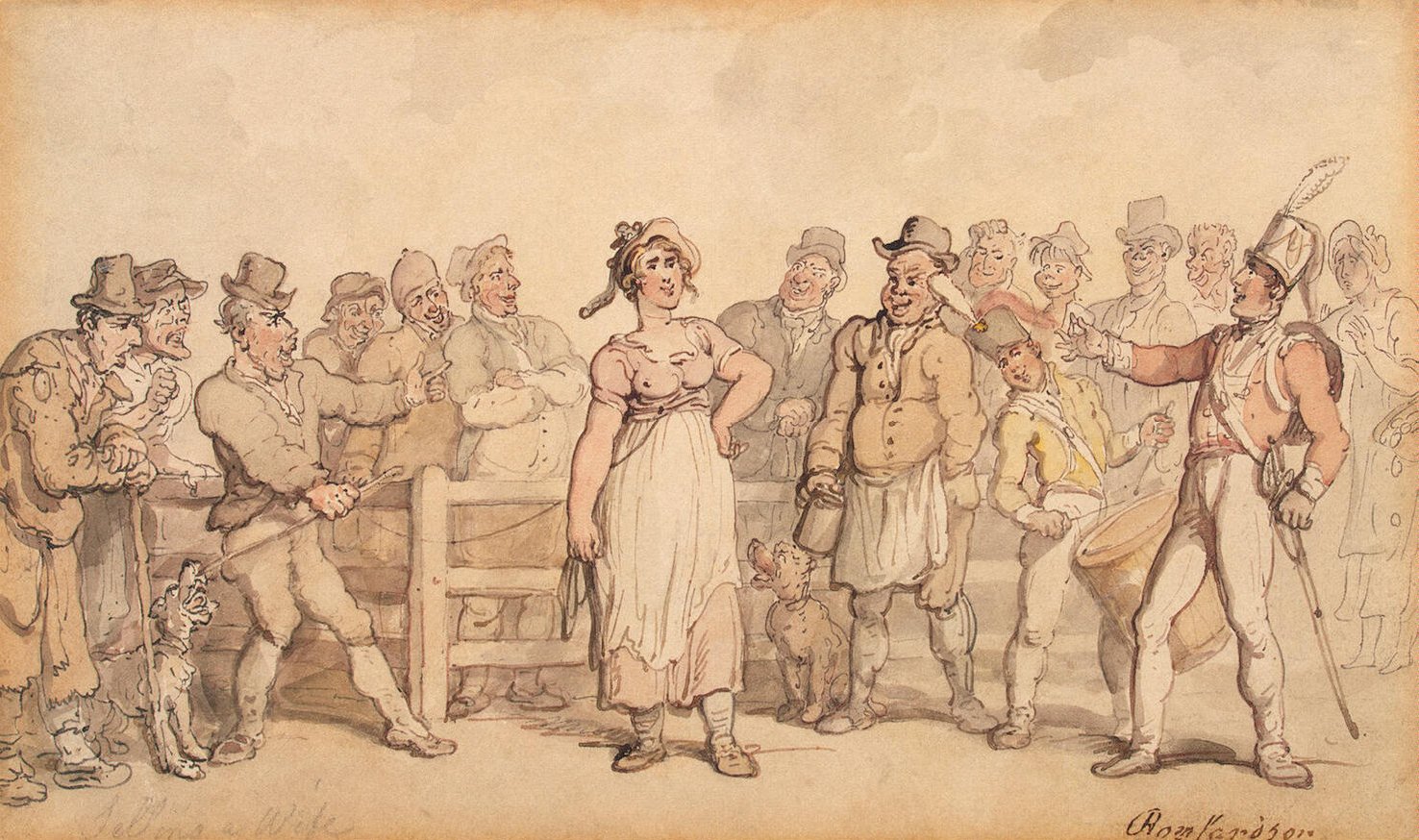
Thomas Rowlandson, Selling a Wife, 1812 – 1814 
 

Here’s an update on an intriguing folk custom I wrote about in Great Convict Stories.


*
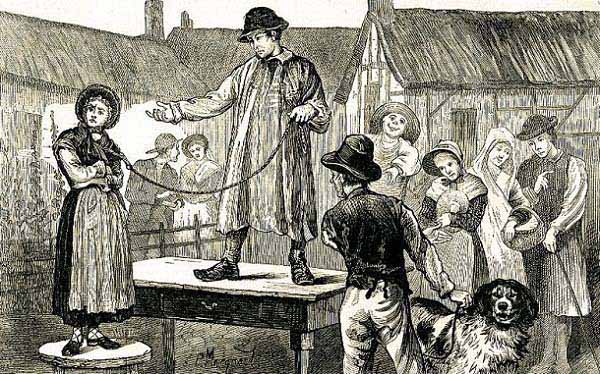
A ‘disgraceful transaction’ took place at Windsor (New South Wales, Australia) in 1811. Ralph Malkin, transported in 1801, put a rope around his wife and led her down the street seeking a buyer. He found one. Thomas Quire stumped up 16 pounds on the spot, plus a few yards of cloth.
While the better classes of society were outraged at such a ‘gross violation of decency’, wife selling was a custom practiced throughout Britain since at least the 16th century. And not only by the common folk. The 2ndDuke of Chandos is said to have purchased his second wife around 1740 and many recorded cases of the custom involve tradesmen and skilled men as the purveyors of their spouses. While the practice was not legal, it was commonly believed to be so and there was often a reluctance by magistrates to prosecute cases, particularly as, it was claimed, the women involved were agreeable to being sold.
By the time Ralph Malkin decided to offer his wife to the highest bidder in Windsor, the custom was increasingly frowned on by public opinion. The writer of the letter in which the event is recorded used words like ‘shameful’ and ‘contemptible to describe the seller and the buyer of Mrs Malkin.
 
 
But all was not as it might seem to contemporary or modern sensibilities. For a wife selling to proceed, the woman had to agree to be sold. Research on this custom indicates that in quite a few cases the women were sold to men who were already their lovers. It seems that wife selling was a form of folk divorce at a time when the average person could not afford such proceedings, or even access the legal means to achieve that state.
Prices paid for wives exchanged by this custom varied from a high of 100 pounds down to three farthings. There are even cases where wives were given away free or for a glass of beer. The price was not as important as the fact that the sale took place in public, usually a market, fair or public house. This ensured the presence of plenty of witnesses to validate the transaction. Popular participation and approval was an important element of the custom and, in some incidents, magistrates seeking to stop a wife sale were driven away by the crowd and on others the crowd refused to allow a sale to proceed if the woman was not agreeable.
An occasional reason for sale was that the wife was simply fed up with the husband, as in the case of a wife sold in Wenlock Market, Shropshire in 1830. When her husband showed signs of cold feet at the last minute she reportedly flipped her apron in his face and said ‘Let be yer rogue. I wull be sold. I wants a change.’
Selling a Wife at Smithfield Market, 1816
 
In the case of the Windsor event, Mrs Malkin (who is never named) was thought to be: ‘… so devoid of the feelings which are so justly deemed the most valuable in her sex, agreed to the base traffic, and went off with the purchaser, significantly hinting that she had no doubt that her new possessor would make her a better husband than the wretch she thus parted from.’ Which was the long-winded nineteenth century way of saying that she not only agreed to be sold but that she thought the new husband was a whole lot better than the old one.
While everyone involved in this transaction was seemingly perfectly happy with it, the local bench of magistrates investigated and determined that a breach of some law had taken place. And in any case, the three ‘base wretches’ involved quite readily admitted to their crime, if it was one. Ralph Malkin received fifty lashes and three months hard labour in irons. His wife – or ex-wife – was transported to the Coal River (Newcastle) for an indefinite period. There seems to be no record of any proceedings against Mrs Malkin’s purchaser.
Wives continued to be sold in Australia. There was a case in the Swan River colony in 1839 and another on the Mount Alexander goldfield in 1861:
‘Last Saturday week a miner residing near Cockatoo discovered that his wife was untrue to him, the gay Lothario being a miner named Sam. The latter party, a cool sort of customer, informed the husband that a row would bring no gain to either party, and that perhaps an arrangement satisfactory to both parties might be effected. The husband offered to sell his wife, tent, cooking utensils for £5.- Sam agreed to the terms, paid the money, and the husband departed.’
But Sam soon tired of his new spouse, a woman of twenty-seven years and reportedly ‘not by any means destitute of personal attractions’. He went in search of another buyer and soon found a miner willing to pay two pounds for the lady.
The belief that wife selling was legal persisted for a long time. Nineteenth century newspapers frequently pointed out that it was a ‘popular error’ but there was a recorded sale in England as late as 1913.


SOURCES

The Sydney Morning Herald, 6 March 1862, p. 2, surveying wife selling in England from 1766 to the 1830s.

Geoffrey C Ingleton, True Patriots All, Angus & Robertson, Sydney 1952, p. 58; Bruce Kercher, Debt, Seduction and Other Disasters: The Birth of Civil Law in Convict New South Wales, Federation Press, 1996 pp. 66-7; ‘Wife Selling’, Jacqueline Simpson and Steve Roud, A Dictionary if English Folklore, Oxford University Press, Oxford, 2000, p. 390. There is a treatment of wife selling in Thomas Hardy’s The Mayor of Casterbridge(1886) and an excellent article by Lauren Padgett, ‘Brutal exhibitions of depravity’: 19th Century Wife-selling in Literature, Illustrations and Practice’ at http://www.leedstrinity.ac.uk/blogs/leeds-centre-for-victorian-studies/19th-century-wife-selling-in-literature-illustrations-and-practice, accessed August 2018.

The Perth and Independent Gazette and Independent Journal of Politics and News, 24 January 1862, p. 3 (in article on state of the colony in 1939).Mount Alexander Mail, 7 June, 1861, P. 5 (reprinted from the North West Chronicle).

Dance’s Historical  Miscellany at http://www.danceshistoricalmiscellany.com/id-sell-my-wife-if-anybody-would-buy-her-wife-sales-in-england/, accessed August 2018.


BURYING THE DEAD HORSE


From Stan Hugill’s Shanties from the Seven Seas
In the days of sail, when sailors signed on to a voyage they were paid a month’s wages in advance. This was spent on clothing and equipment needed for the trip, as well as grog, women and the other necessities of a matelot’s life. Because they had to work this payment off before they were paid again, the first month of the voyage was known as ‘working off the dead horse.’ When the month was over and they began receiving their pay, they might perform a folk play known as ‘Burying the Dead Horse’
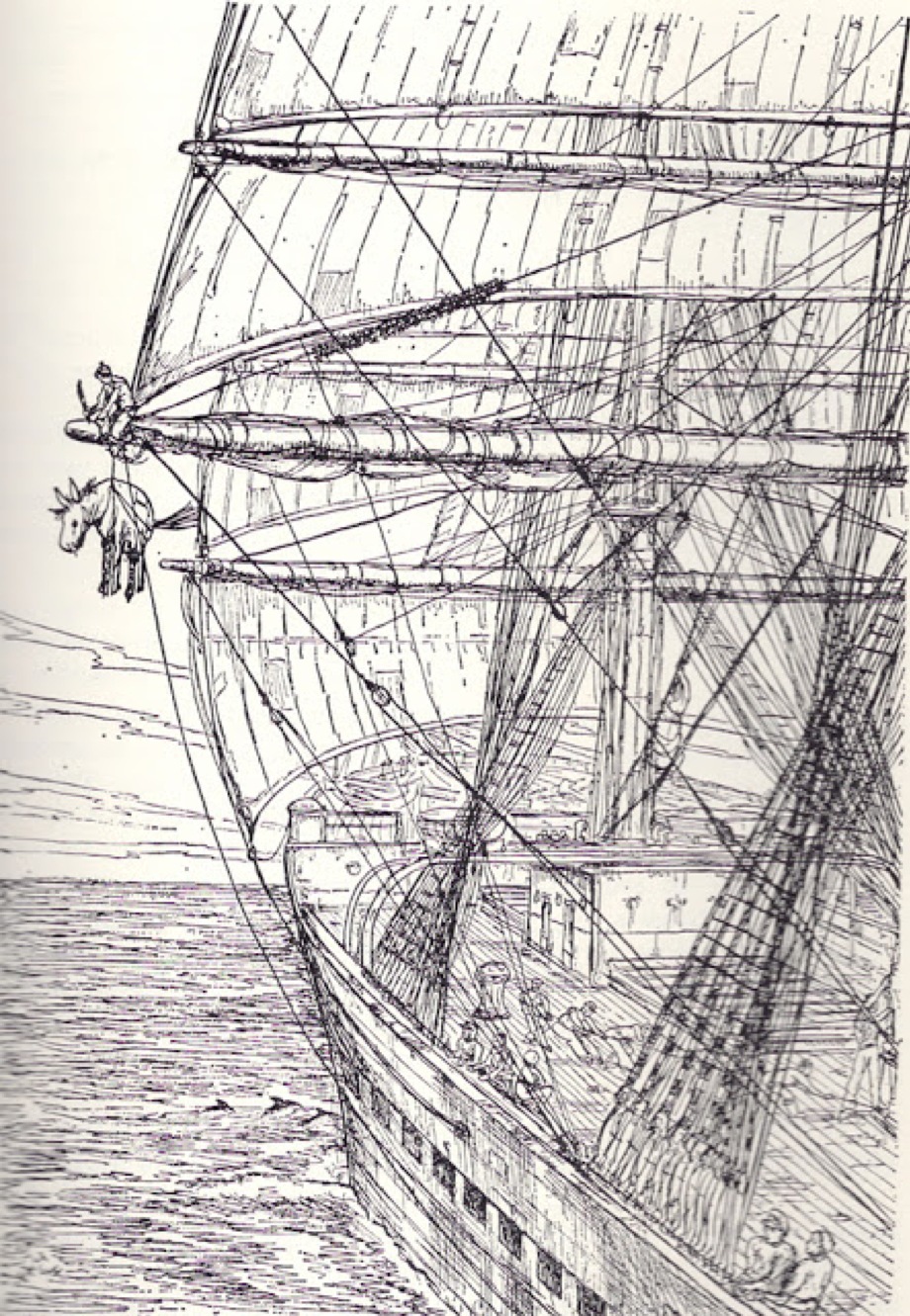
… The crew dress up a figure to represent a horse; its body is made out of a barrel, its extremities of hay or straw covered with canvas, the mane and tail of hemp, the eyes of two ginger beer bottles, sometimes filled with phosphorus.  When complete the noble steed is put on a box, covered with a rug, and on the evening of the last day of the month a man gets on to his back, and is drawn all round the ship by his shipmates, to the chanting of the following doggerel:—
BURYING THE DEAD HORSE.
You have come a long long way,
And we say so, for we know so.
For to be sold upon this day,
Poor old man.
You are goin’ now to say good-bye,
And we say so, for we know so.
Poor old horse you’re a goin’ to die,
Poor Old Man.
Having paraded the decks in order to get an audience, the sale of the horse by auction is announced, and a glib-mouthed man mounts the rostrum and begins to praise the noble animal, giving his pedigree, etc., saying it was a good one to go, for it had gone 6,000 miles in the past month!  The bidding then commences, each bidder being responsible only for the amount of his advance on the last bid.  After the sale the horse and its rider are run up to the yard-arm amidst loud cheers.  Fireworks are let off, the man gets off the horse’s back, and, cutting the rope, lets it fall into the water.  The Requiem is then sung to the same melody.
Now he is dead and will die no more,
And we say so, for we know so.
Now he is gone and will go no more;
Poor Old Man.
After this the auctioneer and his clerk proceed to collect the “bids,” and if in your ignorance of auction etiquette you should offer your’s [sic]to the auctioneer, he politely declines it, and refers you to his clerk!
This was how Richard (later Sir) Tangye, bound for Melbourne aboard the Parramattain 1879 recalled the ceremony aboard that ship. (Richard Tangye, Reminiscences of travel in Australia, America, and Egypt, London, 1884).
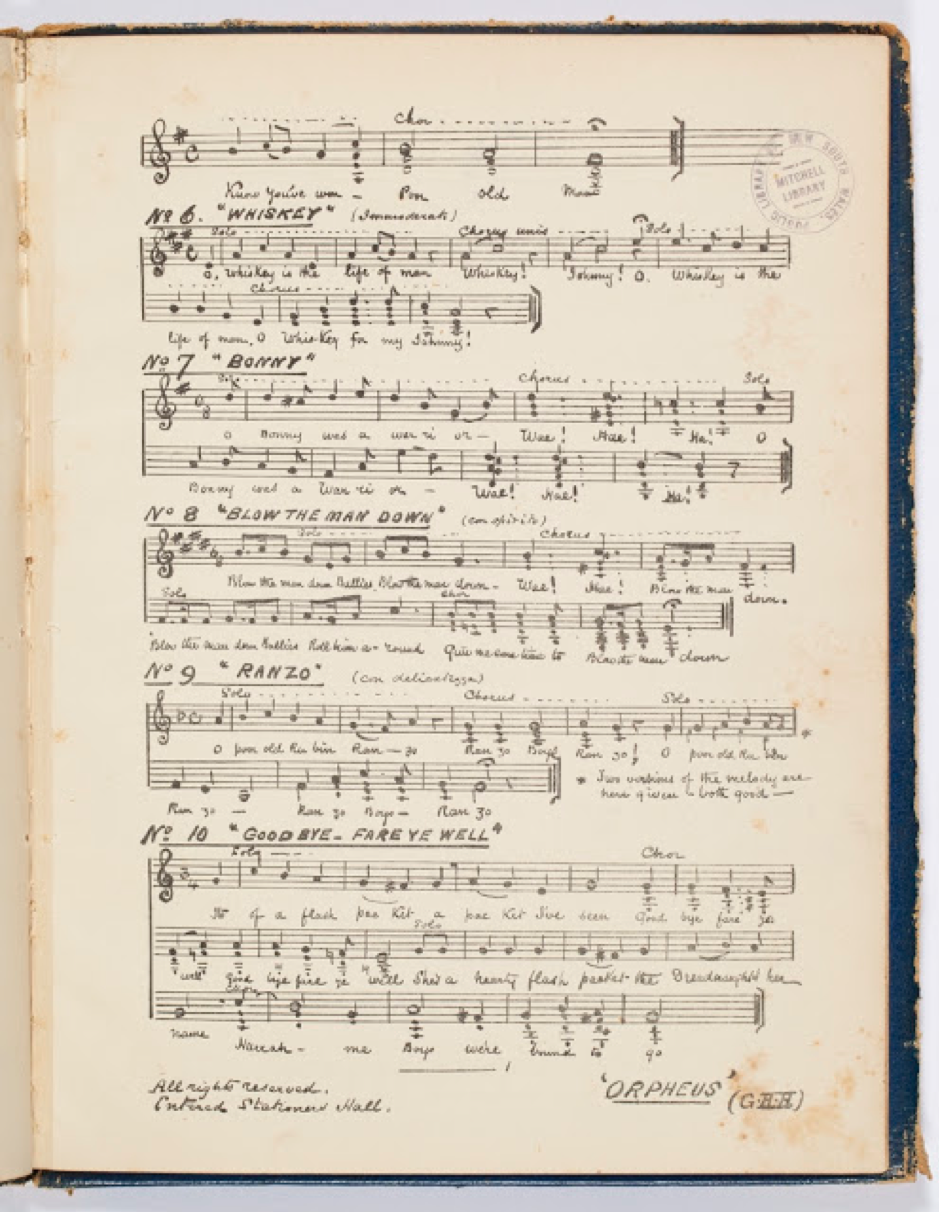
Amazingly, on the same ship and the same voyage a young man named George Haswell took the trouble to document the sailors’ work shanties. He was a skilled musician and transcribed the words and music of their songs, including the ‘Dead Horse’ ceremony described by Tangye (bottom of first page and top of second page, below, for melody).


(SLNSW)NB: Very early use of ‘folksong’ here, especially in its combined form – yes, you really wanted to know that!)
There are many other accounts of this maritime ceremony, which was extant before 1845. It must have been eerie in a probably empty sea at dusk, as well as enjoyable for crew and passengers. Certainly, all accounts involve alcohol. 
But what did it sound and look like as the crew advanced across the deck chanting and pushing or pulling a horse-shaped structure, sometimes with glowing and occasionally, if the captain allowed, with fireworks? We’ll never know. But we can hear the song in a very nice modern rendition by the Ian Campbell Folk Group.
The Dead Horse ceremony usually took place in one of the ocean regions known as ‘the horse latitudes’. Respectively, 30-35 degrees north of the equator and 30-35 degrees south of the equator, these were areas where the winds often died away, becalming sailing ships. As the legend goes, if a ship was becalmed long enough in one of these regions for the drinking water to run out, any horses (and presumably other livestock) might be thrown overboard to preserve water for the crew. A bit more folklore – might even be true!
Graham Seal

A RHYMING SLANG LETTER FROM THE IRON WRENCHES OF WORLD WAR ONE

The following rhyming slang letter appeared in a World War 1 British ‘trench journal’, or soldiers’ newspaper known as The Direct Hit of July, 1917. Apparently penned by Lce-Corp. A. J. Lilliman, RF, it provides an insight into the popularity of rhyming slang among World War 1 troops. It is couched in the form of a letter to the writer’s sister, providing some news of training camp activity and expected departure to the front and of a planned visit home during an upcoming period of leave. It is unlikely that this letter was ever sent, or that it was ever meant to be; it seems more likely to have been a manifestation of the fascination for rhyming slang at the time and place, something the editor of the Direct Hit also mentions in introducing the letter. Many of the terms are not recorded in the usual compilations and dictionaries of rhyming slang, or have other meanings, and so can either be considered personal inventions of the writer and/or terms that had a brief and perhaps restricted currency among those with whom he socialised.
MY DEAR JUST-MISSED-‘ER,
Many thanks for the all-the-better and the Windsor Castle received the last pip-squeak. I am glad to hear mother and the old pot-and-pan are still keeping fit, and that the Giddy-Gaby is doing well. The contents of the parcel were highly appreciated by the Sain-Foys in my water-butt; the piper’s knees went down well for supper with a piece of mine-host made in front of the old-cove, and a drop of pig’s ear. The you-can-bets smoked like small American bars. Keep on sending the bones-and-rags. The give-and-take was one of the best, whilst the small-kits came in very handy on the stiff-as-starch.
 
We are all still hiding in the rob-and-pillage and expect to be here until the lager beer. I suppose we shall be going on-our-knees early in the wedding ring; it is quite time we put some of the Germans’ Hampstead Heath down their ugly nanny-goats. I am fed-up with cleaning my small-trifle to satisfy the Sergeant’s mince pie, and with firing nothing but muddy-banks.
I went sick the other day with a saucy-goat, but the oh-dear-oh! only gave me a darling-mine with Sleeping Beauty, so I went on first-aid the following day. I am pleased to say I am quite William-Tell again now, although the tough-as-leather has left me off with a bit of a up-the-hill and a slight old-toff.
I had a double-mine from Jimmy last week. He has been in the iron-wrenches for three weeks now, and so far has come through all John-Bright. He says he is going back to the fried-fillets in a day or two for a give-and-be-blest. I am glad he is safe and baker’s-round, for Jimmy was always a good world’s-endt o me.
Now I must hurry up with my you-and-me, get a wave-after-wave and a shine up just call in the always-man to light me to my white-and-red tonight, and then I’m off to the knock-me-down to see the pictures at the new near-and-far.
 
I am hoping to see you shortly, for I believe we are to get four day’s Adam-and-Eve. So keep you’re eye on six o’ clock, and be sure to meet me at the Birth-of-a-Nation when I let you know the only-way I am coming, and the time the might-and-main will arrive.
Write soon, and don’t forget the old-nags.
Your loving Brother, SAM.
Lce-Corp. A. J. Lilliman, RF.
The rhyming slang terms used in this letter translate as:
just-missed-her  sister
all-the-better  letter
Windsor-Castle  parcel
last pip-squeak  last week
old pot-and-pan  old man (father)
Giddy-Gaby  baby
the Sain-Foys  the boys
water-butt  hut
piper’s knees  cheese?
mine-host  toast
old-cove  stove
pig’s ear  beer
you-can-bets  cigarettes
American bars  cigars
give-and-take  cake
small-kits  biscuits
stiff-as-starch  march
rob-and-pillage  village
lager-beer  new year
on-our-knees – overseas
wedding-ring  spring
Hampstead Heath  teeth
nanny-goats  throats
small-trifle  rifle
mince-pie  eye
muddy-banks  blanks
saucy-goatsore throat
oh-dear-oh!  MO – Medical Officer
darling-mine  number nine pill ( a laxative)
Sleeping Beauty  duty
first-aid  parade
William Tell  well
tough-as-leather  weather
up-the-hill  chill
old-toff  cough
double-mine  line (letter)
iron-wrenches  trenches
all John-Bright  alright
fried-fillets  billets
give-and-be-blest  rest
safe and baker’s-round  safe and sound
world’s-end  friend
you-and-me  tea
wave-after-wave  shave
always-man  batman
broom-handle  candle
white-and-red  bed
knock-me-down  town
near-and-far  cinema
Adam-and-Eve  leave
[the] six o’ clock  clock
Birth-of-a-Nation– station (from the title of D W Griffith’s movie just released at this time)
only-way  day
might-and-main  train
old-nags  fags (cigarettes)

HAVE YOU EVER SEEN A THYLACINE?


Almost certainly not. Unless it was one of the 756 listed specimens bottled up in museums and other institutions around the world.[1]But soon, you might just be able to see one again.
Extinct on the mainland of Australia and Papua New Guinea, the Thylacine or Tasmanian Tiger, was hunted to oblivion in its one remaining haven. The last of these enigmatic animals died of neglect in Hobart’s Beaumaris Zoo in 1936. Someone forgot to put the creature back into its cage and it perished of exposure. 
But the Tiger still haunts us. Ever since then, people have reported seeing ghostly survivors in the wild and there is a long history of Thylacine hunting in Tasmania and beyond. Substantial rewards have been offered for verified sightings or other evidence of the beast’s existence. As with other modern ‘ABC’ (Alien Big Cat) legends, these tales quickly vanish into the air. But the belief remains strong with many and the quest continues.[2]
The Thylacine was certainly a striking animal. Appearing like a brown wolf with black-brown stripes across its back and down its long tail, the ‘Tassie tiger’, as locals say, was more of a kangaroo than a dog or wolf. It was a carnivorous marsupial, its young suckled and protected in a pouch, kangaroo-style. This perceived oddity was reflected in the scientific name given to it, Thylacinus cynocephalus, meaning a pouched dog with a wolf-like head.
Full grown, the animal stood around 60 centimetres high, grew up to 180cm long and weighed around 30 kilograms. Thylacines barked or yelped infrequently and were anything but tiger-like in demeanour, preferring to hide rather than fight. They sometimes died of fright as soon as they were caught.[3]
Aboriginal traditions on the mainland and in Tasmania provide evidence in rock art and lore of the tiger’s once wide distribution around the country. But the advance of European settlement, the possible effects of natural selection and disease, as well as the exaggerated fear of attacks on livestock, eventually eradicated the animal.The  loss of these creatures was foretold as early as the 1850s when the famous naturalist John Gould predicted: 
‘When the comparatively small island of Tasmania becomes more densely populated, and its primitive forests are intersected with roads from the eastern to the western coast, the numbers of this singular animal will speedily diminish, extermination will have its full sway, and it will then, like the Wolf in England and Scotland, be recorded as an animal of the past…[4]
Scientists are now planning to resurrect the species. This possibility exists because so many stuffed, desiccated and otherwise preserved Thylacine specimens with intact DNA are kept in museums around the world. Researchers have recently turned their attention to this ‘archive of bodies’ created from the colonisation of Australia and the European desire for the exotic. 
Ostensibly, this was proper scientific curiosity. But while all the specimen-collecting preserved genetic material that might make resurrection of the Thylacine possible, the museums in which the bodies are stored are still ‘repositories of loss’. They suggest that our ongoing fascination with the Thylacine, reflected in the alleged sightings and the quest for resurrection, are projections of our shared guilt over the extinction of what was a shy and relatively harmless animal. 
Australia holds the unenviable world record for mammal extinctions.[5]National Threatened Species Day is held on the anniversary of the sad and lonely death of the last Tiger each September 7.Tasmanian Tiger skins have become expensive collectors’ items. If scientists do manage to resurrect the creature, at least that will end.
Graham Seal

[1]The International Thylacine Specimen Database at 
http://www.naturalworlds.org/thylacine/mrp/itsd/itsd_1.htm, accessed May 2018.
[2]There is an extensive literature on the long history of posthumous thylacine hunting, see Col Bailey, Lure of the Thylacine: True Stories and Legendary Tales of the Tasmanian Tiger, Echo Publishing, South Melbourne 2016, for some examples of sightings, as well as innumerable online sites, including the Wikipedia entry, which provides a reasonable and referenced overview.
[3]Parks and Wildlife Service Tasmania at http://www.parks.tas.gov.au/?base=4765, accessed April 2018.
[4]Quoted in Robert Paddle, The Last Tasmanian Tiger: The History and Extinction of the Thylacine, Cambridge University Press, Cambridge, 2000, p. 223.
[5]Penny Edmonds and Hannah Stark, ‘On the trail of the London thylacines’, The Conversationat https://theconversation.com/friday-essay-on-the-trail-of-the-london-thylacines-91473, accessed April 2018.

BOILING DOWN THE BODIES AND OTHER TRENCH MYTHS OF THE GREAT WAR

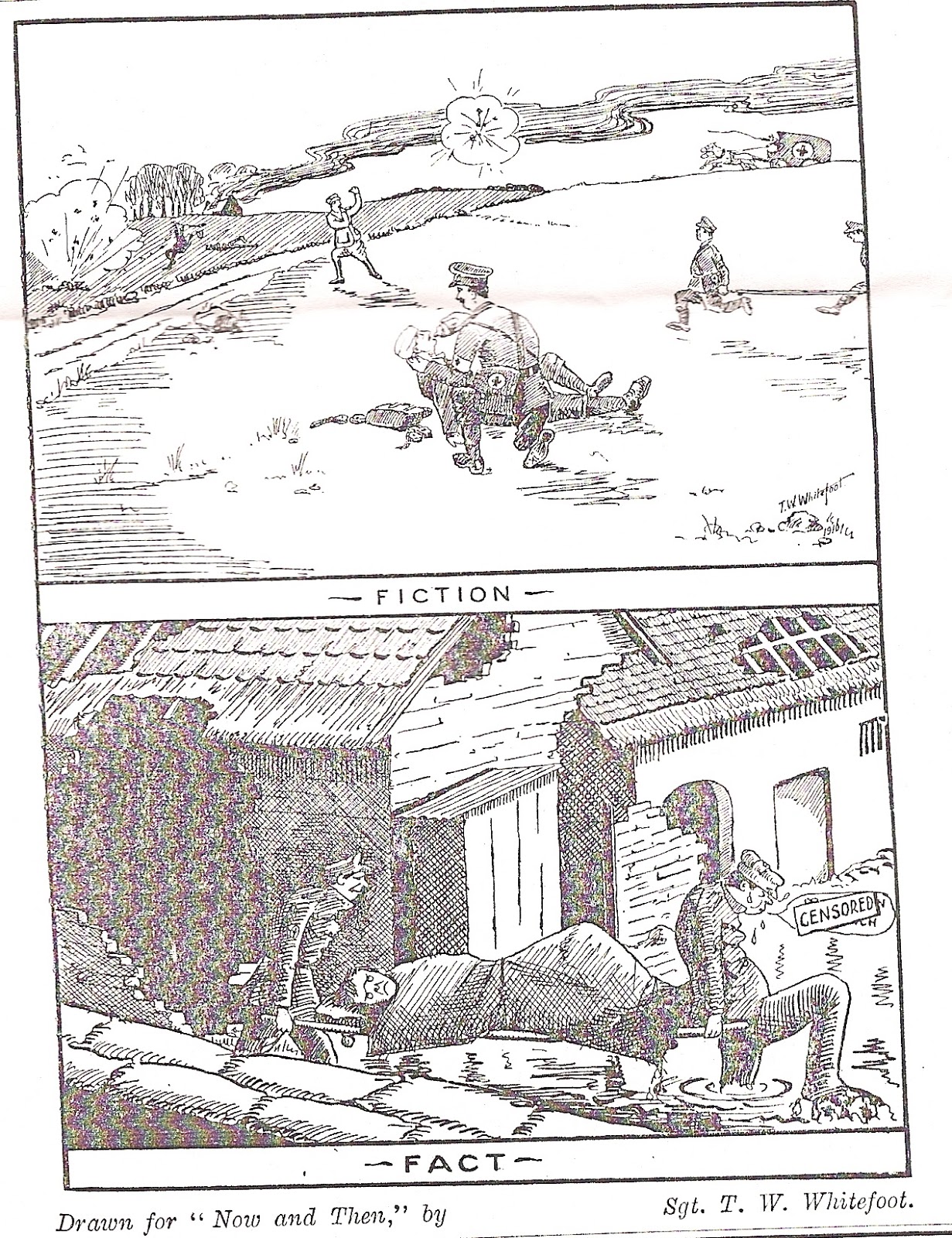
Cartoon from a trench newspaper
The defeat of the British Expeditionary Force (BEF) at Mons in August 1914 was a crushing early blow that gave rise to a still controversial legend of divine intervention and assistance known as ‘The Angels of Mons’. This persistent story is well-known, but the war generated an endless array of other enigmatic trench legends, myths and rumours.
BOILING DOWN THE BODIES
According to this grisly tale, the Germans were recovering bodies from the battlefield and boiling them down in specially-constructed factories to make tallow for candles. Despite no evidence ever being presented to support this fantastic rumour, it was widely believed and re-told throughout the war. So poor was the credibility of atrocity stories that Lord Northcliffe the newspaper mogul, offered a prize for any authentic photograph of a German atrocity. The prize was never claimed.
THE PHANTOM MAJOR
There were ongoing rumours of enemy agents in the allied trenches, usually disguised as officers, like the mysterious German spy, usually in a British major’s uniform, who was said to appear in allied trenches just prior to an attack.
As well as the creepy major in the trenches, spies were spotted everywhere, as they would be for the rest of the war. At this early point in the conflict there were reports of suspicious characters all over Britain and throughout the forces in France.
These stories were given some credence by real events in which a number of German espionage operations had been uncovered. But most of the stories, such as the German arrested on his way to the local water supply with a pocketful of deadly poison, were urban legends of the time, the result of fear rather than clandestine enemy activity.
THE COMRADE IN WHITE
In 1915, another mysterious story began to circulate. It was said that wounded British and French soldiers had been assisted in the trenches by a ghostly white figure. Usually the soldier was sheltering from a hail of bullets and shrapnel, through which the white figure seemed to pass without difficulty or injury. The phantasm reached the soldier who then lost consciousness for a moment or two, and subsequently found himself magically removed from danger. He then notices that there is a wound on the apparition’s hand. The figure explains that it is an old wound which has recently reopened.
The French called this apparition or hallucination ‘The Comrade in White’, a term adopted by the British, who also called him the ‘Helper in White’. Many found this legend a much-needed consolation and it would continue to be heard throughout the war.
THE CRUCIFIED CANADIAN
The Times of May 10, 1915 ran the first press report of the story which claimed that a group of Canadians wounded in the fighting near Ypres had come across one of their officers who had been crucified:
‘He had been pinned to a wall by bayonets thrust through his hand and feet, another bayonet had been driven through his throat and, finally, he had been riddled with bullets.’
A similar horrific tale was picked up by the Canadian press and related in a number of versions and stories of crucified Canadians, as well as British and Australian troops, continued throughout the war. There were numerous attempts to verify the stories, but they never were, though the belief that the event, or something like it had occurred, was certainly strong among Canadian troops at the front and also many on the home front.
SNOWY RUSSIAN SOLDIERS
An early legend involved mysterious brigades of Russian soldiers in sealed trains passing through transportation junctions. They were said to be in full battle dress and with snow upon their boots – in summertime. These were usually said to have originated in the Russian city of Archangel and to be travelling to the Western Front to reinforce the British and French.
CATASTROPHIC LOSSES
It was said that the British had suffered catastrophic losses against the Germans, that hospitals were full to overflowing with wounded troops and that there had been an insurrection in Paris.
A large naval battle had been fought off Holland in which the British were also rumoured to have suffered devastating losses, including the death of Admiral Jellicoe. British naval ports were said to be clogged with war ravaged ships.
RENTED TRENCHES
 It was said that the defenders of the forts at Liege were not Belgians but British soldiers in Belgian uniforms. The British were paying the French rent for the trenches they were occupying and Vickers machine gunners fired their water-cooled weapons in order to boil water for tea.
Many other rumours swirled through the home front and battlefront during the war years:
·      One was a tale told in many wars of the ‘Wild Deserters’, a horde of refugees from all armies, who lived underground, emerging onto the battlefields at night to forage and pillage the dead and dying.
·      Most World War 1 soldiers were familiar with the rumours about ‘free shooters’ who were not fussy which side they shot at.
·      There were stories born of envy or wishful thinking, such as those about the enemy having women in their trenches.
·      Other rumours were spawned by fear and suspicion, including the belief that disloyal Belgians had signalled allied positions to German gunners
·      And there were revenge stories, like that about ‘The Admiral’, a crazed inventor who was horribly killed when one of his own devices of death malfunctioned.
Like most myths, these were the product of ignorance, fear and wishful thinking.
KEYWORDS: World War One trench myths, soldiers newspapers

RAGTIME ARMIES: TRENCH SONGS OF THE GREAT WAR

Singing was a pronounced feature of the Great War, 1914-18. Soldiers sang in camp, on the march, in the trenches and wherever else they felt the need. 1st Lieut. Elmer Hess of the 15th Field Artillery wrote in his diary:
‘The battalion moved again to the front.  The left side of the road was filled with trucks, ammunition, retreating French soldiers, field hospitals-all in great confusion.  We marched until midnight with practically no rest and on into the morning.  We could hear the songs sung by the American artillery marching ahead.’
Many of these songs were made by the soldiers themselves. They were based on their experiences and attitudes to the war and to the authority of officers and were circulated among themselves without commercial involvement or intention. Rifleman Patrick MacGill of the London Irish fought at Loos and left a brief but evocative account of such songs and their singers. He wrote:
‘Their origin is lost; the songs have arisen like old folk tales, spontaneous choruses that voice the moods of a moment and of many moments which are monotonously alike. Most of the verse is of no import; the crowd has no sense of poetic values; it is the singing alone which gives expression to the soldier’s soul.’
One of MacGill’s comrades observed the essential difference between trench songs and those sung elsewhere: ‘”These ‘ere songs are no good in England,” my friend Rifleman Bill Teake remarks. “They ‘ave too much guts in them.”’
Here are some of the most widely sung songs among British, Canadian, Australian and, later, American troops in the trenches …
The Ragtime Infantry
One of the earliest and eventually most widely-heard trench ditties of the war was known variously as Fred Karno’s Army’ or ‘The Ragtime Army’. Sung to the hymn tune ‘Onward Christian Soldiers’, its lyrical variations were many, though the core of satirical self-deprecation remained the same. Ragtime was a form of popular music of the period and Fred Karno was a renowned comic, whose crazy stage antics were the perfect metaphor of the madness in which the soldiers found themselves:
We are Fred Karno’s army, the ragtime infantry,
We cannot shoot, we cannot fight, what bloody use are we?
And when we get to Berlin, the Kaiser he will say:
‘Hoch, hoch! Mein Gott, what a bloody useless lot
Are the ragtime infantry’.
The Bells of Hell
A Royal Welch Fusilier wrote home in December 1917 describing the songs he heard in the trenches. He thought they expressed ‘the men’s stoical cynicism, which is always cheerily, and usually blasphemously expressed’. He gave the lyrics of ‘The Bells of Hell’:
The bells of hell ring ting-a-ling-a-ling
For you but not for me;
The herald angels sing ting-a-ling-a-ling,
They’ve got the goods for me.
Oh death, where is thy sting-a-ling-a-ling
Oh grave, thy victoree!
The bells of hell ring ting-a-ling-a-ling
For you but not for me.
Hush, Here Come a Whizzbang
A whizzbang was any kind of artillery shell, as in the trench parody of a pre-war pop song titled ‘Hush, Here Comes the Dream Man’:
Hush, here comes a whizzbang,
Now, you soldiers get down those stairs,
Down in your dug-outs and say your prayers.
Hush, here comes a whizzbang,
And it’s making straight for you,
You’ll see all the wonders of no-man’s land
If a whizzbang – crump! – hits you.
Keep Your Head Down, Allemand
One of the popular trench ditties of the war, referring to the enemy as Alleymand (Allemand) from the French for German, described what each side did when the other was erecting barbed wire defences:
Keep your head down, Alleymand,
Last night in the pale moonlight
I saw you, I saw you,
You were fixing your barbed wire
So we opened rapid fire
Keep your head down, Alleymand.
I Want to go Home
A widespread trench ditty summed up the effect that machine guns had on morale:
Machine guns they rattle, Jack Johnston’s they roar,
I don’t want to fight with these Fritz anymore,
Take me over the sea where the Germans they can’t get at me,
O my, I don’t want to die
I just want to go home.
My Little Wet Home in the Trench
A soldier parody of the pre-war hit song ‘My Little Grey Home in the West’, this ditty was known not only to Canadian, but also Australian troops and would probably have been sung by British soldiers as well. ‘Jack Johnson’s’ were large, loud shells that left dark smoke in their wake, named after the African American boxer of the period.
I’ve a little wet home in the trench,
Where the rainstorms continually drench,
There’s a dead cow close by,
With her hoofs towards the sky
And she gives off a beautiful stench.
Underneath in the place of a floor,
There’s a mass of wet mud and some straw,
And the ‘Jack Johnsons’ tear
Thro’ the rain sodden air,
O’er my little wet home in the trench.
There are snipers who keep on the go,
So you must keep your napper down low,
And their star shells at night
Make a deuce of a light,
Which causes the language to flow.
Then bully and biscuits we chew,
For its [sic] days since we tasted a stew,
But with shells dropping there,
There’s no place to compare
With my little wet home in the trench.
The Purple Platoon
Some ditties were even more directly critical of the war and those running it, as in the Australian version of some short but pointed couplets:
Our officer’s out on his favourite stunt,
Taking us out for a souvenir hunt,
Taking us out in front of the wire,
Getting us killed by our own rifle fire.
We used to be fifty-odd non-coms and men,
We used to be fifty but now we ae ten,
And if this cross-eyed war doesn’t end ruddy soon,
There’ll be no Aussies left in our purple platoon
The Wrong Way to Tickle Marie
There were few subjects that the Tommies, Poilu’s, Diggers and, later, the Doughboys, did not subject to musical mistreatment. Usually their ditties were to the tune of popular songs of the war or immediate pre-war period, such as ‘Tipperary’ and were often sexually suggestive:
That’s the wrong way to tickle Marie,
That’s the wrong way to kiss!
Don’t you know that over here, lad,
They like it best like this!
Hooray pour le Francais!
Farewell, Angleterre!
We didn’t know the way to tickle Marie,
But we learned how, over there!
Hanging on the Old Barbed Wire
Comments on the perceived inequities between officers behind the liens and the fighting men at the front were not uncommon in trench songs. In one or another of many versions, this one was very popular:

If you want to see the infantry, I know where they are,

They’re hanging on the old barbed wire,
I’ve seen them, I’ve seen them,
Hanging on the old barbed wire I’ve seen them,
Hanging on the old barbed wire.
If you want to see the generals, I know where they are,
They’re miles and miles behind the lines,
I’ve seen them, I’ve seen them,
Miles and miles behind the lines I’ve seen them,
Miles and miles behind the lines.
The fresh troops arriving from America in 1917 were full of the same confident enthusiasm that the British troops had initially possessed. An American ditty to the tune of ‘I Wish I Was in Dixie’ expressed a no-nonsense approach to winning the war by finishing off, or ‘canning’, the German leader:
We’re off to can the Kaiser,
Hurray! Hurray!
In Kaiserland we’ll take our stand,
Until we can the Kaiser.
Let’s go, let’s go, let’s go and can the Kaiser.
The following year allied troops did exactly that.
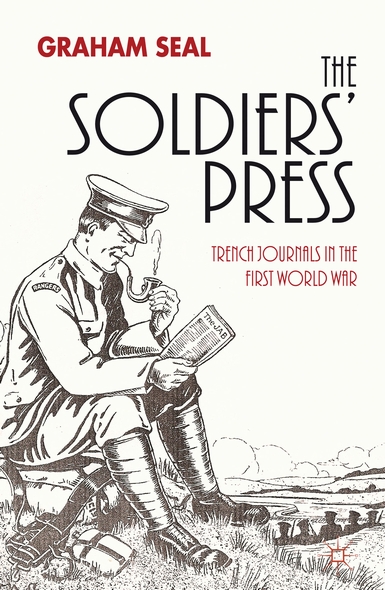
MORE: Graham Seal, The Soldiers’ Press: Trench Journals in the First World War, Palgrave Macmillan, 2013.
KEYWORDS: World War One; Great War; trench songs; soldier songs
FBI TURN TREASURE HUNTERS

Who doesn’t love a good treasure yarn? Even the FBI, it seems. Along with the Department of Conservation and Natural Resources, the feds have set up camp at Dents Run, Elk County PA, the rumoured site of some Civil War gold.

The story goes that a wagon load of Union gold bars was lost in the rugged mountains in this part of the country in 1863 and never seen again. Rumours have abounded ever since and many people have tried to locate the trove. As usual, details are contradictory and murky, but wait for it – there is a map! And even ‘a mysterious note found decades ago in a hiding place on the back of a bed post in Caledonia, Pa.’.

They don’t come much better than this one (though the Nazi Gold train is hard to beat). Anyway, the FBI suddenly descended on the site and started digging. They must like the yarn, as well. Perhaps they were hoping to find the gold to pay their wages in the threatened shutdown of US government functions?

No results reported yet, of course, just a lot of speculation and gold hunter excitement. It must be true if the FBI is on the job!

Read all about it here. And a further update in which the FBI reports they found nothing – sure. The legend lives!

KEYWORDS
Civil War gold, treasure, FBI

MASSACRE AT CHILCOT ISLAND


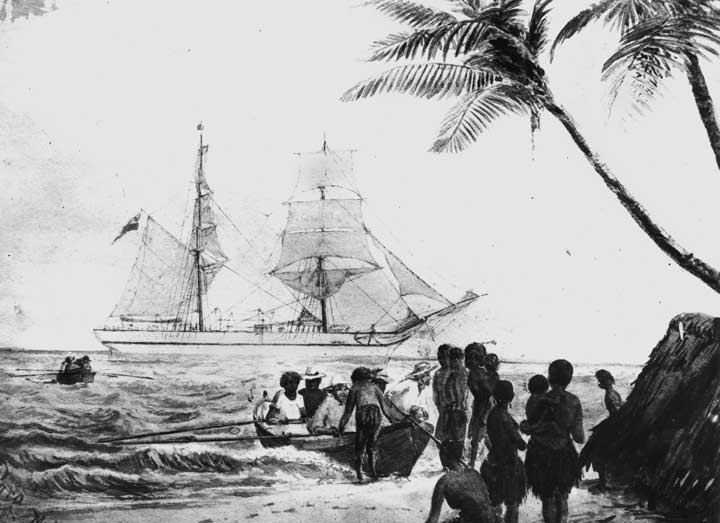
Pacific Island recruiting ship ‘Para’, c 1880 (SLQ)
Thomas Harris, master of the schooner Douglas set sail from Trinity Bay in Queensland for Dunk Island in early January 1877. With ten crew aboard, their ultimate destination was the Coral Sea guano island of Chilcot owned by Beaver & Co, also the owners of the Douglas. The seeds of future trouble were sown the morning after they reached the island:
…  two canoes came off, each having a native on board ; they came on board my ship voluntarily’; I gave them tobacco and other things ; I also gave them to understand that they could come with the ship for eighteen months if they liked ; they said “ budgerrie,” and three days after, just when we were getting underway, four natives came off (the two who had previously visited the ship, and two others); three of them were allowed to come on board ; the other one I refused to take with us on account of his treacherous looks…
Harris and the Douglas were engaged in ‘blackbirding’, the then-legal procurement of black labour, including Aborigines, from Pacific islands to work the sugar cane fields of colonial Queensland.  He provided the details to the magisterial inquiry established to get the facts of the ‘massacre’, as the press termed the murders:
there was a license authority sent on board the ship at Melbourne, authorising me to recruit native black labour on certain islands in the South Pacific, or from the main land, for a period of twelve months, to be engaged in beche-de-mer fishing, or procuring guano. Natives so engaged were not to exceed twenty in number …
What happened when they arrived at Chilcot was recounted by Harris in his evidence:
… at night two of the men (Humphrey Coughlan and Alexander M’Intosh) were left to sleep on the island, two of the blacks remaining with them; the men had no arms save half-axes, which they were cautioned to be careful not to leave in the way of the blacks…
They all turned in for the night. Everyone was tired and with the boat a kilometer or more from land Harris did not consider there was any need to set watch. But:
about midnight, while the mate and I were asleep on the “lockers,” we were awoke by a cry of “Save me, they are murdering me.” I said to the mate, “For God’s sake, get up.” He rushed out and I followed. The mate went by the port side, and when I reached the deck I met one of the hands (James Purcell), all cut and bleeding. I told him to go down into the cabin. He went down but seemed half stupid. I next saw a black following the mate with a raised axe. I sang out to him and he turned round and struck at my head, severely wounding my hand, raised to guard my head. I immediately closed with him to take the foe, but could not succeed. So I made for the cabin where I found Purcell lying in a pool of blood and moaning very much.  The boy was also there. I tried to load a revolver, but could not on account of the wound on my hand.
By now their assailants were trying to smash in the skylight glass using lumps of coal and oars. Harris managed to load his revolver and got off a few shots. The attackers were now in full possession of the dock, ‘cutting and hacking everything with the axes they had.’
about fifteen minutes to 5 o’clock a.m. heard a blackfellow’s voice, and immediately afterwards the steward tumbled down into the cabin, wounded. I gave him a revolver, and told him to fire at the black stationed at the skylight. He fired and I believe hit the black, but did not kill him. He ran up on deck and put another shot into him, which killed him.
Harris heard one of the crew forrard cry out: ‘One of the blacks is overboard’. He looked through a porthole and saw a man swimming:
 I told the steward to fire at him, which he did, but cannot say whether the fugitive was hit. I saw him land on a rock, and sent the boy to the maintop to watch his movements. Next saw a sea take him off the rock. Never saw him again, believe he was drowned.
On looking around saw two blacks dead and ordered the bodies to be thrown overboard. Also saw the body of Patrick Troy, greatly mutilated. On mustering crew, found the others badly wounded, the mate and steward only being unhurt. I sent them away in a boat to the island to see how matters stood there. When they returned, they reported that the two men, Humphrey Coughlan and Alexander M’Intosh, had been murdered in the hut. The mate stated that the bodies wore much cut about the head and that decomposition was fast setting in. But before sending the boat away again, I ordered the body of Patrick Troy to be wrapped up in his blankets and taken on shore to be buried with the others. The murders were no doubt perpetrated with the half-axes. Those now produced are the weapons mentioned.[1]
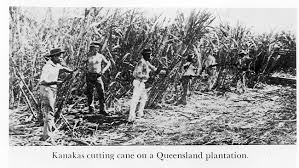
The exact truth behind these grim events will never be known but it seems clear that the Aboriginal men taken aboard at Dunk Island were either tricked or forced into accompanying the crew. This was the era in which the kidnapping of indigenous people for labour was legal. Most were ‘kanakas’ from the South Pacific islands. Known colloquially as ‘sugar slaves’, it is thought that around 60 000 were forced or cajoled to work mainly in the Queensland sugarcane industry where they were often badly treated and poorly paid. The trade began in the 1860s and lasted until 1904 when those who had been indentured and their descendants were deported in accordance with the Commonwealth of Australia’s Immigration Restriction Act (the ‘White Australia Policy’).  But several thousand islanders remained in Australia, forming the basis of a descendant population now numbering 20 000 or more who live mainly in North Queensland.


[1] The Mercury (Hobart), 24 March 1877, 3

STEALING THE PAST

Recent raids on and ongoing investigations of high profile artefact collectors and dealers have highlighted the extensive global trade in illegal antiquities by the many who profit from the past.
Looting humanity’s heritage has always been big business. Today, it’s even bigger. The global trade is variously estimated to be (depending on whether art is included with artefacts) as between four and six billion dollars a year – and counting. But no-one really knows the extent of the trade and these enormous figures are probably just the tip of the pyramid.
Egyptian mummies and their associated grave goods are what most of us first think of in realtion to stolen artefacts. The romance of ‘Egyptism’ has long appealed to westerners and has been mythologized by generations of books, movies and often dodgy History Channel documentaries about Tutankamun and resurrected mummies bent on wreaking bandaged havoc. But almost every other ancient – and modern – culture is being plundered right now. Even WW2 shipwrecks are the target of treasure hunters with diving gear and very bad attitudes to war graves.
Until relatively recently, most of this activity was of interest only to a few police units, academics and joiurnalists. The general public heard little about it. The business has always been necessarily clandestine at every level. It is based on alrge number of hard-strapped locals plundering tombs and burial sites. Their swags of figurines and jewellery are sold for a pittance to middleman/women traders who flog them to unscrupulous dealers at enormous markups. The dealers then unload the artefacts at yet more enormous profits to disreputable, dumb or wilfully ignorant collectors, galleries and museums, many funded largely by taxpayers.
All this used to be very hush-hush. But then ISIS began blowing up antiquity and funding their terrorism by flooding the market with ‘blood artefacts’. As a result, the trade has suddenly become very visible and a hot number for the media and politicians.
Some very prestigious and otherwise respectable institutions have been blushungly returning artefacts they illegally or otherwise dubiously acquired. In recent years both the National Gallery of Australia and the Art Gallery of New South Wales have diplomatically returned illegal objects to their country of origin. Other ‘repatriations’ have been made by the J Paul Getty Msueum and the Cleveland Museum of Art, among others.
Some returns have been grudging and protracted. They would not have happened but for the investigations of a few academic entities like the Trafficking Culture consortium and the determined digging of journalists associated with the Chasing Aphrodite book and blog, together with patient excavations by one or two concerned legal authorities.
But what drives individuals and cultural instutions to seek and obtain pieces of the past? And to jettison ethics and legalities in the process? It’s easy to understand the limited alternative opportunities for local tomb raiders and the greed of traders and some dealers. But why are some people prepared to spend millions of theirs, and sometimes ours, on dusty objects with dubious provenances? Many objects are so ‘hot’, they can never be seen outside the anonymous vaults of private collectors. Others are purchased for public display and, sometimes, research in otherwise highly respected museums and galleries.
In the process of passing from dusty old junk to priceless antiquity, illegal artefacts become what Polish historian Krzysztof Pomian, author of  Collectors and Curiosities: Origins of the Museum, calls ‘semiophores’ – objects that lose their practical function and gain other value by virtue of where they are located and the meanings we invest in their display. In short, a sow’s ear is turned into a silk purse. As we gaze upon the purses on gallery walls and in museums we are supposed to somehow connect with the past and the humans who lived and died in it, the underground population we will all be joining in due course. But in reality, artefacts are simply old objects that, for reasons of our own, we invest with the significance we want them to hold.
Validations for acquiring ancent artefacts, illicitly or otherwise, usually include statements about ‘the treasures of antiquity’, ‘the heritage of humanity’, or how ancient art teaches us about our ancestors and so, allegedly, about ourselves. Any or all of these may be valid. But the real motivation is power – the power of acquisition and ownership. The museums of the world’s colonizing powers are still stuffed with plundered artefacts and even the bones of colonized indigenous peoples – even those who may have disappeared centuries before European invaders arrived. Nowadays, people want their stuff back. There have been some high profile and low profile returns but they barely diminish the piles of victor trophies. (And don’t mention the Elgin Marbles).
Does it matter? So a few overly wealthy relic addicts get stiffed. At least the local grave robbers earn a few crumbs to feed their families.
The trouble is that, for whatever reasons, some very knowledgeable and skilled curators feel the need to attain these objects for their institutions. Their needs, and the expectations and obligations from which they stem, motivate a massive global trade that now even involves mafias peddling the past along with prostitutes, drugs and guns.


It is not just greed. In the end, history thieves and their clients exist because a lot of us want to see the plunder of the past gracing museums and galleries, for our own good or bad reasons. It’s not just ‘them’, it’s ‘us’ as well.
 
Some more links: