THE ORGY THAT WASN’T

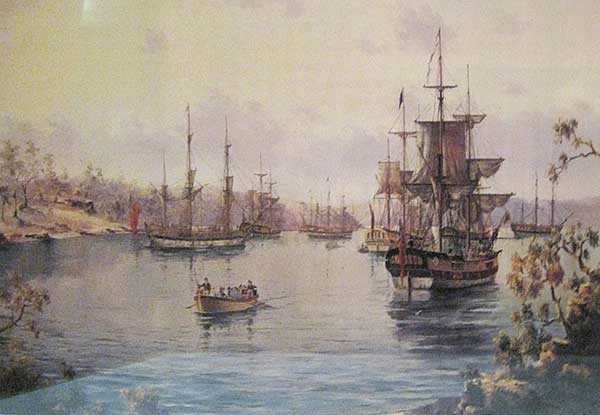
The women convicts of the First Fleet’s Lady Penrhyn went ashore at Sydney Cove on February 6, 1788. Most had seven or fourteen year terms and there were a few ‘lifers’ among them. The surgeon aboard the former slave ship that had brought them to the ends of the earth, Arthur Bowes Smyth, wrote ‘The Men Convicts got to them very soon after they landed, & it is beyond my abilities to give a just discription [sic] of the Scene of Debauchery & Riot that ensued during the night.’ According to subsequent writers, a wild orgy of rum, sex, storm and lightening followed, a fitting act for the foundation of a colony of convicts.

Popular as this story has become, in one version or another, historians have found little evidence of it ever happening. Bowes Smyth was nowhere near the scene of the alleged orgy, he was on the Lady Penrhyn quite a long way out in the harbour. None of the other keen diarists of the First Fleet, such as officers Watkin Tench or Ralph Clark seem to have noticed the orgy either. They certainly did not mention it in their accounts, an unlikely omission, especially for Ralph Clark who believed women convicts were all ‘damned whores.’

Why Bowes Smyth believed that ‘Debauchery & Riot’ occurred as soon as the women set foot in New South Wales is worth considering. He was certainly glad to see the women leave the ship: ‘we had the long wish’d for pleasure of seeing the last of them’, he wrote. The Lady Penrhyn’s voyage from England had been tedious and troubled with illness, lack of food and indiscipline. Many of the women were prostitutes and suffered from venereal disease. Although attempts were made to keep men and women separate, cohabitation quickly became commonplace. In April 1787, a month or so before they set sail for Botany Bay, five women were chained up for having relations with crewmen. There is no record of the sailors being punished.

During the voyage seventy year-old Elizabeth Beckford died of ‘dropsy’, or oedema, her bloated corpse buried at sea. She was not the last. Jane Parkinson died as they sailed from Cape Town to New Holland, as Australia was often known. Off Van Diemen’s Land the lumbering transport was lashed by a storm so fierce that the women fell to their knees praying for deliverance. Short of food once again, the Lady Penrhyn finally made Botany bay in late January 1788, only to discover that Arthur Phillip had decided the place was unsuitable for settlement. He had departed for Port Jackson.

By the time the Lady Penrhyn finally anchored in the great body of water that would become known as Sydney Harbour, the 101 women and more than 70 male crew and Marines had been cooped up on the thirty by eight metre vessel, in some cases for over a year. The women were flogged, chained, punished with thumb screws and had their heads shaved bare. Bowes Smyth wrote in his journal:

‘I believe I may venture to say there was never a more abandon’d set of wretches collected in one place…The greater part of them are so totally abandoned & callous’d to all sense of shame & even common decency that it frequently becomes indispensably necessary to inflict Corporal punishment upon them…’[i]

The doctor was clearly not well disposed towards his female charges. When he finally did ‘see the last of them’ he was predisposed to assume that they would behave in what he considered their typically debauched manner. Bowes Smyth was a product of his time and circumstances, as were all those who arrived on the First and subsequent fleets. 

The double standard that masqueraded as respectability and punished only women for acts that involved a male partner continued in the colony. Four of the convict women of the Lady Penrhyn became the de facto partners of officers and the Judge Advocate. Esther Abrahams and Lieutenant George Johnston began what would become a lifelong relationship during the voyage. They did not marry for another quarter of a century. 

Bowes Smyth also recorded an incident when one of the sailors was caught in the women’s tents. His hands were tied and he was publically drummed out of camp to the tune of ‘The Rogue’s March’, a ceremony used for dishonorable discharge from the army and usually followed by a flogging.

These more domestic relationships and official attempts to maintain propriety are not the stuff of myth. They lie forgotten in history while the more salacious story lives on. Historians have been trying to scotch the orgy myth ever since one of their own mistakenly set the yarn spinning in 1963. Manning Clark wrote of it though soon withdrew the assertion after a more careful look at the available evidence. But it was too late. The lewd rumour neatly captured popular views of early colonial society and the image of degraded convicts that had grown up over the generations. ‘The orgy that wasn’t’ gathered further currency from a procession of later writers and television shows repeating and embellishing the alleged scene.[ii] A yarn of ribald abandonment still resonates with a common view of the founding of Australia. No matter how often and convincingly historians demolish the myth, many still prefer to believe it.

From Great Convict Stories https://www.allenandunwin.com/browse/books/9781760527488


[i] Arthur Bowes Smyth (Smythe), ‘A Journal of a Voyage from Portsmouth to New South Wales and China. 22 March 1787–12 August 1789’. Mitchell Library.

[ii] See Grace Karskens, ‘The Myth of Sydney’s Foundational Orgy’, 2011, at the Dictionary of Sydneyhttp://dictionaryofsydney.org/entry/the_myth_of_sydneys_foundational_orgy, accessed August 2016.
DEFYING THE SYSTEM IN SALEM, 1661

In the seventeenth century, those unfortunate enough to be transported from Britain to the American colonies were sometimes sold to their colonial masters in exchange for cattle or corn. They were not slaves but the conditions in which they laboured were slave-like. Some fought back.

Will Downing and Phillip Welch were before the Salem Quarterly Court of June 26, 1661. They were there for ‘absolutely refusing to serve’ their master, Samuel Symonds, any longer. Seven years earlier, Symonds agreed to pay the master of the ship Goodfellow ‘26li.[pounds] in merchantable corn or live cattle’ due before the end of the following October for the two young men kidnapped from their beds in their own country. They were neither convicts or indentured servants and were almost certainly sold illegally into servitude. Nevertheless, Will and Phillip had worked their master’s fields ever since. And he insisted that he had paid good value for them to do so for nine years, not seven.

One Sunday evening in March 1661, Will and Phillip joined the Symonds family in the parlour for prayer, as usual. Before the family and their servants began to worship, Phillip declared to his master ‘We will worke with you, or for you, noe longer.’ Symonds sarcastically inquired if they were not working what would they do – ‘play?’ 

Phillip and Will stood their ground. They had served Symonds and his family for the seven years they believed to be their penance for simply being in the wrong place at the time Cromwell’s soldiers were scouring their area for victims. Symonds told them that they were obliged to work for him unless they ran away, a crime with severe punishment. They did not wish to flee; instead they pleaded ‘If you will free us, we will plant your corne, & mende your fences, & if you will pay us as other men, but we will not worke with you upon the same termes, or conditions as before.’ 

This must have been a memorable moment in the life of the family and its servants. All had been living and working cheek-by-jowl and praying regularly together for seven years. There was some talk about business difficulties as Symonds sought to make his servants see what he considered to be sense. His wife backed him up, saying this was not a good time to bring up the subject of money. But the young men remained adamant. When their master asked them to begin prayers together, they refused. Next morning Symonds summoned the local constable to his home, demanding that the rebellious servants be ‘secured.’ The constable wondered whether it was necessary for the men to be taken away, but Symonds insisted a warrant be served on them and that they should be paraded before the court. Which they duly were.

Now William and Phillip had a chance to state their case: ‘We were brought out of or owne Country, contrary to our owne wills & minds, & sold here unto Mr. Symonds, by ye master of the Ship, Mr. Dill, but what Agreement was made betweene Mr. Symonds & ye Said master, was neuer Acted by our Consent or knowledge, yet notwithstanding we haue indeauored to do him ye best seruice wee Could these seuen Compleat yeeres …’

William and Phillip considered they had already served their time, and more, because the usual practice of transport ship masters was to sell their stolen human cargoes in Barbados for only four years servitude. But now for seven years the two men had labored on Samuel Symonds’ ten acres of corn ‘And for our seruice, we haue noe Callings nor wages, but meat & Cloths.’ 

For his part, Symonds testified that he had made a bargain with the shipmaster and he had the ‘covenant’, or contract, to prove it. There was a supporting deposition from the shipmaster who said he had sold Symonds ‘two of the Irish youths I brought over by order of the State of England.’

Some other servants gave evidence. One man who had been kidnapped and transported with Will and Phillip described how they had all been rounded up against their will ‘weeping and Crying, because they were stollen from theyr frends.’ Some of Symonds’s own servants testified to the resentment of Phillip and Will against their situation and their determination to be free. Phillip reportedly said at one point that if Symonds would give him the same share of his estate as he would give his own children, then he would continue to serve.

The intensely personal nature of the relationships of master, family and servants in the Symonds household is clear in these testimonies. But the court, rightly or not, found the arrangement was legal and decreed that Will and Phillip should continue to serve until May 1663. An appeal was notified immediately but the two men agreed to work for Symonds until a date for the hearing could be set. He was bound to give them leave to attend.[i]

Whether this appeal was ever heard is not known. Possibly the full nine years were served before it could be and Will and Phillip were finally unbound. If so, they could then sell their labour in an open market and start the families they wished for in the New World. 

From Condemned: The Transported Men, Women and Children Who Built Britain’s Empire

Notes


[i] Salem Quarterly Court. Salem, Massachusetts. June 25, 1661. Records and Files of the Quarterly Courts of Essex County, Massachusetts, vol. II, 1656-1662, pp. 298ff at https://archive.org/stream/recordsandfiles00dowgoog#page/n307/mode/2up, accessed December 20, 2017. Welch’s proper forename was Phillip, as noted in the court records. Some references to these records claim that the youths were referred to as ‘slaves’ –  they were not, see Jennie Jeppesen, ‘Within the protection of law’: debating the Australian convict-as-slave narrative’, History Australia, vol 16, issue 3, 2019, at https://www.tandfonline.com/eprint/TYGCVFDNDUFDAY5NSGNN/full?target=10.1080%2F14490854.2019.1636674&, accessed November 2019.

LIFE ON THE HULKS

When transportation to the American colonies ceased after the War of Independence, British goals soon overflowed with prisoners. This situation soon created a new form of penal horror

To ease the pressure on prisons the government allowed old ships to be anchored in the River Thames (and at Portsmouth, Plymouth and elsewhere) to hold prisoners awaiting banishment across the seas. These ‘hulks’ were supposed to be a stopgap measure, but like many temporary arrangements they became permanent. Many prisoners would endure years aboard the rotting hulks, doing hard labour on the docks and in the naval arsenals, until they were finally transported.

The Dunkirk hulk moored at Plymouth was notorious even before the First Fleet set sail. Prisoners were sometimes without any clothing and in 1784 the abuse of the female convicts by the marine guards led to a ‘Code of Orders’ that were supposed to protect the women. Mary Bryant, later an almost successful escapee from Port Jackson, was held on the Dunkirk before sailing with the First Fleet. She became pregnant on the hulk.

Conditions aboard the Leviathan hulk at Portsmouth in the 1820s were better, but designed to strip convicts of whatever dignity they retained and subdue them into the system:

 ‘…this vessel was an ancient ’74 [1774] which, after a gallant career in carrying the flag of England over the wide oceans of the navigable world, had come at last to be used for the humiliating service of housing convicts awaiting transportation over those seas. She was stripped and denuded of all that makes for a ship’s vanity. Two masts remained to serve as clothes props, and on her deck stood a landward conceived shed which seemed to deride the shreds of dignity which even a hulk retains.’.

The prisoners were taken aboard and ‘paraded on the quarter-deck of the desecrated old hooker, mustered and received by the captain. Their prison irons were then removed and handed over to the jail authorities, who departed as the convicts were taken to the forecastle. There every man was forced to strip and take a thorough bath, after which each was handed out an outfit consisting of coarse grey jacket, waistcoat and trousers, a round-crowned, broad-brimmed felt hat, and a pair of heavily nailed shoes. The hulk’s barber then got to work shaving and cropping the polls of every mother’s son.’ Fettered and shaven prisoners were then marched below ‘where they were greeted with roars of ironic welcome from the convicts already incarcerated there’. The lower deck was a prison of wooden cells, each one holding between fifteen and twenty convicts.[i]

Edward Lilburn, a pipe-maker from Lincoln, described his experience of the Woolwich hulks around 1840:

‘I was led to think there was something dreadful in the punishment I had to undergo, but my heart sank within me on my arrival here, for almost the first thing I saw was a gang of my fellow unfortunates, chained together working like horses. I was completely horror-struck, but every hour serves now to increase my misery; I was taken to the Blacksmith and had my irons, the badge of infamy and degradation rivetted upon me, my name being registered and my person described in the books of the ship; I was taken to my berth, and here new sufferings presented themselves, as the great arrival of convicts had crowded the ship so much, that three of us have but one bed, and this the oldest prisoner claims as his own; our berth is so small, we have no room to lie at length, thus I passed a wretched, a half sleepless night, at the dawn of day we have a wretched breakfast of skilley, in which I cannot partake, and though suffering dreadfully from hunger I subsist wholly on my dinner, at present live on one meal a day!!’

Lilburn had the cheek to complain but was told that he was ‘brought here for punishment and that I must submit to my fate.’ He finished with a warning: ‘Whether I speak of my present situation in reference to daily labour, daily food, or the rigorous severity of the system under which I suffer, I can say, if there is a Hell on earth, it is a convict-ship. Let every inhabitant of the City and County of Lincoln know the Horrors of Transportation, that they may keep in the path of virtue, and happily avoid a life like mine of indescribable misery.’[ii]

After 1844 convicts were transported directly from the prisons where they were held rather than being sent first to the hulks. But the old ships still operated as gaols. By the time the journalists and social reformers Stephen Mayhew and John Binney visited the Thames hulks in the early 1860s, public outcry against the conditions and horrors of the hulks as described by Lilburn and others had already brought about reforms to the system, allegedly at least. Mayhew described conditions aboard the hospital ship Unité just a few years earlier in 1849:

‘… the great majority of the patients were infested with vermin; and their persons, in many instances, particularly their feet, begrimed with dirt. No regular supply of body-linen had been issued; so much so, that many men had been five weeks without a change; and all record had been lost of the time when the blankets had been washed; and the number of sheets was so insufficient, that the expedient had been resorted to of only a single sheet at a time, to save appearances. Neither towels nor combs were provided for the prisoners’ use, and the unwholesome odour from the imperfect and neglected state of the water-closets was almost insupportable. On the admission of new cases into the hospital, patients were directed to leave their beds and go into hammocks, and the new cases were turned into the vacated beds, without changing the sheets.’[iii]

Mayhew and Binney interviewed one of the warders who served under the previous ‘hulk regime’ who said that ‘he well remembers seeing the shirts of the prisoners, when hung out upon the rigging, so black with vermin that the linen positively appeared to have been sprinkled over with pepper…’. By the time this survey was conducted there was regular medical treatment available, a lending library, education for the man who could not read or barely so. The food provided had also improved dramatically, at least according to the regulations:

‘We now followed the chief warder below, to see the men at breakfast. “Are the messes all right ?” he called out as he reached the wards.
“Keep silence there! keep silence!” shouted the officer on duty.

The men were all ranged at their tables with a tin can full of cocoa before them, and a piece of dry bread beside them, the messmen having just poured out the cocoa from the huge tin vessel in which he received it from the cooks; and the men then proceed to eat their breakfast in silence, the munching of the dry bread by the hundreds of jaws being the only sound heard.’

Each prisoner received a breakfast of twelve ounces of bread and a pint of cocoa. For dinner they were allowed six ounces of meat, a pound of potatoes and nine ounces of bread, for supper a pint of gruel with six ounces of bread. Wednesdays, Mondays, and Fridays were ‘Soup Days’, when the dinner was a pint of soup, five ounces of meat, a pound of potatoes, and nine ounces of bread.

For punishment, the luckless convict was reduced to a pound of bread and water each day. Those on the sick list were fed a pint of gruel and nine ounces of bread for breakfast, dinner, and supper. But an enhanced diet was given to the very sick, as the master of the hospital told the journalists:

‘The man so bad, up-stairs, has 2 eggs, 2 pints of arrowroot and milk, 12 ounces of bread, 1 ounce of butter, 6 ounces of wine, 1 ounce of brandy, 2 oranges, and a sago pudding daily. Another man here is on half a sheep’s head, 1 pint of arrowroot and milk, 4 ounces of bread, 1 ounce of butter, 1 pint extra of tea, and 2 ounces of wine daily.’

The trades and occupations of convicts in the 1850s included carpenters, blacksmiths, painters, sawyers, coopers, rope makers, bookbinders, shoemakers, tailors, washers and cooks, even the occasional doctor. Convicts received ‘gratuities’ for the quality of their work and general conduct. They wore badges which indicated their duration of sentence, period in the hulks and levels of good or bad behavior, updated monthly, the details entered into the ‘character book’ of each hulk.

Mayhew also described the work performed by those whose labor was now at the control of the state.

‘The work of the hulk convicts ‘is chiefly labourers’ work, such as loading and unloading vessels, moving timber and other materials, and stores, cleaning out ships, &c., at the dockyard; whilst at the royal arsenal the prisoners are employed at jobs of a similar description, with the addition of cleaning guns and shot, and excavating ground for the engineer department.’

Mayhew saw the working parties in the dockyards:

‘… only the strongest men are selected for the coal-gang, invalids being put to stone-breaking. In the dockyard there are still military sentries attached to each gang of prisoners. We glanced at the parties working, amid the confusion of the dockyard, carrying coals, near the gigantic ribs of a skeleton ship, stacking timber, or drawing carts, like beasts of burden. Now we came upon a labouring party, near a freshly pitched gun-boat, deserted by the free labourers, who had struck for wages, and saw the well-known prison brown of the men carrying timber from the saw-mills. Here the officer called – as at the arsenal – “All right, sir!” Then there were parties testing chain cables, amid the most deafening hammering. It is hard, very hard, labour the men are performing.’

Most closely regulated of all was convict time. From the moment of waking – 5.30 in summer, half an hour later in winter – the prisoners of the hulks ate, worked, washed and prayed to a strict timetable. All were in their beds or hammocks at 9pm.

This strictly regulated world of servitude, obedience and hard labour was an essential element of the larger penal transportation system of the British empire. It lasted for centuries

Adapted from Great Convict Stories from

allenandunwin.com/browse/book/Graham-Seal-Great-Convict-Stories-9781760527488/


[i] James Tucker, (‘Giacomo Rosenberg’), The Adventures of Ralph Rashleigh: A Penal Exile in Australia1825-1844.First published in 1929, though thought to have been written in the 1840s.

[ii] A Complete Exposure of the Convict System. Horrors, Hardships, and Severities, Including an Account of the Dreadful Sufferings of the Unhappy Captives. Containing an Extract from a Letter from the Hulks at Woolwich, written by Edward Lilburn, Pipe-Maker, late of Lincoln, from a broadside in the Mitchell Library (Ferguson 3238).

[iii] Henry Mayhew, John Binney and Benno Loewy, The criminal prisons of London, and scenes of prison life, London, Griffin Bohn, 1862. p. 200.

CONDEMNED: THE TRANSPORTED MEN, WOMEN AND CHILDREN WHO BUILT BRITAIN’S EMPIRE

Here’s the hardback cover of my upcoming book with Yale University Press, published in UK and USA in May and as a paperback in Australia around the same time. 

There’s an audiobook as well. All available on pre-order now.

Condemned came about because the human story of Britain’s transportation system has never been fully told. Historians have researched the legal, political, penal and other aspects of the topic and we now have a good understanding of the operation and impact of transportation in Australia, America, Africa, India and the many other British possessions where men, women and children were sent to labour. Against this background, I wanted to retrieve and tell a few of the life stories of the transported and convey something of how people dealt with such a traumatic experience. Many were broken by it – but many others flourished and made significant contributions to the places of penance to which they were exiled.

My previous work on the transportation was focused on the Australian experience. When I came to look at the much larger picture of imperial transportation, I learned how adroitly Britain had exploited human resources to build and maintain an extensive empire. As I researched further, I began to see that as the penal transportation system declined, one of its main aims was quietly pursued by other means.

Children were among the earliest victims of the system in the seventeenth century. They were again from the nineteenth century through a charitable continuation of transportation. The tens of thousands of orphaned or unwanted girls and boys conveyed to Australia, Canada, New Zealand and Southern Africa were not felons. But, like the convicts who preceded them, they were sent to provide labour for developing the empire, as well as the means to populate it further.

An important reason for the eventual abolition of transportation was public opposition to its abuses, injustices and sheer brutality. Later, the evils of child migration were exposed and addressed through public advocacy in those countries where unaccompanied children were subjected to institutionalised terror. The success of these hard-fought campaigns prefigures contemporary human rights and social justice campaigns, such as the Black Lives Matter movement.

The large and long story of transportation, in whatever form, covers much of the globe and spans four centuries. The consequences continue into the present century through lingering historical guilt about convict ancestors and inquiries, apologies and compensation payments to the system’s last victims. Those who were, rightly or wrongly, condemned to the grinding inhumanity of transportation deserve to have their stories heard today.

*