SPLENDID HELLS AND SKINNING HOUSES – The Lingo of American Gamblers

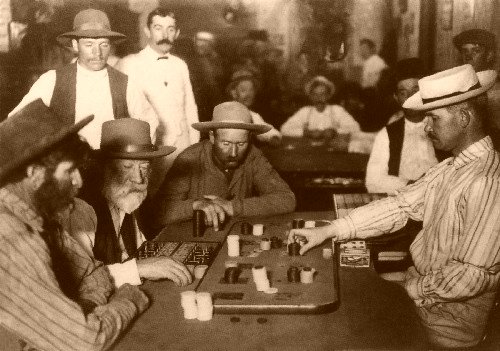
Playing Faro, Arizona 1895 (Wikipedia)

A nineteenth gambler named Mike Macdonald is credited with the phrase ‘There is a sucker born every minute’ and gambling of all kinds was big business in the expansion of America. The first major surge was from around 1800 to the mid-1830s. Games such as faro, craps, monte and, later, klondike became established with the sharpers, or professional gamblers, preying on the suckers with all manner of rigged games, stacked decks and a host of other tricks and traps. So prevalent and frequently ruinous was the urge to gamble that a strong moral and social backlash saw gaming shut down in many places, sending the sharpers and their tricks out across the roads of a rapidly expanding nation.

The Californian gold rushes provided another opportunity for gamblers to ply their trades. It seems that the card and dice game of banco was introduced from Europe at this time (although the founder of the Pinkerton Detective Agency did not come across it until 1869 in New Orleans). It grew rapidly in popularity, developed many variations, mostly crooked and become widely known as bunco, often played in bunco parlours or bunco skins.  The game used accomplices similar to those used in the shell game and later confidence tricks to bring the mark to the fleecing. This person was known as a bunco steerer. Bunco became a byword for swindling of all kinds and the term bunco artist or bunco man became synonymous with fraud and deception of all kinds. Many police departments even referred to their fraud and gaming officers as bunco squads from the period of Prohibition when the game made a return to the criminal pursuits of gangsters, particularly in Chicago, though the numbers rackets, refinements of yet earlier refinements of ancient swindles, seem to have become the main forms of graft by this time. The once popular and powerful expostulation buncombe! is also related to bunco, though which word came first has been the subject of controversy among linguists.

A second major wave of gambling began after the Civil War and lasted to the early twentieth century. During these periods, between them, and after them, gambling ebbed and flowed depending on local politics and economics. Sometimes betting of all kinds, whether square or crooked, was banned, sometimes it was wide open, sometimes it was legal but regulated. Through all these ups and downs though, the card sharps and their victims played on, using an always evolving and extensive language of luck, cheating and skill.

The places in which these games were played and usually lost, ranged from anywhere flat space where dice could be thrown or cards laid, all the way through to elaborate resorts and casinos. The best of these palaces of pleasure and financial pain were known as splendid hells, hell being an old description for gambling dens. Those cheap premises where players set up their own games were known as wolf traps, skinning houses or deadfalls. They were also known as ten percent halls from the size of the cut that the individual gambling entrepreneur gave to the house for the privilege of playing there. If a player got a square deal – the origin of the current phrase – at any of these places it was an oversight.

One of the means devised to make sure that suckers did not prosper was the mechanical dealing box. The first of these seems to have surfaced in the early 1820s. It was a brass box, slightly larger than a standard deck of cards and with thumbhole on the top through which the dealer slid each card out of a slit in the side. A spring pushed the remaining cards to the top as each one was dealt. The potential for chicanery – already developed to a high art in hand dealing – now increased exponentially. Dealing boxes were rigged with a bewildering variety of fiendishly cunning devices for cheating with names like the tongue-tell and the sand-tell, the needle squeeze or the end-squeeze. One was called the gaff, a new variation on an old and widely used word having a long association with the arts of deception. These devices were all legal and could be purchased from specialised suppliers, along with marked and otherwise rigged decks of cards, dice, roulette wheels and hold-outs for secreting cards on the body or beneath the poker table. When all these devices and techniques failed or were unavailable, the gambler could always fall back on the folk wisdom in the traditional rhyme:

Cut ‘em thin, sure to win,

Cut ‘em deep, sure to weep.

The jargon of the many forms of gambling that have evolved in modern times is large and long. Sucker has extended to a sucker bet and there are a variety of words for unskilled or unwary players, including degenerate, meaning a compulsive gambler, a mush (possibly from Romany) is a player who always has bad luck, while a pigeon is a naive gambler. A whale bets extremely large amounts each round, and a square is an inexperienced gambler. Sharp, sharper or shark is still used to denote a professional gambler. One could be skinned, rooked, taken down, fleeced, bilked, milked, bled dry or gypped, among many other expensive consequences. Even the eminent writer and wit, Oscar Wilde, was not safe from the wiles of the notorious bunco man, ‘Hungry’ Joe Louis. He took Wilde for the enormous sum of $5000 during the celebrity’s tour of the United States in 1882. Fortunately, Oscar rapidly stopped payment on the cheque he had wisely given Hungry Joe rather than the cash that these accomplished con men preferred. If the great man responded to this experience with one of his famously well-turned quips, it is not recorded.

In his account of the New York underworld, Low Life (1991), Luc Sante notes how many terms from the card game faro have passed into popular parlance. Faro was a development of an ancient game that had many variations in Europe and Britain, arriving in America at the end of the eighteenth century, spreading across the country during the nineteenth century. It was a complex game in which many betting possibilities could be wagered by the player against the house, represented by a dealer and an assistant. Faro involved twenty-five draws or turns, with the final turn being the one on which most could be won – or lost. The assistant’s job was to replicate a smaller version of the game in a special box, or case-keeper, allowing the dealer to predict how the last turn would go. Although faro was so blatantly rigged it was apparently considered to be a fairer form of gambling than any other, one reason for its great and enduring popularity. This had faded by the turn of the twentieth century, but words and terms such as parlay, keeping tabs on someone or something, piking, to break even, to string along, to be a pigeon and to be in hock are all identified by Sante as having their origins in the hazardous diversion of faro.

Inevitably, gambling lingo has more than its fair share of terms for losing money. These brokisms include being down to the felt, tapped out and dropping money. A player on a losing streak may be cold and scared money is cash that you cannot afford to lose. A bad beat in poker occurs when a player expects to win the pot but loses, while drawing dead is to have an inevitably losing hand, as revealed by subsequent events in the game. According to poker legend, the ultimate losing combination of a dead man’s hand stems from the fact that Wild Bill Hickock was shot dead in 1877 while holding a hand of a pair of aces and a pair of eights, usually said to have been in black coloured suites.

Now, as then, the great and the obscure still flock to lose their earnings and sometimes more in a variety of bedazzling new as well as tried and true old ways. Bunco even made a return to the gambling precincts of New York in the 1980s and online gambling through the World Wide Web is a massive industry. The language of gambling reflects this ongoing tradition. Some of the older gambling terms, or new terms with similar meanings, are in current use. A carpet joint is a luxurious casino, while a sawdust joint is a very basic gambling club. Shills are employed in similar roles to those working for the fleecer in the shell game. They will play at tables on behalf of the house to fill up empty seats until real players arrive. A mechanic is still a dealer who cheats players, as he or she has been for well over a century and grease means a bribe. The commission taken by a casino is known as juice, vigorish or vig. A term associated with circus and carnival speech is also used in modern gambling lingo. The nut can refer either to the overheads incurred in running a gambling house or to the amount a gambler plans to win. It is also used in circus and carny speech. To crack the nut is to win enough to pay for all costs together with a profit margin, also termed white meat.
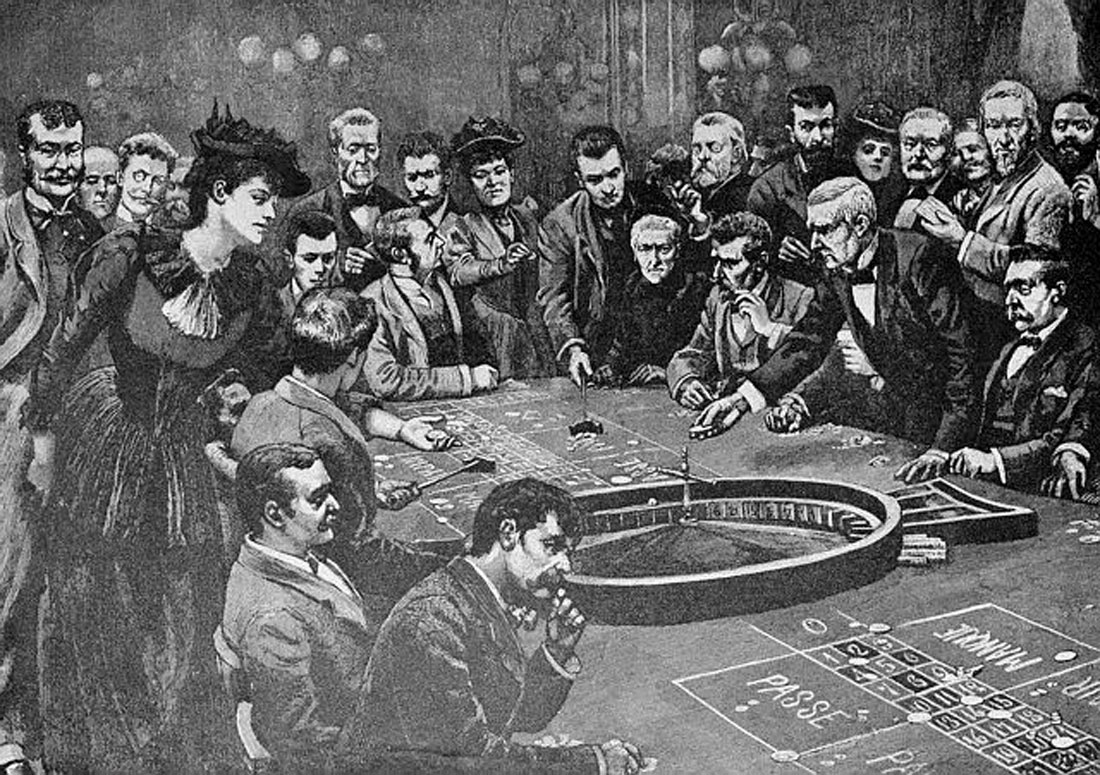
19th century casino, At the House of the Bronze Door, New York

*

THE SECRET LANGUAGE OF GOBAN SAOR

(Image by Sheila 1988, Wikipedia Commons)

Irish stonemasons used a secret language known as bearlager na saor (also as Bearla lagair)., said to have come down from the great ancestor of masons, Goban Saor (variously spelt and pronounced gabawn seer). The mythic Goban Saor – Goban the builder – was, and is, the subject of a body of folktale traditions that present him as a clever and greatly skilled artisan who always outwits those who try to harm him or to refuse his rightful fee for work done. It was he who handed down the closely guarded skills of the stonemason, together with their confidential speech.

Towards the end of the nineteenth century, American word sleuths became aware of a curious language spoken by itinerant Irish workers, particularly stone masons. It was neither Old Irish, Gaelic or even Shelta, but seemed to have some similarities to all of these, as well as its own characteristics. One companion of itinerants, named A T Sinclair, inquired further into this among older Irish stone masons in Massachusetts and discovered that ‘On mentioning the subject to some old Irish masons here in Allston, I was surprised to find they could speak this language which they called “Bearla lagair na saor … a large number of other old Irishmen knew there was such a mason’s talk called ” Bearla lagair” ‘[1]

Sinclair’s informants told him this was a language known only to stonemasons and that no apprentice could claim his ‘indenture’, or trade qualification, without being able to speak it. Masons were forbidden to mention this speech to anyone who was not one of their guild, including their own families. The trade secrets also included special signs, skills and ways of using their tools, together with a variety of rules that must be followed and through which a mason could identify himself to another adept of the craft. Sinclair also collected stories about the Goban Saor, including this one which gives the origin of a famous stone mason’s mark:

Sometimes a love of adventure led the Goban Saor to wander incognito as a common workman. His renown as an architect and artistic sculptor was widespread. One simple story which amuses these workingmen is this. The Goban Saor once, in a foreign land, applied to the master- builder of a cathedral for work. ” What can you do? ” asked the master. “Try me and see,” was the laconic reply. Then the builder placed him in a work-shed alone by himself, and, pointing to a block of stone, said facetiously, “Carve from that a cat with two tails.” The shed was fastened at night, and the next morning Goban had disappeared. When the master unfastened the shed and looked in, he found that the block of stone had been most beautifully carved into a cat with two tails. With an exclamation of surprise, he ejaculated, “It was the Goban Saor himself! No other human being could do such superb work, or so quickly.”[2]

Sinclair gave a selection of Bearla lagair words, mostly those similar to the travellers’ language of Shelta, including:

Un twede dut na bini – do you speak Mason’s talk?

Minkur – low people

Shin – sing

Eolor –  mortar

Glom -yell

Miar – devil, bad luck

Shihukh – whisky, with Sinclair’s comment ‘a large number of other words also’

Skrugal – throat

(NB – diacriticals removed here and throughout)

Bearla lagair was still being spoken by older Irish stonemasons resident in London during the 1970s and was reported to have been widely spoken among Cork stonemasons.[3]

In short, no one really knows exactly where this cryptolect comes from. But we do know that it existed as a secret language among Irish stonemasons and, perhaps, still does. The Stonemason’s Guild of St Stephen and St George maintains a ‘cosmopolitan’ version of Bearla lagaire developed around London and said to be a more sophisticated speech than the ‘argot used by rural rough masons’. The Guild says that the language, which they call ‘bine’, was regularly used in the UK and Ireland until the 1980s and that there are still stonemasons ‘who still hold and use the language today.’ [4]


[1] Sinclair, A. T. ‘The Secret Language of Masons and Tinkers’, The Journal of American Folklore, vol. 22, no. 86, 1909, pp. 353–64. P. 354. JSTORhttps://doi.org/10.2307/534860. Accessed 8 Apr. 2024

[2] Sinclair, p. 356.

[3] Mudcat Café thread, ‘Goban Saor’, May and August 2002. See also Brian Cleeve, ‘The Secret Language’, StudiesAn Irish Quarterly Review, Vol. 72, No. 287 (Autumn, 1983), pp. 252-262, 363.

[4] https://www.guildsg.org/bearlish, accessed September 2019.

PARLARI – THE SPEECH OF FAIRGROUND FOLK

barth-fair

St Bartholomew’s Fair, George Cruikshank


The collection of sideshows, amusements and diversions that appear on parks, commons and other open areas from time to time are usually known as fairsin Britain and as carnivalsin America. Fairground folk in Britain have their own language, known as parlari(parleyaree, polari), probably spoken since the earliest formation of travelling fairs.

Strolling players, mountebanks, mummers and other such entertainers, often referred to disapprovingly as knaves,were on the roads of Britain in medieval times. Sometimes difficult to distinguish from sundry beggars and other itinerants, these acrobats, jugglers, fire-eaters, rope walkers, actors and the like performed wherever and wherever they were likely to earn a crust, preferably before the local authorities moved them on. These venues might be in properly built or makeshift theatres, at fairs and festivals or just on a street corner.

The nefarious reputation of fairs continued over time. A report from eighteenth century Essex tells of performers being jailed for ‘dancing, conversation pieces, tumbling, and fiddling and, by means of a pretended lottery and other subtle craft, deceiving and imposing on many unwary subjects of his Majesty…’.

The most famous of the many fairs was Bartholomew’s Fair, held several times a year in London until 1855. Southwark Fair was another London favourite, especially popular with sailors. In the seventeenth century it featured monkeys, then very exotic animals, an ass that walked a suspended rope and an Italian dancing girl.

In 1800 a continental visitor described one Bartholomew’s Fair, claiming it was unique in Europe. The booths were many, all featuring a noisemaking crew referred to as a ‘band’. Strolling musicians from the streets added their skills to the din, which was further amplified by the shouting of those who pretended no musical abilities at all. There were menageries, roundabouts, open air shows and theatres, many of them converted local houses, where unusual plays were performed. The Punchy and Judy shows were there, of course, along with crowds of prostitutes. Bartholomew, and other fairs, were also frequented by men and women of the respectable classes looking for a little lowlife titillation. By most accounts, they usually found it. Many fairs of this kind were gradually shut down, or carefully regulated, by concerned local authorities and respectable citizens during the Victorian era.

But travelling fairs have a rich and continuing history in Britain, despite regular predictions of their demise. Writing on the history of fairs in 1874, Thomas Frost claimed that: ‘The Nation has outgrown them and the last showman will soon be as great a curiosity as the dodo’.

Frost did not take into account the ability of show people to adapt to change, a talent that saw them rapidly adopt moving pictures after their introduction in 1896, as well as other good ideas from abroad. The popular fair attraction known as the ‘Wall of Death’, in which motorbikes are ridden in perpendicular fashion around circular walls, derives from the United States where it seems to have originated early in the twentieth century. The close-knit character of the fairground community was expressed in their special language.

Sea-On-Land

In Britain, fairground language is often called parlari and has been spoken by show people for as long as anyone knows. In some versions it includes more than a smattering of Romany, Shelta and words borrowed from a variety of western European languages. The fairground itself is known as a gaff, cheap shows being known as penny gaffs. A gaffmay also be a game that is designed to cheat its players, a usage also found in American carny. The gafferis the boss of a fairground, a term that has passed into general English slang and used with the same meaning in American circus talk. A gaff ladis a male staff member resident at the fair and a skippyis a female staff member.

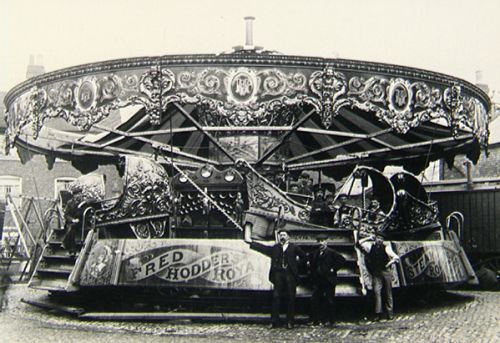
Erecting a tent is a buildup, accomplished with kingpoles, while the top or roof of a tent is a tilt. A paper houseis a performance where most of the audience have been given free entrance to fill otherwise empty seats. A spotis a particular performance or act. A Dobbyor Dobby Setis a merry-go-round with fixed seats, or a galloperif all theseats move up-and-down. Dukkeringis fortune-telling. The word slangmay be used as a verb meaning to perform, or as a noun, meaning a sideshow or circus tent. To spielis to introduce an act or to announce information to the audience. This word also turns up in American carnyspeak and in Australian show lingo.

The close connection between the rumbustious entertainment of the fair and various forms of chicanery was one continued until almost to the present day. Crowds attracted pickpockets, thimbleriggers and other tricksters anxious to separate dull yokels up from the country or unwary townsfolk from their possessions.


For more on the rich history and culture of fairs go to the National Fairground and Circus Archive.