The women convicts of the First Fleet’s Lady Penrhyn went ashore at Sydney Cove on February 6, 1788. Most had seven or fourteen year terms and there were a few ‘lifers’ among them. The surgeon aboard the former slave ship that had brought them to the ends of the earth, Arthur Bowes Smyth, wrote ‘The Men Convicts got to them very soon after they landed, & it is beyond my abilities to give a just discription [sic] of the Scene of Debauchery & Riot that ensued during the night.’ According to subsequent writers, a wild orgy of rum, sex, storm and lightening followed, a fitting act for the foundation of a colony of convicts.
Popular as this story has become, in one version or another, historians have found little evidence of it ever happening. Bowes Smyth was nowhere near the scene of the alleged orgy, he was on the Lady Penrhyn quite a long way out in the harbour. None of the other keen diarists of the First Fleet, such as officers Watkin Tench or Ralph Clark seem to have noticed the orgy either. They certainly did not mention it in their accounts, an unlikely omission, especially for Ralph Clark who believed women convicts were all ‘damned whores.’
Why Bowes Smyth believed that ‘Debauchery & Riot’ occurred as soon as the women set foot in New South Wales is worth considering. He was certainly glad to see the women leave the ship: ‘we had the long wish’d for pleasure of seeing the last of them’, he wrote. The Lady Penrhyn’s voyage from England had been tedious and troubled with illness, lack of food and indiscipline. Many of the women were prostitutes and suffered from venereal disease. Although attempts were made to keep men and women separate, cohabitation quickly became commonplace. In April 1787, a month or so before they set sail for Botany Bay, five women were chained up for having relations with crewmen. There is no record of the sailors being punished.
During the voyage seventy year-old Elizabeth Beckford died of ‘dropsy’, or oedema, her bloated corpse buried at sea. She was not the last. Jane Parkinson died as they sailed from Cape Town to New Holland, as Australia was often known. Off Van Diemen’s Land the lumbering transport was lashed by a storm so fierce that the women fell to their knees praying for deliverance. Short of food once again, the Lady Penrhyn finally made Botany bay in late January 1788, only to discover that Arthur Phillip had decided the place was unsuitable for settlement. He had departed for Port Jackson.
By the time the Lady Penrhyn finally anchored in the great body of water that would become known as Sydney Harbour, the 101 women and more than 70 male crew and Marines had been cooped up on the thirty by eight metre vessel, in some cases for over a year. The women were flogged, chained, punished with thumb screws and had their heads shaved bare. Bowes Smyth wrote in his journal:
‘I believe I may venture to say there was never a more abandon’d set of wretches collected in one place…The greater part of them are so totally abandoned & callous’d to all sense of shame & even common decency that it frequently becomes indispensably necessary to inflict Corporal punishment upon them…’[i]
The doctor was clearly not well disposed towards his female charges. When he finally did ‘see the last of them’ he was predisposed to assume that they would behave in what he considered their typically debauched manner. Bowes Smyth was a product of his time and circumstances, as were all those who arrived on the First and subsequent fleets.
The double standard that masqueraded as respectability and punished only women for acts that involved a male partner continued in the colony. Four of the convict women of the Lady Penrhyn became the de facto partners of officers and the Judge Advocate. Esther Abrahams and Lieutenant George Johnston began what would become a lifelong relationship during the voyage. They did not marry for another quarter of a century.
Bowes Smyth also recorded an incident when one of the sailors was caught in the women’s tents. His hands were tied and he was publically drummed out of camp to the tune of ‘The Rogue’s March’, a ceremony used for dishonorable discharge from the army and usually followed by a flogging.
These more domestic relationships and official attempts to maintain propriety are not the stuff of myth. They lie forgotten in history while the more salacious story lives on. Historians have been trying to scotch the orgy myth ever since one of their own mistakenly set the yarn spinning in 1963. Manning Clark wrote of it though soon withdrew the assertion after a more careful look at the available evidence. But it was too late. The lewd rumour neatly captured popular views of early colonial society and the image of degraded convicts that had grown up over the generations. ‘The orgy that wasn’t’ gathered further currency from a procession of later writers and television shows repeating and embellishing the alleged scene.[ii] A yarn of ribald abandonment still resonates with a common view of the founding of Australia. No matter how often and convincingly historians demolish the myth, many still prefer to believe it.
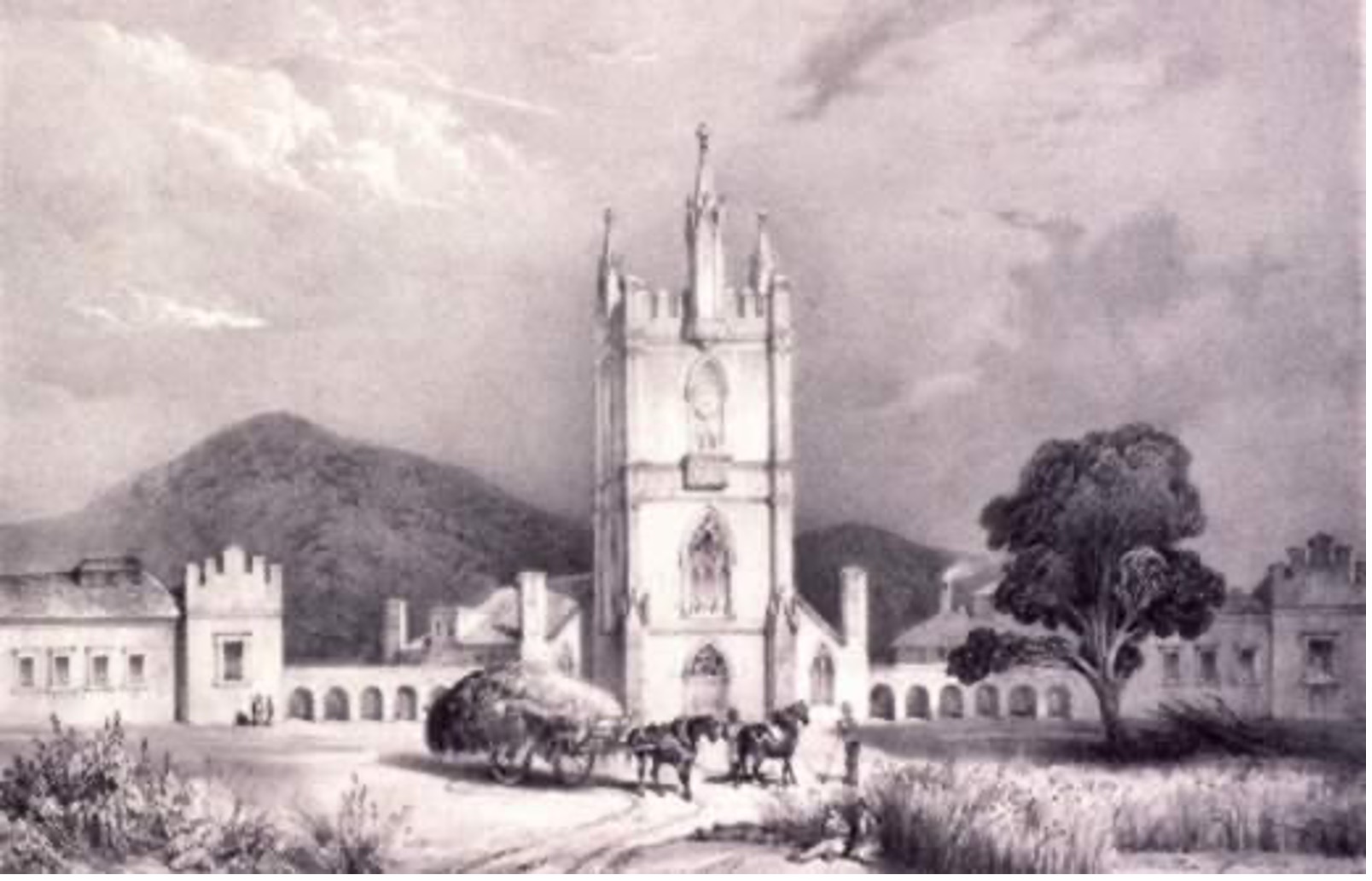
The King’s Orphan Asylum, later known as the Queen’s Orphan Schools, the girls’ school to the left of the chapel, boys’ school to the right, Mount Wellington in the background. The idyllic scene masked the horrors which were imposed on its inmates.
Bruce Lindsay has researched and written about the life and times of his great grandfather, John Lindsay. John was the son of Scots highland Traveller parents, transported to Van Diemen’s Land (Tasmania) at the age of three with his mother, Mary, in the mid-1830s. Mary had been one of a group of travellers who invaded a home-based store at Sweetie Hillock (just outside Aberdeen), and stole a number of items, including clothing, food and drink. Mary was transported for fourteen years, accompanied by young John. His story throws much light on the little-known life experiences of transports to Australia (whether convicted or not) and is a valuable historical record. Below is an edited version of a chapter from Bruce’s fascinating colonial family history.
*
John Lindsay is thought to have been born at Inverness on 15th January 1832, in the year following the marriage of Isaac Williamson and Mary Lindsay. Common Scots naming practice at the time was for the bride to retain her maiden name, although children generally adopted their father’s surname. However, children of female convicts travelled under their mother’s name, and without this convention, we may have never established the connection to our family line.
John first appears in our records sitting in the tinkers’ horse-drawn cart in March 1835, while his parents and the rest of the troupe confronted the shopkeepers at Sweetie Hillock. After his safe arrival in Hobart with his mother on 25th April 1836, and following a decision by Lt Governor Arthur on 4th May 13 children of mothers confined at the Cascades Female Factory were admitted on 5th May to what was then known as King’s Orphan Asylum (from 1837, upon assumption of the British throne by Queen Victoria, as the Queen’s Orphan Schools). Surviving records show John was listed as “#341, John Linsay (sic), Age 3 at Sept 5 1836, Father unknown, Mother a Prisoner”. Routine practice was to remove children from convict women, either for the term of their mothers’ servitude, or until they reached the age of 14.
The orphanage is described by contemporary and later observers as a severe and uncaring place, in which young John may well have felt intimidated and alone. Robert Hughes, in his seminal work The Fatal Shore, quotes the Reverend Robert Crooke – catechist with the Van Diemen’s Land Convict Department at the time – as saying:
“The slightest offence, whether committed by boy or girl, was punished by unmerciful flogging and some of the officers, more especially females, seem to have taken a delight in inflicting corporal punishment… The female superintendent was in the habit of taking girls, some of them almost young women, to her own bedroom and for trifling offences… stripping them naked, and with a riding whip or a heavy leather strap flagellating them until their bodies were a mass of bruises” (p. 525).
A surviving Report on the state and conduct of the orphan schools dated 30th August, 1848, by the Inspector of Schools, Charles Bradbury, provides depressing details of the physical and educational conditions under which John and the other inmates lived. He said:
“The punishments employed are the cane, solitary confinement, and in extreme cases the birch; few of the latter only have occurred during the last four years. Solitary confinement is inflicted perhaps once in the course of a fortnight; 48 hours have been resorted to as a severe punishment, but the customary time is about two or three hours. The offences, so far as I could ascertain, appear to be those ordinarily incident to large schools; there are none of a flagrant character, petty stealing, violence, and oppression towards each other; occasional indecent and blasphemous language are the chief varieties of misconduct.”
(This report was part of a despatch from Lt. Governor Sir William Denison to Earl Grey and was copied from the British Parliamentary Papers Volume 8, pp356-374, held at the University of Tasmania Library).
In her comprehensive study of children’s lives at the orphanage, Joyce Purtscher (Children in Queen’s Orphanage, Hobart Town, 1828-1863) describes a daily regimen beginning at 5.00am in Summer or 6.00-6.30am in Winter, with a mix of play and classroom instruction. Inspector Bradbury recorded that:
“The industrial training is on a very limited scale: the trades taught are only those of the tailor, shoemaker, and baker. Not one of the boys is employed in farming or gardening. The boys in the shoemaker’s shop are taught repairs alone, not one can cut out, or is acquainted with the making of a shoe. The shoes in the first instance are supplied from the Ordinance Storekeepers’ Department”.
Since internal records from the orphan schools do not survive, if indeed they were ever kept, we cannot confirm whether John may have undertaken basic training in shoemaking during his time there, even though he later practised the trade with his stepfather, William Higgs.
Schooling took place in large single rooms 50’ X 30’, heated by one small fireplace. Bradbury noted that the only teachers in the boys’ school, girls’ school and infants’ school were unqualified and had never previously been engaged as teachers. This was reflected in the children’s typically poor reading and writing skills, of which Bradbury was scathingly critical.
Of the children’s very limited scholastic abilities he observed somewhat laconically:
“I found the members of the upper classes with reference to secular information very deficient, far below the average of the primary schools I am accustomed to visit. Several, especially in the first class, can read with tolerable correctness, though with no expression; but they cannot explain the meanings of many of the commonest words…”, “There is nothing attractive, stimulating, or strengthening in the whole routine, and, at the same time, little actual information is given, that the memory may possibly retain. It would seem, indeed, that, for the ages of the children, their mental capacity and intelligence, are, as a general result, in inverse proportion to the duration of their attendance in the school”.
He further noted that the children’s capacity to learn was not helped by the fact that they were required to stand in class, there being no seating.
Care of the boys’ physical wellbeing was apparently as peremptory as their schooling. They slept in hammocks 80 to a dormitory, and bathed their upper bodies in cell-like rooms paved with flagstones, with stone water troughs in their centre. There was no hot water. Once a week, winter and summer, they were taken to the Derwent River to bathe. Bradbury observed
“In the personal habits of the boys, I think cleanliness and order might to a much greater extent be enforced. In their dress they are mostly untidy, and in some instances so dirty, that it is unpleasant to stand near them, from the odour arising from their outer clothes”.
The orphanage was always overcrowded, hastening the spread of any disease, and in 1843 (while John was there) 56 children died from Scarlet Fever. Even the handsome convict-built stone chapel – St John’s Anglican Church – was heated only by four small fireplaces, one of which was located conveniently abreast of the Governor’s pew. The children could freeze, but not His Excellency.
The interior (2014) of St John’s Anglican Church, New Town, which doubled as the chapel for the Orphan Schools. The gallery shown was used to accommodate the orphans, girls to the left of the monitors’ enclosure, boys to the right. Free settlers rented named and lockable pews on the ground floor (now replaced with standard movable pews facing the sanctuary).
Given several damning assessments of the incompetence of the orphan schools’ provision neither of physical care, nor of any stimulating curriculum or training, it is heartening that young John not only survived the time he spent there, but appears to have emerged ready to take his place in the world. From such unpromising parentage, and such inadequate schooling, he appears to have become a sober, hard-working young man with strong ethics and family values. His later service to his large family was augmented by a willingness to become involved in community affairs (when living at Winslow in Victoria), and the generation by the community of genuine respect and affection for the man.
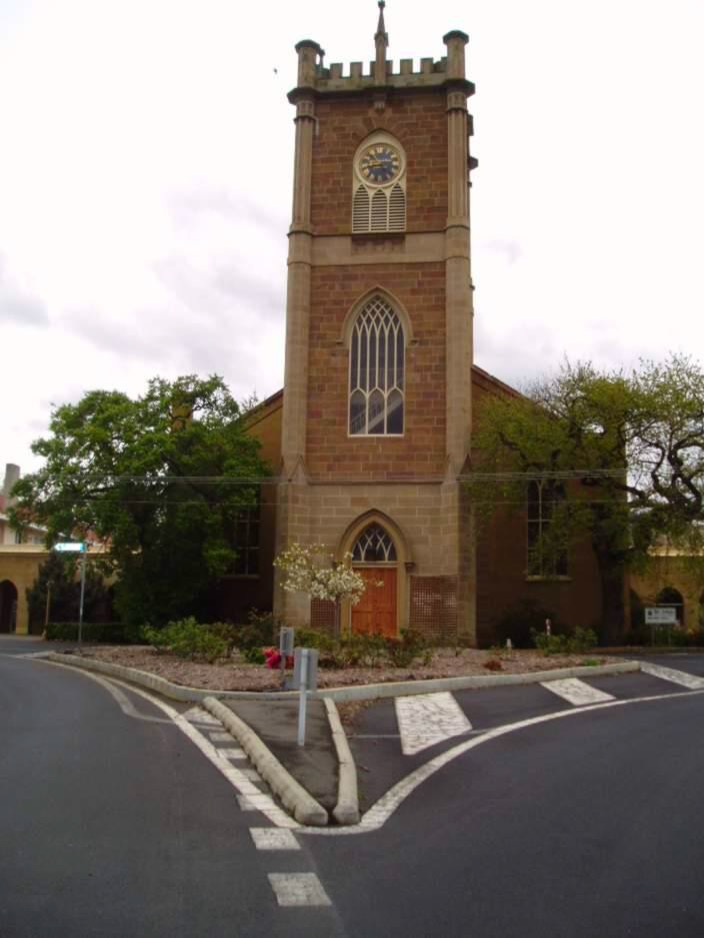
Originally the Chapel for the orphan schools, this handsome building, designed by Colonial Architect John Lee Archer, and built with convict labour in 1835, is now St John’s Anglican Church, New Town – WITH heating.
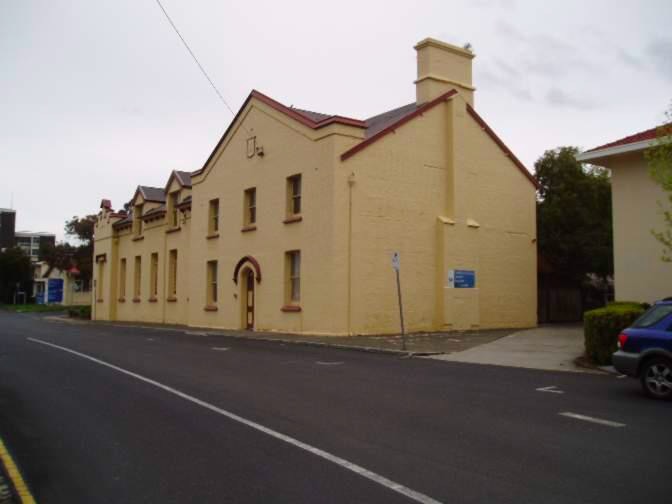
Boys’ section of the Queen’s Orphan Schools, where John survived 11 years from 1836 to 1847. Photographed in 2012, and externally largely unchanged, it then housed the “Meals on Wheels” organisation.
Joyce Purtscher further tells us:
“When children turned 14 years of age, they were apprenticed out. They had to work for no money until they were 18. They were at the mercy of their masters regarding food, clothing and housing”.
John was released from the orphanage on 26th August 1847, and apprenticed to Mrs Mary Cox, a remarkable woman who had operated several businesses in Launceston. Her late husband, John Edward Cox, was licensee initially of the Macquarie Hotel in Hobart, and later the Cornwall Hotel in Launceston, owned by John Batman – the co-founder of Melbourne. He also initiated Tasmania’s first coaching service between Launceston and Hobart, and fathered nine children, eight of whom survived. Upon his death in 1837, responsibility for management of family and businesses fell to his wife.
Assuming that, as outlined by Joyce Purtscher above, John was required to work for Mrs Cox without payment until he was 18 years old, by 1851 he would have been free to live and work where he pleased. We know from the 1848 Census that Mary Lindsay and William Higgs were then living together in Adelaide Street, Westbury (after marrying there in 1844), and Higgs had resumed his trade as a shoemaker. John probably joined them after leaving Mrs Cox. Surviving records do not tell us in what trade or capacity John was indentured, but it is possible that he learned the basics of shoemaking when at the Orphan School. Since on the title to his Westbury property later in the 1850s he is listed as a shoemaker, he evidently joined his stepfather in the trade, although this possibility has not been confirmed by searches for business registrations or commercial advertisements. But we know that at that time he adopted his stepfather’s surname, becoming known as John Lindsay Higgs.
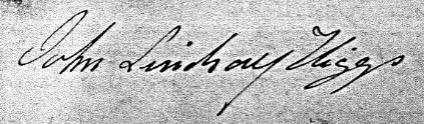
John’s signature on the title deed for 1 Reid Street, Westbury, which he sold on 28.5.1862
Under that name he married Charlotte Wells at Westbury on 3rd July 1857. Charlotte was the free-born daughter of former convicts Robert Wells and Margaret Casey. They married in her parents’ private home “according to the Rites and Ceremonies of the Wesleyan Church”. Although born of convict parents on 13th January 1839, Charlotte never suffered the horrors of the Queen’s Orphan School, having been raised by her parents in Longford and Launceston.
John appears to have been industrious and successful in his trade, since he managed to acquire property in Westbury, and ultimately to sustain a large family. It seems that the married couple lived on a block of land in what is now Reid Street, Westbury, purchased on John’s behalf by Higgs, where Charlotte gave birth to their first child – John – on 5th July 1858. In 1859, with Higgs subsiding into alcoholism, John acquired the nine-acre block owned by him on Suburb Road, Westbury, from the mortgagees to whom it had been surrendered. They continued to live at Reid Street, where Charlotte produced their second child – Alexander – on 28th October 1859. Their third child – Robert – was born on 5th May 1861.
John was devastated by his step-father’s suicide on 17th December, 1861. For reasons unknown, he shortly thereafter sold the Reid Street property and acquired a 160-acre rural block at Liffey Plains, near Westbury, from where we presume he continued his shoemaking business. He also deleted “Higgs” from his surname, reverting to “Lindsay”. In the absence of Title records, we must presume he sold the Liffey Plains property late in 1862, then embarked from Launceston with the family aboard the Western for Portland, Victoria, arriving there on 9th August 1862. It is possible that he sought to remove himself from the strong social stigma attaching to suicide at the time, and make a new start with his wife and family.
They settled at Winslow, a small town north of Warrnambool in Victoria’s Western District, where John probably established a shoemaking business in his own name, and from 1883 he and Charlotte assumed management of the local Post Office. Their family continued to grow and Charlotte produced 14 healthy children over a period of 28 years – the last when she was 48 years old – a quite remarkable achievement now, and even more so on the cusp of the 20th century.
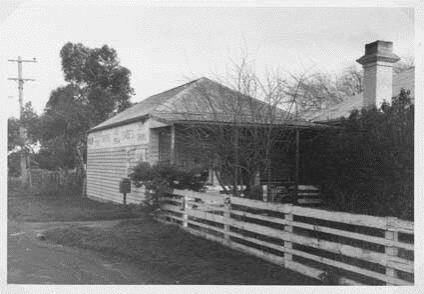
The Winslow Post Office and store, attached to the south east front corner of the house in which John, Charlotte and their family resided from 1893 to 1922.
John died on 20th November 1890, when drawing water from a freshwater lake about 100 metres from the back of the family home in Winslow. To reach the water, it was necessary to descend steps, from which newspaper accounts reported John slipped and fell. One of his daughters discovered his hat and coat floating on the surface, and raised the alarm. By the time help arrived, John could not be revived. His age was given as 56 years, though if his assumed birth-date of 1832 is correct, he would have been 58.
The sometime freshwater lake in which John drowned while drawing water for his family. The house is off to the left of this picture, about 100m away. Since that time, a tannery operated on the lake’s shore, and the water is now brackish.
So ended the last direct family connection to the redoubtable Mary Lindsay. The large family produced by John and Charlotte developed in ways that Mary as a Highland Traveller could never have imagined. John’s wife Charlotte lived until 7th January 1922, dying at Winslow from a cerebral haemorrhage and pneumonia, aged 83.
John Lindsay, wife Charlotte and infant daughter, Eliza rest at Tower Hill cemetery near Warrnambool.
*
Readers may also be interested in my book Condemned: The Men, Women and Children Who Built Britain’s Empire, which includes the Van Diemen’s Land experience, though not the King’s Orphanage story. My thanks to Bruce for bringing it to my attention and for allowing this part of his family history research to appear on Gristly History.
In the seventeenth century, those unfortunate enough to be transported from Britain to the American colonies were sometimes sold to their colonial masters in exchange for cattle or corn. They were not slaves but the conditions in which they laboured were slave-like. Some fought back.
Will Downing and Phillip Welch were before the Salem Quarterly Court of June 26, 1661. They were there for ‘absolutely refusing to serve’ their master, Samuel Symonds, any longer. Seven years earlier, Symonds agreed to pay the master of the ship Goodfellow ‘26li.[pounds] in merchantable corn or live cattle’ due before the end of the following October for the two young men kidnapped from their beds in their own country. They were neither convicts or indentured servants and were almost certainly sold illegally into servitude. Nevertheless, Will and Phillip had worked their master’s fields ever since. And he insisted that he had paid good value for them to do so for nine years, not seven.
One Sunday evening in March 1661, Will and Phillip joined the Symonds family in the parlour for prayer, as usual. Before the family and their servants began to worship, Phillip declared to his master ‘We will worke with you, or for you, noe longer.’ Symonds sarcastically inquired if they were not working what would they do – ‘play?’
Phillip and Will stood their ground. They had served Symonds and his family for the seven years they believed to be their penance for simply being in the wrong place at the time Cromwell’s soldiers were scouring their area for victims. Symonds told them that they were obliged to work for him unless they ran away, a crime with severe punishment. They did not wish to flee; instead they pleaded ‘If you will free us, we will plant your corne, & mende your fences, & if you will pay us as other men, but we will not worke with you upon the same termes, or conditions as before.’
This must have been a memorable moment in the life of the family and its servants. All had been living and working cheek-by-jowl and praying regularly together for seven years. There was some talk about business difficulties as Symonds sought to make his servants see what he considered to be sense. His wife backed him up, saying this was not a good time to bring up the subject of money. But the young men remained adamant. When their master asked them to begin prayers together, they refused. Next morning Symonds summoned the local constable to his home, demanding that the rebellious servants be ‘secured.’ The constable wondered whether it was necessary for the men to be taken away, but Symonds insisted a warrant be served on them and that they should be paraded before the court. Which they duly were.
Now William and Phillip had a chance to state their case: ‘We were brought out of or owne Country, contrary to our owne wills & minds, & sold here unto Mr. Symonds, by ye master of the Ship, Mr. Dill, but what Agreement was made betweene Mr. Symonds & ye Said master, was neuer Acted by our Consent or knowledge, yet notwithstanding we haue indeauored to do him ye best seruice wee Could these seuen Compleat yeeres …’
William and Phillip considered they had already served their time, and more, because the usual practice of transport ship masters was to sell their stolen human cargoes in Barbados for only four years servitude. But now for seven years the two men had labored on Samuel Symonds’ ten acres of corn ‘And for our seruice, we haue noe Callings nor wages, but meat & Cloths.’
For his part, Symonds testified that he had made a bargain with the shipmaster and he had the ‘covenant’, or contract, to prove it. There was a supporting deposition from the shipmaster who said he had sold Symonds ‘two of the Irish youths I brought over by order of the State of England.’
Some other servants gave evidence. One man who had been kidnapped and transported with Will and Phillip described how they had all been rounded up against their will ‘weeping and Crying, because they were stollen from theyr frends.’ Some of Symonds’s own servants testified to the resentment of Phillip and Will against their situation and their determination to be free. Phillip reportedly said at one point that if Symonds would give him the same share of his estate as he would give his own children, then he would continue to serve.
The intensely personal nature of the relationships of master, family and servants in the Symonds household is clear in these testimonies. But the court, rightly or not, found the arrangement was legal and decreed that Will and Phillip should continue to serve until May 1663. An appeal was notified immediately but the two men agreed to work for Symonds until a date for the hearing could be set. He was bound to give them leave to attend.[i]
Whether this appeal was ever heard is not known. Possibly the full nine years were served before it could be and Will and Phillip were finally unbound. If so, they could then sell their labour in an open market and start the families they wished for in the New World.
[i] Salem Quarterly Court. Salem, Massachusetts. June 25, 1661. Records and Files of the Quarterly Courts of Essex County, Massachusetts, vol. II, 1656-1662, pp. 298ff at https://archive.org/stream/recordsandfiles00dowgoog#page/n307/mode/2up, accessed December 20, 2017. Welch’s proper forename was Phillip, as noted in the court records. Some references to these records claim that the youths were referred to as ‘slaves’ – they were not, see Jennie Jeppesen, ‘Within the protection of law’: debating the Australian convict-as-slave narrative’, History Australia, vol 16, issue 3, 2019, at https://www.tandfonline.com/eprint/TYGCVFDNDUFDAY5NSGNN/full?target=10.1080%2F14490854.2019.1636674&, accessed November 2019.
When transportation to the American colonies ceased after the War of Independence, British goals soon overflowed with prisoners. This situation soon created a new form of penal horror
To ease the pressure on prisons the government allowed old ships to be anchored in the River Thames (and at Portsmouth, Plymouth and elsewhere) to hold prisoners awaiting banishment across the seas. These ‘hulks’ were supposed to be a stopgap measure, but like many temporary arrangements they became permanent. Many prisoners would endure years aboard the rotting hulks, doing hard labour on the docks and in the naval arsenals, until they were finally transported.
The Dunkirk hulk moored at Plymouth was notorious even before the First Fleet set sail. Prisoners were sometimes without any clothing and in 1784 the abuse of the female convicts by the marine guards led to a ‘Code of Orders’ that were supposed to protect the women. Mary Bryant, later an almost successful escapee from Port Jackson, was held on the Dunkirk before sailing with the First Fleet. She became pregnant on the hulk.
Conditions aboard the Leviathan hulk at Portsmouth in the 1820s were better, but designed to strip convicts of whatever dignity they retained and subdue them into the system:
‘…this vessel was an ancient ’74 [1774] which, after a gallant career in carrying the flag of England over the wide oceans of the navigable world, had come at last to be used for the humiliating service of housing convicts awaiting transportation over those seas. She was stripped and denuded of all that makes for a ship’s vanity. Two masts remained to serve as clothes props, and on her deck stood a landward conceived shed which seemed to deride the shreds of dignity which even a hulk retains.’.
The prisoners were taken aboard and ‘paraded on the quarter-deck of the desecrated old hooker, mustered and received by the captain. Their prison irons were then removed and handed over to the jail authorities, who departed as the convicts were taken to the forecastle. There every man was forced to strip and take a thorough bath, after which each was handed out an outfit consisting of coarse grey jacket, waistcoat and trousers, a round-crowned, broad-brimmed felt hat, and a pair of heavily nailed shoes. The hulk’s barber then got to work shaving and cropping the polls of every mother’s son.’ Fettered and shaven prisoners were then marched below ‘where they were greeted with roars of ironic welcome from the convicts already incarcerated there’. The lower deck was a prison of wooden cells, each one holding between fifteen and twenty convicts.[i]
Edward Lilburn, a pipe-maker from Lincoln, described his experience of the Woolwich hulks around 1840:
‘I was led to think there was something dreadful in the punishment I had to undergo, but my heart sank within me on my arrival here, for almost the first thing I saw was a gang of my fellow unfortunates, chained together working like horses. I was completely horror-struck, but every hour serves now to increase my misery; I was taken to the Blacksmith and had my irons, the badge of infamy and degradation rivetted upon me, my name being registered and my person described in the books of the ship; I was taken to my berth, and here new sufferings presented themselves, as the great arrival of convicts had crowded the ship so much, that three of us have but one bed, and this the oldest prisoner claims as his own; our berth is so small, we have no room to lie at length, thus I passed a wretched, a half sleepless night, at the dawn of day we have a wretched breakfast of skilley, in which I cannot partake, and though suffering dreadfully from hunger I subsist wholly on my dinner, at present live on one meal a day!!’
Lilburn had the cheek to complain but was told that he was ‘brought here for punishment and that I must submit to my fate.’ He finished with a warning: ‘Whether I speak of my present situation in reference to daily labour, daily food, or the rigorous severity of the system under which I suffer, I can say, if there is a Hell on earth, it is a convict-ship. Let every inhabitant of the City and County of Lincoln know the Horrors of Transportation, that they may keep in the path of virtue, and happily avoid a life like mine of indescribable misery.’[ii]
After 1844 convicts were transported directly from the prisons where they were held rather than being sent first to the hulks. But the old ships still operated as gaols. By the time the journalists and social reformers Stephen Mayhew and John Binney visited the Thames hulks in the early 1860s, public outcry against the conditions and horrors of the hulks as described by Lilburn and others had already brought about reforms to the system, allegedly at least. Mayhew described conditions aboard the hospital ship Unité just a few years earlier in 1849:
‘… the great majority of the patients were infested with vermin; and their persons, in many instances, particularly their feet, begrimed with dirt. No regular supply of body-linen had been issued; so much so, that many men had been five weeks without a change; and all record had been lost of the time when the blankets had been washed; and the number of sheets was so insufficient, that the expedient had been resorted to of only a single sheet at a time, to save appearances. Neither towels nor combs were provided for the prisoners’ use, and the unwholesome odour from the imperfect and neglected state of the water-closets was almost insupportable. On the admission of new cases into the hospital, patients were directed to leave their beds and go into hammocks, and the new cases were turned into the vacated beds, without changing the sheets.’[iii]
Mayhew and Binney interviewed one of the warders who served under the previous ‘hulk regime’ who said that ‘he well remembers seeing the shirts of the prisoners, when hung out upon the rigging, so black with vermin that the linen positively appeared to have been sprinkled over with pepper…’. By the time this survey was conducted there was regular medical treatment available, a lending library, education for the man who could not read or barely so. The food provided had also improved dramatically, at least according to the regulations:
‘We now followed the chief warder below, to see the men at breakfast. “Are the messes all right ?” he called out as he reached the wards. “Keep silence there! keep silence!” shouted the officer on duty.
The men were all ranged at their tables with a tin can full of cocoa before them, and a piece of dry bread beside them, the messmen having just poured out the cocoa from the huge tin vessel in which he received it from the cooks; and the men then proceed to eat their breakfast in silence, the munching of the dry bread by the hundreds of jaws being the only sound heard.’
Each prisoner received a breakfast of twelve ounces of bread and a pint of cocoa. For dinner they were allowed six ounces of meat, a pound of potatoes and nine ounces of bread, for supper a pint of gruel with six ounces of bread. Wednesdays, Mondays, and Fridays were ‘Soup Days’, when the dinner was a pint of soup, five ounces of meat, a pound of potatoes, and nine ounces of bread.
For punishment, the luckless convict was reduced to a pound of bread and water each day. Those on the sick list were fed a pint of gruel and nine ounces of bread for breakfast, dinner, and supper. But an enhanced diet was given to the very sick, as the master of the hospital told the journalists:
‘The man so bad, up-stairs, has 2 eggs, 2 pints of arrowroot and milk, 12 ounces of bread, 1 ounce of butter, 6 ounces of wine, 1 ounce of brandy, 2 oranges, and a sago pudding daily. Another man here is on half a sheep’s head, 1 pint of arrowroot and milk, 4 ounces of bread, 1 ounce of butter, 1 pint extra of tea, and 2 ounces of wine daily.’
The trades and occupations of convicts in the 1850s included carpenters, blacksmiths, painters, sawyers, coopers, rope makers, bookbinders, shoemakers, tailors, washers and cooks, even the occasional doctor. Convicts received ‘gratuities’ for the quality of their work and general conduct. They wore badges which indicated their duration of sentence, period in the hulks and levels of good or bad behavior, updated monthly, the details entered into the ‘character book’ of each hulk.
Mayhew also described the work performed by those whose labor was now at the control of the state.
‘The work of the hulk convicts ‘is chiefly labourers’ work, such as loading and unloading vessels, moving timber and other materials, and stores, cleaning out ships, &c., at the dockyard; whilst at the royal arsenal the prisoners are employed at jobs of a similar description, with the addition of cleaning guns and shot, and excavating ground for the engineer department.’
Mayhew saw the working parties in the dockyards:
‘… only the strongest men are selected for the coal-gang, invalids being put to stone-breaking. In the dockyard there are still military sentries attached to each gang of prisoners. We glanced at the parties working, amid the confusion of the dockyard, carrying coals, near the gigantic ribs of a skeleton ship, stacking timber, or drawing carts, like beasts of burden. Now we came upon a labouring party, near a freshly pitched gun-boat, deserted by the free labourers, who had struck for wages, and saw the well-known prison brown of the men carrying timber from the saw-mills. Here the officer called – as at the arsenal – “All right, sir!” Then there were parties testing chain cables, amid the most deafening hammering. It is hard, very hard, labour the men are performing.’
Most closely regulated of all was convict time. From the moment of waking – 5.30 in summer, half an hour later in winter – the prisoners of the hulks ate, worked, washed and prayed to a strict timetable. All were in their beds or hammocks at 9pm.
This strictly regulated world of servitude, obedience and hard labour was an essential element of the larger penal transportation system of the British empire. It lasted for centuries
[i] James Tucker, (‘Giacomo Rosenberg’), The Adventures of Ralph Rashleigh: A Penal Exile in Australia, 1825-1844.First published in 1929, though thought to have been written in the 1840s.
[ii] A Complete Exposure of the Convict System. Horrors, Hardships, and Severities, Including an Account of the Dreadful Sufferings of the Unhappy Captives. Containing an Extract from a Letter from the Hulks at Woolwich, written by Edward Lilburn, Pipe-Maker, late of Lincoln, from a broadside in the Mitchell Library (Ferguson 3238).
[iii] Henry Mayhew, John Binney and Benno Loewy, The criminal prisons of London, and scenes of prison life, London, Griffin Bohn, 1862. p. 200.
Thomas Benson was born into a substantial merchant family in Devon in 1708. He inherited some ships and resources at his father’s death and embarked on a career of legitimate trading supplemented by piracy and smuggling. By the late 1740s Benson was in a position to lease the island of Lundy, around ten miles off the Devon coast, for sixty pounds a year. This enabled him to land tobacco from America and smuggle it to the mainland, avoiding the duty payable.
Benson also obtained a government contract to transport convicts to Maryland. He had a clever scheme in mind. Instead of taking the convicts across the Atlantic Ocean to the American colony, for which the government paid him twenty pounds a head, he simply offloaded them on Lundy. Here they were forced to work on improvements to the island’s infrastructure and assist with the tobacco-smuggling operation. The convicts were boarded in the castle keep and worked around the island in chains. A group of seven or eight managed to reach the mainland in the island’s boat, vanishing into oblivion. But their unfortunate companions remained to labour on the island.
It was a scheme of criminal genius and worked like a charm – until Benson unwisely took some house guests to Lundy, including the Sheriff of Somerset, to show off his enterprise. The Sheriff was not impressed with Benson’s claim that he was only obliged to transport convicts off mainland Britain and not all the expensive way to the Americas. He was prosecuted, but unsuccessfully. So imprecise and contradictory were the laws governing transportation that his feeble excuse was accepted.
To this point Benson appeared not to have been much more scheming than many other traders of the time. But he would eventually distinguish himself as a criminal exploiter of the worst kind. His plan was devious and audacious. Deep in debt, Benson now planned a bold insurance scam. He indemnified his oldest and leakiest ship, the Nightingale, together with its cargo and crew, for as much as the insurance company would bear. Suborning his upright but needy Captain Lancey and a crew of sea-going desperadoes, Benson had them ready the Nightingale for sea in the summer of 1752. Her cargo was an unremarkable mix of salt, cloth, pewter and cutlery, along with a mysterious ‘hogshead of dry goods’.
As well, there were twelve men and three women, all in chains, the men in pairs and the women together. Brought down from Exeter Gaol, the miserable convicts were bound for transportation to Maryland. From Bristol they sailed straight to Lundy where most of the cargo was illegally unloaded and the crew bribed to keep quiet about their part in this act and in what was to follow.
After a couple of nights trans-shipping the cargo to the island, an operation kept concealed from the convicts, the Nightingale put to sea. About eighty kilometres west they encountered the Charming Nancy out of Philadelphia. After the customary exchange of pleasantries, the American ship continued on her way and Lancey initiated the next stage of the scheme.
The ship’s boat was readied and two sailors were ordered to break open the hogshead of dried goods. It was filled with small barrels of tar and oakum soaked in tar. The black tar was spread around in the hold and a hole cut between that area and the bread room or pantry. A hole was drilled below the waterline and stopped with a marlinspike. A lighted candle was then pushed through the hole into the hold where it ignited the tar. And then the marlinspike was pulled out. The Nightingale was afire.
The crew then pretended to put out the fire, making as much noise as possible to attract the attention of the Charming Nancy. While all this was taking place, the hapless convicts remained in chains. Lancey loudly accused them of starting the fire and moved them towards the waiting ship’s boat. Everyone clambered into the lifeboat, the convicts protesting their innocence. By now the American ship had sighted the smoke and swung around to pick up the Nightingale’s boat. A few hours later another ship took them aboard and brought them all safely ashore at Clovelly. From here, Lancey was able to quickly return to Benson’s house.
Surprised by this unexpectedly early return of his co-conspirators, willing and otherwise, Benson insisted that the captain and the crew sign affidavits attesting that the fiery fate of the Nightingale was an accident. But it was in vain. One of the crew drank too much and boasted of the deed in Barnstaple one market day where plenty of eager ears heard the true story. One of Benson’s rivals bribed the sailor to confess. Lancey was arrested and the crew began to turn themselves in to the authorities. Eventually the captain and one of the sailors were examined by the Judge of the Admiralty, as was the custom then. Lancey refused to give evidence against Benson, despite being promised clemency. The two men were committed for trial.
Meanwhile, Benson attempted to ensure through various legal and financial ploys that the true story did not come out in court and so reveal the extent of his debt. None of these were successful and he was eventually judged to owe over £8,000, an enormous sum in those days. Unable to pay, his property was seized and in December he fled to Portugal where he had family business connections.
Lancey and two of the crew were tried at the Court of the Admiralty in February 1754. The unlucky captain was found guilty and sentenced to death. He seems to have accepted his fate without rancour for any of his co-conspirators, even Benson. He prayed day and night for two days leading up to his execution and ‘to his last hour, behaved with a steadiness and composure, very seldom seen on the like solemn occasion’. Lancey was hanged at Wapping on 17 June 1754. Benson soon revived his business in Portugal, courtesy of his captain’s misplaced loyalty. Threatened with extradition, he fled to Spain. But his crimes were soon forgotten as Britain went to war with France once again and Benson returned to Portugal where he lived until his death in 1772.
The fate of the island convict colony is unknown. Research into initials carved into the walls of what is now known as ‘Benson’s Cave’, quarried into shale beneath the castle keep, provides only the barest hints of who these people were. They seem to have been transported from Exeter in two groups, the first in 1749 and the second group on the Nightingale a few years later. It is assumed the authorities arranged for the men and women to continue their interrupted voyage to Maryland to serve out whatever remained of their original sentences.
The stench from the ship was ‘unbearable’. But the Samurai disguised as a fisherman had no choice but to board the strange vessel that appeared near Mugi on Shikoku Island in January 1830. Japan was closed to foreign shipping and the local authorities were anxious to know what had just arrived on their shores.
The secret Samurai took careful note of what he saw and heard. The ship was crewed by a rag-tag bunch of foreigners with long noses, strange gaudy clothing and a small object they stuck in their mouths, lit and inhaled. They had a dog that the Samurai thought did not look like food and were clearly in some distress, pleading for water and firewood, though not food.[i] An alcoholic drink was offered, though the Samurai declined and went back to report to his commander. After considerable discussion, the Japanese decided that the men on the strange ship were pirates and should be destroyed.
In fact, the men were escaped convicts. They had mutinied aboard the brig Cyprus in Recherche Bay, Van Diemen’s Land, five months earlier. The overcrowded brig was carrying around thirty ironed prisoners to the dreaded Macquarie Harbour penal station but became storm bound for a week during which the convicts plotted a mutiny. Four were able to seize the ship. They unchained their fellow transports and then sent ashore any who did not want to join them, along with the soldiers, sailors and civilian passengers. Forty-four were cast away on the beach and later rescued through the bravery of one of the convicts marooned with them. One of them was a convict named William Pobjoy, who had deserted the mutineers in favour of the castaways. He would play a crucial role near the end of an epic tale.
The eighteen convicts still aboard the Cyprus sailed boldly into the Pacific Ocean for a life of piracy and plunder. Their only experienced sailor was a man who named himself for a free-flying bird, William Swallow. His real name was William Walker, though he had a long list of other criminal aliases and a colourful record. Born in 1792, Walker was transported for stealing, arriving in Van Diemen’s Land in 1829. The records describe him as nearing five foot nine inches in height with brown hair, blue eyes and a small scar across his nose and chin. He was married with three children.[ii] He escaped back to England, where he was eventually recaptured and tried under an alias, escaping a likely death sentence for returning from transportation. Back in Van Diemen’s Land, he again attempted to escape, for which crime he was being sent to Macquarie Harbour aboard the Cyprus.
Now William Swallow and his companions were praying for the Japanese to stop firing on their bedraggled vessel. They had been given a few days to leave but a lack of wind prevented their departure. This delay gave the Japanese time to confirm that the ship was British, and so, a legitimate target. Their warning ‘hail of cannon and musketoon balls’ became a fusillade of cannon balls aimed at the waterline. Two smashed into the ship. There was nothing for William Swallow and the other convicts to do but pray. Their prayers were answered when the Japanese decided to help them out with some advice about the weather and winds, allowing them to set sail and drift away to sea. After dusk the Japanese heard the strains of ‘a strange pipe and singing’ from the Cyprus as it floated away to China.[iii]
Without much experience as navigators they managed to reach China, losing only one man overboard. Three more departed the crew and in February 1830, the remaining mutineers scuttled the Cyprus and took to the ship’s boat with the aim of pretending they were shipwrecked sailors. The authorities in Canton believed their lies and the convicts scattered. Some headed for America never to be heard from again, but Swallow and three others sailed for England.
While they were in transit, news of the mutiny on the Cyprus reached Canton and one of the convicts who had remained there confessed to the crime. A fast ship carried the news to England and when Swallow and his accomplices arrived there six days later the authorities were waiting. Swallow managed to escape but was later recaptured. Not only did Swallow tell convincing lies about how the other fugitives had forced him to sail the Cyprus, but Pobjoy was now in London and prepared to testify against them. Two of Swallow’s accomplices were hanged but he escaped the noose by convincing the court that he acted under intimidation and navigated the ship to save himself. He was found not guilty of piracy and sentenced to serve out the remainder of his sentence. For the third time, he sailed to Van Diemen’s Land and arrived at the destination of his original voyage – two years late. He died in 1834 at another notorious prison a few years after returning to penal servitude. William Walker alias, among other names, William Swallow, was laid to rest in an unmarked grave on the Isle of the Dead, the Port Arthur cemetery.
The sensational story of the mutiny and subsequent voyage of the Cyprus inspired a defiant ballad that vividly put the prisoner’s point of view and added another item to the clandestine traditions of convict underculture.
Come all you sons of Freedom, a chorus join with me, I’ll sing a song of heroes, and glorious liberty. Some lads condemned from England sail’d to Van Diemen’s Shore, Their Country, friends and parents, perhaps never to see more.
Unlike the official view of the escape, the convicts knew Bill Swallow and his runaway mates had indeed made it to Japan:
… For Navigating smartly Bill Swallow was the man, Who laid a course out neatly to take us to Japan.
These triumphant verses of convict revenge concluded:
Then sound your golden trumpets, play on your tuneful notes, The Cyprus brig is sailing, how proudly now she floats. May fortune help the Noble lads, and keep them ever free From Gags, and Cats, and Chains, and Traps, and Cruel Tyranny.[iv]
Even as late as the 1960s an elderly Tasmanian could sing a version of this ballad to a visiting folklorist and it can still occasionally be heard today performed by revival folksingers. It was one of many similar ballads in the underground repertoire of convicts.
From Condemned: The Transported Men, Women and Children Who Built Britain’s Empire
In the English city of Chester one day in September 1825 ‘an elderly-looking woman’ was brought before a local magistrate and the town clerk to answer a few questions. She had arrived back in London from Australia two years earlier, where she had ‘promptly been robbed of 170 pounds’.
In those days there were no social security welfare payments and those without other means of support had to apply to the parish for relief.
The interview began with the woman being asked her name:
‘Well my name, your Honour’s, a very ugly name – it’s Kitty Gravy, (dropping a curtsey) I come from the Vale of Clwyd.’
Next, they wanted to know if the woman was married;
‘Married! O yes; I are be married very often; I have had four husbands, and the last he is in Liverpool Infirmary with a broken leg, and his name’s John Joachim Gravy; a very ugly name, isn’t it your Worship?’
What His Worship replied, if anything, was not recorded but Mrs Gravy went on to tell the panel that she had been married at Botany Bay. They thought she meant a place in Chester near the canal, opposite Queen Street.
‘Pooh, no: I mean Botany Bay – the real Botany Bay, 30 000 miles off, your Honour.’
‘And what took you there?’
‘ ‘Pon my word, they transported me for seven years for doing nothing – nothing at all; God knows what for, I can’t tell. I never stole anything in my life.’
Kitty then put her hand into her ‘sinister pocket’ and drew out some papers. They turned out to include what purported to be a certificate from the Governor General of New South Wales dated twenty years earlier. On the back was a description of the ‘fair complexion’ of a much younger Kitty. When the clerk read it out ‘Mrs Kitty, looking very knowing, and with a shrug of her shoulders, exclaimed, “Aye, but it’s withered now”.’
Kitty went on to explain that Mr Gravy, a German, had been a free settler in New South Wales, living at Woolloomooloo. It was there that she had, presumably, met and married him.
All this time, Kitty ‘appeared to be in high glee’. So much so that she was rebuked for her levity by one of the Aldermen. She replied:
‘Thank your Honour, (curtseying), I’m much obliged: I paid 100 pounds for my passage home, and everyone loves poor Kitty. I’m all fair yea and nay, your Honours.’
It was then suggested by one of the interviewers that Kitty was in fact living with a Frenchman in Brighton ‘but she repelled the charge indignantly’ and went on to catalogue the history of her various husbands.
‘My first husband was James Miller, and he was a Scotchman; Thomas Wilson was my next, and he was a Hollander in the Navy; my third husband John Grace, an Irishman, from the County of Wicklow; and my fourth was John Gravy, a German. So you see (said Mrs Kitty with all the naivety of an accomplished punster) that for my last two husbands I had Grease and Gravy!’ Of the four, Kitty reckoned the first had been ‘worth them all.’
When asked when she had first married, Kitty replied:
‘Eh! The Lord knows, it’s a long while ago.’ She told the panel that she had a daughter aged 46 with six children and it was eventually decided that Kitty Gravy must have been seventy-six years of age.
Although she was asking for financial help, her fingers were decked with rings, some silver, and the papers in her ‘sinister pocket’ included a number of receipts for relief she had already received from other parishes. Whether the interviewers decided that Kitty was a deserving case for the Poor Books we do not know. But her practiced arts of flattering and cajoling the system to satisfy her needs, real or contrived, were certainly on display that day in Chester and they would also have served her well in the penal system of New South Wales.[i]
NOTES
[i] A broadside from The Australian of 1826, reproduced in Geoffrey Ingleton, True Patriots All, p. 104. A version of this story appeared in my Great Convict Stories.
On 4 May 1826, the ‘gentleman bushranger’ of Van Diemen’s Land, Mathew Brady, awaited his imminent hanging. Brady was ready to die for his crimes but lamented that he was fated to enter oblivion together with a man he once called a ‘de-humanised monster’. Brady had a point. Suffering that day at Hobart Gaol alongside the other condemned was Thomas Jefferies (Jeffries), a ghoulish embodiment of the creatures the transportation system could produce. Even by the standards of Van Diemen’s Land his crimes were considered exceptional enough for the people of Launceston to attempt to lynch him when he was finally brought in from the bush.
Jefferies stood apart from the general rabble of convicts even before he left Britain. While awaiting transportation he accepted the role of flogger and executioner. Arriving in October 1823, Jefferies was soon sent to Macquarie Harbour after threatening a constable. Following that twelve-month sentence, he was unwisely appointed as a watchhouse keeper in Launceston. Here he again took up the task of official scourger and sexually assaulted several women. He took to the bush and began a brief but bloody career. From Christmas Day 1825 he and some accomplices carried out a number of callous murders, including that of a five-month old baby whose brains Jefferies smashed out on a tree trunk because the mother he had kidnapped could not keep up with the fleeing bushrangers. The colonial press told the tale:
It is with feelings of the utmost horror, that we have to make public the following appalling circumstance. On Saturday last, Jeffrey [sic], the notorious villain, who lately broke out of the Launceston watch-house, accompanied with the two miscreants who followed him, after having robbed Mr. Barnard’s hut, proceeded to the residence of a respectable Settler named Tibbs, about 5 miles from Launceston. They arrived there about noon. Mr. Tibbs and his wife, a young and respectable woman, to whom he had been married about two years, with their child, and a servant of a neighbouring Settler, named Basham, were in the house. The ruffians attempted to bind them, but, upon their offering resistance, these diabolical murderers shot them both. The man fell dead; Mr. Tibbs was dangerously wounded, but he escaped with his life, and contrived to give an alarm. The whole town of Launceston, with one accord, rushed out after the murderous villains; but the unhappy female and her child were gone. About 3 o’clock on Sunday, she returned to her forlorn residence. She was in a state of distraction. The dæmons had murdered her infant. We cannot relate the rest. The agitation this dreadful event has excited is beyond expression. We hope and trust the execrable monsters may be quickly brought to condign punishment.[i]
Fleeing from these appalling crimes and running short of food, the bushrangers murdered one of their group while the foolish man slept. His body kept them alive for four days until they were able to slaughter a couple of sheep. They were still carrying about five pounds of human flesh when apprehended. Jefferies surrendered without a fight and was happy to inform against his accomplices.
Captured in late January:
‘The monster arrived in Launceston a few minutes before nine o’clock on Sunday Evening. The town was almost emptied of its inhabitants to meet the inhuman wretch. Several attempts were made by the people to take him out of the cart that they might wreak their vengeance upon him, and it became necessary to send to Town for a stronger guard to prevent his immediate dispatch. He entered the Town and gaol amidst the curses of every person whomsoever.’[ii]
Jefferies was called ‘The greatest monster who ever cursed the earth’ and nobody mourned his death.
[ii]Hobart Town Gazette, 28 January 1826, given in broadside form in Geoffrey Ingleton, True Patriots All, Charles E Tuttle Co., Rutland, Vermont and Tokyo, 1988, p. 107.






 GRISTLY HISTORY