Before the personal computer, the Internet and the mobile phone, there was the fax machine. There are still a few businesses that use this antiquated bit of early electronic communication – architects, medics – but for most of us the clacketing fax machine has long been replaced by emails, scans and all sorts of electronic wizardry.
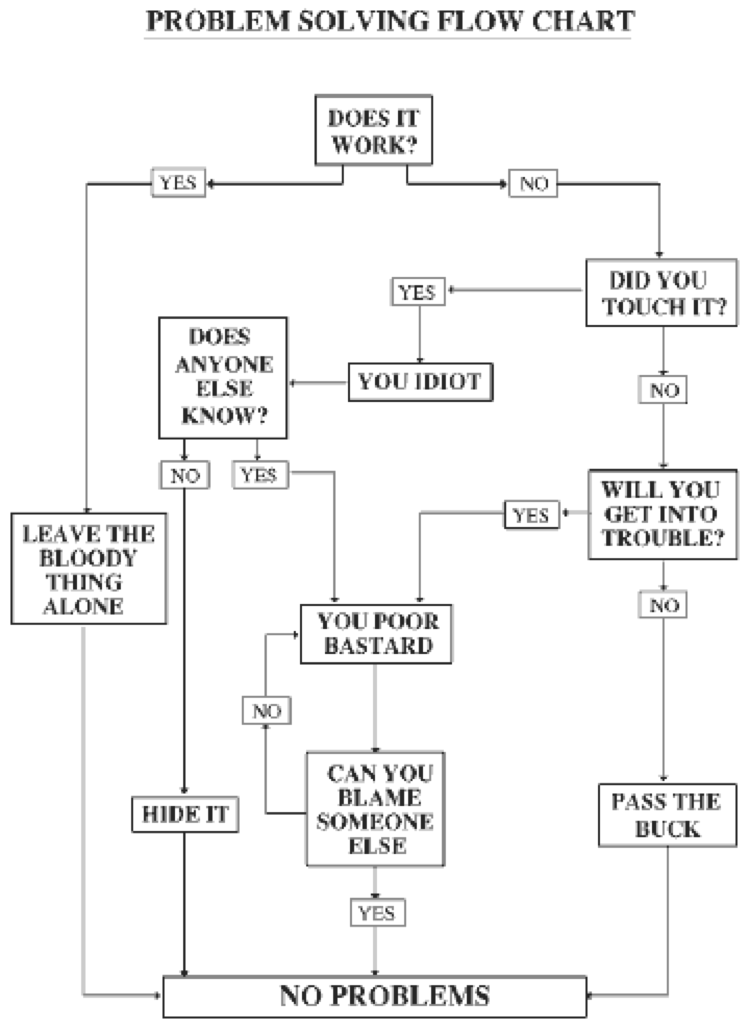
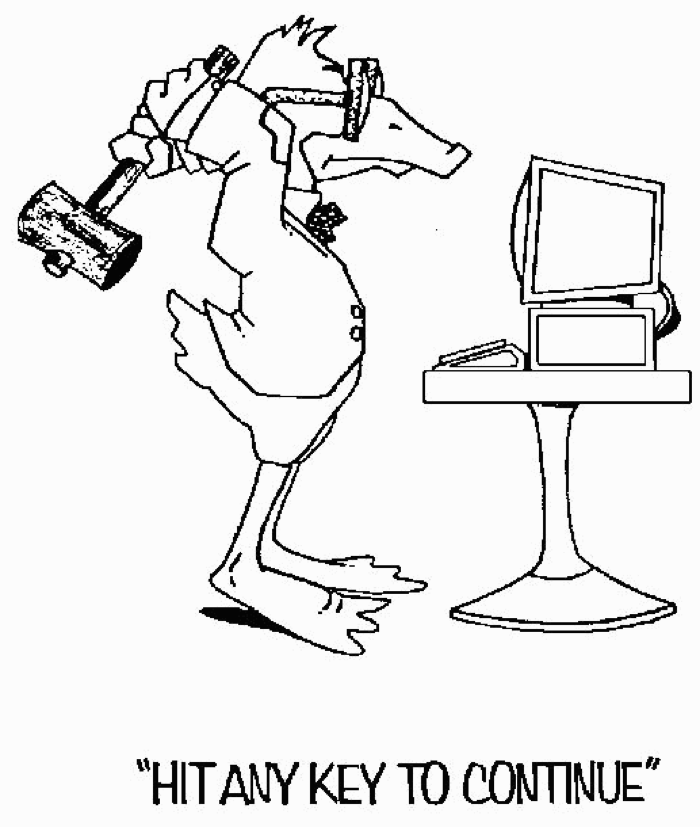
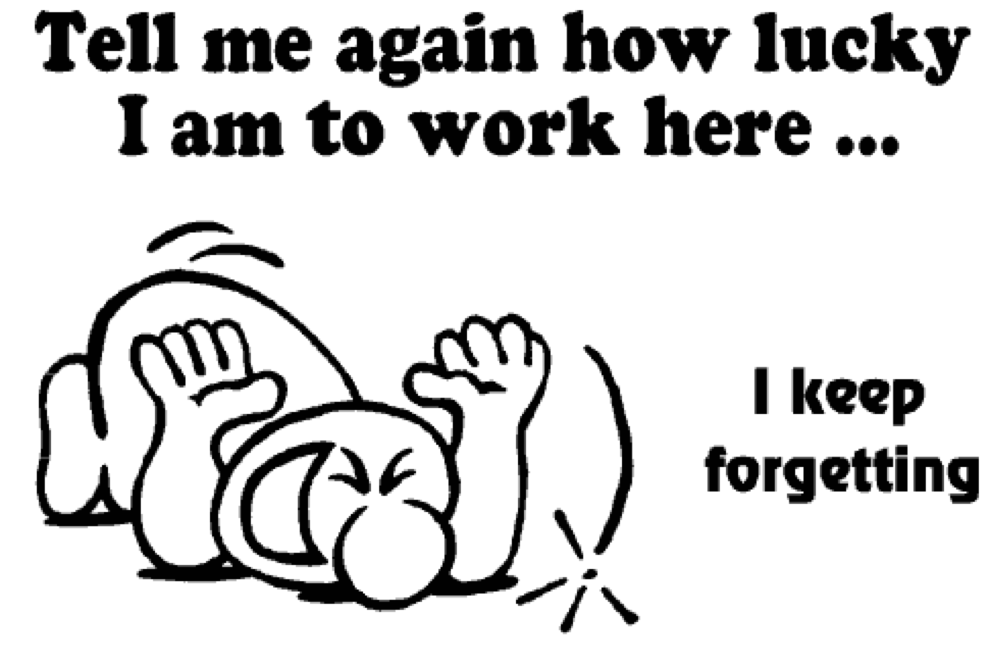
As well as official communications, the fax machine – assisted by the office photocopier – was also a favourite device for spreading workplace humour like this:
The objective of all dedicated company employees should be to thoroughly analyse all situations, anticipate all problems prior to their occurrence, have answers to all these problems, and move swiftly and efficiently to solve these problems when called upon.
HOWEVER …
When you are up to your arse in alligators it is difficult to remind yourself that your initial objective was to drain the swamp.
Or this:
THE TOES YOU STEP ON TODAY
MAY WELL BE ATTACHED TO THE LEGS
THAT SUPPORT THE ARSE
YOU NEED TO KISS
TOMORROW …
There were thousands of these globally distributed satires, cartoons, parodies and expressions of frustrations and rage. I collected a few together in my Bare Fax (1996), now considered a classic. Most of these expressions from below have been lost to time, though one or two survivors patter through the WWW from time to time. Versions of this one are still about:
Although not entirely extinct, the mid-twentieth to early 21st centuries was the golden era of the bare fax, or Xerox lore as these early memes were often known. But while fashions and technology may change, the need for a laugh or two, especially at work, remains the same. So, for those who may not have known this form of subversive humour (it was often forbidden in workplaces), or those who might have forgotten, here are a few classics of the genre. Enjoy.
Finally, one of the finest examples of the form is a parody of an ancient fable, just as relevant today as it was in the era of the bare fax and, perhaps, even in Aesop’s day:
When God made man all the parts of the body argued over who would be the BOSS.
The BRAIN explained that since he controlled all the parts of the body, he should be the BOSS.
The LEGS argued that since they took the body wherever it wanted to go, they should be the BOSS.
The STOMACH countered with the explanation that since it digested all the food, it should be BOSS.
The EYES said that without them, the body would be helpless, so they should be BOSS.
Then the ARSEHOLE applied for the job.
Then other parts of the body laughed so hard that the arsehole got mad and closed up.
After a few days the BRAIN went foggy, the LEGS got wobbly, the STOMACH got ill and the EYES got crossed and unable to see.
They all conceded defeat and made the ARSEHOLE the BOSS.
This proves that you don’t have to be a brain to be a BOSS …
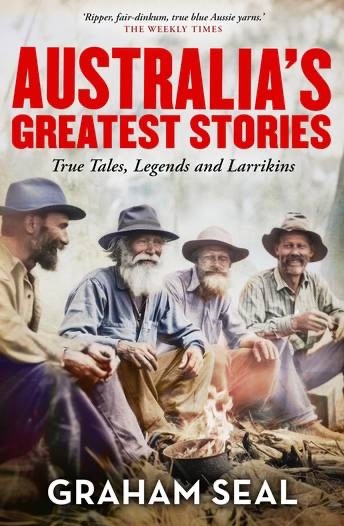
Tall tales and colourful characters, from ancient times to today; these are the stories that reveal what makes us distinctively Australian.
Some of the world’s oldest stories are told beneath Australian skies. Master storyteller Graham Seal takes us on a journey through time, from ancient narratives recounted across generations to the symbols and myths that resonate with Australians today.
He uncovers tales of ancient floods and volcanic eruptions, and shows us Australia’s own silk road. He locates the real Crocodile Dundee and explores the truth behind the legend of the Pilliga Princess. He retells old favourites such as the great flood at Gundagai, the boundary rider’s wife and the Australian who invented the first military tank, and presents little known figures like mailman Jimmy, who carried the post barefoot across the Nullarbor Plain, architect Edith Emery and Paddy the Poet, as well as the unusual sporting techniques of the Gumboot Tortoise.
These yarns of ratbags, rebels, heroes and villains, unsettling legends and clever creations reveal that it’s the small, human stories that, together, make up the greater story of Australia and its people.
Children playing in the street Turnham Green, 1891. Catalogue Ref: COPY1/406 (149) National Archives UK
There are many children’s word games, including Pig Latin, Double Dutch and G-talk. They all arise, thrive and go in and out of fashion within the restricted sub-culture of children. This is a culture of the playground and the park that is to some extent in opposition to the world of grown-ups, teachers and formal education. It is a world that is made and maintained by children for children. Adults who may cling fondly to the more romanticised images of childhood often find the expressions of this world to be shocking, which children fully intend them to be.
After surveying children’s play and language across Britain, Iona and Peter Opie produced their classic work The Lore and Language of Schoolchildren (1959). It revealed a deep, vast and everchanging reservoir of kidspeak, resonant with creativity, colour and not a little mischief. Children from Newcastle and elsewhere used what they often called crook’s language, such as going for a ball and chalk, meaning to go for a walk and calling a thief a tea-leaf.
The Opies were also able to report on the varieties of backslang and related language tricks played by children on each other and on parents and teachers. Kids in different places had their own names for these secret languages, such as eggy-peggy and arague. Most of these involved moving the last sound in the word to the front, so that ‘bash you if you don’t shut your trap’ was rendered as Shba uyo fi uyo tedon teshu aryou petray.
Pig Latin, in which the initial consonants are moved to the end of the word while either ‘ay’ or sometime ‘ee’ was added, turning the same more or less standard English phrase given above into Ashbay ouyay ifay ouyay ontday utshay ouyay aptray. Other variations involved the addition of one, sometimes two syllables, before the vowel. This produced sentences like eg, known in some areas as stage slang and elsewhere as aygo-paygo language.
The Opies give a literary reference to the existence of such children’s languages at least as early as 1808. Around the same time similar language games were played by American children. One was called hog Latin and involved the addition of ‘gery’ to every word spoken.
The lexicographer, Eric Partridge, gives examples of a children’s language called ziph, which apparently had various levels of complexity. The intermediate form, as he calls it, was a simple addition of the suffix vis to each English word, a sentence like ‘Shall we go away in an hour’ becoming Shagall wevis govis awayvis invis andvis houris? The more complex form that inserted syllables such as ga, ge, gi and go into the words. The same English sentence then becomes Shagall wege gogo agawaygay igin agan hougour? Variations on these techniques are almost endless, limited only by the creativity, playfulness and needs of their speakers.
Such word games are also known to have been played by French children in the seventeenth century. One variety known as le javanaise, was eventually picked up by adults and became a craze during the 1860s. Expatriate Trinidadian musicians in 1970s London played with another variation of this word game. They called it ‘I Y’. It consisted of adding these sounds to the start and finish of words. Multi-syllabic words could also have these sounds inserted, the overall effect being a playful obfuscation of whatever was being said.
Another form of children’s speech is the nonsense oration, a variety of the stump speeches sometimes used by adults as a form of verbal amusement. Here is an example from American tradition:
Ladies and jellyfish, I come here not to dress you or undress you, but to address you as to how Christopher Cockeyed Cucumber crossed the Missisloppi River with the Declaration of Indigestion in one hand and the Star Speckled bannaner in the other.
Another whimsy from British children, highlights the fact that the common tongues of children are not bound by national boundaries:
Ladles and jellyspoons,
I stand upon this speech to make a platform,
The train I arrived in has not yet come,
So I took a bus and walked.
I come before you to stand behind you
And tell you something I know nothing about.
It hardly needs to be said that these expressions show the familiarity of children with the adult ways of the world and their delight in sending up those ways. The Opies called such expressions ‘tangletalk’, also providing some examples in verse form:
I went to the pictures next Tuesday
And took a front seat at the back.
I said to the lady behind me,
I cannot see over your hat.
She gave me some well-broken biscuits,
I ate them and gave her them back;
I fell from the pit to the gallery
And broke my front bone at the back.
An important element of the adult world is the insult, in which skills children also serve a linguistic apprenticeship. Children also have inventive repertoires of name-calling and other insults designed to bring other children into line with whatever is considered to be the norm at any particular time or place. In Scotland children who were conceited were known as swankpots, in England as Swankypants or Swanky Liz, a porky prig and a puff bag, among other derogations.
Moody types were cross-patches, oldgrousey, grumpy, misery, mardy-baby, sourpuss or sulky Sue. Unusually bright children were clever-Dicks, clever–guts, clever-pot or clever-sticks, among other half admiring, half-demeaning terms. Inquisitive children were nosey parkers, peep-eyes, flap-ears and keyhole Kates. In Australia such people are known as stickybeaks. And so it went on through cry babies, toadies, blabber-mouths, snitches and wide-mouths, just a few among the amazing number and diversity of children’s insults recorded by the Opies.
In her collection of children’s speech from Australia, Kidspeak (2000), June Factor identified over 4500 terms used by children. These included words related to toilet functions (poo, bum), sex (a tonguey is a French kiss), insult (dweeb, dork, vege head) play (chasey, the truce term barley and its variants, names for marbles, such as cat’s eye, peewee and stonk, among many others), friends (pals, buddys, dudes) and enemies (scrags, square bears and the reviled dobber).
The languages are not only Australian-English but also varieties of Aboriginal-English, including fully-developed Creoles such as to get proper wild or angry, and gury, a Kimberley Creole for ‘greedy’. There are also words taken from the many non-English languages of the community, including Greek (malaca, an insult), Italian (putana, an insult. Factor also highlighted the sheer creativity and verbal vibrancy of childisms like snot block (vanilla slice) and over-shoulder boulder-holder (bra) as well as a few rhyming slang terms such as horse and cart for fart and backslang, as in gaff for a fag, or cigarette.
Irish stonemasons used a secret language known as bearlager na saor (also as Bearla lagair)., said to have come down from the great ancestor of masons, Goban Saor (variously spelt and pronounced gabawn seer). The mythic Goban Saor – Goban the builder – was, and is, the subject of a body of folktale traditions that present him as a clever and greatly skilled artisan who always outwits those who try to harm him or to refuse his rightful fee for work done. It was he who handed down the closely guarded skills of the stonemason, together with their confidential speech.
Towards the end of the nineteenth century, American word sleuths became aware of a curious language spoken by itinerant Irish workers, particularly stone masons. It was neither Old Irish, Gaelic or even Shelta, but seemed to have some similarities to all of these, as well as its own characteristics. One companion of itinerants, named A T Sinclair, inquired further into this among older Irish stone masons in Massachusetts and discovered that ‘On mentioning the subject to some old Irish masons here in Allston, I was surprised to find they could speak this language which they called “Bearla lagair na saor … a large number of other old Irishmen knew there was such a mason’s talk called ” Bearla lagair” ‘[1]
Sinclair’s informants told him this was a language known only to stonemasons and that no apprentice could claim his ‘indenture’, or trade qualification, without being able to speak it. Masons were forbidden to mention this speech to anyone who was not one of their guild, including their own families. The trade secrets also included special signs, skills and ways of using their tools, together with a variety of rules that must be followed and through which a mason could identify himself to another adept of the craft. Sinclair also collected stories about the Goban Saor, including this one which gives the origin of a famous stone mason’s mark:
Sometimes a love of adventure led the Goban Saor to wander incognito as a common workman. His renown as an architect and artistic sculptor was widespread. One simple story which amuses these workingmen is this. The Goban Saor once, in a foreign land, applied to the master- builder of a cathedral for work. ” What can you do? ” asked the master. “Try me and see,” was the laconic reply. Then the builder placed him in a work-shed alone by himself, and, pointing to a block of stone, said facetiously, “Carve from that a cat with two tails.” The shed was fastened at night, and the next morning Goban had disappeared. When the master unfastened the shed and looked in, he found that the block of stone had been most beautifully carved into a cat with two tails. With an exclamation of surprise, he ejaculated, “It was the Goban Saor himself! No other human being could do such superb work, or so quickly.”[2]
Sinclair gave a selection of Bearla lagair words, mostly those similar to the travellers’ language of Shelta, including:
Un twede dut na bini – do you speak Mason’s talk?
Minkur – low people
Shin – sing
Eolor – mortar
Glom -yell
Miar – devil, bad luck
Shihukh – whisky, with Sinclair’s comment ‘a large number of other words also’
Skrugal – throat
(NB – diacriticals removed here and throughout)
Bearla lagair was still being spoken by older Irish stonemasons resident in London during the 1970s and was reported to have been widely spoken among Cork stonemasons.[3]
In short, no one really knows exactly where this cryptolect comes from. But we do know that it existed as a secret language among Irish stonemasons and, perhaps, still does. The Stonemason’s Guild of St Stephen and St George maintains a ‘cosmopolitan’ version of Bearla lagaire developed around London and said to be a more sophisticated speech than the ‘argot used by rural rough masons’. The Guild says that the language, which they call ‘bine’, was regularly used in the UK and Ireland until the 1980s and that there are still stonemasons ‘who still hold and use the language today.’[4]
[3] Mudcat Café thread, ‘Goban Saor’, May and August 2002. See also Brian Cleeve, ‘The Secret Language’, Studies: An Irish Quarterly Review, Vol. 72, No. 287 (Autumn, 1983), pp. 252-262, 363.
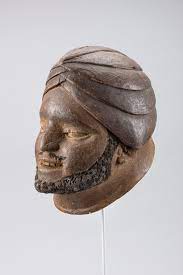
A mask by an unidentified Makonde artist of the mid-20th century QCC Art Gallery of the City University of New York, Smithsonian Magazine.
Once, they were thought to be. Then they were not. Now, it seems possible that many might be.
Recent genetic research into the origins of the Swahili people of East Africa strongly suggests that the ancient account of their kings, known as the Kilwa Chronicle, is substantially correct. In that narrative, the Swahili people of Africa are said to have originated in Persia (Iran) and began mixing with Africans one thousand or more years ago.[1]
Other research over the last decade or so has also provided support for the likelihood that traditional narratives, previously dismissed as fables, probably do record events that happened in deep time.
The frenzy of story collecting that accompanied the mercantile and colonial expansion of Europe from the seventeenth century to the nineteenth century led to the first attempts to understand the world’s massive body of folk and traditional narrative. Excited scholars proposed many theories of the origins and diffusion of these tales. Was it simply coincidence that the same stories, in one or another variation, appeared time and time again among cultures not known to have ever had any direct connection? How old were they? Could they be true?
The answer to the first question may be ‘as old as time’, at least human time.
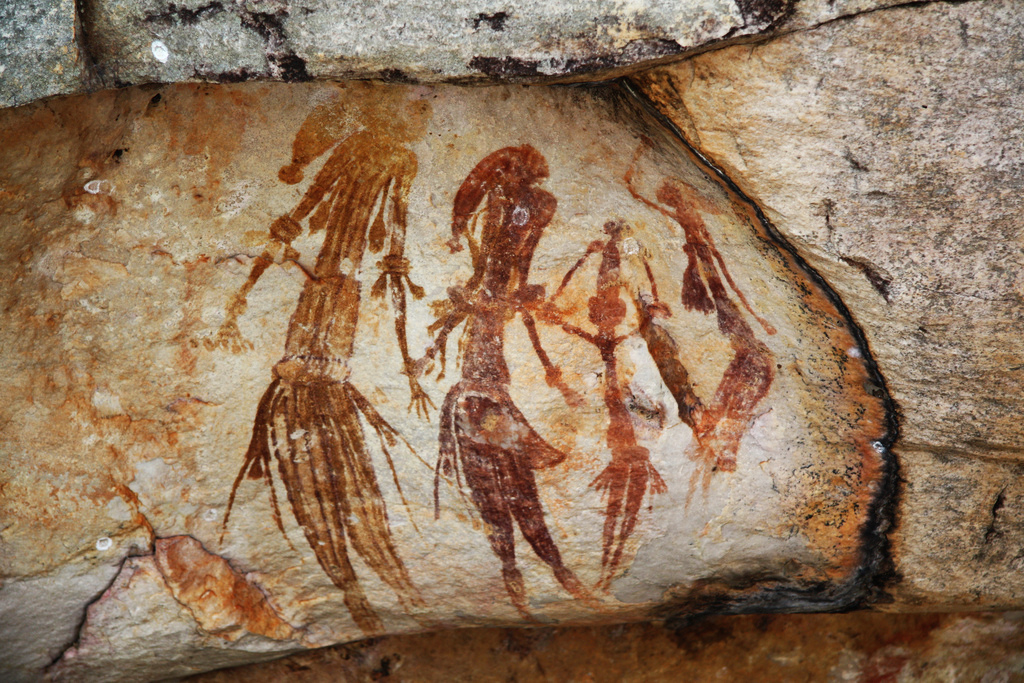
Using the Gaia space telescope, astronomers studying the constellations and how they appear in various mythologies across the world have recently added further evidence for the antiquity of story. The star pattern known as the Pleiades was the object of mythmaking in many ancient cultures, many of which refer to seven stars that make it up. Today, we can only see six stars, but 100 000 years ago, seven stars would have been visible, strongly suggesting that the Australian Aboriginal Seven Sisters songline, the Greek story of the seven daughters of Atlas and similar storylines in African, Native American and Asian traditions had their origins in the way things were one hundred millennia ago.[2]
The answer to the second question is equally momentous.
Stories of a great flood appear so often in so many of the world’s narrative traditions that many have concluded there must have been some such event or events in antiquity. Noah and his Ark may be the most familiar to many, but there are an immense number of variations on the theme. Until recently, the trend has been to dismiss oral traditions of historical or pre-historic events as fantasy. But research linking scientific evidence with indigenous stories has brought about a more nuanced interpretation.[3] One topic which can now be linked to provable pre-historic events is the inundation of land. Twenty or more Australian Aboriginal stories of such events are thought to be around 10 000 years old.[4]
One of those traditions is that of the Narrinyeri (Ngarrindjeri and other spellings) people of Lake Alexandrina and the Lower Murray region of what is now South Australia. They recounted a tradition of their great ancestor, Nurundere (also Martummere) to German Lutheran missionary, Heinrich Meyer, in the 1840s. This version of the story, part of a longer sequence, tells how Nurundere came to create a passage between Kangaroo Island and the mainland by causing the sea to ‘flow’ and so punishing his two fleeing wives.[5] Kangaroo Island was separated from what is now the mainland of South Australia around seven thousand years ago.
In 2020, archaeologists working in north-western Australia discovered Aboriginal settlements beneath the sea near the Burrup Peninsula at Cape Brugieres. The drowning of these sites is thought to have occurred between 7000 to 8500 years ago.[6]
Using weather patterns and other evidence, researchers have discovered that Polynesian oral traditions of sunken lands can be correlated with geological events.[7] Subsequent research in Australia found evidence that Aboriginal stories of a great flood on the east coast of the continent reflect a verified rising of sea levels around 7000 years in the past.[8]
Related research suggests that indigenous traditions in both Australia and Brazil might carry memories of the megafauna who were extinct by 40 000 years ago.[9] Adrienne Mayor has looked closely at the connections between fossil remains and First American myths and legends and at the archaeological evidence for warrior women.[10] Other researchers have used DNA evidence to trace the migration of narrative motifs from South Siberia to North America around twelve thousand years ago.[11]
In 2020, a team of geologists suggested that the Gunditjmara story explaining the origins of the volcano they call Budj Bim might relate to an event that occurred in southeastern Australia around 37 000 years ago. They suggest that ‘If aspects of oral traditions pertaining to Budj Bim or its surrounding lava landforms reflect volcanic activity, this could be interpreted as evidence for these being some of the oldest oral traditions in existence’.[12]
The extensive amount of archaeological and palaeontological research currently underway in all parts of the world is revealing new evidence of human occupation, journeying and interacting.[13] In recent years some of these discoveries and interpretations of them have rewritten the history of humankind. Some important parts of that history are held in age old tales.
[1] Brielle, E.S., Fleisher, J., Wynne-Jones, S. et al. ‘Entwined African and Asian genetic roots of medieval peoples of the Swahili coast’. Nature 615, 866–873 (2023). https://doi.org/10.1038/s41586-023-05754-w.
[2] Efrosyni Boutsikas, Stephen C. McCluskey and John Steele (eds), Advancing Cultural Astronomy: Studies in Honour of Clive Ruggles, Springer International Publishing, 2021.
[3] Timothy Burberry, Geomythology: How Common Stories Reflect Earth Events, Routledge, 2021.
[4] Patrick Nunn, The Edge of Memory: Ancient Stories, Oral Tradition and the Post-Glacial World, Bloomsbury, London, 2018.
[5] Collected by Meyer and quoted in Rev George Taplin, The Native Tribes of South Australia, E S Wigg & Son, Adelaide, 1879, pp. 60-61.
[6] Benjamin J, O’Leary M, McDonald J, Wiseman C, McCarthy J, Beckett E, et al. (2020) ‘Aboriginal artefacts on the continental shelf reveal ancient drowned cultural landscapes in northwest Australia’. PLoS ONE 15(7): e0233912.
[7] Patrick D Nunn, Vanished Islands and Hidden Continents of the Pacific, University of Hawaii Press, Honolulu, 2009.
[8] Patrick D. Nunn & Nicholas J. Reid (2016) ‘Aboriginal Memories of Inundation of the Australian Coast Dating from More than 7000 Years Ago’, Australian Geographer, 47:1, 11-47, DOI: 10.1080/00049182.2015.1077539.See also Patrick Nunn, The Edge of Memory.
[10] Adrienne Mayor, Fossil Legends of the First Americans. Princeton University Press, 2005 and The Amazons: Lives and Legends of Warrior Women across the Ancient World. Princeton University Press, 2014.
[11] Korotayev, Andrey. ‘Genes and Myths: Which Genes and Myths Did the Different Waves of the Peopling of Americas Bring to the New World.’ History & Mathematics (2017): n. pag. Print.
[12] Erin L. Matchan, David Phillips, Fred Jourdan, and Korien Oostingh, ‘Early human occupation of southeastern Australia: New insights from 40Ar/39Ar dating of young volcanoes’, Geology, Volume 48, Number 4, 1 April 2020 at
After surviving, this must have been one of the first questions our earliest ancestors asked themselves. It might have been asked around the same time that they wondered where they had come from and how their part of the world originated. It seems likely that the stories they evolved to explain what we generally think of as ‘creation’ also included guidelines for living together and for coexisting with the animals, plants and natural phenomena of the planet.
This consciousness may have evolved around the same time as language and the ability to shape it into narratives that could be told by one to another – and another and another, in a multi-generational chain of tellings. When writing evolved, those stories, perhaps thousands of years old by then, could be written down. They were. The earliest written works we have are tales of unknowable forces, titanic beings and tectonic configurations of earth, sky, land and sea. They are also tales of interaction between gods, monsters, demigods, heroes and, eventually, everyday mortals.[1]
Creation stories were told probably by all peoples wherever they came together into communities to get on with the business of living and dying. As well as engaging with the unknowable cosmic conundrums plumbed by all origin myths and, later, by organised religions, people needed to develop ways of getting on and getting by. This meant figuring out what worked, what did not and agreeing on the rules for living together.
How should procreation be managed? The universal human problem of ensuring a degree of separation in the gene pool was worked out and encoded in stories.
What should be done with the aged? Despatched when they could no longer contribute to the tribe, clan, or supportive group in which they had lived out their lives? Or did they have something unique to provide to the group? Wisdom, perhaps?
What is fair, equitable? What is not? Who should decide, and how?
Evil? What did that consist of and how could it be avoided or otherwise managed?
The unknowable. In deep time, pretty well everything in the natural world and beyond – including death. And then what?
These, and other fundamentals, were dealt with through narratives – myths, legends, fables, ‘fairy’ tales, as we now term them. Not only were stories like these evolved, told, written and ultimately printed around the world, they tended to be remarkably similar to each other. Mystical beings made the world. Gods – or a god – ran the afterlife. Heroes brought fire, descended to the underworld, or slew monsters, mostly to the ultimate benefit of their people. A great flood drowned the earth. Evil spirits abounded. Devils and demons had to be outwitted. Animals, places and everything else had to be named and their characteristics accounted for. People did stupid things. People did wicked things. Sometimes they were held to account and received their just desserts. Often, whether saints or sinners, the protagonists of stories were transformed. Or not. Life not only had to be lived, it had to be storied.
These processes, at once banal and profound, have been going on in storytelling since as long as we know.[2] As well as their speech, people hold onto the tales carried within their language. Many of these are carried on the tongue rather than the page. But even where oral communication has been largely replaced by print and visual media, the same old tales continue to be told in books, films, digital games.[3]
How old are these stories? The answer to that question may be ‘as old as time’, at least human time.
Using the Gaia space telescope, astronomers studying the constellations and how they appear in various mythologies across the world have recently added further evidence for the antiquity of story. The star pattern known as the Pleiades was the object of mythmaking in many ancient cultures, many of which refer to seven stars that make it up. Today, we can only see six stars, but 100 000 years ago, seven stars would have been visible, strongly suggesting that the Australian Aboriginal Seven Sisters songline, the Greek story of the seven daughters of Atlas and similar storylines in African, Native American and Asian traditions had their origins one hundred millennia ago.[4]
Could these stories possibly be true? Do they somehow record historical, or even pre-historical, events?
The truth that western scholars sought, and mostly still do, is an objective reality based on verifiable evidence. That version is generally given in a linear sequence, originally through chronicles, later in histories, that present a more or less coherent narrative of events through time. But this is a very European notion. Elsewhere in the world, time is not streaming from past to present and into the future.
The Australian Aboriginal ‘Dreamtime’ (a western attempt to describe it), like many other indigenous mythologies and spiritualities, exists in an ‘always-ever’ form in which these neat chronological divisions do not exist. The past is here now and the future is held in the past, all of which could well be happening right now. And is. I have been told by Aboriginal people of evil night beings who lurk at a particular location. The traditional owners of what is now known as ‘Nyungar country’ in Western Australia, will not go near that place after dark.
Nor are stories of the past necessarily told through one voice or perspective. The people who migrated south through the tenth to thirteenth centuries into what is now Mexico evolved a culturally diplomatic form of storytelling that made space for the interpretations of different, previously warring groups who were now allied through intermarriage and common interest. When the stories of these people, who we know as ‘Aztecs’, were told, different speakers could stand up and tell their version of particular, usually traumatic, events.
In these tellings, chronology had little purchase as stories flowed between different periods, often in what western scholars perceived as confusing repetition and so, as evidence of degraded or incoherent and fragmentary forms of oral transmission. Modern scholarship has revealed that repetition was a necessary feature of Aztec historical storytelling. Their historical truth was a communal, consensual one, a composite of the various and often conflictual meanings of what had happened to them.[5]
Humankind’s body of story remains in obscure publications and vast archives around the world, many of which are not even catalogued, let alone fathomed.[6] These narrative treasures, known and still unknown, are the fundamental cultural heritage of humanity. To allow them to languish is to abandon the roots of our being and the lessons they contain for living and dying on planet earth. Confronting though it may be, this is the human condition.
Scientists also speculate that the very act of telling stories, of whatever kind, is itself essential to being human and surviving. Our brains process stories, whether ‘true’ or ‘fictional’, in ways that we find compelling as we try and understand the world and our place in it. Through telling and retelling ‘the metanarrative of human culture spins a half-real, half-fictional reality’.[7] Through this reality we achieve empathy, the state that allows us to share and comprehend the emotions of others as presented in stories that rehearse the primalities of existence. Fundamentally, these are benefits of cooperating with each other and understanding the consequences of not doing so.[8]
It seems that we instinctively respond to the deep meanings within these narratives. Anthropologist and author David Bowles recounts how his study of the Nahuatl indigenous Mexican myth brought him to a sense of self through an understanding that the Aztec, and all humanity, inhabit ‘a liminal space between creation and destruction, order and chaos’, understanding this fundamental equilibrium is ‘A gift bequeathed by the ancients to all of us, their biological and spiritual children alike.’[9] We can’t all learn to speak Nahuatl, but we can read the stories in translation and gain something of Bowles’s insight into self and the cosmos.
In keeping with the reworking of the past to present different views, traditional stories are frequently reinterpreted by fiction writers, especially from a feminist perspective. Psychologists and others involved in various forms of therapy are drawing on ancient traditions to help patients with a range of psychological, emotional and other problems.[10]
The meanings and purposes of the tales may differ between cultures, often in ways that outsiders cannot comprehend. But the global reverberation of the same narratives told across time and space resonates of common concerns beyond specific periods, places and storytellers. Story and storying confirm the essential oneness of human beings, now scientifically proven by genetics, with any two individuals differing by a negligible measure of DNA.[11]
* Referencing Deborah Bird Rose, Dingo Makes Us Human: Life and Land in an Australian Aboriginal Culture (1992)
[1] McCarthy, J., Sebo, E., & Firth, M. (2023). ‘Parallels for cetacean trap feeding and tread-water feeding in the historical record across two millennia’. Marine Mammal Science, 1– 12. https://doi.org/10.1111/mms.13009.
[2] Smith, D., Schlaepfer, P., Major, K. et al. ‘Cooperation and the evolution of hunter-gatherer storytelling’. Nat Commun 8, 1853 (2017). https://doi.org/10.1038/s41467-017-02036-8.
[3] Claudia Schwabe (ed), The Fairy Tale and Its Uses in Contemporary New Media and Popular Culture, Special Issue of Humanities 2016, 5, 81; doi:10.3390/h5040081, http://www.mdpi.com/journal/humanities, accessed June 2017.
[4] Efrosyni Boutsikas, Stephen C. McCluskey and John Steele (eds), Advancing Cultural Astronomy: Studies in Honour of Clive Ruggles, Springer International Publishing, 2021.
[6] A case in point is the discovery of a field collection of tales made in Germany at the time the Grimms were busy elsewhere, see Franz Xaver von Schonwerth (Author), Erika Eichenseer (Editor), Engelbert Suss (Illustrator), Maria Tatar (Translator), The Turnip Princess and Other Newly Discovered Fairy Tales, Penguin, 2015. Many of the stories are like those collected and/or anthologised by the Grimms, yet they are given without editing and are often darkly or perplexingly different to those that have become canonical through the unbalancing influence of the heavily edited tales of Jacob and Wilhelm Grimm.
[7] Le Hunte, Bem & Golembiewski, ‘Stories have the power to save us: A neurological framework for the imperative to tell stories’, Arts and Social Sciences Journal, 5(2), January 2014.
[10] The works of Carl Jung on ‘archetypes’ and of Joseph Campbell on the hero’s journey are the most influential. For other theories of heroic narrative and its significance see Robert A Segal (ed), In Quest of the Hero, Princeton University Press, 1990 for a survey of the main theories up to the 1990s.
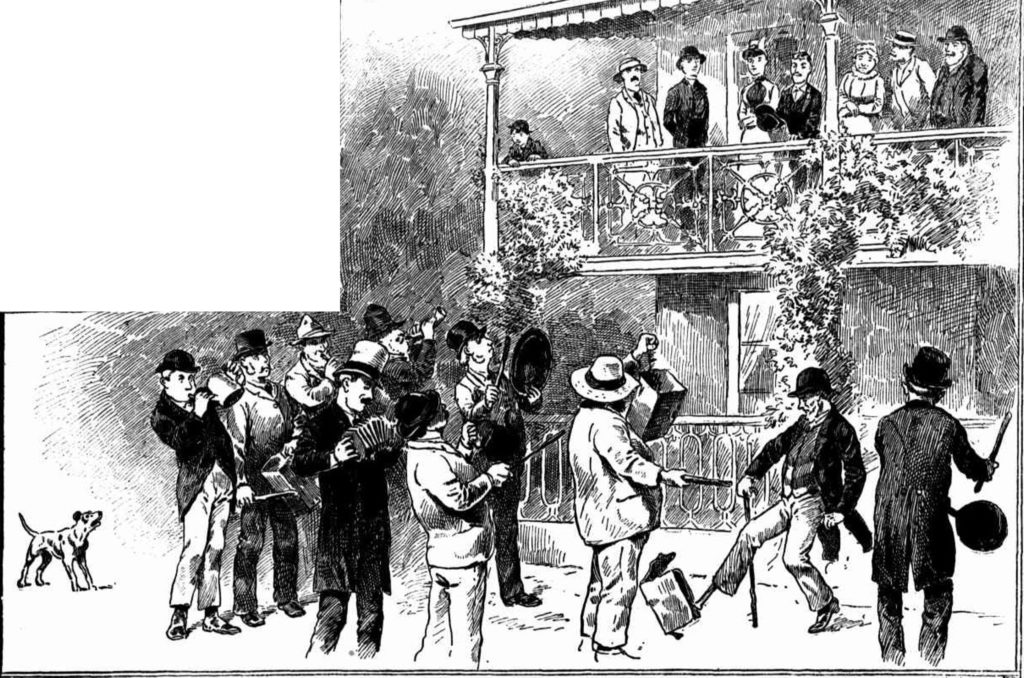
The lost folk custom of ‘tin kettling’ welcomed many newly married couples into rural communities during the nineteenth and early twentieth centuries.
Tin kettling, or sometimes ‘tin tattling’, is the name by which this widespread marriage custom was known in Australia. It usually took place after the bride and groom had retired to wherever they were going to spend their first night of wedded bliss. Allowing them enough time to settle down, the rowdier youths and younger men of the area gathered near the premises equipped with kerosene tins, pots, pans, maybe a concertina or anything else that made a lot of noise. At the agreed moment they began beating on their noisemakers, catcalling and often throwing stones onto the roof of the marital residence.
With variations, this animated custom was practiced in western Europe, Britain and America. In Germany and in the Barossa Valley it was known as ‘polterabend’, in America as a ‘tin kettle band’ or a ‘Dutch band’ and sometimes as a ‘shivaree’. It seems to have been mostly observed in rural communities and can best be thought of as a humorous welcoming of the newlyweds into what were usually small communities. A more recent, though now probably defunct, custom of tying tin cans and other decorations to the newlyweds’ car as they leave for their honeymoon may be an echo of the earlier tradition.
Reactions to the tin kettling experience varied. In some places, particularly but not exclusively where German people had settled, it was an honour to be tin kettled at your wedding and considered a mark of respect for the bride and groom as well as a sign of community approval for the union. Sometimes, the couple subjected to this rough music were expected to invite the noisy revellers into the house for a cup of tea, or perhaps something stronger. Not that the tin kettlers were likely to need much more alcohol following the earlier wedding festivities.
But not everyone enjoyed being tin kettled. According to one writer on the subject ‘performance invariably gives dire offence to the parties, whom it is intended to honour’. It could also easily become a public as well as a personal nuisance if it were kept up for a long time, as it sometimes was. But usually, there was little point in complaining as ‘Tis a custom of the country, and therefore to be winked at by the police’, according to one observer.[i]
While the ceremony had its cosier aspects, it could also become a scene of crime, as frequently reported in newspapers from the 1850s.
Yesterday several charges of assault were brought before the bench. The two first were Sarah Bailey v. Samuel Clift, and Sarah Bailey v. Thomas Wise. These charges arose out of the fact that a number of young men assembled opposite Mr. Bailey’s house on the 10th instant, to keep up the ancient but disagreeable practice of ushering in a wedding by unmusical noises, beating tin kettles, smacking stockwhips, etc. ; Mrs. Bailey not approving this, went out and tried to disperse them, and words proving ineffectual, she tried a whip, but was obliged to give it up, and as she retreated, she stated she was struck by some bones on the back, thrown by the young men, and by a stock-whip lash curling round her …
Clift and Bone were charged. Clift was able to provide witnesses who testified that Mrs Bailey gave at least as good as she got with her whip. He got off. His mate was charged with throwing the bones, probably marrow bones as these were often part of the custom. He was not so lucky and had to pay two shillings and sixpence in costs or go to prison for a month.[ii]
A few years later in Avoca, Victoria:
Complaints having been made to the Inspector of Police, that several persons have been insulted on the occasion of their marriage- by a number of people calling at their dwellings, and hooting, shouting, and playing on tin kettles &c, before the said persons dwellings, very much to the annoyance of those persons and other inhabitants of the township …
Local police wasted no time in issuing a stern warning:
… this is to give notice that this is insulting behaviour, whereby a breach of the peace may be occasioned, and is punishable under the 16th of Victoria, No.22, clause 5. The Inspector has given instructions to the constables of this district to arrest all such persona who may be found so offending. — Hugh Ross Barclay, Inspector Police Department, Avoca, 26th September, 1859.[iii]
Some reports from South Australia detail more serious lawbreaking. At Marrabel in 1871 four local youths set up a tin kettling of some newlyweds in the traditional manner. But things soon got out of hand. They took to breaking windows and began destroying the window frames. The groom reported the incident and three of the offenders were brought to court. They escaped conviction with a published apology, legal expenses and twenty pound’s compensation to the complainant.
At Baker’s Swamp, New South Wales, tin kettlers made such a nuisance of themselves in 1903 that an enraged relative of the newlyweds sent them reeling with a shotgun blast.[iv] The same year a man was stabbed at a tin kettling near Bethany, South Australia, where ‘The gathering of tinkettler’s was an extremely noisy and rowdy one, and much larrikinism was in evidence’.[v] That tin kettling saw no less than 31 ‘persons’ charged with disturbing the peace.
There are frequent references to these events around the country from the mid- nineteenth century. If caught, perpetrators were usually charged with disturbing the peace and given relatively small fines, as at Casterton, Victoria, where six young boys were each fined two shillings and sixpence in default of six hours imprisonment.[vi]
It seems likely that tin kettling was disrupted by World War 1 when many young men went away to fight. In some areas it continued into the 1940s then faded away, though there are recent signs of a revival of sorts. Recalling tales of tin kettling on the Darling Downs told by her German grandparents during the 1930s and 40s, ‘Jo’ and a few mates tin kettled a friend on her birthday a couple of years ago. It was during a COVID lockdown but everyone had a great socially distanced time out on the grass in front of the surprised birthday girl’s house. She was ‘very surprised and quite touched as well’.[vii]
[i] Geoffrey H Manning A colonial experience, 1838-1910 : a woman’s story of life in Adelaide, the District of Kensington and Norwood together with reminiscences of colonial life, Gillingham Printers, Adelaide, 2001.
[ii]The Maitland Mercury and Hunter River General Advertiser, 16 June 1852, p. 2.