Author Archives: Graham Seal
THE THYLACINE FILES – UPDATE FROM 1936
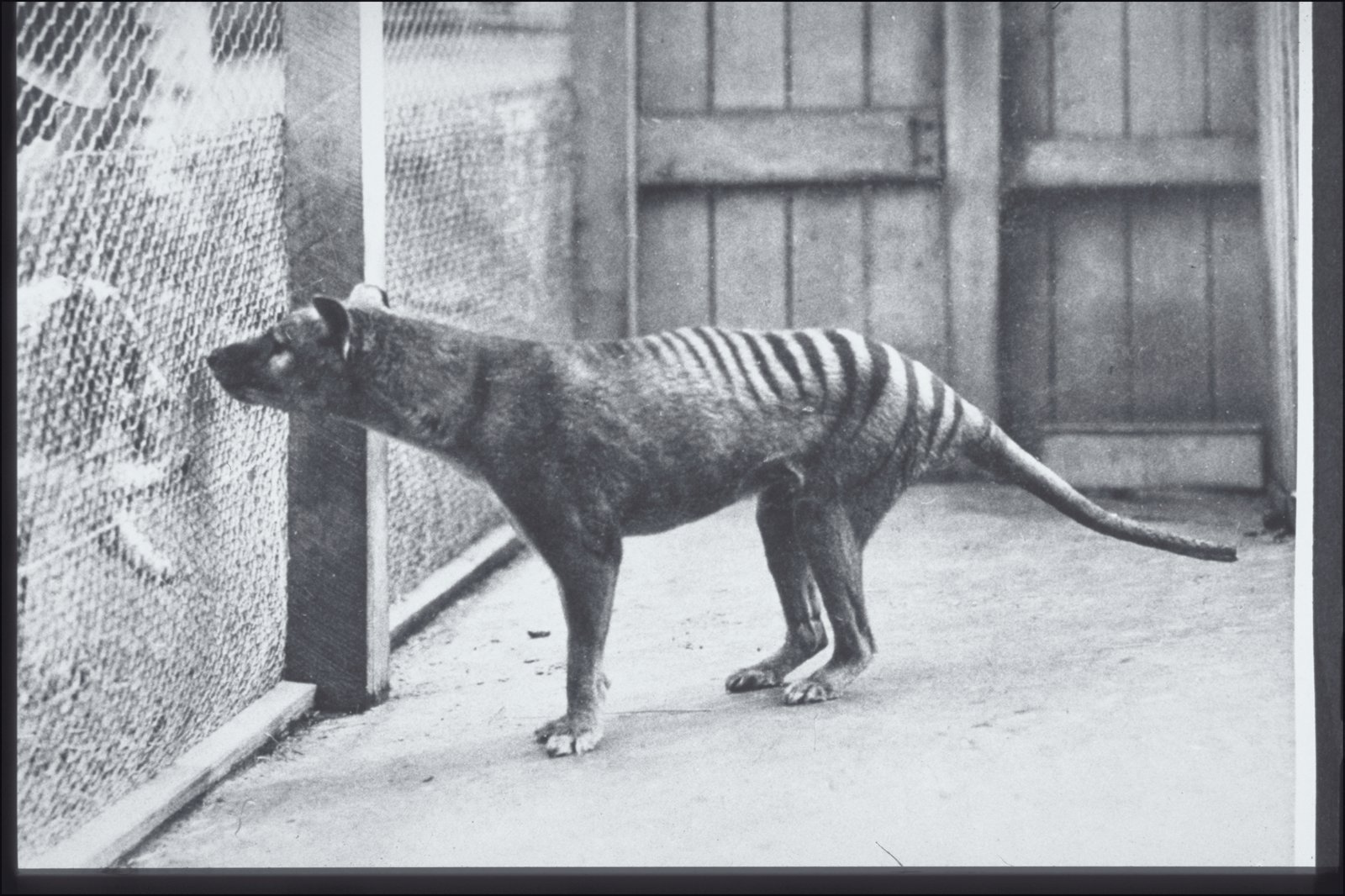
Postcard of ‘Tasmanian Marsupial Wolf’ – the Thylacine. Hobart Zoo c. 1928 (G.P. Whitley Papers Australian Museum Archives). AMS139/4/20/1. Image: Harry Burrell.
Peggie Bassett, 94, remembers seeing the last Tassie Tiger in captivity, Hobart 1936:
“Before you actually got there you could hear it … not barking or howling, just a low guttural sort of sound,” Ms Bassett said.
“It was in an enclosure — very small — with a concrete floor … just there, by itself, prowling around.”
THE BARE FAX – RETRO FOLK HUMOUR

Before the personal computer, the Internet and the mobile phone, there was the fax machine. There are still a few businesses that use this antiquated bit of early electronic communication – architects, medics – but for most of us the clacketing fax machine has long been replaced by emails, scans and all sorts of electronic wizardry.
As well as official communications, the fax machine – assisted by the office photocopier – was also a favourite device for spreading workplace humour like this:
The objective of all dedicated company employees should be to thoroughly analyse all situations, anticipate all problems prior to their occurrence, have answers to all these problems, and move swiftly and efficiently to solve these problems when called upon.
HOWEVER …
When you are up to your arse in alligators it is difficult to remind yourself that your initial objective was to drain the swamp.
Or this:
THE TOES YOU STEP ON TODAY
MAY WELL BE ATTACHED TO THE LEGS
THAT SUPPORT THE ARSE
YOU NEED TO KISS
TOMORROW …
There were thousands of these globally distributed satires, cartoons, parodies and expressions of frustrations and rage. I collected a few together in my Bare Fax (1996), now considered a classic. Most of these expressions from below have been lost to time, though one or two survivors patter through the WWW from time to time. Versions of this one are still about:
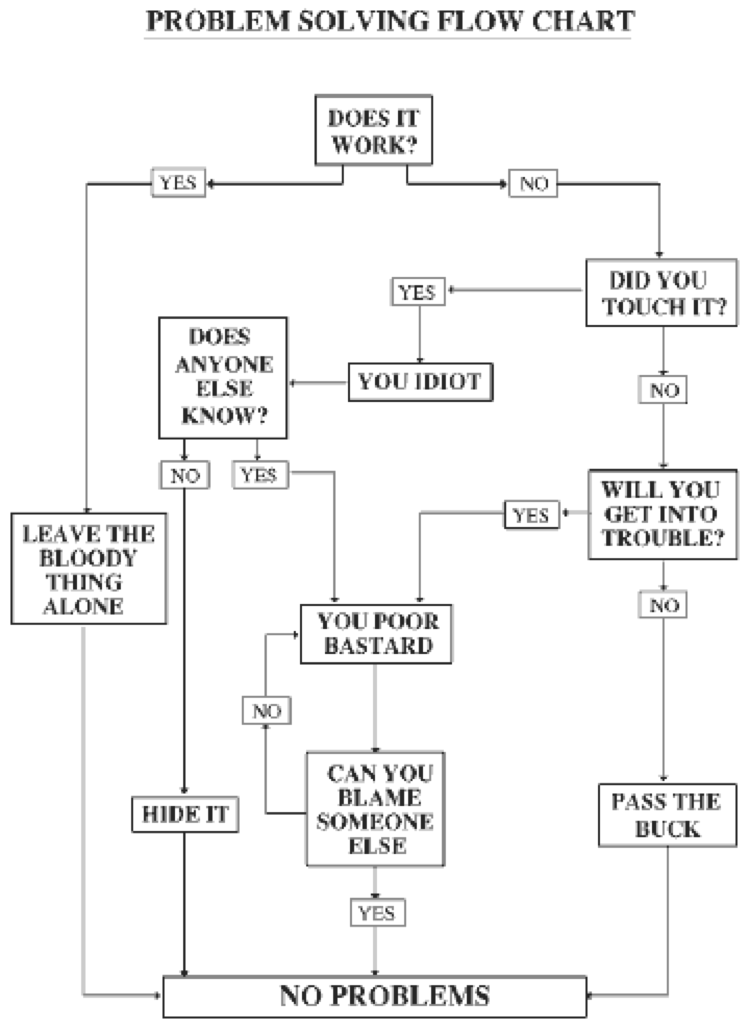
Although not entirely extinct, the mid-twentieth to early 21st centuries was the golden era of the bare fax, or Xerox lore as these early memes were often known. But while fashions and technology may change, the need for a laugh or two, especially at work, remains the same. So, for those who may not have known this form of subversive humour (it was often forbidden in workplaces), or those who might have forgotten, here are a few classics of the genre. Enjoy.




Finally, one of the finest examples of the form is a parody of an ancient fable, just as relevant today as it was in the era of the bare fax and, perhaps, even in Aesop’s day:
When God made man all the parts of the body argued over who would be the BOSS.
The BRAIN explained that since he controlled all the parts of the body, he should be the BOSS.
The LEGS argued that since they took the body wherever it wanted to go, they should be the BOSS.
The STOMACH countered with the explanation that since it digested all the food, it should be BOSS.
The EYES said that without them, the body would be helpless, so they should be BOSS.
Then the ARSEHOLE applied for the job.
Then other parts of the body laughed so hard that the arsehole got mad and closed up.
After a few days the BRAIN went foggy, the LEGS got wobbly, the STOMACH got ill and the EYES got crossed and unable to see.
They all conceded defeat and made the ARSEHOLE the BOSS.
This proves that you don’t have to be a brain to be a BOSS …
JUST AN ARSEHOLE.
*
BEST AUSTRALIAN GHOST STORIES
Available now on pre-order, publishing in September…

https://www.allenandunwin.com/browse/book/Graham-Seal-Best-Australian-Ghost-Stories-9781761472107
THE LADY ON THE SAND

The slight figure boarding Louis de Freycinet’s Uranie hardly attracted a second glance. Ship’s boys as young as ten were not uncommon in the early nineteenth century. But this ‘boy’ was the beautiful wife of the captain dressed as a man. The year was 1817 and 23 year old Rose and 35 year-old Louis had just married. It was a truly romantic marriage for love. Rose was a commoner and de Freycinet an aristocrat. So helplessly in love were the couple that they could not bear to be separated and Louis broke every rule of the French navy to have her with him on what they knew would be a very long journey.
De Freycinet needed to modify his ship to cater for a female passenger and it was not long before word escaped ashore, causing great official consternation. But by then Uranie had sailed. The story delighted the French public and the de Freycinet’s became celebrities in their absence. The authorities decided to allow the romantic voyage to proceed. They were bound for the great south land via the Cape of Good Hope and Mauritius on a round-the-world voyage of scientific discovery.
A year after leaving France the expedition anchored in Shark Bay to conduct scientific observations and map the area. But Rose’s husband also had some unfinished business in this part of the great south land. In 1802 de Freycinet had been with the Baudin expedition when they discovered the plate left by Willem de Vlamingh to mark his visit to the unknown land in 1697. De Freycinet and other officers wanted Baudin to remove the plate and take it back to France. But Baudin refused. De Freycinet swore that he would one day return and take the plate. His justification for doing this was ‘that such a rare plate might again be swallowed up by the sands, or else run the risk of being taken away and destroyed by some careless sailor, I felt that its correct place was in one of these great scientific depositories which offer to the historian such rich and precious documents. I planned, therefore, to place it in the collections of the Académie Royale des Inscriptions et Belles-Lettres de L’Institut de France …’ [i], which he duly did. The plate immediately disappeared and was not seen again until 1940 when it was found in the basement of the Académie, reportedly in a box of old junk.
Rose kept a journal of her travels, recounting the sights she saw and the adventures she experienced with her husband. She also wrote many letters home. Her first view of New Holland, as the west coast of Australia was known at the time, did not impress her. She saw a ‘low and arid coast’ with ‘nothing in the sight to ease our minds, for we knew we would find no water in this miserable land…’ She would later go ashore with Louis and spend a few nights under canvas but‘That stay on land was not a pleasant one for me, the country being entirely devoid of trees and vegetation…’ In the cooler part of the day she collected shells and read in her tent.
Here Rose had her first contact with Indigenous people. She went ashore in a small boat but was unable to land because the water was too shallow. A couple of sailors had to carry the captain’s wife to the beach in all her finery. When they reached it a group of ten or so Aborigines approached, making strong signals for the intruders to return to their ship. ‘I was afraid, and would willingly have hidden myself’, she wrote home. The Aborigines retreated, leaving Rose, Louis and some officers to picnic on the beach beneath a canvas shade they had brought from the ship along with food. This they supplemented with some local oysters ‘far tastier than all those I had, sitting at a table in comfort, in Paris.’
What the people of the region might have made of this strange scene is not recorded. They may have thought that the strangers picnicking on their beach, Rose in her fashionable finery and the sailors in their colourful uniforms, did not present a very serious threat. In any case, just a few days later, friendly contact with the locals was established when they exchanged some of their weapons in return for tin and glass trinkets. Not likely to have been a fair exchange, setting the tone for much that was to come.
The French sailed north to Timor, then to the Moluccas, the Carolines, the Marianas and the Sandwich islands. In November 1819 they arrived in the growing colony at Port Jackson. Here the de Freycinet’s were welcomed enthusiastically by almost everyone. The Governor sent a military band to play them along the river to meet him at his Parramatta residence. There were endless parties and the French were provided with a house and facilities to pursue their scientific work. But on their first night in the house they were robbed of their silver service, table linen, the servants’ clothing and other items. Rose wrote home: ‘You know the purpose of this colony and what sort of people are to be found here in plenty; you will therefore not be astonished at this misdeed: might one not say it is roguery’s classic shore.’
Rose departed on the Uranie on Christmas morning. Aboard were two merino rams, adding to the black swans and emus they had already collected on their journey. Also aboard was a convict stowaway suffering the effects of too much Christmas cheer. He was handed over to the pilot but when they got out to sea another ten escapees were found. They joined the crew and one lady on board as they set a course for the Falkland Islands in search of an abandoned French settlement.
Here the Uranie was wrecked, though the expeditioners managed to save their notes and around half of their samples. They eventually made it back to France where Louis was court martialled for losing his ship. He was cleared of the charge and then feted for his scientific achievements. Rose and Louis were a celebrated couple until Rose died of cholera in 1832. Louis died in 1841. The de Vlamingh plate was gifted to Australia in 1947. [ii]
[i] De Freycinet, Voyage Historique, Vol. I, 449.
[ii] Marc Serge Rivière (trans & ed), A Woman of Courage: The Journal of Rose de Freycinet on her voyage around the world 1817-1820, National Library of Australia, Canberra, 1996, pp. 51-52.
THE ORGY THAT WASN’T
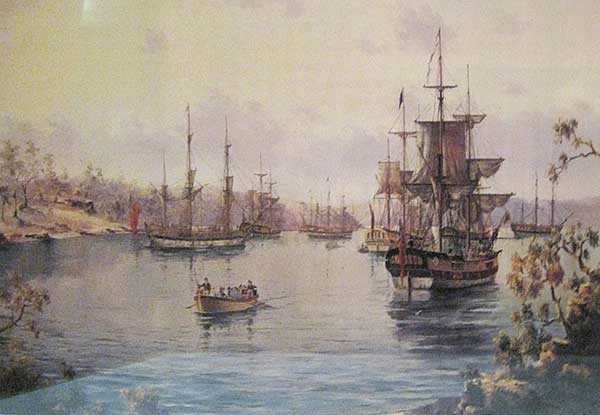
The women convicts of the First Fleet’s Lady Penrhyn went ashore at Sydney Cove on February 6, 1788. Most had seven or fourteen year terms and there were a few ‘lifers’ among them. The surgeon aboard the former slave ship that had brought them to the ends of the earth, Arthur Bowes Smyth, wrote ‘The Men Convicts got to them very soon after they landed, & it is beyond my abilities to give a just discription [sic] of the Scene of Debauchery & Riot that ensued during the night.’ According to subsequent writers, a wild orgy of rum, sex, storm and lightening followed, a fitting act for the foundation of a colony of convicts.
Popular as this story has become, in one version or another, historians have found little evidence of it ever happening. Bowes Smyth was nowhere near the scene of the alleged orgy, he was on the Lady Penrhyn quite a long way out in the harbour. None of the other keen diarists of the First Fleet, such as officers Watkin Tench or Ralph Clark seem to have noticed the orgy either. They certainly did not mention it in their accounts, an unlikely omission, especially for Ralph Clark who believed women convicts were all ‘damned whores.’
Why Bowes Smyth believed that ‘Debauchery & Riot’ occurred as soon as the women set foot in New South Wales is worth considering. He was certainly glad to see the women leave the ship: ‘we had the long wish’d for pleasure of seeing the last of them’, he wrote. The Lady Penrhyn’s voyage from England had been tedious and troubled with illness, lack of food and indiscipline. Many of the women were prostitutes and suffered from venereal disease. Although attempts were made to keep men and women separate, cohabitation quickly became commonplace. In April 1787, a month or so before they set sail for Botany Bay, five women were chained up for having relations with crewmen. There is no record of the sailors being punished.
During the voyage seventy year-old Elizabeth Beckford died of ‘dropsy’, or oedema, her bloated corpse buried at sea. She was not the last. Jane Parkinson died as they sailed from Cape Town to New Holland, as Australia was often known. Off Van Diemen’s Land the lumbering transport was lashed by a storm so fierce that the women fell to their knees praying for deliverance. Short of food once again, the Lady Penrhyn finally made Botany bay in late January 1788, only to discover that Arthur Phillip had decided the place was unsuitable for settlement. He had departed for Port Jackson.
By the time the Lady Penrhyn finally anchored in the great body of water that would become known as Sydney Harbour, the 101 women and more than 70 male crew and Marines had been cooped up on the thirty by eight metre vessel, in some cases for over a year. The women were flogged, chained, punished with thumb screws and had their heads shaved bare. Bowes Smyth wrote in his journal:
‘I believe I may venture to say there was never a more abandon’d set of wretches collected in one place…The greater part of them are so totally abandoned & callous’d to all sense of shame & even common decency that it frequently becomes indispensably necessary to inflict Corporal punishment upon them…’[i]
The doctor was clearly not well disposed towards his female charges. When he finally did ‘see the last of them’ he was predisposed to assume that they would behave in what he considered their typically debauched manner. Bowes Smyth was a product of his time and circumstances, as were all those who arrived on the First and subsequent fleets.
The double standard that masqueraded as respectability and punished only women for acts that involved a male partner continued in the colony. Four of the convict women of the Lady Penrhyn became the de facto partners of officers and the Judge Advocate. Esther Abrahams and Lieutenant George Johnston began what would become a lifelong relationship during the voyage. They did not marry for another quarter of a century.
Bowes Smyth also recorded an incident when one of the sailors was caught in the women’s tents. His hands were tied and he was publically drummed out of camp to the tune of ‘The Rogue’s March’, a ceremony used for dishonorable discharge from the army and usually followed by a flogging.
These more domestic relationships and official attempts to maintain propriety are not the stuff of myth. They lie forgotten in history while the more salacious story lives on. Historians have been trying to scotch the orgy myth ever since one of their own mistakenly set the yarn spinning in 1963. Manning Clark wrote of it though soon withdrew the assertion after a more careful look at the available evidence. But it was too late. The lewd rumour neatly captured popular views of early colonial society and the image of degraded convicts that had grown up over the generations. ‘The orgy that wasn’t’ gathered further currency from a procession of later writers and television shows repeating and embellishing the alleged scene.[ii] A yarn of ribald abandonment still resonates with a common view of the founding of Australia. No matter how often and convincingly historians demolish the myth, many still prefer to believe it.
From Great Convict Stories https://www.allenandunwin.com/browse/books/9781760527488
[i] Arthur Bowes Smyth (Smythe), ‘A Journal of a Voyage from Portsmouth to New South Wales and China. 22 March 1787–12 August 1789’. Mitchell Library.
[ii] See Grace Karskens, ‘The Myth of Sydney’s Foundational Orgy’, 2011, at the Dictionary of Sydneyhttp://dictionaryofsydney.org/entry/the_myth_of_sydneys_foundational_orgy, accessed August 2016.
THE AGE OF CON
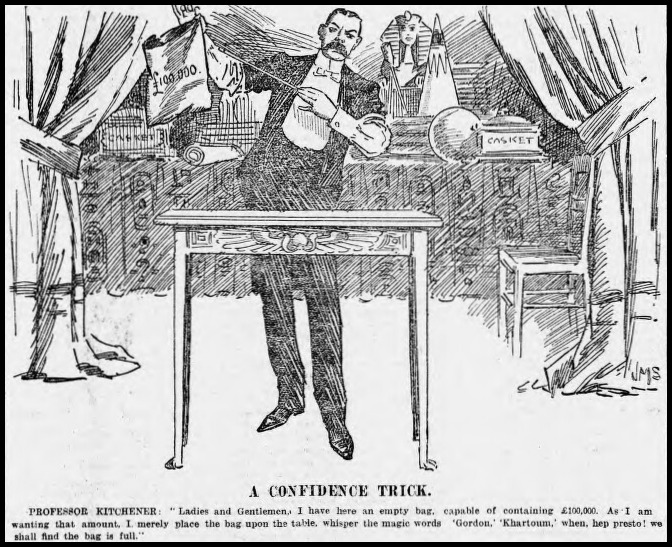
As the story goes, Detective Chief Inspector Harry (Henry) Mann of the Western Australian police was wined and dined at London’s swanky Cafe Monaco in the early years of the twentieth century. His genial hosts were from a group of Australian con men with records longer than the arms of everyone at the table. The cafe was their London hangout and distribution centre for the proceeds of crime. Cop and crims were obviously well known to each other and this strange moment says a lot about the relationship between the police and the Down Under dupers who dominated Britain’s confidence games for decades.
In the years directly before the Great War of 1914–18, right through to the end of World War II in 1945, there were more Australian con men on British police registers than those of any other nationality—by a long shot.[i] They were recognised as highly skilled exponents of their nefarious schemes and were very successful. When caught, many had what amounted to small fortunes in their bank accounts and stuffed into the upholstery of their expensive furniture and cars—and they were just the stashes the police found. No self-respecting trickster would be without a secret hidey-hole or two for the inevitable emergencies. Bags of cash were essential to set up the bigger cons and to fund the lavish lifestyles needed to impress rich marks.
And there were plenty of them. Especially after World War I, Britain, Europe and the United States were awash with money flowing through newly opened international financial channels and connections. Business deals and schemes were being rolled out around the world in oil, minerals and a hundred other lucrative enterprises. A lot of people made a lot of money—and often spent it lavishly and ostentatiously. Perfect pigeons for gangs like London’s Hanley Mob, among others working the same rackets.
Sometimes the wealthy individuals suckered in were themselves con men of a kind, wheeling and dealing in the white-collar areas of finance and investment. But they were rarely found out and, if they were, could usually buy their way out of trouble. Eventually, their activities would play a part in the great stock market crash of 1929 and the deep depression that followed. But, for now, it was not only an era of excess and indulgence, it was also the golden age of the con.
The fix was in.
Just how and why Australians became the main exponents of the con in Britain, and sometimes Europe, is a mystery. Operators like Bludger Bill Warren, Dictionary Harry (Harry Harrison) and Dave the Liar (David John Lewis) excelled in new and clever versions of classic cons. These included the infallible betting system (and its variant known as ‘the brass’), ‘the pay-off’ (and an adaptation known as ‘the rag’), and other scams large and small also perfected by the cons from Oz. In one celebrated operation, Bludger Bill and some accomplices took down the immensely wealthy English shipping magnate, Sir Walter Cockerline, for more than £20,000—just under $2 million—in 1923.
At the time for—let’s say—professional reasons, Bill was sojourning on the continent. He’d fleeced a businessman in Portugal of £15,000 and found it necessary to fade away, turning up on the French Riviera. Here, the normally foul-mouthed Bill with his strong Australian accent became the owner of a South African diamond mine or three. Employing his practised skills, Bill checked into the same expensive hotel as Sir Walter, and soon made a good friend of him. Only a day or two later, Bill introduced Sir Walter to an acquaintance who was, quite coincidentally, a guest at the same hotel. The acquaintance was an American oil king.
After getting to know each other a little more, the convivial trio visited Monte Carlo for some wagering at the tables. As they refreshed themselves with a coffee, the oil king noticed a man he described as ‘the biggest bookmaker in the United States’. The bookmaker, whose betting limit was said to be ‘the blue sky’, was invited to the table and was soon a member of the affable group.
It wasn’t long before the conversation was about betting on the gee-gees. Bill and the oil king placed big bets through the bookmaker and invited Sir Walter to join the fun. By day’s end, the bookmaker was pleased to tell the informal syndicate that they had netted £170,000 in winnings.
It was time for the sting.
When settlement of the bets was due, Bill, very annoyed, informed Sir Walter that the bookmaker’s club through which he had laid their bets would only pay up when the punters proved they could show they were men of substance. ‘But’, said Bill, flashing a large wad of cash, ‘I’ll put up the “cover”’, as it was called. Being gentlemen, of course, the others couldn’t allow Bill to pony up the full amount of their joint obligation so they each wrote personal cheques for £25,000.
Sir Walter then had to return to England before the group’s winnings were drawn. Soon after he arrived, he received a wire from France. Bill was embarrassed, naturally, but he’d had a spot of bad luck and was temporarily short of £12,000 of his share of the cover. Would Sir Walter possibly be so good as to advance him that sum until the winnings were available? Completely conned, Sir Walter obligingly wired the money to Bill and never heard from the diamond magnate again.
Until the French police caught up with Bill and his wife in Paris. They had fled there in a newly purchased luxury car after another mark had complained to the authorities. When the police raided the con man’s apartment they found stashes of bank notes in various European currencies, as well as share certificates and a lot of diamonds being worn by Bill’s wife. The expensive car was also full of loot.
One of the advantages of being a confidence trickster was that the risk of being caught was very low compared with most other forms of crime. Victims were often too embarrassed to admit they had been so easily fooled and often reluctant to report their loss to police. Even when they did, it was often difficult for prosecutors to make winnable cases because the nature of the transactions could often be represented as commercial business deals, gambling wins and losses, or gifts. There was rarely a paper trail documenting what happened, whatever that had been. In the case of Bludger Bill, the French court in which he was brought to book was at first reluctant to admit the case at all, as the prosecution failed to establish Bill’s true identity, even with help from Scotland Yard. The wily fraudster also maintained that his arrangement with Sir Walter had been a commercial matter.[ii]
This and the odd loophole in the laws of the various countries in which the Aussies operated meant that they often escaped conviction. The only recourse available was to prosecute them for fraud under civil law, a course taken by several victims who had the financial resources required. No that this made much difference to their finances. Bill and his accomplices were tried and convicted, spending some more years in a French prison. It’s unlikely any of their victims ever saw their money again.
Confidence tricksters are a special type of criminal. They depend on their wits, powers of persuasion, and the gullibility and greed of their ‘marks’, or victims. They have been fleecing the foolish forever and will never stop. Their wiles and ploys are complex and clever, as well as despicable. As one writer on the subject put it in 1935: ‘in its higher reaches the art of the confidence trick is a subtle science demanding more than common qualities of nerve and brain—or if you like a front of brass and a fertile cunning. Steal a fiver and you get thrust into gaol; steal a million and they build you a monument. That is the creed of the master of craft.’[iii]
Con artists are generally considered to be elite criminals who avoid violence in favour of elaborately researched and constructed frauds usually perpetrated against those who most people think are too wealthy for their own good. That includes the averagely paid police officers tasked with tracking con artists down. Chief Inspector Mann was in London to visit colleagues at Scotland Yard and swap intelligence on the roots and scams of the con men well known to them all. They were few enough in number to be recognised by police who often had an ambivalent relationship with them. The hunters and the hunted shared a bond of common interest in crime, even if from different perspectives. The diners at Cafe Monaco were all aware of their roles that night but suspended hostilities for a few convivial hours, each no doubt hoping to learn something to his advantage from the event.
Confidence tricksters also need to keep up with changing times. The Australians were at the forefront of the new, twentieth-century breed of operators. A few gentlemen thieves and suave manipulators of an earlier age were still around but had largely been succeeded by a brasher, often more proletarian crim, better suited to the world of self-made millionaires, often with colonial connections. The same skills of deceit and manipulation were used to rob the rich and had evolved, from the lowliest short con to the most sophisticated long con, into finely staged performances in which the star was also the mark.
The con men, and some women, weren’t exactly benefiting the poor but they did not batten onto everyday mugs. Not worth the trouble, of course. Since that time, scams and cons have increasingly targeted you and me through the internet and mobile phones. We’re not filthy rich but there are an awful lot more of us and it’s all so easy to play the Nigerian money scam, for example: simply the modern form of an ancient con known as ‘the Spanish prisoner’. These tawdry rorts employ the tricks of deception, diversion and persuasion used by the earlier fraudsters, but they are crude echoes of a much cleverer and more artistic form of criminality. The old-time operators weren’t known as ‘con artists’ for no reason.
[i] W. Meier, Property Crime in London, 1850–Present, Palgrave MacMillan, Basingstoke, UK, 2011.
[ii] ‘Warren’s arrest’, The Evening Star (Dunedin), 10 July 1923, p. 4. According to this report, Bill netted £23,000 from Sir Walter. Dilnot, below, also says £23,000.
[iii] George Dilnot, Getting Rich Quick: An outline of swindles old and new with some account of the manners and customs of confidence men, Geoffrey Bles, London, 1935.
THE SUPERHIGHWAYS OF SAHUL

She was a slight, short woman, a young adult. He was around fifty years old, built lightly and around 1.7 metres tall. They were both buried in the Willandra Lakes on Paakantji, Ngyiampaa, and Mutthi Mutthi country around forty-two thousand years ago. Mungo Lady’s remains were recovered in 1968 and those of Mungo Man in 1974. Until these discoveries, humans were thought to have occupied Australia for only around ten or twelve thousand years. More recent evidence suggests that the ancestors of First Nations people arrived here much earlier.
Mungo Lady and Mungo Man were buried only around five hundred metres apart yet they did not know each other. Later excavations revealed many more sets of human remains and a community of humans living for generations in the usually well-watered area, hunting, harvesting, procreating, dying and being ritually buried – she by cremation, crushing and interment; he face upwards, hands folded on his lap and his body sprinkled with red ochre. [i] Ancient though these people were, their forebears may have lived in Australia for thirty or more thousand years.
Scientists are rewriting what we thought we knew about early human history and a prehistoric supercontinent called ‘Sahul’ has an outsize role in the story. Existing in the Pleistocene Epoch, from around 2.6 million to around twelve thousand years ago, it consisted of mainland Australia, attached to Tasmania, and to many of the islands we know as Papua New Guinea and to what is now called Timor. From perhaps as long as seventy-five thousand years ago, large groups of technologically sophisticated humans crossed from the northern reaches of the supercontinent to begin the peopling of Australia. More followed at later times, probably by sea, and within around ten thousand years of first arrival the ancestors of the First Nations had reached the southern tip of Sahul.
The routes these first comers travelled on their epic journeys – continental ‘superhighways’ – began in Timor and Papua New Guinea then passed, broadly, along the west and east coasts and through the centre, looping through the Nullarbor and, eventually, reaching Tasmania. There were secondary connecting routes but the superhighways were created by waves of people moving towards and through ‘highly visible terrain’, basically the mountain ranges of the continent. These tracks became trade routes and songlines and often correlate with later stock routes and even modern highways.[ii]
We have long held the idea that Australia and the people living here before colonisation were unknown and isolated from the rest of the world. For many centuries, stories of an unknown continent at the southern end of the globe circulated through the ancient and medieval worlds. Often called ‘the unknown south land’, or ‘terra australis incognita’, this continent was shrouded in mystery and myth. Any people who might live there would necessarily walk upside down, it was said, and there would be strange beasts and flowers growing there – wherever it might be.
Beginning in the seventeenth century, European navigators began to slowly peel back the mysteries of the land as they came into contact with it and, sometimes with its original inhabitants. Gradually, coastlines were charted, the odd river or island was hastily explored and by the time James Cook came to make his celebrated voyage along the east coast in 1770, Europeans had some idea of the size and shape of what we now call Australia. But at this time there was almost complete ignorance of the inland and it was not clear whether Tasmania was attached to the rest of the continent. Answers to those questions would come in time, but the dominant story was that the great south land was completely unknown – other than to its original occupiers – until ‘discovered’ and colonised by Europeans. It followed that there had been no outside contact for millennia. But in recent years, other possibilities have arisen.
The north-west of Arnhem Land has a wealth of rock paintings depicting sea creatures, European sailing ships and other scenes. Among these paintings are two intriguing images that archaeologists believe to be war craft from the Maluku Islands. It has long been known that trepang fishers from the area usually known as Macassar regularly visited and sojourned in Arnhem Land since around 1700.[iii] But these were, as far as we know, peaceful visits by fishing boats. The paintings on the rock shelters of Awunbarna (Mount Borraedaile) show craft with pennants and other indications that they were designed and fitted out for war rather than trade.[iv] To date, no one has found any indications of conflict between First Nations people and whoever might have sailed the warships, but the paintings are evidence of pre-European interactions with people from islands to the north of Australia.
In Queensland’s channel country, the Mithaka have been quarrying stone for seed grinding for several thousand years. These quarries are spread across an area of more than 30 000 square kilometres in which are dwellings and elaborate stone arrangements thought to be of ceremonial significance. The stones are also part of an ancient industrial production and trade system dubbed ‘Australia’s Silk Road’ that runs from the Gulf of Carpentaria to the Flinders Ranges in South Australia.[v] Archaeologist Michael Westaway observes that the route ‘connected large numbers of Aboriginal groups throughout that arid interior area on the eastern margins of the Simpson Desert’ and that ‘You get people interacting all across the continent, exchanging ideas, trading objects and items and ceremonies and songs’.[vi]
It is possible that this trans-continental Silk Road also connected with trade routes beyond Australia. There is strong evidence of interchange between Torres Strait Islanders and what is now Papua New Guinea for over two thousand years.[vii] The discovery of a platypus carved into a sixteenth-century church pew in Portugal and the documented presence of cockatoos in medieval Sicily[viii] suggests that there were links between Australia, south Asia and, ultimately, Southern Europe, for centuries before Europeans began to arrive on the unknown south land.
First Nations people also travelled beyond Australia to islands in the north, even forming family attachments there. These places were linked to other parts of the world through trading networks we are only beginning to uncover, so it would be possible to send Australian wildlife, as well as other items, along these routes. Ongoing research will reveal more information about the pre-modern world and its extensive connections, so the image of an unknown south land might need to be even more radically reshaped. First Australians were not completely isolated though they, and almost everything else about Australia, would remain a mystery to those who came much later. In the many millennia before that there was enough time for even geological and cosmic events to become part of Australia’s story.
From Australia’s Greatest Stories https://www.allenandunwin.com/browse/book/Graham-Seal-Australia’s-Greatest-Stories-9781761471131
AUSTRALIA’S GREATEST STORIES
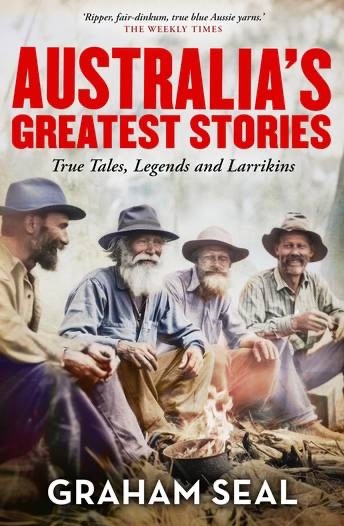
Tall tales and colourful characters, from ancient times to today; these are the stories that reveal what makes us distinctively Australian.
Some of the world’s oldest stories are told beneath Australian skies. Master storyteller Graham Seal takes us on a journey through time, from ancient narratives recounted across generations to the symbols and myths that resonate with Australians today.
He uncovers tales of ancient floods and volcanic eruptions, and shows us Australia’s own silk road. He locates the real Crocodile Dundee and explores the truth behind the legend of the Pilliga Princess. He retells old favourites such as the great flood at Gundagai, the boundary rider’s wife and the Australian who invented the first military tank, and presents little known figures like mailman Jimmy, who carried the post barefoot across the Nullarbor Plain, architect Edith Emery and Paddy the Poet, as well as the unusual sporting techniques of the Gumboot Tortoise.
These yarns of ratbags, rebels, heroes and villains, unsettling legends and clever creations reveal that it’s the small, human stories that, together, make up the greater story of Australia and its people.
THE FLYING DUTCHMAN DOWN UNDER
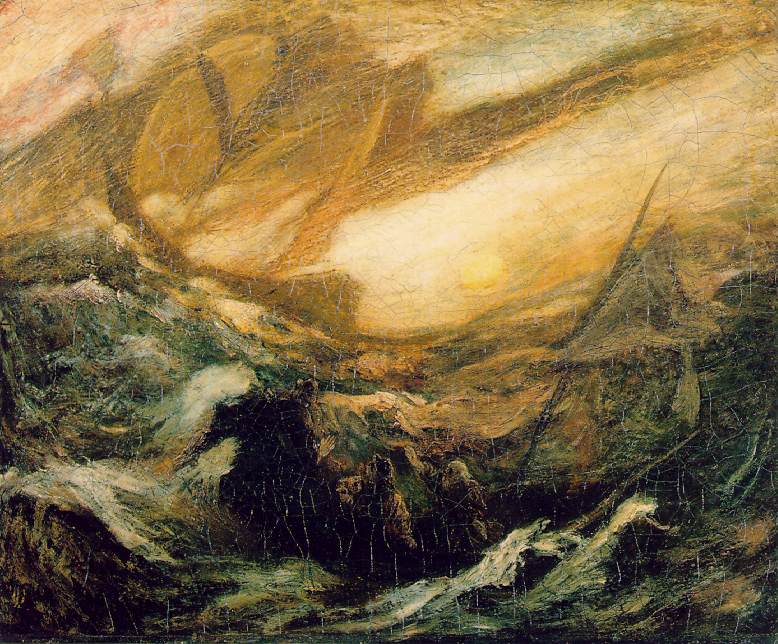
The Flying Dutchman by Albert Pinkham Ryder c. 1887 (Smithsonian American Art Museum)
The legend is first recorded in 1790, but it was already old in sailors’ lore. Undoubtedly the most famous nautical yarn of all, the enigmatic tale of the Flying Dutchman is known around the world. And the spectral sailing ship has been sighted in many oceans, including in Australian waters.
At first, the story was a short yarn about a distressed Dutch ship seeking safe harbour at the Cape of Good Hope during a raging storm. A pilot to guide the vessel to safety was not available and the ship was lost with all her crew. Ever since then, the glowing apparition has been seen during stormy weather. Sighting the Flying Dutchman was considered to be an omen of doom.
The Cape of Good Hope was a regular port of call for ships on the Australian run from Europe and although the legend was initially a Dutch story and largely restricted to sailors, it flowed into the broader community in the late eighteenth century. One of the earliest accounts is that of the ‘Prince of Pickpockets’, George Barrington, on his way to serve a sentence in Australia in 1795. Barrington’s version of the story is a little more elaborate than the basic legend (though he was a notorious confidence trickster with a silver tongue):
. . . it seems that some years since a Dutch man-of-war was lost off the Cape, and every soul on board perished; her consort weathered the gale, and arrived soon after at the Cape. Having refitted, and returning to Europe, they were assailed by a violent tempest nearly in the same latitude. In the night watch some of the people saw, or imagined they saw, a vessel standing for them under a press of sail, as though she would run them down: one in particular affirmed it was the ship that had foundered in the former gale, and that it must certainly be her, or the apparition of her; but on its clearing up, the object, a dark thick cloud, disappeared. Nothing could do away the idea of this phenomenon on the minds of the sailors; and, on their relating the circumstances when they arrived in port, the story spread like wild-fire, and the supposed phantom was called the Flying Dutchman.
Barrington did not see the apparition, but he met a sailor who did. About 2 a.m. he was woken by the boatswain ‘with evident signs of terror and dismay in his countenance’ and begging for a drink of spirits. The man claimed to be ‘damnably scarified’ because he had just seen:
the Flying Dutchman coming right down upon us, with everything set—I know ’twas she—I cou’d see all her lower-deck ports up, and the lights fore and aft, as if cleared for action. Now as how, d’ye see, I am sure no mortal ship could bear her low-deck ports up and not founder in this here weather. Why, the sea runs mountains high. It must certainly be the ghost of that there Dutchman, that foundered in this latitude, and which, I have heard say, always appears in this here quarter, in hard gales of wind.
After a few deep draughts, the boatswain ‘grew a little composed’, admitting that he was prone to seeing ghosts. Barrington went on deck with him to see for himself but ‘it had cleared up, the moon shining very bright, and not a cloud to be seen; though, by what I could learn from the rest of the people who were on deck, it had been very cloudy about half an hour before, of course I easily divined what kind of phantom had so alarmed my messmate’.
A more respectable figure who did see the Flying Dutchman in Australian waters was no less a personage than Prince George of Wales, destined to be King George V. Sometime before dawn on 11 July 1881, while travelling through Bass Strait, the prince (or his brother travelling with him) recorded:
At 4 a.m. the Flying Dutchman crossed our bows. A strange red light as of a phantom ship all aglow, in the midst of which light the masts, spars and sails of a brig 200 yards distant stood out in strong relief as she came up on the port bow. The look-out man on the forecastle reported her as close as on the port bow, where also the officer of the watch from the bridge clearly saw her, as did also the quarterdeck midshipman, who was sent forward at once to the forecastle; but on arriving there was no vestige nor any sign whatever of any material ship was to be seen either near or right away to the horizon, the night being clear and the sea calm. Thirteen persons altogether saw her . . .
Just over six hours later, the sailor who had first reported seeing the Flying Dutchman fell to his death from the foretopmast and ‘was smashed to atoms’.
Another Australian connection with the Flying Dutchman comes from John Boyle O’Reilly, the famous Irish rebel. While being transported with his fellow Fenians to Western Australia in 1867, O’Reilly wrote a poem for the ship’s newspaper. The poem uses the Flying Dutchman tale to give expression to O’Reilly’s forebodings at what was going to be a long exile from his homeland:
They’ll never reach their destined port
They’ll see their homes no more,
They who see the Flying Dutchman
Never, never reach the shore.
Since then the legend has grown, gathering more detail and depth through endless accounts, books, films and artworks that feed from it. The Flying Dutchman soon fused with another piece of world folklore known as the ‘Wandering Jew’. This is said to be a man who refused to help Christ bear the burden of the cross as he struggled towards his crucifixion. In a bit of Old Testament revenge, the man was condemned to wander the Earth forever in eternal life. In the Flying Dutchman version, the captain of a Dutch merchantman attempting to enter Table Bay was frustrated by a change in the wind. The captain swore to be eternally damned if he did not enter the bay and that he would sail these waters until Judgement Day. He did not and he does.
In another version it is said that the crew of the Dutch ship committed some atrocious crime and are condemned to never enter a port and must voyage onwards until their penance is done. This echoes a theme of Coleridge’s famous poem, The Rime of the Ancient Mariner (1797–98). A few years later the arch-romancer Walter Scott made the Flying Dutchman a pirate ship, in which guise the tale may be most familiar to modern audiences in the Pirates of the Caribbean movies.[i]It’s not surprising that such a compelling legend is told again and again and that the cursed ship has been seen even in Australian waters.
[i] George Barrington, A Voyage to Botany Bay, with a description of the country, manners, customs, religion, &c. of the natives, sold by H.D. Symonds: London, 1795.
Prince Albert Victor and Prince George of Wales, The Cruise of Her Majesty’s Ship ‘Bacchante’ 1879–1882. Compiled from the private journals, letters, and note-books of Prince Albert Victor and Prince George of Wales, with additions by J. D. Dalton, Vol. 1, Macmillan and Company: London, 1886, p. 551.
Buy me a coffee!
A$5.00
 GRISTLY HISTORY