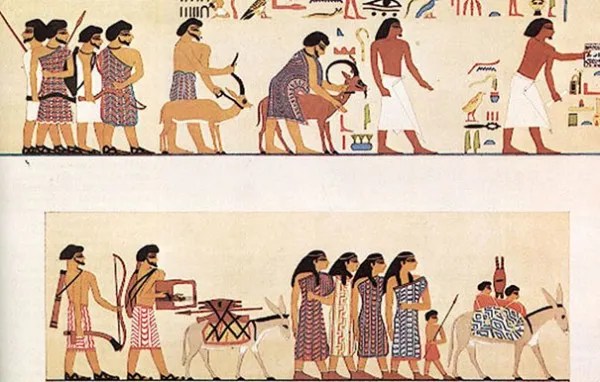
Egyptian tomb painting of nomads from about 1900BC. Tomb of Khnumhotep at Beni Hassan 12th Dynasty.
One of the world’s earliest known stories is a romance. A three and a half thousand-year-old fantasy of forbidden love between a high-born woman and a lowly outcast, the Sumerian tale of Adjuar and Martu pre-figures narratives like Romeo and Juliet and West Side Story, among many others.
Adjuar and Martu
Martu is a young nomad, from a people known as the Martu, who are considered barbaric and untouchable, let alone marriageable. But Martu needs a wife to keep his mother happy but is unable to find one among his own people.
On a feast day he goes into the city of Inab where he meets the beautiful Adjar-kidug, daughter of the city god (or ruler). They fall in love and Martu distinguishes himself in the feast games and sports by winning all the wrestling bouts. Asked what he wants for a prize, he rejects gold and jewels in preference for the hand of Adjar-kidug.
Her father sets him some tasks which, if completed, will guarantee his daughter’s hand. Martu does what he is asked and goes far beyond, gifting gold, fine cloths, silver jugs to everyone in the city, from the elders down to the slaves. Still, he received no permission to proceed even though Adjar-kidug is still deeply in love with him, as proven by her reply to a friend who warns her against marrying a barbarian:
Listen, the Martus, their hands are destructive and their features are those of monkeys; he is one who eats what Nanna forbids and does not show reverence. They never stop roaming about ……, they are an abomination to the gods’ dwellings. Their ideas are confused; they cause only disturbance. He is clothed in sack-leather ……, lives in a tent, exposed to wind and rain, and cannot properly recite prayers. He lives in the mountains and ignores the places of gods, digs up truffles in the foothills, does not know how to bend the knee, and eats raw flesh. He has no house during his life, and when he dies he will not be carried to a burial-place. My girlfriend, why would you marry Martu?”
But Adjar has been impressed by Martu’s efforts to be like her people and the efforts he has made to prove himself, rejecting wealth in preference for her love. She replies ‘with the certainty of a woman who knows her heart, her mind and her soul: “I will marry Martu!’
The story ends with the statement that ‘Adjar had seen the raw diamond in the nomad made civilised by her love’.[i]
We are not told whether the two lovers do marry or not, but their ancient story is as relevant today as it was over three millennia ago.
[i] Black, J.A., Cunningham, G., Robson, E., and Zólyomi, G. ‘The Mariage of Martu’, The Electronic Text Corpus of Sumerian Literature, Oxford 1998-, https://www.gatewaystobabylon.com/myths/texts/classic/martu.htm, accessed November 2022.

 GRISTLY HISTORY