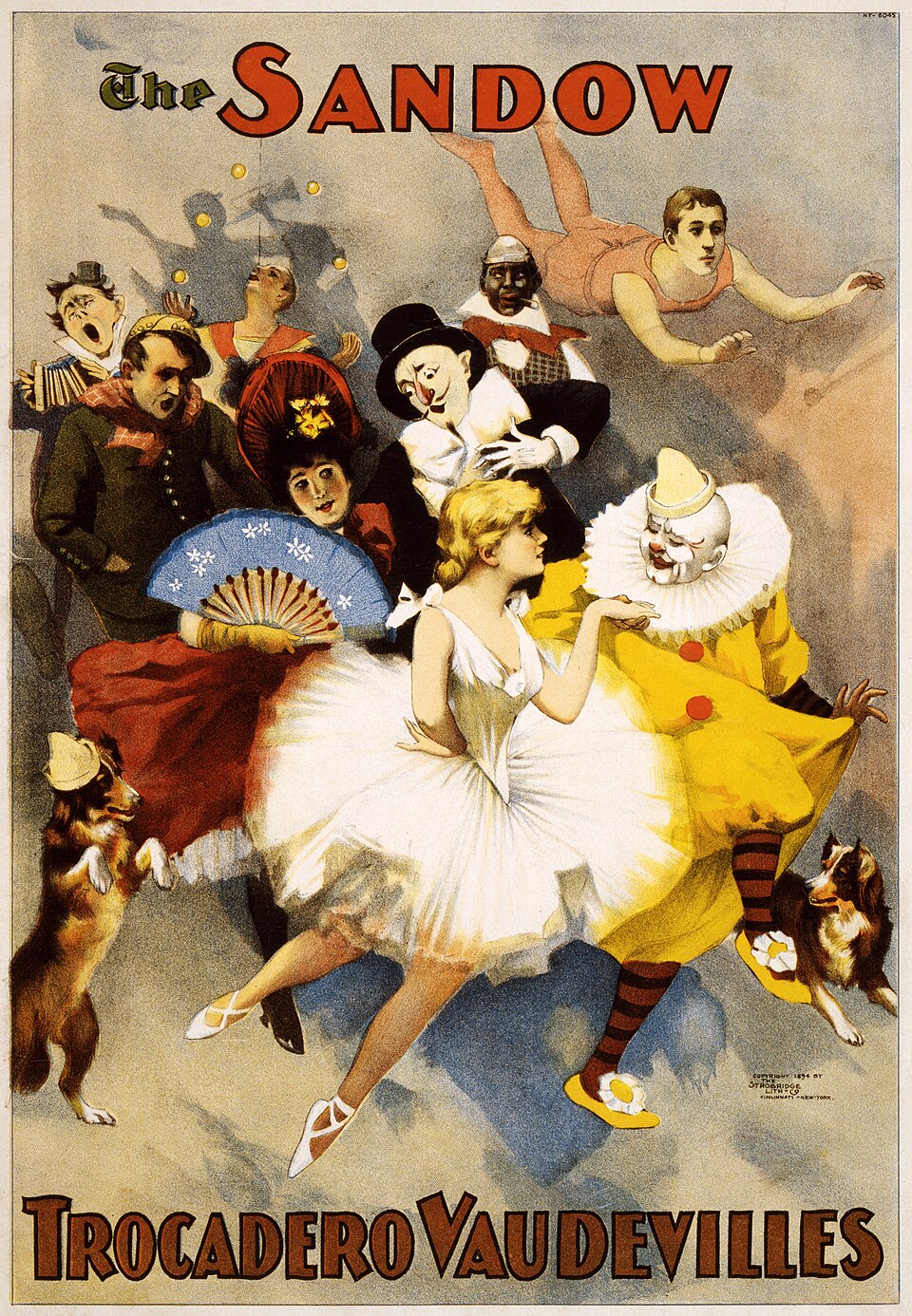
By Strobridge Lithographing Co., Cincinnati & New York – This image is available from the United States Library of Congress’s Prints and Photographs divisionunder the digital ID cph.3g12307. See Commons:Licensing., Public Domain, https://commons.wikimedia.org/w/index.php?curid=11158985
Always looking for a yock, a really big laugh from the audience, or a show stopper of any kind, the Vaudeville performer’s heyday was from the late nineteenth century until the 1920s. Originating in a variety of occasional performances in bars, theatres and wherever else a show could go on, its first appearance under that name is usually said to have been at a Boston saloon in 1840.
Vaudeville was essentially a travelling collection of comedy routines, musical acts, jugglers, acrobats, animal acts, ropers, (cowboy acts) and pretty well anything else that would play – and possibly pay. It became very popular throughout America and Canada, with around two thousand theatres by the start of the twentieth century. By the mid-1920s Vaudeville was destined for oblivion when the movies turned into the talkies. As Vaudeville was increasingly threatened, so many of the houses became blue, incorporating risqué items in an attempt to lure audiences away from the enticements of the silver screen. The overlapping entertainment form that came to be known as Burlesque suffered the same fate, its once glittering shows descending into little more than strip joints.
The name Vaudeville is said to derive from a French slang term for songs of the town – voix de ville, but there are a number of other stories, all of which have a French connection. There is a tradition in the carnival that a circus clown began Vaudeville, but this more likely reflects the close relationship between the two forms of entertainment, a relationship also reflected in the sharing of some lingo. Wherever the term came from, it was firmly established in the 1880s when a circuit of glittering Vaudeville theatres flourished in the northeastern states of America, providing non-stop daily performances for audiences keen to pay for the comedy and out-of-the-ordinary acts available.
Unlike more settled entertainments, such as revues, Vaudeville generally changed its acts each week or so. The acts were known by in-group names. An acrobatic or similarly physical act was called an alley-oop, allegedly from the fact that many of these acts were European in origin and spoke French. They would use a combined form of the French for everyone – ‘allez’ and the English ‘up’ as a command to begin their performance. A slapstick act was known as a baggypants comic. A blackout was a short comedy routine followed immediately by the houselights being turned off. The deuce spot was the least popular second act on a bill, straight after the opener which was usually the worst, but just before the best feature act, which meant that your number two performance was forgotten almost before it was over. Worse still, the audience might simply sit on their hands and decline to show their appreciation at all. The last act was called playing to the haircuts, meaning the performer was playing to the back of the departing crowd.
The vernacular of Vaudeville is full of terms for playing to an unappreciative house or bombing in front of an audience, a reflection of the difficulties of the business. A Brodie was a disaster, said to be named after a performer who survived a fall off the Brooklyn Bridge. As in other forms of showbiz, to flop or die was a common term for failure and an unappreciative house could be called a morgue. A poor act might be called a fish (because it stank). There was always a chance that the act could wow the stubholders, as the audiences were known, or if they were only applauding politely, milk them of more by reappearing onstage, or refusing to leave it until the bitter end.
Acts were often made up of shorter sections,called business. Soemetimes these wereso highlyexaggerated or overdone that they were described as Schtik, a term that moved beyond its original showbiz location and is now used to mean any kind of overly cloying presentation or approach.
Many Vaudeville terms were shared with the closely related entertainment known as Burlesque, or burly-q to its practitioners and aficionados, as expressed in my next post.

 GRISTLY HISTORY