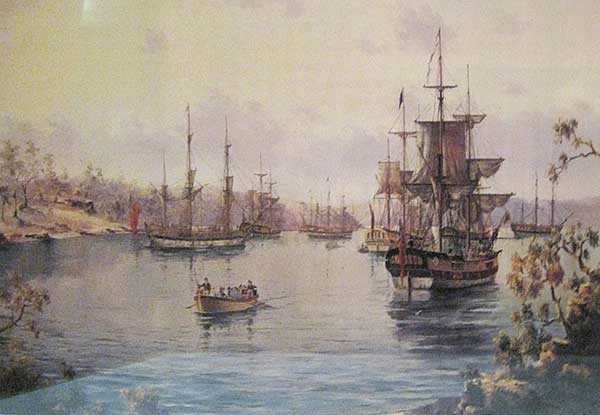
The women convicts of the First Fleet’s Lady Penrhyn went ashore at Sydney Cove on February 6, 1788. Most had seven or fourteen year terms and there were a few ‘lifers’ among them. The surgeon aboard the former slave ship that had brought them to the ends of the earth, Arthur Bowes Smyth, wrote ‘The Men Convicts got to them very soon after they landed, & it is beyond my abilities to give a just discription [sic] of the Scene of Debauchery & Riot that ensued during the night.’ According to subsequent writers, a wild orgy of rum, sex, storm and lightening followed, a fitting act for the foundation of a colony of convicts.
Popular as this story has become, in one version or another, historians have found little evidence of it ever happening. Bowes Smyth was nowhere near the scene of the alleged orgy, he was on the Lady Penrhyn quite a long way out in the harbour. None of the other keen diarists of the First Fleet, such as officers Watkin Tench or Ralph Clark seem to have noticed the orgy either. They certainly did not mention it in their accounts, an unlikely omission, especially for Ralph Clark who believed women convicts were all ‘damned whores.’
Why Bowes Smyth believed that ‘Debauchery & Riot’ occurred as soon as the women set foot in New South Wales is worth considering. He was certainly glad to see the women leave the ship: ‘we had the long wish’d for pleasure of seeing the last of them’, he wrote. The Lady Penrhyn’s voyage from England had been tedious and troubled with illness, lack of food and indiscipline. Many of the women were prostitutes and suffered from venereal disease. Although attempts were made to keep men and women separate, cohabitation quickly became commonplace. In April 1787, a month or so before they set sail for Botany Bay, five women were chained up for having relations with crewmen. There is no record of the sailors being punished.
During the voyage seventy year-old Elizabeth Beckford died of ‘dropsy’, or oedema, her bloated corpse buried at sea. She was not the last. Jane Parkinson died as they sailed from Cape Town to New Holland, as Australia was often known. Off Van Diemen’s Land the lumbering transport was lashed by a storm so fierce that the women fell to their knees praying for deliverance. Short of food once again, the Lady Penrhyn finally made Botany bay in late January 1788, only to discover that Arthur Phillip had decided the place was unsuitable for settlement. He had departed for Port Jackson.
By the time the Lady Penrhyn finally anchored in the great body of water that would become known as Sydney Harbour, the 101 women and more than 70 male crew and Marines had been cooped up on the thirty by eight metre vessel, in some cases for over a year. The women were flogged, chained, punished with thumb screws and had their heads shaved bare. Bowes Smyth wrote in his journal:
‘I believe I may venture to say there was never a more abandon’d set of wretches collected in one place…The greater part of them are so totally abandoned & callous’d to all sense of shame & even common decency that it frequently becomes indispensably necessary to inflict Corporal punishment upon them…’[i]
The doctor was clearly not well disposed towards his female charges. When he finally did ‘see the last of them’ he was predisposed to assume that they would behave in what he considered their typically debauched manner. Bowes Smyth was a product of his time and circumstances, as were all those who arrived on the First and subsequent fleets.
The double standard that masqueraded as respectability and punished only women for acts that involved a male partner continued in the colony. Four of the convict women of the Lady Penrhyn became the de facto partners of officers and the Judge Advocate. Esther Abrahams and Lieutenant George Johnston began what would become a lifelong relationship during the voyage. They did not marry for another quarter of a century.
Bowes Smyth also recorded an incident when one of the sailors was caught in the women’s tents. His hands were tied and he was publically drummed out of camp to the tune of ‘The Rogue’s March’, a ceremony used for dishonorable discharge from the army and usually followed by a flogging.
These more domestic relationships and official attempts to maintain propriety are not the stuff of myth. They lie forgotten in history while the more salacious story lives on. Historians have been trying to scotch the orgy myth ever since one of their own mistakenly set the yarn spinning in 1963. Manning Clark wrote of it though soon withdrew the assertion after a more careful look at the available evidence. But it was too late. The lewd rumour neatly captured popular views of early colonial society and the image of degraded convicts that had grown up over the generations. ‘The orgy that wasn’t’ gathered further currency from a procession of later writers and television shows repeating and embellishing the alleged scene.[ii] A yarn of ribald abandonment still resonates with a common view of the founding of Australia. No matter how often and convincingly historians demolish the myth, many still prefer to believe it.
From Great Convict Stories https://www.allenandunwin.com/browse/books/9781760527488
[i] Arthur Bowes Smyth (Smythe), ‘A Journal of a Voyage from Portsmouth to New South Wales and China. 22 March 1787–12 August 1789’. Mitchell Library.
[ii] See Grace Karskens, ‘The Myth of Sydney’s Foundational Orgy’, 2011, at the Dictionary of Sydneyhttp://dictionaryofsydney.org/entry/the_myth_of_sydneys_foundational_orgy, accessed August 2016.

 GRISTLY HISTORY