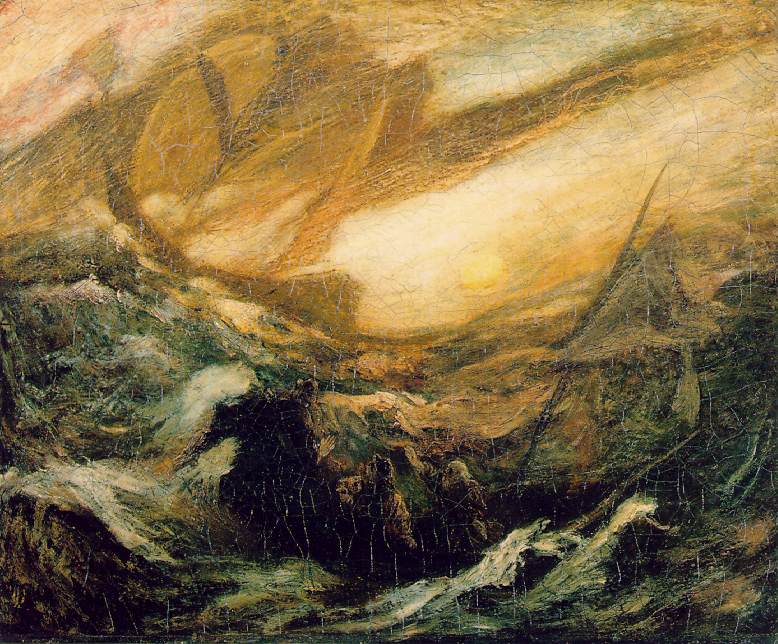
The Flying Dutchman by Albert Pinkham Ryder c. 1887 (Smithsonian American Art Museum)
The legend is first recorded in 1790, but it was already old in sailors’ lore. Undoubtedly the most famous nautical yarn of all, the enigmatic tale of the Flying Dutchman is known around the world. And the spectral sailing ship has been sighted in many oceans, including in Australian waters.
At first, the story was a short yarn about a distressed Dutch ship seeking safe harbour at the Cape of Good Hope during a raging storm. A pilot to guide the vessel to safety was not available and the ship was lost with all her crew. Ever since then, the glowing apparition has been seen during stormy weather. Sighting the Flying Dutchman was considered to be an omen of doom.
The Cape of Good Hope was a regular port of call for ships on the Australian run from Europe and although the legend was initially a Dutch story and largely restricted to sailors, it flowed into the broader community in the late eighteenth century. One of the earliest accounts is that of the ‘Prince of Pickpockets’, George Barrington, on his way to serve a sentence in Australia in 1795. Barrington’s version of the story is a little more elaborate than the basic legend (though he was a notorious confidence trickster with a silver tongue):
. . . it seems that some years since a Dutch man-of-war was lost off the Cape, and every soul on board perished; her consort weathered the gale, and arrived soon after at the Cape. Having refitted, and returning to Europe, they were assailed by a violent tempest nearly in the same latitude. In the night watch some of the people saw, or imagined they saw, a vessel standing for them under a press of sail, as though she would run them down: one in particular affirmed it was the ship that had foundered in the former gale, and that it must certainly be her, or the apparition of her; but on its clearing up, the object, a dark thick cloud, disappeared. Nothing could do away the idea of this phenomenon on the minds of the sailors; and, on their relating the circumstances when they arrived in port, the story spread like wild-fire, and the supposed phantom was called the Flying Dutchman.
Barrington did not see the apparition, but he met a sailor who did. About 2 a.m. he was woken by the boatswain ‘with evident signs of terror and dismay in his countenance’ and begging for a drink of spirits. The man claimed to be ‘damnably scarified’ because he had just seen:
the Flying Dutchman coming right down upon us, with everything set—I know ’twas she—I cou’d see all her lower-deck ports up, and the lights fore and aft, as if cleared for action. Now as how, d’ye see, I am sure no mortal ship could bear her low-deck ports up and not founder in this here weather. Why, the sea runs mountains high. It must certainly be the ghost of that there Dutchman, that foundered in this latitude, and which, I have heard say, always appears in this here quarter, in hard gales of wind.
After a few deep draughts, the boatswain ‘grew a little composed’, admitting that he was prone to seeing ghosts. Barrington went on deck with him to see for himself but ‘it had cleared up, the moon shining very bright, and not a cloud to be seen; though, by what I could learn from the rest of the people who were on deck, it had been very cloudy about half an hour before, of course I easily divined what kind of phantom had so alarmed my messmate’.
A more respectable figure who did see the Flying Dutchman in Australian waters was no less a personage than Prince George of Wales, destined to be King George V. Sometime before dawn on 11 July 1881, while travelling through Bass Strait, the prince (or his brother travelling with him) recorded:
At 4 a.m. the Flying Dutchman crossed our bows. A strange red light as of a phantom ship all aglow, in the midst of which light the masts, spars and sails of a brig 200 yards distant stood out in strong relief as she came up on the port bow. The look-out man on the forecastle reported her as close as on the port bow, where also the officer of the watch from the bridge clearly saw her, as did also the quarterdeck midshipman, who was sent forward at once to the forecastle; but on arriving there was no vestige nor any sign whatever of any material ship was to be seen either near or right away to the horizon, the night being clear and the sea calm. Thirteen persons altogether saw her . . .
Just over six hours later, the sailor who had first reported seeing the Flying Dutchman fell to his death from the foretopmast and ‘was smashed to atoms’.
Another Australian connection with the Flying Dutchman comes from John Boyle O’Reilly, the famous Irish rebel. While being transported with his fellow Fenians to Western Australia in 1867, O’Reilly wrote a poem for the ship’s newspaper. The poem uses the Flying Dutchman tale to give expression to O’Reilly’s forebodings at what was going to be a long exile from his homeland:
They’ll never reach their destined port
They’ll see their homes no more,
They who see the Flying Dutchman
Never, never reach the shore.
Since then the legend has grown, gathering more detail and depth through endless accounts, books, films and artworks that feed from it. The Flying Dutchman soon fused with another piece of world folklore known as the ‘Wandering Jew’. This is said to be a man who refused to help Christ bear the burden of the cross as he struggled towards his crucifixion. In a bit of Old Testament revenge, the man was condemned to wander the Earth forever in eternal life. In the Flying Dutchman version, the captain of a Dutch merchantman attempting to enter Table Bay was frustrated by a change in the wind. The captain swore to be eternally damned if he did not enter the bay and that he would sail these waters until Judgement Day. He did not and he does.
In another version it is said that the crew of the Dutch ship committed some atrocious crime and are condemned to never enter a port and must voyage onwards until their penance is done. This echoes a theme of Coleridge’s famous poem, The Rime of the Ancient Mariner (1797–98). A few years later the arch-romancer Walter Scott made the Flying Dutchman a pirate ship, in which guise the tale may be most familiar to modern audiences in the Pirates of the Caribbean movies.[i]It’s not surprising that such a compelling legend is told again and again and that the cursed ship has been seen even in Australian waters.
[i] George Barrington, A Voyage to Botany Bay, with a description of the country, manners, customs, religion, &c. of the natives, sold by H.D. Symonds: London, 1795.
Prince Albert Victor and Prince George of Wales, The Cruise of Her Majesty’s Ship ‘Bacchante’ 1879–1882. Compiled from the private journals, letters, and note-books of Prince Albert Victor and Prince George of Wales, with additions by J. D. Dalton, Vol. 1, Macmillan and Company: London, 1886, p. 551.
Buy me a coffee!
A$5.00

 GRISTLY HISTORY